
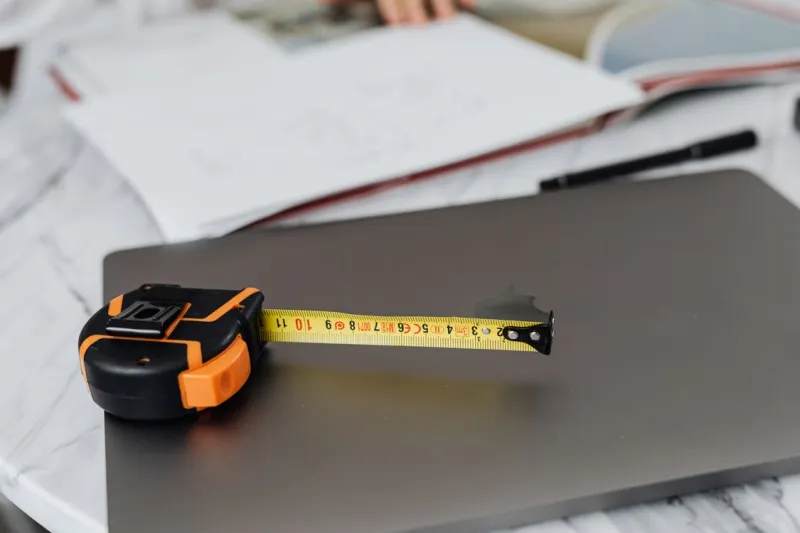
Can I use AI-generated images for my product listings? Sellers ask this constantly, and the short answer is: usually yes, with conditions that vary by platform. The question that actually matters gets skipped — even when a marketplace allows an AI-generated or AI-enhanced photo, can that image tell a buyer the real size of what they're about to order? No. AI restyling tools are genuinely good at backgrounds, lighting, and lifestyle scenes. They are structurally incapable of measurement, and three myths about what that means keep costing sellers both compliance headaches and buyer trust.
Myth 1: "AI-Generated Images Are Banned Everywhere"
This is the myth that scares sellers into either avoiding AI tools entirely or ignoring the rules altogether, and both reactions are based on a false premise. Platform policy on AI generated listing images is not one rule — it's a patchwork, and the differences matter more than the similarities.
The AI product image rules Amazon publishes for sellers require every image to accurately represent the product for sale, and its 2026 seller guidelines extended that further: content where generative AI contributes more than minor adjustments — fully synthetic scenes, AI-created lifestyle backgrounds, digitally generated models — now requires disclosure. Routine edits like cropping, brightness correction, or standard background removal don't trigger that requirement.
eBay draws the line differently. For new items, AI-generated product images are allowed as long as they accurately represent the item and meet standard photo requirements. For used items, the rule tightens: the main image must be a real photograph of the actual unit sellers are shipping, not a stock photo or a synthetic render, with narrow exceptions for media categories like books and games. eBay does not currently require an in-listing disclosure label for AI-generated images, though sellers shipping into the EU should expect that to change as the EU AI Act's transparency obligations for AI-generated content phase in.
| Platform | AI-generated images allowed? | Disclosure required? | Where the rule bites hardest |
|---|---|---|---|
| Amazon | Yes, for enhancement and background/lifestyle generation | Yes, for substantially AI-generated content beyond minor edits | Main image must still show an accurate representation of the physical product |
| eBay | Yes for new items; restricted for used items | Not currently required in the listing itself | Used-item listings need a real photo of the actual unit |
| Marketplaces generally | Varies by category and platform | Trending toward mandatory as regulation catches up | Accuracy of the underlying product claim, not the editing method |
The common thread is accuracy, not prohibition. No major marketplace bans AI-assisted imagery outright. What they ban is a photo that misrepresents what the buyer is going to receive — which is exactly where AI-generated dimensions become a problem, covered next.
Myth 2: "If It Looks Realistic, the Dimensions Must Be Accurate"
This is the more expensive myth, because it's invisible until a return shows up. AI image generators work by pattern-generation: they predict pixels that look statistically plausible given a prompt and training data, not by measuring a physical object and rendering it to scale. Poor AI image accuracy for product dimensions isn't a bug in one tool — it's how the entire category works.
Ask a generic AI image tool to "add a ruler" or "show the size" next to a product, and it will draw something that looks like a ruler, at a scale that looks plausible, anchored to nothing. The model has no coordinate system tying the drawn measurement marks to the actual product's real-world proportions in the source photo. It is generating a plausible-looking answer to "what would a ruler next to this product look like," not measuring the product.
This shows up constantly in AI-restyled lifestyle scenes: a coffee table that looks correctly proportioned to a couch that was never actually in the same room as it, a backpack that looks roomy enough for a laptop the AI never measured against it, a throw pillow rendered slightly larger than the sofa cushion it's meant to sit on. None of these are the AI "getting it wrong" in a way that better prompting fully fixes — perspective, lens distortion, and reference-free generation compound the error, and the model has no ground truth to check itself against.
Buyer trust doesn't survive first contact with this gap. A buyer who compares the listing photo to the unboxed item and finds one detail off — size, proportion, color relationship — doesn't file a narrow complaint about that one detail. They stop trusting the whole listing, including the parts that were accurate. That's the real cost: it's not just the return, it's the buyer who now assumes every other AI-touched image on your storefront is equally unreliable.
Myth 3: "Labeling Dimensions on a Real Photo Counts as AI-Generated Content"
This myth causes the opposite problem — sellers who avoid adding accurate size information to their listings because they think it triggers the same disclosure and risk exposure as AI-generated imagery. It doesn't, and the distinction is worth being precise about.
Generating an image means creating pixels that didn't previously exist — a synthetic background, a rendered model, a fabricated lifestyle scene. Annotating a photo means adding a label, callout, or measurement line on top of a real photograph that a camera actually captured. The underlying image is unchanged; what's added is data about it, not new visual content pretending to be photographic.
Platform policies on AI-generated content are written to catch the first case: content that could mislead a buyer about what the camera saw. A dimension label anchored to a real product photo — height marked at 32 inches because the product actually measures 32 inches — isn't generating a fictional visual claim. It's documenting a real one. Amazon's and eBay's accuracy requirements exist specifically to protect this kind of true, verifiable claim; they don't exist to discourage it.
The practical takeaway: sellers should stop treating "add measurements to my photos" and "use AI to generate my photos" as the same compliance category. They aren't. One is a synthetic-content question that varies by platform and is trending toward mandatory disclosure. The other is basic product information that buyers are asking for anyway.
What Actually Works: Real Photos, Deterministic Measurements
The fix for both the trust problem and the compliance ambiguity is the same: start from a real photo, then add measurements that are anchored to what's actually in that photo — not generated, not estimated, not restyled into existence.
That's the practical difference between AI background removal vs dimension labeling. Background removal, lighting cleanup, and lifestyle-scene generation are restyling operations — they change how the product looks without making any claim about its physical size. Dimension labeling is a measurement operation — it makes a specific, checkable claim ("this shelf is 18 inches deep") that has to be tied to the pixels of the actual photographed object, not to a statistically plausible guess.
This is where deterministic-geometry tools differ from AI restyling tools by design. Instead of predicting what a ruler might look like, a spec diagram for industrial products or furniture listing gets built by anchoring a dimension line to normalized coordinates on the real photo — the callout moves and scales with the actual pixels of the product, so the number on the label always corresponds to something real in the image, not something the model imagined. That's the same reason it matters for how to look professional to overseas buyers: a buyer scanning a supplier catalog trusts a labeled measurement more than a polished lifestyle render precisely because the label is checkable against the photo itself.
For sellers weighing where to invest editing effort, the split is straightforward:
- Use AI restyling for backgrounds, lighting cleanup, and lifestyle staging — it's fast, it's usually compliant with light or no disclosure, and it doesn't make a size claim.
- Use real photos plus anchored dimension callouts for anything a buyer needs to trust as a physical fact — height, width, depth, capacity, clearance.
- Never let an AI-generated ruler, tape measure, or size comparison stand in for an actual measurement in a listing image.
- Disclose AI involvement wherever the platform's policy requires it for substantially generated content, even if you're confident the image is accurate.
- Keep the source photo and the measurement data separate in your workflow so you can update either without regenerating the other.
Sellers who want this to scale beyond one listing can pull the underlying feature set — accurate dimension callouts anchored to the source photo's real proportions — from a spec-diagram builder built around callouts anchored to the photo itself rather than rebuilding the same manual annotation process for every SKU.
FAQ
Are AI generated images allowed on marketplaces like Amazon, Etsy, and eBay?
Generally yes, but with different rules per platform. Amazon allows AI-enhanced and AI-generated images as long as the product itself is accurately represented, and now requires disclosure for substantially AI-generated content. eBay allows AI-generated images for new items but requires a real photo of the actual unit for used items. The pattern across platforms is that AI-generated imagery is permitted; misrepresenting the product is not.
What is the platform policy on AI generated listing images if my product looks different in real life?
If the delivered product doesn't match what the image showed — in size, color, features, or proportion — that's a policy violation regardless of whether the image was AI-generated, AI-enhanced, or a straight photograph. The AI-generated-content rules add a disclosure layer on top of that baseline accuracy requirement; they don't replace it. A photo-realistic AI image that misrepresents scale is a bigger risk than an obviously synthetic one, because buyers are less likely to question it before ordering.
Why can't AI image generators show accurate product dimensions?
Because they generate pixels by pattern prediction, not by measuring anything. An AI model trained on millions of images can produce a photorealistic ruler or a plausible-looking size comparison, but it has no coordinate system linking that drawing to the real-world proportions of the specific product in your photo. Any dimension that needs to be trustworthy has to come from a real photo with measurements anchored to it, not from a generated one.
What's a compliant way to show accurate size information without violating AI-image policies?
Start with a real, unedited photo of the actual product, then add dimension labels or callouts anchored to that photo's actual pixels rather than generating a new image with size markers baked in. That approach sidesteps AI-generated-content disclosure questions entirely, since nothing about the underlying photo is synthetic — only a data label is added. A dimension and spec annotation tool built for this does exactly that: it places measurement callouts on the real photo, tied to its true proportions, so the label is always checkable against the image itself rather than being a plausible-looking guess.
Does labeling dimensions on a photo count as AI-generated content under marketplace rules?
No. Marketplace AI-content policies are aimed at synthetic visual content — generated backgrounds, rendered models, fabricated scenes — because that's what could mislead a buyer about what the camera captured. Adding a measurement label to an unedited photo doesn't change the underlying image; it adds verifiable data on top of a real photograph, which is a different category from generating new pixels.
Sources & References
Amazon Seller Central: Product Image Guide
eBay: Images, Videos and Text Policy
Federal Trade Commission: Artificial Intelligence