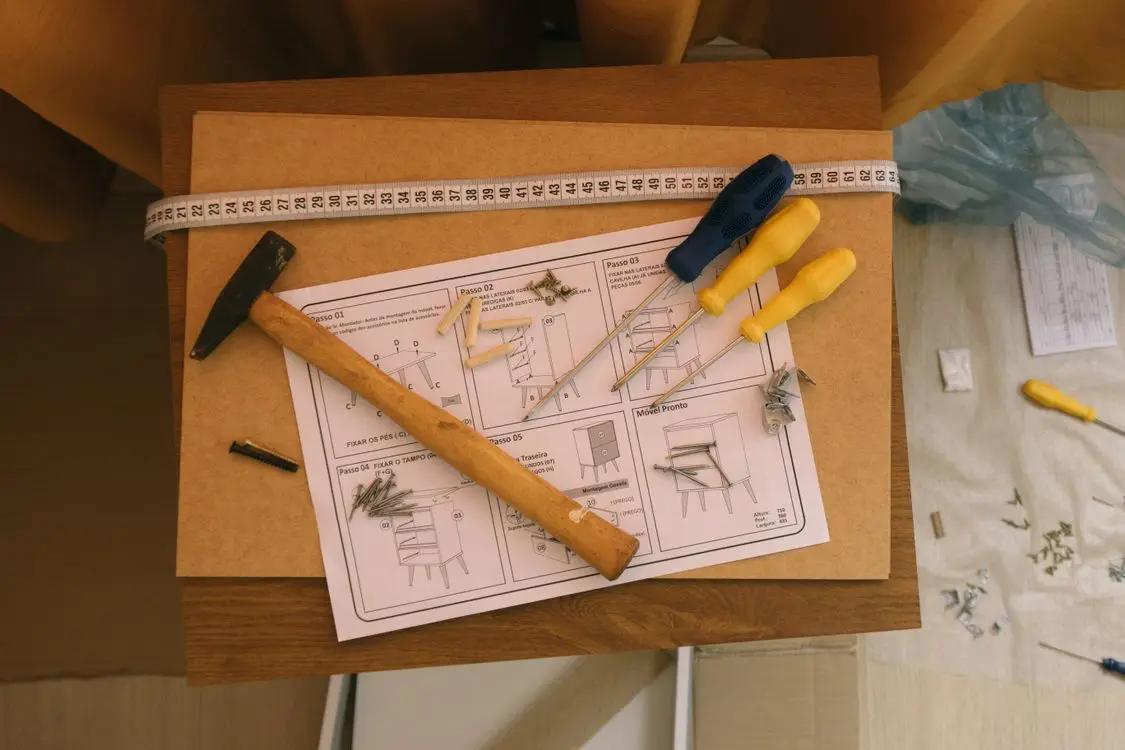
Assembly instructions for flat pack furniture are treated as the last thing in the carton and the first thing a buyer blames. A cabinet comes back logged as "missing parts." You open the returned box and every part is there — the hardware bag was taped under the base panel and the sheet never told anyone to look. That is not a manufacturing defect. It is a documentation defect that your factory paid for at full freight, both ways.
Four formats dominate export furniture. They cost wildly different amounts, they fail in different ways, and only two of them satisfy what European law now asks for. Here is how they actually compare.
What the Standards Require Before You Compare Anything
Two documents set the floor, and most suppliers have read neither.
IEC/IEEE 82079-1:2019 is the international standard for preparation of information for use. It is published jointly by IEC, IEEE and ISO, and it deliberately covers everything "ranging from a tin of paint to large or highly complex products" — furniture very much included. Its second edition made two changes that matter commercially: the process for preparing the information became part of the normative text rather than an appendix, and empirical evaluation methods — actually testing whether real users can follow the instructions — moved into the normative part too. Under the current edition, "we wrote a sheet" is no longer the standard's idea of compliance; "we checked that someone could follow it" is.
The EU General Product Safety Regulation adds a hard language requirement. Instructions, warnings and safety information must be supplied in the language or languages of the member state where the product is sold, and must be clear, legible and visible. A single English sheet for a pan-European order does not meet it. Because a flat-pack unit is shipped disassembled and the safety-relevant content — anti-tip anchoring, load limits, the order in which panels must be joined — lives entirely in the instructions, this is one of the categories where the requirement bites hardest. The wider labelling picture is covered in GPSR labelling requirements.
The nail: for flat-pack goods the assembly instruction is the product for the first forty minutes of ownership, and it is the only part of the shipment your buyer is guaranteed to read.
How We Compared the Four Formats
Not a lab test — a procurement comparison. Each format is scored against five things a supplier can actually verify before signing off artwork:
- Standard fit — does it satisfy IEC/IEEE 82079-1 and the GPSR language rule without extra work?
- Language cost — what does adding the eleventh market cost?
- Failure mode — what specifically goes wrong, and at whose expense?
- Unit cost — printing, inserting, hosting.
- What it fixes — which return reason it actually removes.
Method 1: A Printed Text Sheet in the Carton
The default. Two or three A4 pages, numbered steps, one small line drawing per step, English plus whatever the buyer asked for.
Standard fit: weak. Text-led instructions have to be translated in full for every market, and translation errors in a safety step are exactly what the GPSR is aimed at. Language cost: linear and painful — every added market is another full translation and another SKU of printed matter. Failure mode: the buyer skips the wall of text, guesses, and reverses two panels; or the sheet is lost in the packaging and never found. Unit cost: lowest. Fixes: almost nothing on its own.
The one thing a text sheet does better than any other format is legal specificity — warnings written out in words, in the required language, that a regulator can read. Keep it for that, not as the primary assembly aid.
Method 2: Exploded Diagram With a Numbered Hardware Map
One large exploded view of the finished piece, every panel and fitting called out with a part number, plus a one-to-one hardware map showing each screw and cam at actual size against its count and its dimensions.
Standard fit: strong. Graphics carry no language, so the same artwork serves every market and only the short warning block needs translating. Language cost: near zero after the first market. Failure mode: ambiguity about orientation — a panel that is symmetrical in the drawing but not in reality. Fix it with an asymmetry marker rather than a sentence. Unit cost: one-off drawing work, then the same print cost as Method 1. Fixes: the two most common non-defect returns — "missing parts" that were present but unrecognised, and "wrong part" complaints where the buyer could not tell an M6×40 from an M6×50.
That hardware map is worth dwelling on, because it is pure dimension work. Printing each fastener at 1:1 with its length and thread diameter labelled lets the buyer lay the real screw on the paper and match it in two seconds. It only works if the drawing is dimensionally honest, which is the practical argument for locking measured values onto the artwork rather than drawing something that looks about right: a spec drawing built from real measurements can be laid against the physical part, while a generated illustration of a screw has no measurement behind it and quietly breaks the whole trick. The same standard of evidence that makes a product spec sheet buyers read useful is what makes an exploded diagram useful.
Method 3: QR Code to a Hosted PDF or Video
A printed card with a QR code, pointing to a hosted manual, often with a short assembly video.
Standard fit: partial, and this is the trap. A hosted document does not satisfy the requirement for information to accompany the product in durable form — a link can rot, a phone can be flat, a warehouse can have no signal. Treat digital as a supplement, never as the whole delivery. Language cost: low; one landing page can serve language variants. Failure mode: dead link two years into the product's life, or a buyer in a market where your hosting domain is slow or blocked. Unit cost: trivial per unit, real ongoing hosting and maintenance. Fixes: genuinely hard steps that static drawings cannot convey — cam-lock orientation, tensioning sequences, anti-tip anchoring into different wall types.
Video earns its place on exactly those steps and nowhere else. Nobody watches four minutes to learn which way a back panel faces.
Method 4: Wordless Illustrated Booklet
The format big flat-pack retailers converged on: a stapled booklet, sequential frames, almost no text, pictograms for warnings, a tools-required page at the front and a parts inventory page facing it.
Standard fit: strongest overall, provided the warning content still appears in the required languages — pictograms supplement legal text, they do not replace it. Language cost: lowest of all four at scale; one artwork set, a short multilingual warning spread. Failure mode: expensive to originate, and easy to get subtly wrong — a frame that implies the wrong sequence is worse than a paragraph that states the right one. This is precisely why 82079-1 moved user testing into its normative text. Unit cost: highest to produce, competitive per unit at volume. Fixes: the whole assembly experience, including the reviews you never see because the build went fine.
Head-to-Head Comparison
|
Printed text sheet |
Exploded diagram + hardware map |
QR to PDF/video |
Wordless booklet |
| Meets GPSR language rule alone |
No |
With translated warning block |
No — supplement only |
With translated warning block |
| Cost of adding a market |
Full translation |
Warning block only |
Landing page variant |
Warning block only |
| Origination cost |
Low |
Medium |
Low |
High |
| Per-unit print cost |
Low |
Low |
Lowest |
Medium |
| Removes "missing parts" returns |
No |
Yes |
Partly |
Yes |
| Removes "wrong hardware" returns |
No |
Yes |
Partly |
Yes |
| Handles genuinely tricky steps |
Poorly |
Adequately |
Best |
Well |
| Survives with no phone or signal |
Yes |
Yes |
No |
Yes |
| Verifiable against 82079-1 user testing |
Hard |
Straightforward |
Straightforward |
Straightforward |
What We Would Actually Ship
For most export furniture suppliers the honest answer is a combination, not a winner.
Ship Method 2 as the core — an exploded diagram with a 1:1 hardware map, because it removes the two return reasons that are pure documentation cost and it scales across languages for free. Wrap it with a translated warning block covering anti-tip, load limits and child-safety content in each destination language, which is what keeps the GPSR satisfied. Add a QR code as a supplement for the two or three steps that genuinely need motion, and never as the primary route. Upgrade to Method 4 only when a single SKU family ships enough volume that the origination cost amortises.
Before you decide how much drawing work to fund, price the alternative honestly: a flat-pack return is freight both ways on a bulky carton, a unit that usually cannot be resold as new, and a review that keeps costing after the refund clears. Put your own carton dimensions and unit value into the return cost calculator — for most furniture SKUs the whole exploded-diagram redraw pays for itself somewhere in the low double digits of prevented returns.
FAQ
What do assembly instructions for flat pack furniture legally have to include in the EU?
Under the General Product Safety Regulation, instructions, warnings and safety information must accompany the product in the language or languages of the member state where it is sold, and must be clear, legible and visible. For flat-pack furniture that means the assembly sequence, anti-tip and anchoring guidance, and load limits all need to be understandable in the destination language — pictograms may support that content but do not replace the required text.
Is a QR code to an online manual enough?
No. A link is not information that accompanies the product in durable form: it can rot, and it depends on a charged phone and a signal in the room where the furniture is being built. Use hosted PDFs and video as a supplement for genuinely difficult steps, and keep a physical instruction in the carton.
What is IEC/IEEE 82079-1 and does it apply to furniture?
It is the international standard for preparing information for use, published jointly by IEC, IEEE and ISO, and it explicitly covers products of all kinds from a tin of paint upward — furniture included. The 2019 edition put both the preparation process and empirical evaluation of the instructions into the normative text, so demonstrating that real users can follow your instructions is part of conforming to it.
Which format actually reduces "missing parts" returns?
An exploded diagram paired with a hardware map printed at 1:1, with each fastener labelled by dimension and count. Most "missing parts" claims are recognition failures rather than genuine shortages — the buyer cannot tell two similar screws apart, or never found the bag. A drawing that lets them physically lay a part on the page against a dimensioned outline settles it before they open a case. Tools that lock the real measured dimensions onto that artwork are what make the comparison trustworthy; a rendering that only looks correct defeats the purpose.
How many languages do assembly instructions need?
One per market you sell into, for the warning and safety content. The assembly sequence itself can be language-free if it is drawn well, which is why graphics-led formats cost so much less to scale — you translate a warning block, not a booklet.
Should the hardware bag be inside or outside the packing?
Somewhere the parts inventory page tells the buyer to look, and stated on the first page of the instruction. Most "missing hardware" claims resolve to a bag taped to a panel face or tucked under protective foam. The location is instruction content, not packing detail.
Sources & References