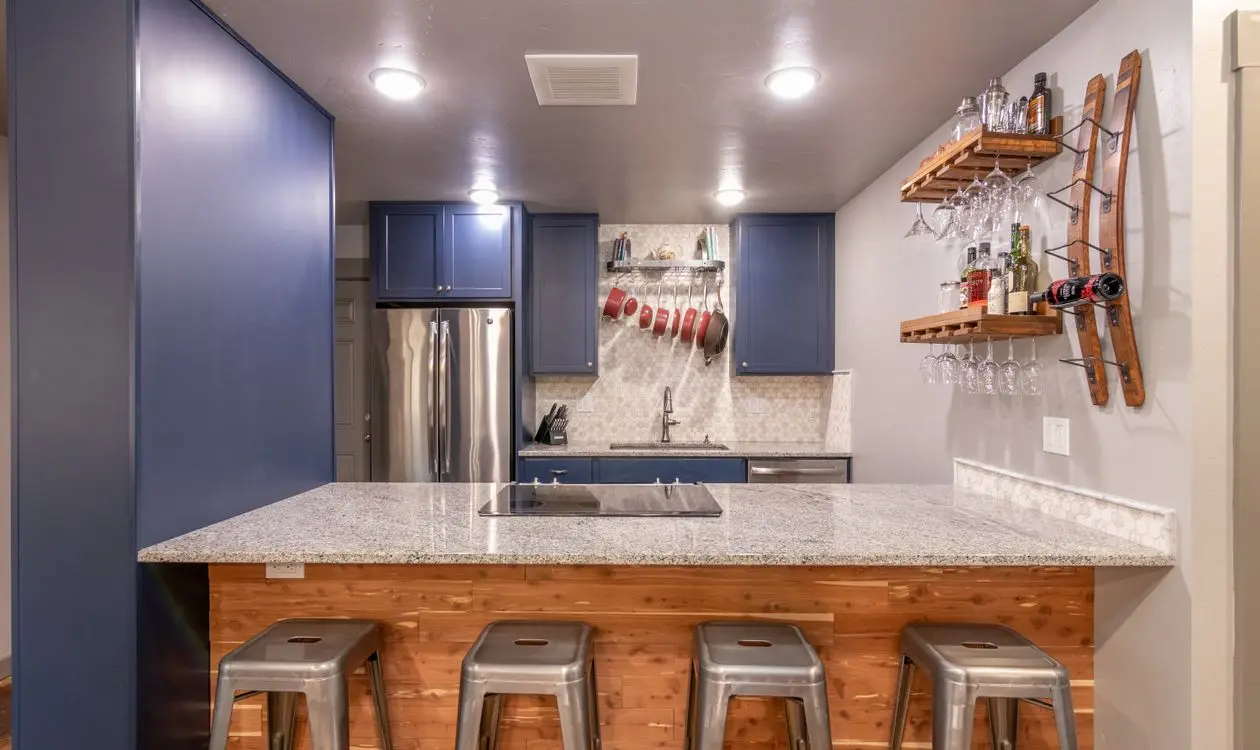
Counter height vs bar height stools is the single most expensive naming confusion in furniture. The two terms sound like sizes. They are not sizes — they describe the surface the stool was built for, and a buyer who orders the wrong one gets a stool that is functionally unusable and entirely undamaged. That combination is the worst kind of return: the goods are perfect, the freight is one-way, and nobody can be blamed except the listing.
Here are the five mistakes that produce those returns, with the numbers in inches and millimetres, and what to change on your spec sheet this week.
First, the number that settles the argument
A stool's usable seat height equals the height of the surface it serves, minus 10 to 12 inches (250–305 mm) of leg clearance. Everything else — counter height, bar height, spectator height — is a nickname for a range that falls out of that one subtraction.
| Surface type |
Surface height |
Correct seat height |
| Dining table / desk |
28–30 in (710–760 mm) |
17–19 in (430–480 mm) |
| Kitchen counter |
34–36 in (865–915 mm) |
24–26 in (610–660 mm) |
| Bar |
40–42 in (1015–1065 mm) |
28–30 in (710–760 mm) |
| Spectator / extra-tall |
44–47 in (1120–1195 mm) |
33–36 in (840–915 mm) |
Absolute floor: 10 inches (250 mm) between the top of the seat and the underside of the surface. Below that, knees hit the apron. This is the number to check first when a buyer disputes a fit.
Mistake 1: Treating "counter height" as a dimension
"Counter height" is not 24 inches, 25 inches, or 26 inches. It is the category of stool built for a counter, and different manufacturers place their seats anywhere across that 24–26 inch band. A wholesale buyer comparing your 24-inch counter stool against a competitor's 26-inch counter stool is comparing two products that behave differently under the same worktop — two inches is the difference between comfortable and cramped.
The fix: never let a category word travel without its number. "Counter height (26 in / 660 mm seat)" is a spec. "Counter height" alone is a guess you have delegated to the buyer.
Mistake 2: Quoting overall height instead of seat height
This one produces more disputes than every other mistake combined, because both parties are quoting real measurements of the same stool. A backless stool's overall height and seat height are the same number. Add a backrest and overall height jumps 10 to 16 inches with no change to the seat. A catalogue row reading "Height: 41 in" describes a counter stool with a tall back just as easily as a bar stool without one.
The fix: publish both, labelled, always. Seat height 26 in (660 mm) · Overall height 41 in (1040 mm). If your catalogue has room for only one number, it is seat height — that is the number that decides whether the stool works.
The same trap runs through the whole category: the headline number and the fit-critical number are different numbers. It is exactly what drives bed frame and mattress sizing mistakes, where the frame's external size gets quoted when the buyer needs the internal mattress opening.
Mistake 3: Assuming every counter in the world is 36 inches
A US kitchen counter is 36 inches (914 mm) as a near-universal convention. A European kitchen worktop is commonly 900 mm. Australian benchtops are typically specified at 900 mm as well, and a lot of contemporary EU kitchens run 920–950 mm. Meanwhile a commercial bar might sit at 42 inches (1067 mm) or at 1100 mm depending on which market's fit-out standard the venue followed.
Ship a stool designed against a 36-inch counter to a market building 900 mm worktops and the seat lands about 15 mm high — inside tolerance, nobody complains. Ship the same stool into a 1100 mm bar assuming it is "bar height" and you are 33 mm short of usable clearance, and complaints arrive.
The fix: state the surface height your stool was designed for, not just the stool's own height. "Designed for counters 890–915 mm" tells an overseas buyer in one line whether the product suits their market. It also stops your distributor from making the assumption for you.
Mistake 4: Converting inches to centimetres and rounding to be tidy
26 inches is 660.4 mm. Rounded to "66 cm" the error is under half a millimetre and harmless. Rounded to "65 cm" — which happens constantly, because 65 looks like a normal number and 66 does not — you have moved the seat by 14 mm and invented a stool you do not manufacture. When the buyer's own drawing then places a 65 cm stool under a 900 mm worktop, the clearance calculation they run is not the one your product satisfies.
The fix: convert once, in millimetres, at the source, and reuse that value everywhere. Never let a conversion happen inside a catalogue layout, a translated datasheet, or a marketplace listing form. Dual units belong on the drawing itself — one measured figure rendered as both 26 in and 660 mm — not re-derived by whoever is typing that week.
Mistake 5: Publishing seat height and stopping there
Seat height decides whether one stool fits. It says nothing about whether four of them fit. The working allowance is 24 to 30 inches (610–760 mm) of counter run per stool, measured centre to centre, and more when the stool swivels, has arms, or carries a wide back. A buyer who fits four 26-inch counter stools along a 2.1 m island discovers at installation that elbows collide, and the complaint that reaches you is "the stools are too big" — which reads as a dimension error even though every dimension you published was correct.
The fix: publish seat width and overall width alongside seat height, and state the recommended spacing. Three numbers turn a stool listing into something a buyer can lay out before ordering rather than after.
The reference table to put on your spec sheet
| Spec line |
Why the buyer needs it |
Example |
| Seat height |
Determines fit under the surface |
660 mm (26 in) |
| Overall height |
Shipping, clearance under wall units |
1040 mm (41 in) |
| Designed-for surface height |
Removes the market-standard assumption |
890–915 mm |
| Seat width / depth |
Comfort and layout |
380 × 350 mm |
| Overall width at widest point |
Spacing along the run |
430 mm |
| Recommended spacing, centre to centre |
Stops the "too big" complaint |
610–760 mm |
| Footrest height from floor |
Comfort at bar height and above |
450 mm |
| Adjustable range, if gas lift |
Seat height becomes a range, not a value |
610–760 mm |
| Weight capacity |
Commercial buyers filter on it |
120 kg |
Nine rows. Most stool listings publish two of them.
What the mistake actually costs
A wrong-height stool comes back for reasons that have nothing to do with quality, which means it comes back at full freight with no supplier fault to offset it. On a container order the arithmetic is worse than a single consumer return: rework, re-labelling, storage while the buyer decides, and a wholesale customer who now checks every other dimension you publish. Size-driven furniture returns are the reason furniture return rates sit above most other categories — the products are large, the freight is expensive, and the fit question is decided entirely by numbers on a page.
If you want the figure for your own volumes rather than a category average, the return cost calculator will take your freight, unit cost and return rate and produce the annual number. It is usually larger than people expect, because the freight on a bulky item both ways can exceed the margin on the sale.
Pre-listing checklist
FAQ
What is the difference between counter height and bar height stools?
Counter height stools have seats 24–26 in (610–660 mm) from the floor and suit counters 34–36 in (865–915 mm) high. Bar height stools have seats 28–30 in (710–760 mm) and suit bars 40–42 in (1015–1065 mm). Both names describe the surface the stool was designed for, not a fixed stool dimension — which is why the seat height number has to be published alongside the category name.
What seat height do I need for a 36-inch counter?
24 to 26 inches (610–660 mm). Subtract 10–12 inches from the surface height and choose within that band; 26 inches suits taller users, 24 inches leaves more clearance. Keep at least 10 inches (250 mm) between the top of the seat and the underside of the counter, and check for an apron or overhang that eats into it.
How much space should I leave between bar stools?
24 to 30 inches (610–760 mm) centre to centre. Go to the upper end, or beyond it, for swivel stools, stools with arms, or wide-backed designs. Divide the usable run by 27 inches (685 mm) for a quick count that will not need revising at installation.
Why do so many stool returns happen even when the product is fine?
Because fit is decided by a number on a listing, and the listing usually publishes the wrong number — overall height instead of seat height, a category word instead of a measurement, or a value rounded during unit conversion. The stool arrives exactly as manufactured and still cannot be used. The fix is to mark the fit-critical dimensions directly on the product image where buyers look first, using measured values rather than figures retyped between documents. Software built for dimension and spec annotation snaps to the real edges of the photographed product and exports the same measured numbers to every channel, so the listing, the catalogue and the quotation cannot drift apart — which is the failure an AI-generated product visual cannot prevent, because it renders a plausible-looking stool it never measured.
Do adjustable stools solve the counter versus bar problem?
Partly. A gas-lift stool with a 610–760 mm range covers both counter and bar surfaces, which removes the ordering error. It introduces a different one: buyers assume the maximum is the working height, when comfortable use sits mid-range. Publish both end values and the range, never a single number, and state the seat height at which the footrest is correctly positioned.
Sources & References