
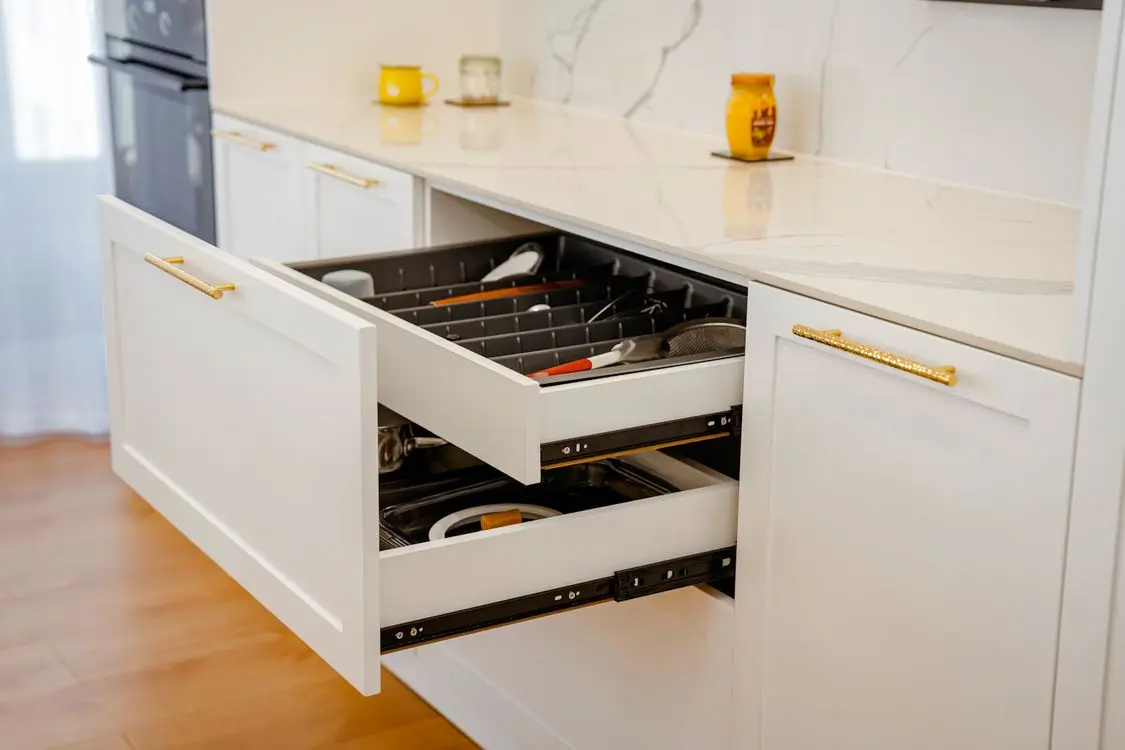
Drawer slide clearance is the gap between the drawer box and the cabinet side that the runner lives in — and it is the number most often taken from a forum post instead of a datasheet. That's why two "1/2-inch clearance" articles will tell you to deduct 1/2 inch and 1-1/16 inch from the same opening. Both numbers are published. Only one of them belongs to the runner you actually bought.
This is the order to lock the numbers in, before anything gets cut.
Step 1: Measure the opening, not the cabinet
The clearance is referenced to the finished opening the drawer travels through — not the carcass width, not the nominal cabinet size.
- Measure the clear opening width at the front, then again at the back of the runner's travel.
- Measure the height from the top of whatever the drawer sits above to the underside of whatever is over it.
- Take the smallest width you measured. A carcass that's 2 mm tight at the back will bind a slide that fits perfectly at the front.
- For face-frame cabinets, measure to the inside of the frame, and note that the frame overhang may need a rear mounting bracket.
Write these down as opening width and opening height, not as "cabinet size." Every deduction below comes off the opening.
Step 2: Choose the mount type before you choose anything else
The mount type changes the clearance by an order of magnitude, so it can't be a downstream decision.
| Mount type | Side clearance needed | Sets the drawer box width by | Where it shows up |
|---|---|---|---|
| Side-mount ball bearing | 12.7 mm (1/2 in) per side, per Accuride's published spec | A fixed geometric allowance — material thickness doesn't change it | Most volume kitchen and office furniture |
| Undermount | 3/16–1/4 in total for both sides | Drawer side thickness — the runner hooks the box from underneath | Premium kitchen, soft-close programmes |
| Centre-mount | Effectively none at the sides | Vertical space above and below the rail | Light-duty, traditional casework |
The distinction that matters: side-mount clearance is a constant; undermount clearance is a function of your drawer material. Swap 16 mm drawer sides for 12 mm on a side-mount programme and the box width is unchanged. Do the same on an undermount programme and every box width changes.
Step 3: Deduct the published width allowance
Take the opening width from Step 1 and subtract the allowance for your mount type and material.
| Mount type | Drawer side thickness | Deduct from opening width |
|---|---|---|
| Side-mount ball bearing (Accuride 3832 class) | Any | 1-1/16 in (27.0 mm) |
| Undermount | 1/2 in (12.7 mm) | 5/8 in (15.9 mm) |
| Undermount | 5/8 in (15.9 mm) | 3/8 in (9.5 mm) |
Accuride's own sheet states the side space as 0.50 in +0.031/−0.0 (12.7 mm +0.8/−0) and notes that slides may not function correctly below 12.7 mm. Read the tolerance direction: it is one-sided. You may be up to 0.8 mm generous; you may not be 0.1 mm tight. That asymmetry is the whole reason to round the drawer box down rather than to the nearest millimetre.
The undermount figures come from Eagle Woodworking's measuring guide, and they look backwards until you see the mechanism: a thicker drawer side gives the runner's hook more material to grab, so it needs less width taken out of the box. This is exactly why an undermount clearance number quoted without a material thickness is meaningless.
Step 4: Deduct the height and rear allowances too
Width failures are obvious. Height and depth failures are the ones that pass inspection and fail at the customer's house.
| Mount type | Deduct from opening height | Clear space needed behind the drawer |
|---|---|---|
| Undermount | 13/16 in (20.6 mm) minimum | 1/2 in (12.7 mm) minimum |
| Side-mount | 1/2 in (12.7 mm) minimum | 3/8 in (9.5 mm) minimum |
Undermount needs more height because the runner sits under the box; it needs more depth because the rear socket and the drawer back both occupy the same last inch of the cabinet. A drawer that closes but leaves the soft-close disengaged in the last 5 mm of travel is almost always a rear-clearance problem, not a runner fault.
Step 5: Pick the slide length against the cabinet depth
Slide length is not a free choice — it's the largest standard length that fits inside your cabinet depth after the back panel.
- Undermount lengths run 9 in to 30 in in 3 in increments.
- Side-mount lengths run 10 in to 30 in in 2 in increments (the 3832EC family covers 12–28 in).
- Always round down. A slide 1/2 in too long doesn't shorten itself; it stops the drawer closing flush and the fix is a new slide.
Worked example, frameless base cabinet:
| Input | Value |
|---|---|
| Cabinet outside depth | 24 in (610 mm) |
| Less back panel and rear clearance | −1-1/4 in |
| Usable internal depth | 22-3/4 in |
| Largest side-mount length that fits (2 in steps) | 22 in |
| Largest undermount length that fits (3 in steps) | 21 in |
Two mount types, the same cabinet, one inch apart. If your drawing says "600 mm slides" without saying which system, the factory picks one and you find out at assembly.
Step 6: Check the limits nobody reads
The 3832EC is rated at 100 lb (45 kg) maximum drawer load and a 24 in maximum drawer width. Both limits get exceeded quietly on export furniture: a wide vanity drawer, a file drawer loaded with A4, a toy chest a buyer describes as "a drawer."
- Over 24 in wide, the slide pair can rack even under a light load — the failure is a drawer that binds diagonally, not one that collapses.
- Over the load rating, the visible symptom is usually the ball retainer walking out of position after a few hundred cycles, well after your inspection.
- If either limit is close, move up a duty class before you move up a length.
Step 7: Reconcile with the cabinet's hole pattern
In 32 mm system casework, drawer runners mount to the same column of holes as hinge plates and shelf pins: 5 mm holes at 32 mm centres, with the front row set back 37 mm from the front edge, per the Euro 32 hole-boring system. If your line bores the front row at a different setback because it always has, the runner brackets land off-hole, and someone drills on site.
Confirm the setback in writing on the same drawing that carries the clearances. It costs one dimension line and removes an entire category of site dispute. The same reference-point discipline applies to the door side of the cabinet — the five numbers in cabinet hinge boring dimensions fail the same way when one of them is assumed rather than stated.
The pre-cut checklist
Run this before the panel saw, per SKU, not per order:
- Opening width measured front and back; smallest value recorded
- Opening height measured to the real obstructions above and below
- Mount type fixed (side-mount / undermount / centre-mount)
- Drawer side thickness fixed — and confirmed relevant if undermount
- Width deduction taken from the runner model's own installation sheet, not a general rule
- Height deduction and rear clearance both applied
- Slide length rounded down to the correct increment for the mount type
- Load rating and maximum drawer width checked against the real loaded weight
- 37 mm front setback confirmed against the cabinet's system holes
- Runner brand and model written on the drawing the numbers came from
That last line resolves more disputes than the other nine combined. Clearances aren't universal — they belong to a model — so a drawing without the model name is a drawing that can't be checked.
Next steps
Once the numbers are settled, the remaining risk is that they never reach the person cutting or the buyer approving. Three ways to close that gap, in rough order of effort:
- Put the deductions on the drawing, not in the email. A dimension line from the opening edge to the drawer box side, labelled with the runner model, survives translation and staff turnover. An email doesn't.
- Standardise on one runner family per programme. Most rework in this category comes from mixing two systems across SKUs that look identical on the packing list.
- Publish the clearance drawing to the buyer with the quotation. Buyers who receive dimensioned runner clearances up front stop asking whether the drawer will fit their carcass, which is the single most repeated pre-sale question on kitchen components.
For point 1 and 3, what's needed is a spec image where the numbers are measured off the actual geometry and pinned at the feature they describe — opening edge to box side, box underside to runner, drawer back to cabinet back — then exported at the size the buyer's catalogue or marketplace listing takes. That's a measurement job, not a retouching job: an image generator will render a crisp "12.7 mm" against a drawer it never measured, and a 12.0 mm reality passes the eye test right up to the point the runner binds. If you want the cost side of the argument before you invest the hour, the return cost calculator prices what one rework cycle takes out of the order margin, and the wall cabinet spec diagram example shows the label density that stays readable at listing size.
FAQ
How much space do you need for drawer slides on each side?
For side-mount ball-bearing slides, 12.7 mm (1/2 in) per side — Accuride publishes the side space as 0.50 in +0.031/−0.0 and states the slide may not function below 12.7 mm. For undermount, the total for both sides is roughly 3/16 to 1/4 in, but the usable figure is the width deduction tied to your drawer side thickness, not a per-side gap.
What size drawer slides do I need for a 24 inch cabinet?
Deduct the back panel and rear clearance from the 24 in outside depth to get roughly 22-3/4 in usable, then round down to the nearest standard length: 22 in for side-mount (2 in increments) or 21 in for undermount (3 in increments). Never round up — an over-length slide stops the drawer closing flush.
Why does undermount clearance depend on drawer side thickness?
Because the runner supports and hooks the box from underneath the sides rather than gripping the outside faces. Thicker sides give the hook more material, so less width comes out of the box: a 5/8 in side deducts 3/8 in from the opening, while a 1/2 in side deducts 5/8 in. A side-mount runner is indifferent to the material because it occupies a fixed gap.
Should I round drawer box width up or down?
Down, always. The published side space carries a one-sided tolerance — Accuride's is +0.031/−0.0 in — so extra clearance is tolerated and a shortfall is not. Rounding down costs you a slightly wider reveal; rounding up costs you a drawer that binds.
What happens if drawer slide clearance is too tight?
The drawer will feel stiff when empty and jam when loaded, because the load deflects the box outward into a gap that had nothing to give. Ball-bearing retainers walk out of position under that side pressure, so the failure usually appears weeks after assembly rather than at inspection — which is exactly when it becomes a warranty claim rather than a rework.
Sources & References
- Accuride 3832EC Quick Reference (side space 1/2 in +1/32 in per side, drawer 1-1/16 in less than opening, 100 lb load, 24 in maximum drawer width, 12–28 in lengths)
- Eagle Woodworking — How to Measure Drawer Slides (undermount and side-mount width, height and rear deductions; length increments)
- Engineer Fix — How Much Space to Leave for Drawer Slides (per-side clearance by mount type in inches and mm)
- Cabinet Now — Measuring for Cabinet Drawers (opening measurement method for face frame and frameless)
- Euro 32 Hole-Boring System Manual (5 mm system holes, 32 mm pitch, 37 mm front setback for runners and hinge plates)