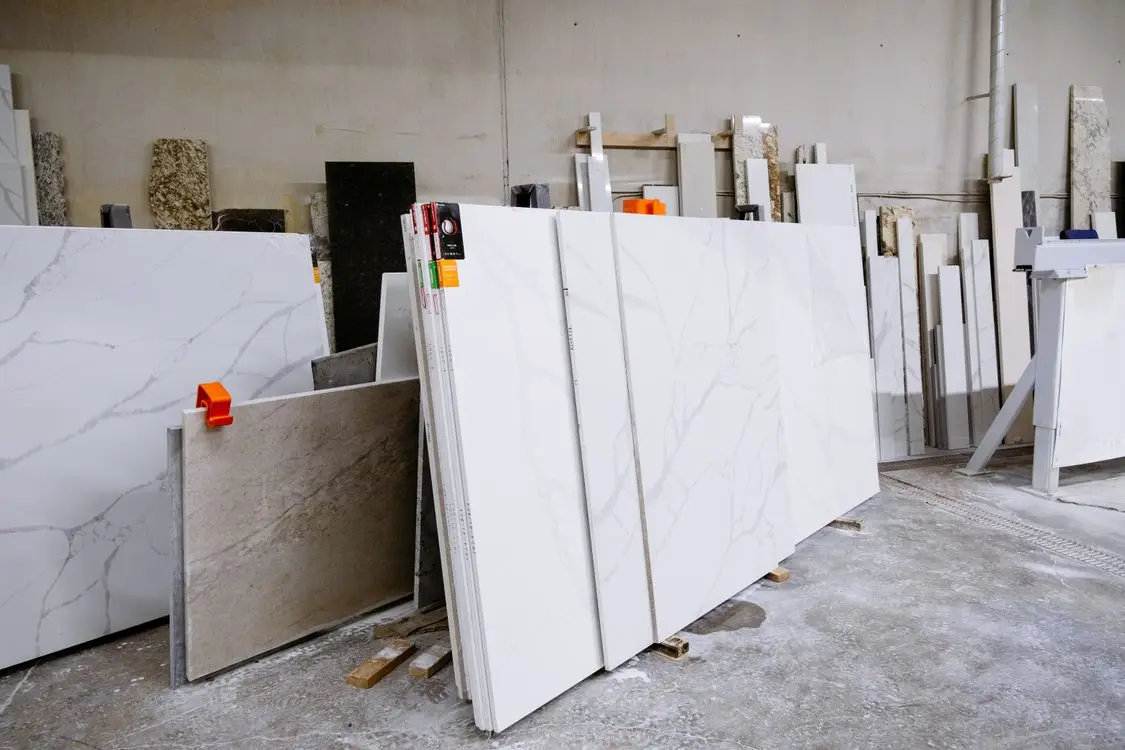
Stone Slab Dimensions: How Big Is a Slab, Really?
Stone slab dimensions are less standardized than buyers assume. What overseas buyers ask about granite, quartz and porcelain slab sizes, thicknesses and usable yield.
A buyer asks "what size is your slab?" expecting one number back. There isn't one. Stone slab dimensions work differently from tiles or sheet goods: the thickness is effectively standardized, but the length and width are not — they depend on the natural block a slab was cut from, or on the individual brand's press for engineered material. Quote a single "standard slab size" and you'll be wrong for half your inventory, and the buyer who plans a countertop around it loses material they didn't budget for. Here are the questions overseas buyers actually ask about slab size, with the numbers that are defensible and the ones that aren't.
Is there a standard stone slab size?
No — not for length and width. No standards body sets a granite, marble, or quartz slab's L×W. The ASTM and GB material specifications for dimension stone govern material properties (absorption, density, strength) and sampling, not slab footprint. A natural slab's size follows the quarry block; an engineered slab's size follows the manufacturer's press. So "standard slab = X by Y" is marketing shorthand, not a spec.
What is consistent is thickness. Treat thickness as the standardized axis and slab footprint as a supplier-specific range you confirm per lot.
What are the standard slab thicknesses?
Two thicknesses dominate the trade, and nearly every fabricator worldwide follows them:
| Thickness |
Metric |
Imperial (marketed) |
Typical use |
| 2 cm |
20 mm |
≈ 3/4" (true 3/4" = 19.05 mm) |
Wall cladding, vertical panels, substrate-backed surfaces |
| 3 cm |
30 mm |
≈ 1-1/4" (more exactly 1-3/16" = 30.16 mm) |
Countertops, overhangs — now the US countertop norm |
| 1.5 cm |
15 mm |
≈ 0.59" |
Lighter cladding, some vertical applications |
Note the imperial figures are roundings: 2 cm is 0.79 inch, not exactly 3/4; 3 cm is 1.18 inch, closer to 1-3/16 than 1-1/4. If a buyer's fabricator works in inches, put the real millimetre thickness on the spec so nobody assumes an exact fraction. Large-format porcelain and sintered slabs are the exception — those run much thinner, from about 3 mm up to 20 mm depending on the line.
How big is a granite or marble slab?
Industry-typical, and always block-dependent — state it as a range, never a fixed size:
- Standard natural slab: roughly 270–305 cm long × 150–185 cm wide (about 108–120" × 60–72").
- "Jumbo" natural slab: larger seam-reducing formats, commonly 160×320 cm up to 165×330 cm, with premium lines going bigger.
Because a natural slab is sawn from whatever the block yields, two slabs of the "same" material can differ by tens of centimetres. The honest way to quote it: give the buyer the actual measured dimensions of the specific slabs on offer, not a catalogue average.
How big is a quartz or porcelain slab?
Engineered material is more predictable because it's factory-pressed — but the number belongs to the brand, not to a standard. Quote the brand's own spec sheet:
- Engineered quartz: standard formats around 1435×3050 mm and "jumbo" formats around 1600×3340 mm. One major brand states its jumbo yields roughly 20% more surface area than its standard slab — a real reason buyers ask for jumbo on large kitchens.
- Sintered stone / large-format porcelain: common formats 1200×2400 mm and 1600×3200 mm, with the largest lines reaching about 1620×3240 mm; thicknesses from ~3 mm to 20 mm.
Different brands press different sizes, so "quartz slab = 3200×1600" is only true for the collections that publish that number. Confirm the format per collection before you cut.
Why is the usable area smaller than the slab size?
Because a slab is never 100% usable. Edge trimming, natural defects, sink and cooktop cutouts, and layout nesting all remove material. A realistic fabrication yield is 85–90% on straightforward jobs, dropping to 70–75% on complex or vein-matched work. Planners commonly budget around 50 usable square feet per slab and add a 15–25% waste factor when estimating how many slabs a project needs.
This is where a "gross size" quote quietly misleads a buyer. If your listing implies the whole slab is usable countertop, the buyer orders too few slabs and comes back short — a size dispute that started with an over-optimistic number, not a bad slab.
What standards actually apply to slabs?
Buyers who ask for "the standard" usually want one of these — and they cover material and classification, not slab L×W:
- ASTM material specs (US): C615 granite, C503 marble, C616 quartz-based (natural), C568 limestone, C629 slate, C1527 travertine. These set physical-property requirements, not sizes. There is no ASTM material spec for engineered/resin quartz — spec it by the brand's datasheet.
- EN product standards (Europe): the split is by thickness — EN 12057-family modular tiles are ≤ 12 mm, EN 12058 slabs for floors/stairs are > 12 mm, and EN 1469 covers slabs for cladding. Twelve millimetres is the standardized tile/slab dividing line.
- ANSI A137.3 (US porcelain): defines gauged porcelain panels/slabs as ≥ 1 m² facial area, with nominal thicknesses in the 3.5–6.5 mm range. Useful when a buyer calls a thin porcelain sheet a "slab."
- GB/T (China): GB/T 18601-2024 granite building slabs, GB/T 19766-2016 marble building slabs, and GB/T 41919-2022 for engineered/artificial stone slabs. These define tolerance grades and property requirements.
The radioactivity class buyers ask for
For stone with natural aggregate — granite especially — many buyers request a radioactivity certificate. China's GB 6566-2010 sorts decorative materials into three classes by dimensionless index (not Bq/kg):
- Class A: internal index IRa ≤ 1.0 and external index Iγ ≤ 1.3 — usable in all interior decoration.
- Class B: IRa ≤ 1.3 and Iγ ≤ 1.9 — not for Class-I interiors like homes.
- Class C: Iγ ≤ 2.8 — exterior use only.
If you export granite, labeling it "Class A (放射性A类)" on the test report is the mark buyers look for to confirm it's cleared for interior use.
Quick-reference summary
| Question |
Short answer |
| Standard slab L×W? |
No — block/brand dependent; quote a range |
| Standard thickness? |
2 cm and 3 cm (plus 1.5 cm); porcelain 3–20 mm |
| Granite/marble slab size |
≈ 270–305 × 150–185 cm; jumbo to ~165×330 cm |
| Quartz/porcelain slab size |
Brand-specific; ~1435×3050 to ~1620×3240 mm |
| Usable vs gross |
85–90% yield typical; budget 15–25% waste |
| Which standard for size |
None sets L×W; ASTM/EN/GB set material & thickness class |
FAQ
Is a 2 cm slab the same as a 3/4 inch slab?
Close, not exact. 2 cm is 20 mm, which is 0.79 inch; a true 3/4 inch is 19.05 mm. The trade markets 2 cm as "3/4 inch," but put the millimetre figure on the spec so a fabricator working in inches doesn't machine to the wrong depth.
What is the biggest stone slab I can order?
Among natural stone, "jumbo" formats reach roughly 165×330 cm, block permitting. Among engineered material, sintered/porcelain lines go to about 1620×3240 mm. There's no universal maximum — it depends on the block or the manufacturer's press, so ask for the specific format on offer.
How many square feet does one slab cover?
Plan on about 50 usable square feet per slab as a conservative figure, after edge waste and cutouts, and add a 15–25% waste factor. A slab's gross size is always larger than its usable area.
How should I show slab size to a buyer so there's no dispute?
Put the actual measured length, width, and nominal thickness of the specific slabs on the spec image, and mark that the usable rectangle is smaller than the gross slab. A spec diagram that pins the real measured dimensions to the photo — rather than a catalogue average typed from memory — is what keeps a buyer from ordering to a number that turns out optimistic. It's the same discipline behind reading building material coverage per box and labeling glass and mirror dimensions for export: quote the measured figure, not the assumed one. When a wrong-size assumption does trigger a return, the freight on a pallet of stone is brutal — worth pricing out on a return cost calculator before you let a vague size go out.
Sources & References