
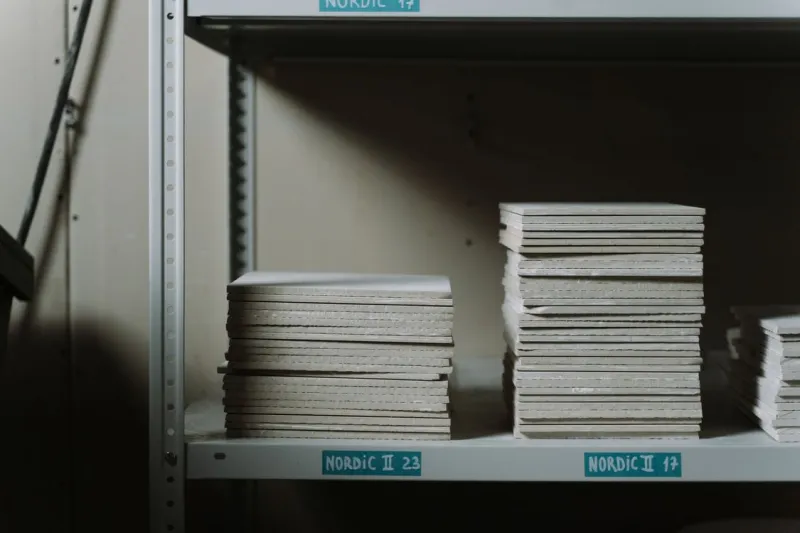
Building-material size labeling breaks down in one specific, predictable place: the gap between the number on the spec sheet and the number a buyer needs to actually place an order. A tile listed as 600 x 600mm rarely measures 600 x 600mm on the tape — it's closer to 597mm, with the missing 3mm reserved for the grout joint. A panel quoted at "12mm thick" might ship at 11.7mm and still pass inspection. A profile's cross-section drawing means nothing if the wall thickness isn't called out separately from the overall envelope. None of this is a manufacturing defect — it's how tile, panel, and profile production actually works. The problem is that most product pages never explain it, so buyers guess, order the wrong quantity, or send an email before they'll commit to anything. Below is a fixed-field template that answers those questions once, on the image itself, so it doesn't have to be answered again for every SKU in the catalog.
The Building-Material Size Labeling Template
Building-material size labeling only works if every SKU uses the same field order — a buyer scanning fifty products in a catalog shouldn't have to relearn where the tolerance number lives each time. This building-material spec sheet uses a fixed field sequence, regardless of whether the product behind it is a tile, a panel, or a profile:
| Field | What It Captures | Example |
|---|---|---|
| Product name / SKU | Unique identifier tying the label to the order form | Matte Porcelain Tile — SKU TL-6060-M |
| Material category | Tile, panel, or profile — sets which of the fields below apply | Ceramic tile |
| Nominal size | The marketing dimension used in the name and search filters | 600 x 600mm |
| Actual (work) size | The measured manufacturing dimension the nominal size is built from | 597 x 597mm |
| Tolerance | Allowable deviation from the actual size, as a value or percent | ±0.6mm (±0.1%) |
| Thickness | Material thickness, with its own tolerance if it differs from the size tolerance | 9.5mm ±0.3mm |
| Joint / module spacing | Grout joint (tile) or seam allowance (panel) built into the nominal size | 3mm joint |
| Unit system | Metric, imperial, or both if selling into mixed markets | mm (in shown on request) |
| Reference standard | The standard the tolerance is measured against | ANSI A137.1 |
| Series note | Which other SKUs in the line share this template | Matches TL-6060 series, all finishes |
Ten fields, one order, every time. A buyer who has seen one labeled image in the catalog already knows how to read the next fifty. The same labeling discipline already works for other categories — how to show furniture dimensions in photos and spec diagram for industrial products follow a similar fixed-field logic. Building materials just need three fields most templates skip entirely: nominal-vs-actual size, joint or module spacing, and a named reference standard.
How to Fill Each Field: Nominal vs. Actual Size, Tolerance, and Joint Spacing
Nominal Size vs. Actual (Work) Size
Nominal size is the number in the product name and the search filter — it's what a buyer types into a sourcing platform. Actual size, sometimes called work size, is what a caliper reads on the finished piece. For tile, the two are almost never identical, because the nominal size is measured center-to-joint-center, not edge-to-edge: a 600 x 600mm nominal tile commonly ships at roughly 597 x 597mm, with the remaining 3mm accounted for by the grout joint between two tiles. Skip this distinction on a spec label and a buyer calculating coverage area from the nominal number alone will over-order material or under-order boxes — a mistake that shows up as a shortfall mid-installation, not at the time of the order.
Tolerance — the Number That Prevents the Angriest Emails
Tolerance tells the buyer how far the actual piece is allowed to drift from the stated size before it's a defect. List it as both a measurement and a percentage where the industry uses percentage-based tolerance — ceramic tile is commonly toleranced around ±0.5% for length and width under general ceramic tile testing conventions, while calibrated and rectified tile lines carry noticeably tighter figures because the edges are mechanically finished after firing. Aluminum profiles use a different convention entirely: cross-sectional tolerance is typically expressed in absolute terms, roughly ±0.1mm to ±0.5mm depending on the size of the section and wall thickness, per the tolerance tables published in Aluminum Standards and Data. Whichever convention applies to the material, name it — "tolerance: industry standard" is not a number a buyer can plan around.
Module and Joint Spacing (Tile-Specific)
Module or joint spacing is the built-in gap the nominal size already accounts for. It matters for two reasons: it's the difference between nominal and actual size described above, and it determines whether a buyer's grout budget and area coverage math will actually work out on-site. State the joint width as its own field rather than folding it into a note — "3mm joint, included in nominal size" is one line a purchasing agent can paste directly into a quantity calculation.
Panel Thickness Labeling and Profile Wall Thickness
Thickness deserves its own tolerance figure, separate from the size tolerance, because the two are governed by different physical processes and often by different allowable ranges. Insulated wall panels are commonly toleranced to a fraction of a millimeter on thickness even though the panel length tolerance is a different figure entirely; composite panels see thickness tolerances in a similar range. A profile's "thickness" usually means wall thickness at the narrowest point of the cross-section, which is a structural number, not a cosmetic one — label it separately from the overall profile envelope (height x width) so a buyer checking whether the profile fits a channel isn't accidentally reading the wrong number.
Worked Examples: Tile, Panel, and Profile Spec Labels
Tile Spec Sheet Template Example
| Field | Value |
|---|---|
| Product | Matte Porcelain Floor Tile TL-6060-M |
| Nominal size | 600 x 600mm |
| Actual size | 597 x 597mm |
| Tolerance | ±0.6mm (±0.1%), rectified |
| Thickness | 9.5mm ±0.3mm |
| Joint spacing | 3mm, included in nominal size |
| Standard referenced | ANSI A137.1 (rectified tile) |
Panel Example
| Field | Value |
|---|---|
| Product | Insulated Metal Wall Panel WP-1200-R |
| Nominal size | 1200mm cover width x custom length |
| Actual size | 1198mm cover width (interlocking seam allowance: 2mm) |
| Tolerance | Length: ±3mm; cover width: ±1.5mm |
| Thickness | 50mm core ±1.5mm |
| Seam allowance | 2mm interlock, included in cover width |
| Standard referenced | EN 14509, Annex D |
Profile Dimension Diagram Example
| Field | Value |
|---|---|
| Product | Aluminum Window Frame Profile PF-4520 |
| Nominal size | 45mm x 20mm envelope |
| Actual size | 45.0mm x 20.0mm ± cross-section tolerance |
| Tolerance | ±0.25mm on envelope, per section class |
| Wall thickness | 1.4mm ±0.1mm (structural, not envelope) |
| Joint/module spacing | Not applicable — profiles don't tile, so this field is omitted |
| Standard referenced | Aluminum Standards and Data, ANSI H35.2 |
Three materials, one field order, three different sets of numbers. That consistency is the entire point — a buyer who has read one of these labels already knows how to read the next one, whether it's a different finish of the same tile or an entirely different product category in the same catalog.
Customizing the Template Across a Batch or Product Series
A tile, panel, or profile is rarely sold as a single SKU — it's a family of finishes, lengths, or cross-sections sharing one base geometry. Building-material size labeling at the series level means the template above holds for the whole family with a few adjustments per SKU, not a rebuild from scratch:
- Confirm which fields are truly shared across the series (material category, standard referenced, unit system) and which change per SKU (nominal size, tolerance, thickness)
- Label one representative image per finish or colorway, not per SKU — a matte and gloss version of the same tile size only need one dimension label between them
- Keep the field order identical across every image in the series, even when a field is not applicable (mark it "n/a" rather than deleting the row, so the layout stays predictable)
- Version the template when a supplier changes tolerance class or a standard revision updates a figure, and note the effective date on the label
- Store the filled-in values in a spreadsheet keyed by SKU so relabeling a resized or re-toleranced product doesn't require rebuilding the layout by hand
Batching this way is also what makes a case for doing it at all: a furniture size-label case study showed that putting dimensions directly on the image — not buried in a linked PDF — is what actually stops the same question from arriving by email fifty times. The same math holds for a fifty-SKU tile or profile catalog; the labeling work happens once per template, not once per repeat inquiry.
FAQ
What's the difference between nominal size and actual size for tiles?
Nominal size is the marketing dimension used in the product name and search filters; actual (or work) size is what a caliper measures on the finished tile, which is smaller than the nominal size by the width of one grout joint. A tile named "600 x 600mm" typically measures close to 597 x 597mm in hand.
How do I calculate tile quantity when the nominal size includes the grout joint?
Use the nominal size, not the actual size, for area coverage math — nominal size already accounts for the joint spacing between tiles when they're laid edge to edge, so multiplying nominal dimensions by piece count gives the correct total coverage area. Using the smaller actual size for this calculation will under-order material.
What tolerance should I list for panel thickness on a spec sheet?
List panel thickness tolerance as its own field, separate from the length and width tolerance, because the two are usually governed by different figures. State it as an absolute value (for example, ±1.5mm) rather than a vague "manufacturing tolerance applies," and reference the standard the figure comes from, such as EN 14509's Annex D for insulated sandwich panels.
How is a profile's dimension diagram different from a tile or panel spec label?
A profile's diagram centers on the cross-section envelope (overall height and width) plus wall thickness at the narrowest point, since that determines structural fit — it has no joint or module spacing field, because profiles don't tile edge to edge the way flooring or wall panels do. Tile and panel labels center on face dimensions and how much of that dimension is reserved for a joint or seam.
How do I label product dimensions for an export catalog with dozens of SKUs?
Build one field template per base geometry and reuse it across the whole series rather than designing a new layout per SKU — only the values (nominal size, tolerance, thickness) change per finish, length, or cross-section variant, while the field order, unit system, and referenced standard stay identical across the family. That consistency is what lets an overseas buyer read fifty labeled images in the time it would otherwise take to read five.
Sources & References
Tile Council of North America (TileLetter) — Tolerances for Tile
Tile Council of North America — Grout FAQ (Nominal Size and Joint Width)
The Aluminum Association — Understanding Aluminum Extrusion Tolerances
iTeh Standards / CEN — EN 14509:2013 Self-Supporting Insulating Sandwich Panels
Alibaba.com Rules Center — Rules for Filling of Product Information