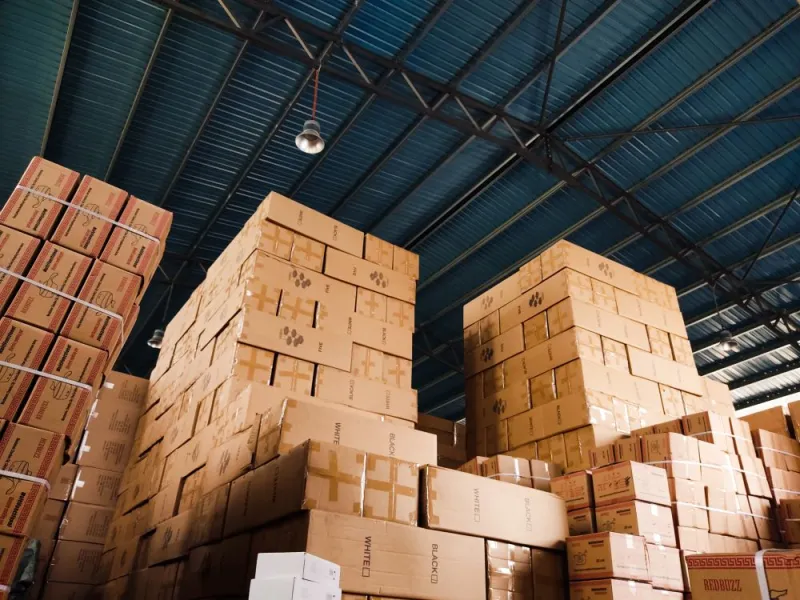
A buyer rejects a container not because the product was wrong, but because the cartons weren't marked the way their warehouse scans them — no carton numbers, origin missing, handling symbols absent, and the customs broker flags it. Export carton shipping marks feel like an afterthought until one of them costs you a delivery. The confusing part is that most of what goes on a master carton is not an international standard — it's driven by your sales contract and the letter of credit — while a few elements genuinely are law or ISO. Here's exactly what belongs on an export carton, field by field, and which rules are hard versus convention.
What actually governs carton markings
Three different things decide what goes on the box, and suppliers constantly mix them up:
| Element |
Who mandates it |
Status |
| Main mark / side mark layout |
Sales contract + letter of credit + packing list |
Trade convention — not an ISO standard |
| Country-of-origin ("Made in China") |
Importing country's customs law |
Legal requirement |
| Handling symbols (This Way Up, Fragile…) |
ISO 780 |
International standard |
| GS1/SSCC logistics label |
The specific buyer / retailer / 3PL |
Buyer-driven, only when specified |
The single most useful thing to know: there is no ISO or UN standard that dictates the traditional consignee/port/carton-number layout. The one international recommendation, UNECE Recommendation No. 15 "Simpler Shipping Marks," actually argues for a minimal mark — a buyer reference, an order number, the destination, and the package number — and says extra data should be kept to a minimum. So when a buyer's L/C specifies a mark, that L/C wins; follow it verbatim.
The shipping mark, field by field
The conventional export carton carries a main mark (the identifying block) and a side mark (weights, dimensions, counts). Treat this as the industry-standard habit, then override any field your buyer's L/C specifies differently.
| Field |
Abbrev. |
What it means |
| Consignee / buyer reference |
— |
Initials or short name of the buyer (per Rec. 15, keep it brief) |
| Reference / order number |
— |
The contract or PO number |
| Destination |
— |
Port and/or city of discharge |
| Carton number |
C/No. |
Running number, written 1/300, 2/300 … 300/300 so every carton is traceable |
| Net weight |
N.W. |
Product only |
| Gross weight |
G.W. |
Product plus packaging |
| Measurement |
MEAS. |
Carton external L×W×H, used to compute CBM |
| Country of origin |
— |
"MADE IN CHINA" (or actual origin) — legally required, see below |
Put the most-scanned data — SKU or barcode — on the short side of the carton, because that face stays visible when cartons are stacked. That's convention, not a rule, but it's the difference between a warehouse scanning your cartons in place and having to restack them.
ISO 780 handling symbols
Handling and storage symbols are the part that is standardized. ISO 780:2015 ("Distribution packaging — Graphical symbols for handling and storage of packages") defines exactly 17 symbols. The ones you'll actually print:
| Symbol |
ISO 780 name |
Use it when |
| ↑↑ |
This way up |
Orientation matters — arrows point up, apply the right way |
| Glass |
Fragile, handle with care |
Breakable contents (one combined symbol — there's no separate "handle with care") |
| Umbrella |
Keep away from rain |
Must stay dry (the standard's term — not "keep dry") |
| Stacking limit by mass |
Max weight that can be stacked on top |
Load-sensitive goods |
| Stacking limit by number |
Max number of identical packages stacked |
Load-sensitive goods |
| Do not stack |
Nothing on top |
Crushable cartons |
| Temperature limits |
Storage temperature range |
Temperature-sensitive goods |
Three application rules from the standard worth getting right: the symbol colour must be black (avoid red/orange/yellow, which collide with dangerous-goods labels); the symbol height is 100 mm, 150 mm, or 200 mm for normal use; and the standard excludes dangerous goods — those follow their own labeling. Print symbols only when they're needed; a wall of icons dilutes the ones that matter.
Carton dimensions: inside vs outside, and CBM
Two dimension sets live on every corrugated carton, and quoting the wrong one causes fit problems and freight disputes:
- Inside (internal) dimensions = product fit. This is the space your goods actually occupy; size it to the product.
- Outside (external) dimensions = the space the carton occupies in a container or on a pallet. Board thickness (single-wall ≈ 3–4 mm, double-wall more) makes the outside larger than the inside.
For freight and MEAS., always use the outside dimensions. The volume — the MEAS. figure and the CBM you quote the forwarder — is pure arithmetic:
CBM = L × W × H (all in metres) — or (L × W × H in cm) ÷ 1,000,000.
A 60 × 40 × 40 cm carton is 96,000 cm³ ÷ 1,000,000 = 0.096 CBM. The reason this matters beyond loading: ocean LCL and air freight bill on the greater of actual weight or volumetric weight derived from these outside dimensions — the same trap covered in gross weight vs net weight vs volumetric weight. Measure the assembled carton, not the flat blank, and put the outside L×W×H on the carton drawing exactly as measured. A spec-diagram tool that pins the measured outside dimensions onto the carton image — rather than a designer typing "approx" from the product size — is what keeps your MEAS., your CBM, and your buyer's DC intake all agreeing on one number.
If you're estimating how many cartons fill a container or how coverage maps to carton count for building materials, the same measured-dimension discipline shows up in building material coverage per box.
Country-of-origin marking: the one legal must
This is not convention. For goods entering the US, Section 304 of the Tariff Act (19 U.S.C. §1304) requires every article of foreign origin — or its container — to be marked "conspicuously, legibly, indelibly and permanently" with the English name of the country of origin, so the ultimate purchaser knows where it was made. The implementing rules are 19 CFR Part 134, and US Customs can demand redelivery of improperly marked goods. Other importing countries have their own origin-marking laws — check the destination's, not just the US's. "MADE IN CHINA" on the carton isn't an ISO nicety; it's how the shipment clears customs.
A carton that fails customs marking can be held, refused, or ordered redelivered — and the cost of reworking labels or reshipping a flagged container dwarfs the price of getting the mark right the first time. If you want to see what a refused or returned shipment actually costs before it leaves your dock, run the numbers through a return cost calculator.
When the buyer requires a GS1/SSCC label
Big-box retail, many EU/US distribution centers, and EDI programs require a GS1 logistics label carrying an SSCC (Serial Shipping Container Code) — an 18-digit number that uniquely identifies each logistics unit (carton or pallet) so it scans on receipt. It's built from Application Identifier (00) + extension digit + your GS1 company prefix + serial reference + a check digit, encoded in a GS1-128 barcode.
You only add this when a specific buyer or their 3PL mandates it. Most furniture, industrial, and building-material B2B cartons ship on the traditional shipping mark plus ISO 780 symbols. If the buyer's routing guide asks for GS1 labels, that requirement overrides the traditional mark — build to their spec.
Pre-ship carton marking checklist
A note on carton strength standards
Buyers sometimes ask for a "box compression" or "edge crush" figure. Know what those standards are so you don't over-promise: ASTM D642 and ISO 12048 are test methods for box compression, not pass/fail specs — they describe how to measure, not a required kgf. Edge crush (ISO 3037, result in kN/m) and bursting/Mullen strength are two separate board-rating systems; don't conflate them. On the China side, corrugated transport boxes fall under GB/T 6543 (the 2025 edition applies to boxes with content mass ≤ 55 kg). Any specific strength target comes from the buyer's spec, not from citing a test-method number.
FAQ
What is the difference between a main mark and a side mark?
The main mark is the identifying block — consignee reference, order number, destination, carton number. The side mark carries weights and measurements — N.W., G.W., and MEAS. (outside L×W×H). Neither layout is an ISO standard; both follow trade convention and whatever the letter of credit specifies.
Is "Made in China" required on the carton or only the product?
The importing country's law decides. Under US 19 U.S.C. §1304, the article or its container must be marked with the country of origin, so a properly marked carton can satisfy it — but confirm the destination country's specific rule, since some require marking on the product itself.
What does C/No. mean on a shipping mark?
C/No. is the carton (case) number, written as a running fraction like 1/300, 2/300 through 300/300, so every carton in a shipment is individually identifiable against the packing list.
How do I calculate CBM for a carton?
Multiply outside length × width × height in metres, or multiply the centimetre dimensions and divide by 1,000,000. A 60×40×40 cm carton is 0.096 CBM. Always use the outside dimensions, since that's what determines container loading and volumetric freight charges.
Do I need ISO 780 symbols on every carton?
Only where they add information — This Way Up when orientation matters, a stacking limit when the goods are crush-sensitive, and so on. ISO 780:2015 says to use symbols only when necessary, print them in black, and size them 100–200 mm. Dangerous goods are excluded and use separate labeling.
Sources & References