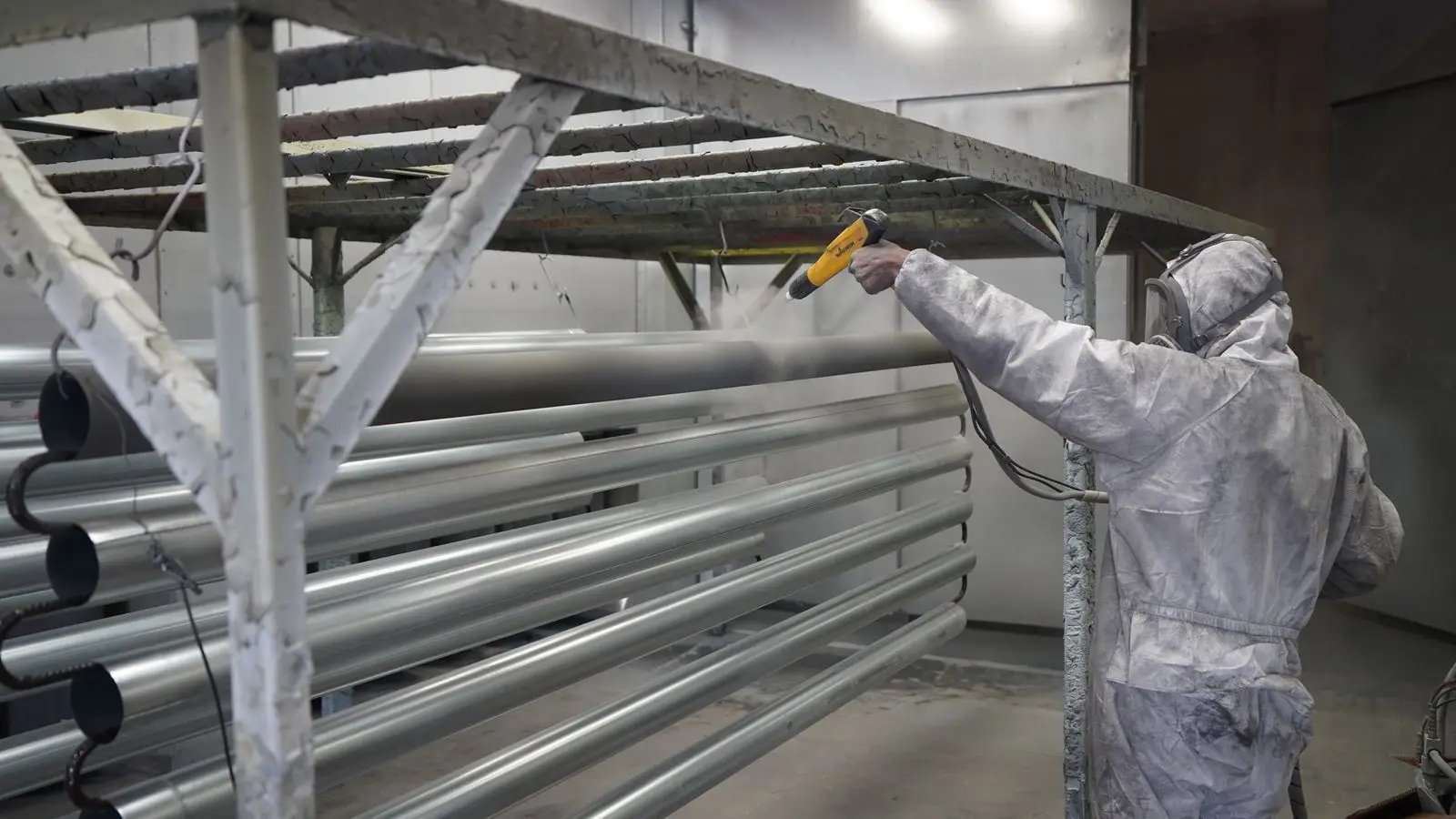
Powder coating specifications fail overseas buyers in one specific way: the supplier quotes hours, the buyer lives in a climate, and nobody writes down where the product will actually stand. The same shelving unit that survives fifteen years in a heated warehouse outside Munich can bloom rust in eighteen months on a dock in Jeddah — identical powder, identical thickness, identical certificate.
The complaint lands six to eighteen months after the container does, which is when it costs the most: goods installed, the buyer's customer angry, and your test report saying 1,000 hours. Here is what belongs on the spec sheet for each destination environment, and which numbers to stop quoting.
The Five Lines a Powder Coating Specification Needs
Most spec sheets carry one line — "powder coated, RAL 9005" — and that line commits you to nothing and protects you from nothing. A complete specification answers five separate questions:
| Line |
What it answers |
A usable entry |
| Substrate + pretreatment |
What is under the powder, and how it was prepared |
Cold-rolled steel, zinc phosphate conversion coating |
| Destination environment |
How corrosive the buyer's actual location is |
Corrosivity category C4 (coastal, moderate salinity) |
| Powder chemistry |
Indoor, exterior, or super-durable exterior |
Super-durable polyester TGIC, exterior grade |
| Film thickness window + method |
How thick, measured how |
60–80 µm average, measured to ISO 2178 |
| Acceptance tests, with direction |
What "pass" means numerically |
Cross-cut to ISO 2409, result 0 |
Each line removes an argument you would otherwise have after arrival.
The standard almost everyone cites wrongly
Start with a correction, because it appears on a large share of supplier spec sheets: ISO 12944 does not cover powder coating. Its scope is limited to coating materials that dry or cure under ambient conditions, and powder cures in an oven at high temperature. A 2021 peer-reviewed review states it plainly: "The ISO 12944 series of standards in their scope of application clearly excludes powder coatings, stove enamels and thermosetting coating materials."
"ISO 12944 C5 powder coating system" on a quotation is not a stronger claim than saying nothing — it is a claim a technically literate buyer reads as a red flag.
What you can borrow is the environment vocabulary. The same review notes that the corrosivity categories from ISO 12944-2 / ISO 9223 are used inside genuine powder schemes such as Qualisteelcoat and GSB-ST. The categories describe the buyer's climate; they do not certify your coating. The documents that actually govern powder are EN 13438 for powder over galvanised structural steel, Qualisteelcoat and GSB-ST 663 as licensing schemes, and Qualicoat or AAMA 2603/2604/2605 for architectural aluminium.
The corrosivity categories, and what they mean physically
These six categories are the shared language. The loss figures are measured on bare metal after the first year of exposure, which makes them concrete rather than adjectival:
| Category |
Typical environment |
Steel loss, year 1 |
Zinc loss, year 1 |
| C1 Very low |
Heated buildings with clean atmospheres — offices, shops, schools, hotels |
≤ 1.3 µm |
≤ 0.1 µm |
| C2 Low |
Unheated buildings where condensation may occur; mostly rural |
> 1.3–25 µm |
> 0.1–0.7 µm |
| C3 Medium |
Urban and industrial atmospheres, moderate sulfur dioxide; coastal areas with low salinity |
> 25–50 µm |
> 0.7–2.1 µm |
| C4 High |
Chemical plants, swimming pools, coastal boatyards; coastal areas with moderate salinity |
> 50–80 µm |
> 2.1–4.2 µm |
| C5 Very high |
Coastal and offshore areas with high salinity |
> 80–200 µm |
> 4.2–8.4 µm |
| CX Extreme |
Offshore areas with a large amount of salt in the air |
200–700 µm |
> 8.4–25 µm |
Two changes from the pre-2017 edition catch people out. C5-M and C5-I were merged into a single C5, and CX was created for offshore structures. If a buyer's drawing says "C5-M," they are working from a superseded edition — worth a polite note, because it usually means the rest of the specification is old too.
Durability classes were renumbered at the same time: low is now up to 7 years, medium 7–15, high 15–25, and a new very-high class covers beyond 25. For any buyer who reads a class as a guarantee, the class describes "the performance duration of the coating system before first major maintenance" — not a warranty period.
Scenario A: Heated indoor — office furniture, retail fixtures, enclosures
Environment: C1–C2. State chemistry and thickness, then stop.
This is the one case where over-specifying costs you the order. An epoxy-polyester hybrid at 60–90 µm is the normal answer; hybrids chalk badly in sunlight, which is irrelevant in a shop fitting. AkzoNobel's indoor hybrid data sheet specifies 60–90 microns for exactly this use.
Iron phosphate pretreatment is sufficient here, and IGP publishes the boundary: alkaline phosphating "is generally not sufficient for painted surfaces exposed to weathering and permanent moisture, but is sufficient as corrosion protection for powder coated parts in unstressed areas." Put that boundary in the spec sheet and you have pre-answered "why didn't you use zinc phosphate."
Scenario B: Unheated warehouse, humid indoor, sheltered outdoor
Environment: C3. Move to exterior polyester and zinc phosphate.
This is where hybrids fail and buyers blame the colour. Switch to an exterior polyester, and switch pretreatment to zinc phosphate — an 8–20 µm conversion layer instead of a sub-micron iron phosphate film. It is the largest step change in corrosion performance available to you, and it costs less than adding 20 µm of powder.
That ordering is not a preference. Sherwin-Williams puts the industry figure at "Up to 80% of all coatings failures can be directly attributed to inadequate surface preparation". When a buyer asks you to raise film thickness after a failure, the honest answer is usually that thickness was not the problem.
Scenario C: Coastal — outdoor furniture, marine hardware, railings
Environment: C4–C5. Specify a duplex system, or expect claims.
Powder alone on bare steel in a C5 coastal location is a warranty claim with a delivery date. The workable answer is a duplex system: hot-dip galvanise first, powder over it. The American Galvanizers Association publishes the synergy figure — the combination protects for "1.5 to 2.3 times the sum of the expected life of each system alone".
Check the direction of that range before quoting it. The AGA's environment-specific multipliers are 1.5 for extreme marine and extreme pollution and 2.0–2.3 only for non-aggressive suburban or rural sites. The multiplier is smallest exactly where you need it most.
Duplex also has a process trap that produces beautiful parts which blister in the container. Galvanised steel must be prepared before powder — sweep blasting is "angled onto the surface at 30 to 60 degrees, in contrast to standard blasting which uses a 90-degree angle" — and the part must be degassed by baking at 30 °C above cure temperature for at least an hour, or trapped gas becomes pinholes. ASTM D7803 governs this. A coater who cannot name that standard is not ready for duplex work.
Stainless is not the shortcut either. The British Stainless Steel Association lists 304 as "Grade not recommended" for coastal or marine locations, and its seawater guidance is blunter: "The 304, and more especially the free machining 303 types, should not be considered suitable for seawater service."
Scenario D: Industrial and chemical exposure
Environment: C4–C5 inland. State the exposure, not the category.
Chemical plants, pool halls and washdown areas all land in C4–C5, but they fail differently — chlorides, ammonia and caustic cleaners attack in ways a salt-fog number never sees. State the actual exposure ("daily washdown, pH 11 alkaline detergent, 60 °C") and let the coater select the chemistry.
Scenario E: Architectural facades — the buyer specifies, you comply
Environment: defined by the project. State which class, and which edition.
Architectural aluminium runs on two competing schemes, and mixing them up is the most common technical error in facade quotations.
|
AAMA 2603 |
AAMA 2604 |
AAMA 2605 |
| Tier |
Good |
High |
Superior |
| South Florida exposure |
1 year |
5 years |
10 years |
| Salt spray (current) |
ASTM G85, 1,000 h |
ASTM G85, 1,500 h |
ASTM G85 Annex A5, 2,000 h |
| Humidity |
1,500 h |
3,000 h |
4,000 h |
| Gloss retention after exposure |
Not specified |
Min 30% |
Min 50% |
| Minimum film thickness |
20 µm |
30 µm |
30 µm |
The salt-spray row is where most suppliers are out of date. The old figures — B117 at 1,500 / 3,000 / 4,000 hours — were replaced by the cyclic ASTM G85 test at 1,000 / 1,500 / 2,000 hours. Gordon Inc. explains the reasoning: the membership moved to "ASTM G85, Annex A5, which is a cyclic test that, many felt, better represented the corrosion process in nature, especially in coastal environments", at half the exposure time of the old method. A certificate reading "AAMA 2605, 4,000 hours salt spray" is quoting a withdrawn revision.
Europe runs on Qualicoat, and the schemes do not map onto each other. Qualicoat is "a global quality label organisation" with four classes — 1, 1.5, 2 and 3 — requiring Florida exposure of 1, 2, 3 and 10 years respectively. Two details suppliers get wrong: Qualicoat's corrosion test is acetic acid salt spray (AASS to ISO 9227), not neutral fog, and its minimum film thickness of 60 µm is double AAMA 2604's 30 µm. "Qualicoat Class 2" and "AAMA 2605" are not equivalents in either direction.
Why Salt-Spray Hours Are Not Years
This is the number every buyer asks for and the one that carries the least information — and the standard defining the test says so itself. ASTM B117, Standard Practice for Operating Salt Spray (Fog) Apparatus, states in its Significance and Use section: "Prediction of performance in natural environments has seldom been correlated with salt spray results when used as stand alone data."
The same section adds — and this should end every "our lab says 1,000 hours" conversation — that "Variability has been observed when similar specimens are tested in different fog chambers even though the testing conditions are nominally similar." Two 1,000-hour certificates from two labs are not the same claim.
For the scale of the mismatch, look at the wet-paint world, where ISO 12944 does apply and does publish an hours table: a C4 system rated for 15–25 years of service must survive only 720 hours of neutral salt spray. Salt-spray hours are a pass/fail gate on a coating system, not a clock.
What to do instead: state the environment category, state the test and its annex, and state the exposure regime the number came from. "ASTM G85 Annex A5, 2,000 h, 1–2 mm creepage" is a specification. "1,000 hours salt spray" is a rumour.
Two Numbers Buyers Routinely Misread
Film thickness is a window, not a floor. Published ranges from manufacturer data sheets cluster at 60–80 µm for a single exterior coat, and going higher is a defect rather than insurance — DeFelsko's guidance is that "Applying excessive film thickness risks the possibility of incomplete cure… Too much powder coating may result in poor adhesion and tends to peel or chip from the substrate." Qualicoat shows what a real thickness spec looks like: minimum 60 µm measured across at least five areas, and no single reading below 80% of that minimum — 48 µm. One number on a drawing hides an entire acceptance protocol, so write the protocol. And always print the method beside the number: ISO 2178 (magnetic, for steel), ISO 2360 (eddy current, for aluminium), or ASTM D7091.
Adhesion grades run in opposite directions. ISO 2409 grades cross-cut results from 0 (best) to 5; ASTM D3359 grades from 5B (best) to 0B. Both describe their top grade in word-for-word identical language, which is why the confusion survives. Elcometer states the trap directly: the two standards "assign a rating for the adhesion in the opposite manner". A supplier reporting "Class 0" and a buyer demanding "5B" are agreeing entirely by accident — and D3359 notes it is "similar in content (but not technically equivalent) to ISO 2409," so they are not interchangeable even once the direction is fixed. ISO 2409 also says outright that the cross-cut test "is not to be regarded, however, as a means of measuring adhesion." It is a pass/fail screen.
Powder Coating Specifications by Environment: The Decision Matrix
| Destination |
Category |
Pretreatment |
Chemistry |
Typical DFT |
Test to state |
| Heated indoor |
C1–C2 |
Iron phosphate |
Epoxy-polyester hybrid |
60–90 µm |
Cross-cut, ISO 2409 = 0 |
| Unheated / humid indoor |
C3 |
Zinc phosphate |
Exterior polyester |
60–80 µm |
Cross-cut + humidity |
| Urban outdoor |
C3–C4 |
Zinc phosphate or Ti-Zr |
Exterior / super-durable polyester |
60–80 µm |
AASS or G85, hours stated |
| Coastal |
C4–C5 |
Galvanise + sweep blast (ASTM D7803) |
Super-durable polyester over HDG |
60–80 µm over zinc |
G85 A5 + duplex declaration |
| Industrial / chemical |
C4–C5 |
Zinc phosphate |
Selected against the stated chemical |
Per coater |
Name the actual exposure |
| Architectural facade |
Per project |
Per scheme |
Per scheme |
30 µm (AAMA) / 60 µm (Qualicoat) |
AAMA class or Qualicoat class |
Next Steps
Pick whichever you are missing, in rough order of how much argument each one prevents:
- Add a destination-environment line to your spec template. One field, six possible values, and it reframes every later conversation from "how many hours" to "where is this going."
- Audit existing certificates for withdrawn revisions. Anything citing AAMA 2605 at 4,000 hours of B117, ISO 12944 as a powder standard, or C5-M as a live category is quoting superseded documents to buyers who may check.
- Put the numbers on the product image, not only in the PDF. A buyer comparing five quotations opens five photos and maybe one attachment. Software that locks measured dimensions and spec callouts onto the photo itself — snap-to-edge measurement, then export at each marketplace's image size — puts "C4 duplex, 60–80 µm, ISO 2178" where the decision is actually made. It matters that those figures are placed geometrically rather than generated: an AI image tool can restyle a product shot, but it will invent a number that looks plausible and is wrong, and a wrong figure on a spec image is a claim you pay for later.
- Price the failure before the buyer does. If you have never costed a finish complaint across freight, replacement and the lost reorder, the return cost calculator gets you there in a couple of minutes.
- Fix the neighbouring lines too. See how to label metal product specifications for the dimensional equivalents, and goods not as described claims for what counts as a spec once a dispute is open.
FAQ
How many salt spray hours do I need for coastal use?
There is no defensible hours figure, because hours do not convert to service life — ASTM B117 states that prediction of natural performance "has seldom been correlated" with salt spray results used alone. Specify the environment category (C4 or C5), specify a duplex system for bare steel, and if the buyer insists on a corrosion test, use a cyclic one: ASTM G85 Annex A5 or acetic acid salt spray to ISO 9227, with the hours and the pass criterion stated.
Is ISO 12944 C5 a valid powder coating specification?
No. ISO 12944's scope covers coatings that dry or cure at ambient conditions and explicitly excludes powder coatings and thermosetting materials. Categories C1–CX are legitimate shared vocabulary for describing the buyer's environment, and real powder schemes such as Qualisteelcoat and GSB-ST use them — but "ISO 12944 C5 powder system" is not a certification claim. Cite EN 13438, Qualisteelcoat, GSB-ST 663, Qualicoat or AAMA instead, depending on substrate and market.
What powder coating thickness should I specify?
For a single exterior coat, manufacturer data sheets cluster at 60–80 µm, with bright colours needing up to 100 µm for opacity and indoor hybrids running 60–90 µm. Specify it as a window with a measurement method and a per-reading floor, the way Qualicoat does: 60 µm average across at least five measuring areas, no single reading below 48 µm, measured to ISO 2360 or ISO 2178. Thicker is not safer — excess film risks incomplete cure and poor adhesion.
Does AAMA 2605 still require 4,000 hours of salt spray?
No. That belonged to an older revision. The current requirement is ASTM G85 Annex A5 — a cyclic fog/dry test — at 2,000 hours, chosen because it represents coastal corrosion better than continuous neutral fog. The 4,000-hour figure still in circulation is the humidity requirement, not salt spray.
Does RoHS restrict chromate pretreatment on furniture and shelving?
Not on furniture or shelving. RoHS Directive 2011/65/EU sets a 0.1% limit on hexavalent chromium in homogeneous materials, but Article 4(1) binds electrical and electronic equipment placed on the market — not metal furniture or structural products. The restriction that reaches general industry is REACH Annex XIV, which lists chromium trioxide with a sunset date of 21 September 2017.
Sources & References
- ASTM B117 — Standard Practice for Operating Salt Spray (Fog) Apparatus (full text)
- Kunce, Królikowska & Komorowski, "Assessment of Powder Coating Systems Corrosion Resistance," Materials, 2021
- Nordic Galvanizers — Hot Dip Galvanizing and Corrosion Categories (C1–CX loss tables)
- Sherwin-Williams — ISO 12944:2018 Specification Guide (durability classes and test durations)
- Teknos — Corrosivity Categories and Durability Ranges
- AkzoNobel / International Paint — durability is not a guarantee time
- Powder Coating Institute — AAMA 2603 / 2604 / 2605 requirement comparison
- Gordon Inc. — Powder Coatings for AAMA 2604 and 2605 Applications
- QUALICOAT — About the quality label
- QUALICOAT Specifications (film thickness, classes, weathering, AASS)
- American Galvanizers Association — Duplex Systems and the synergistic effect
- American Galvanizers Association — Preparing HDG for Powder Coating (ASTM D7803)
- IGP Powder Coatings — TI 100, Pretreatment of Metals
- Sherwin-Williams — Surface Preparation
- AkzoNobel Interpon 700 technical data sheet (indoor hybrid, 60–90 µm)
- DeFelsko — Powder Coating Thickness Measurement
- Elcometer — Cross Hatch Method: ISO 2409 and ASTM D3359 run in opposite directions
- British Stainless Steel Association — Care and Maintenance of Stainless Steel
- British Stainless Steel Association — Selection of 316, 304 and 303 types for seawater applications
- Directive 2011/65/EU (RoHS) — Annex II and Article 4(1) scope
- Commission Regulation (EU) No 348/2013 — REACH Annex XIV, chromium trioxide