
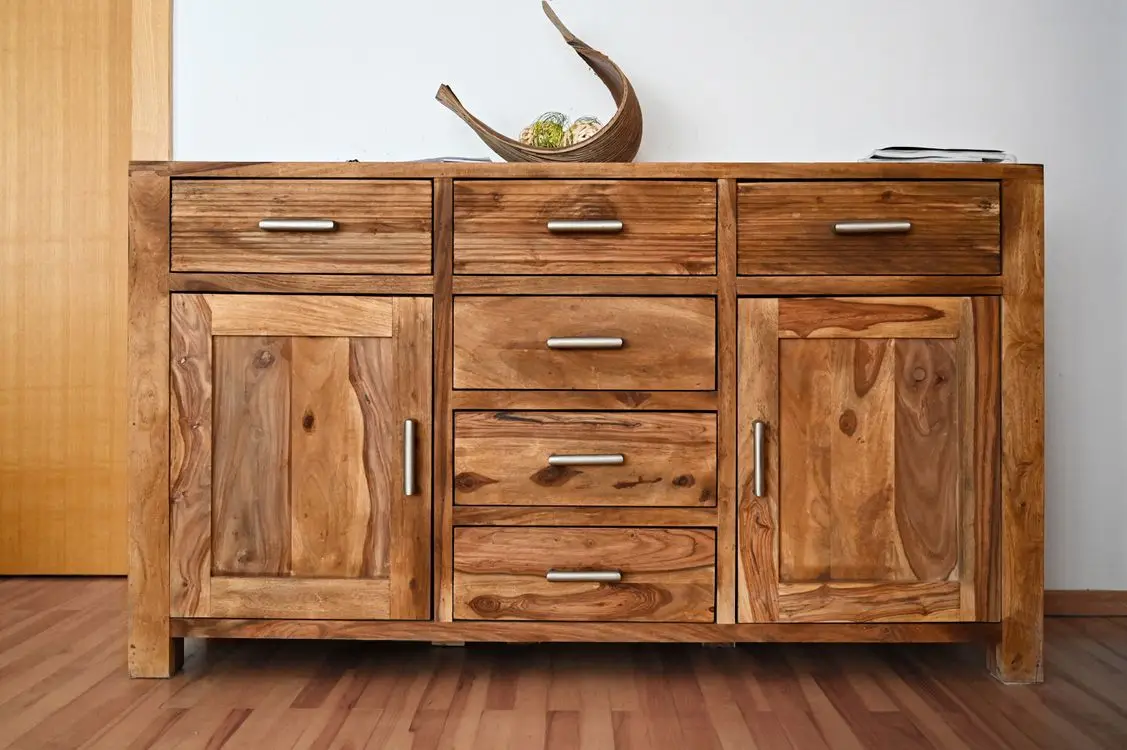
STURDY Act requirements do not care what you call the product. They care about three measurements: 27 inches tall, 30 pounds, 3.2 cubic feet of enclosed storage. Cross all three and your chest of drawers is a regulated product in the United States, whether the label says dresser, chest, bureau or storage cabinet.
That threshold catches a lot of furniture that was never designed with a tip-over test in mind — and it has been enforceable since September 2023.
STURDY Act requirements in one paragraph
The STURDY Act — Stop Tip-overs of Unstable, Risky Dressers on Youth — ordered the US Consumer Product Safety Commission to make a stability standard mandatory for clothing storage units. The CPSC did that by adopting ASTM F2057-23 into 16 CFR Part 1261. Under §1261.1(b), "all clothing storage units that are manufactured after September 1, 2023, are subject to the requirements of this part." The rule exists to protect children up to 72 months of age from tip-over death or injury, and it applies to units manufactured in the US and to units imported into it, equally.
The timeline: how a voluntary test became a federal rule
| Date | What happened |
|---|---|
| Before 2022 | ASTM F2057 exists as a voluntary consensus standard. Editions run -00, -04, -09, -09A, -09B, -14, -17, -19. Compliance is a buyer requirement, not a legal one. |
| 3 February 2022 | CPSC publishes its own proposed mandatory stability rule for clothing storage units. |
| 29 December 2022 | The STURDY Act is enacted as Division BB, Title II, section 201 of Public Law 117-328. It requires a mandatory standard using a 60-pound test weight and tests that simulate real-world use. |
| 1 February 2023 | ASTM approves F2057-23, rewritten to meet what STURDY asked for. |
| 19 April 2023 | CPSC votes 3-1 that ASTM F2057-23 meets the STURDY Act's requirements, and adopts it instead of the Commission's own rule. |
| 4 May 2023 | The direct final rule is published at 88 FR 28408, amending 16 CFR Part 1261. |
| 1 September 2023 | The rule takes effect. Units manufactured after this date must comply. |
| Today | ASTM F2057-23 is still the active edition. No newer edition has superseded it. |
The practical consequence for an exporter: under the STURDY Act requirements, date of manufacture is the trigger, not date of import and not date of sale. Stock manufactured before 1 September 2023 sits outside the rule; a repeat run of the same SKU made after it does not.
Where the rule stands today
The three numbers that put a unit in scope
ASTM F2057-23 defines a clothing storage unit as a freestanding furniture item with drawers and/or doors that may reasonably be expected to be used for storing clothing, and that meets all three attributes below.
| Attribute | Threshold | Note for metric factories |
|---|---|---|
| Height | 27 in. or greater | 686 mm, as a converted value |
| Mass | 30 lb or greater | 13.6 kg, as a converted value |
| Enclosed storage volume | 3.2 ft³ or greater | 90.6 dm³, as a converted value |
Named examples in the standard include chests, chests of drawers, drawer chests, armoires, chifferobes, bureaus, door chests and dressers. The list is explicitly not exhaustive, which is why arguing about product naming is a losing strategy — a buyer's compliance team measures.
The height threshold is the one that surprises people. Twenty-seven inches is low. A three-drawer chest that reads as a low nightstand-adjacent piece in a catalogue photo clears it easily, and the difference between "in scope" and "out" can be a plinth. If you are working out where your SKUs sit, the standard dresser dimensions reference shows how ordinary case-goods heights cluster against that line.
What is explicitly out of scope
The exclusions in §1.2 are as important as the inclusions, because they are where most supplier-buyer disputes start:
- Shelving units such as bookcases or entertainment furniture
- Office furniture
- Dining room furniture
- Jewelry armoires
- Underbed drawer storage units
- Occasional and accent furniture not intended for bedroom use
- Laundry storage and sorting units
- Built-in units intended to be permanently attached to the building
- Clothing storage chests as defined in ASTM F2598
"Not intended for bedroom use" is a claim about your own marketing, not a physical property. If your listing photographs the piece in a bedroom, styles it beside a bed, or the copy says bedroom, an exclusion argument built on intended use is weak. Decide which side of the line a SKU is on before the photography brief is written, not after a customs hold.
What the tests actually simulate
The STURDY Act specified that the standard must use objective, repeatable, measurable tests reflecting real-world use. In practice that means the unit is not tested standing empty on a flat lab floor:
| Test condition | What it represents |
|---|---|
| Unit placed on a test block that replicates carpet tilt | A bedroom floor, not a showroom slab |
| Drawers loaded at 8.5 lb per cubic foot (0.136 kg/dm³) | Drawers full of clothing |
| Multiple drawers open at once | How a child actually opens furniture |
| A 60 lb test weight applied | A child up to roughly six years old climbing |
| Separate strength test for units with interlocks | Drawer interlocks are a design answer, so they get their own test |
During testing, the unit must not tip over, and it must not end up supported only by an opened drawer, an opened door, or a flap. A sample that stays upright because a drawer front is resting on the floor has failed.
This is the single most common surprise for factories with an in-house stability jig: an empty unit on a hard floor passes almost anything. The rule's whole design is to remove those two conveniences.
The unit trap: inch-pound is the standard, metric is a courtesy
Section 1.4 of ASTM F2057-23 states that the values in inch-pound units are the standard, and that the SI values in parentheses are "mathematical conversions to SI units that are provided for information only and are not considered standard."
Read that again if your factory works in millimetres. A unit designed to exactly 686 mm is designed to the converted number, and 686 mm is 27.008 in — fine. But a unit designed to 685 mm sits at 26.97 in, which is under the threshold on the governing scale by 0.03 in. Betting a compliance position on the third decimal place of a conversion is a bad bet, and a buyer's lab will measure in inches.
The same asymmetry runs through your documentation. If the spec sheet, the carton marking and the listing all publish only metric, the person deciding whether the product is in scope has to convert — and their conversion is the one that counts. Publish both, on the same image, from the same measurement.
What comes next
Two things are worth watching rather than assuming.
First, edition drift. The STURDY Act requirements are pinned to a specific edition: CPSC incorporated ASTM F2057-23, approved 1 February 2023. When ASTM revises F2057, the revision is not automatically mandatory — the Commission has to act. Your compliance statement should name the edition, not just the standard number.
Second, enforcement. CPSC has continued to issue public warnings naming specific dressers sold online for violating the clothing storage unit regulation, which is the pattern to expect for imported case goods sold through marketplaces: the warning lands on the product listing, and the listing is what the buyer sees.
What the buyer will ask you to put in writing
Compliance testing is a lab's job. Presenting the result is yours, and it is the part that decides whether an inquiry converts. A US importer's compliance reviewer is usually working from your listing images and your spec sheet before anything else exists.
| Field | What to state | Where it should appear |
|---|---|---|
| Overall height | Assembled height in inches and millimetres | Spec sheet and spec image |
| Product mass | Net weight of the assembled unit, lb and kg | Spec sheet and carton marking |
| Enclosed storage volume | Total functional volume of enclosed storage, ft³ and dm³ | Spec sheet |
| Scope position | In scope of 16 CFR 1261, or the specific §1.2 exclusion relied on | Spec sheet |
| Standard and edition | ASTM F2057-23 | Spec sheet and test report cover |
| Test report | Issuing lab, report number, date, sample identification | Attached |
| Tip-over restraint | Restraint supplied with the unit, and its fixing detail | Spec sheet and assembly instructions |
| Date of manufacture | Because manufacture date is the legal trigger | Carton and unit marking |
Put the first three on the image, not only in the PDF. Height, weight and enclosed volume are the three numbers that decide the entire question, and they are dimensional facts — exactly the kind of thing a buyer expects to read off a diagram rather than dig for. Weight in particular travels badly in prose, which is why it belongs on the picture; the same argument applies when you label weight capacity on product images. The same discipline that keeps you out of arguments about wardrobe internal dimensions applies here, and a furniture spec diagram is the format that carries it.
Why this is a commercial issue, not only a legal one
The CPSC's 2023 tip-over report puts an estimated annual average of 17,800 emergency-department-treated tip-over injuries across 2020 to 2022, and counts 217 reported fatalities between 1 January 2013 and 31 July 2023. Chests, bureaus and dressers account for 36 percent of those deaths — 79 of 217 — and 81 percent of those 79 involved a child. There is an estimated annual average of 1,800 emergency-department-treated injuries to children involving chests, bureaus and dressers.
Those numbers are why a US buyer's legal team treats a dresser inquiry differently from a coffee table inquiry, and why "we can pass the test" answered with a paragraph of prose loses to a competitor who answers with a diagram and a report number.
Pre-shipment compliance checklist
- Assembled height measured in inches, against the 27 in. threshold, not converted from a rounded metric figure
- Net mass of the assembled unit checked against 30 lb
- Enclosed storage volume calculated and checked against 3.2 ft³
- Scope decision recorded: in scope, or the specific §1.2 exclusion being relied on
- Test report references ASTM F2057-23 by edition, not "ASTM F2057"
- Test sample matches the production configuration being shipped
- Tip-over restraint packed with every unit, with fixings suited to the declared wall types
- Date of manufacture marked, since manufacture date is the legal trigger
- Assembly instructions and warnings supplied in the language of the destination market
- Height, mass and enclosed volume published on the spec image, in both unit systems
FAQ
What are the STURDY Act requirements for a dresser?
A clothing storage unit manufactured after 1 September 2023 for the US market must comply with ASTM F2057-23, incorporated into 16 CFR Part 1261. In scope means all three of: 27 in. or greater in height, 30 lb or greater in mass, and 3.2 ft³ or greater of enclosed storage volume.
Does the STURDY Act apply to imported furniture?
Yes. 16 CFR §1261.1(b) covers any free-standing furniture item "manufactured in the United States or imported for use in the United States" that is intended for the storage of clothing. There is no exemption for imported goods, and the trigger is the date the unit was manufactured.
Is a bookcase covered by the clothing storage unit rule?
No. ASTM F2057-23 §1.2 excludes shelving units such as bookcases and entertainment furniture, along with office furniture, dining room furniture, jewelry armoires, underbed drawer storage, laundry storage and sorting units, built-in units, and occasional or accent furniture not intended for bedroom use.
How do I show a buyer that my unit is out of scope?
State the measured height, mass and enclosed storage volume, in inch-pound units first, and name the specific §1.2 exclusion you are relying on. Then put those three numbers on the product image itself so a reviewer can verify the claim without asking. That is a job for measured annotation — dimensions snapped to the real edges of the unit and exported at the size the buyer's system displays, rather than typed over the photo by eye or generated by an image tool that produces a plausible-looking number instead of the actual one. A wrong number on a compliance-relevant image is worse than no number.
Does ASTM F2057-23 replace older editions like F2057-19?
For US legal purposes, yes: the CPSC incorporated the -23 edition specifically, and it is currently the active edition. A test report against F2057-19 does not demonstrate compliance with 16 CFR Part 1261.
Sources & References
- 16 CFR Part 1261 — Safety Standard for Clothing Storage Units (eCFR)
- Federal Register — Safety Standard for Clothing Storage Units, 88 FR 28408 (4 May 2023)
- ASTM F2057-23 — Standard Safety Specification for Clothing Storage Units (scope and edition history)
- Public Law 117-328 — text including the STURDY Act (Division BB, Title II, section 201)
- CPSC — Product Instability or Tip-Over Injuries and Fatalities: 2023 Report (February 2024)
- SGS SafeGuardS 48/23 — CPSC adopts ASTM F2057-23 as mandatory, including the test conditions