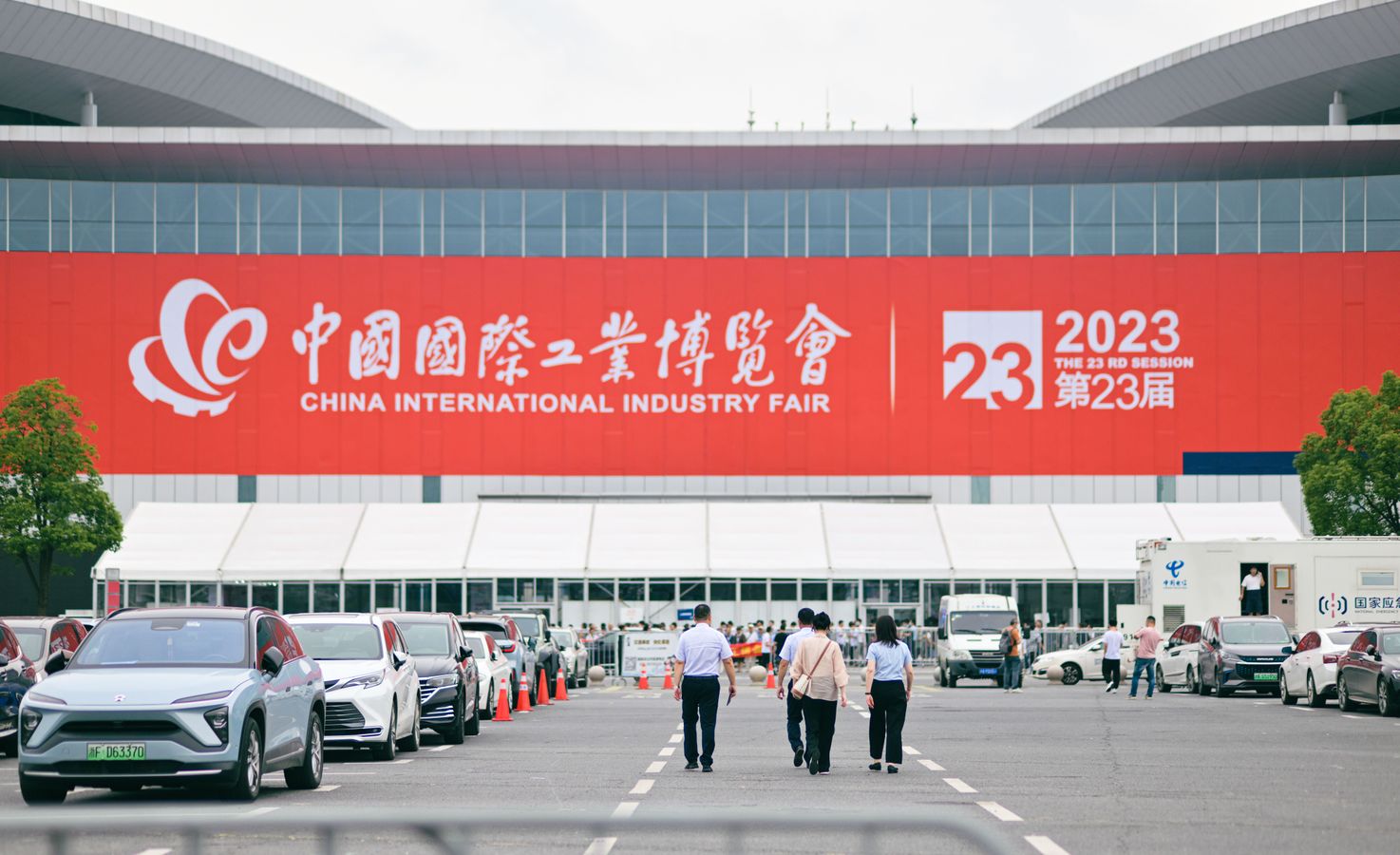
Trade show follow-up is not an email problem. It is a packet problem. Phase 2 of the 140th Canton Fair closed on 27 October 2026, and every furniture or building-material exhibitor who worked that hall now has roughly one working day before the buyers they met stop remembering faces and start comparing files.
Picture what the buyer carries away: two business cards, a photo of your label, and a note reading "vanity, stone top, 1200?" with no supplier name on it. By the time they land, that note sits in a folder with thirty-nine others. The supplier whose packet arrives first — model number in the subject line, size drawn on the photo — gets the next question. Everyone else gets silence and calls the lead cold.
What a trade show follow-up packet actually is
A trade show follow-up packet is a small, self-contained set of files sent within one working day of a booth conversation: one sheet per SKU you discussed, one image that shows the size, the three commercial numbers the buyer asked for, and one question that is easy to answer.
The word "small" is doing the work. A packet is not a catalogue and it is not a folder of everything you make. It is the ten minutes of your booth conversation rebuilt so the buyer can forward it to a colleague who was never there — a project manager, a fit-out contractor, an engineer on a phone in another time zone. If your file needs the buyer to explain it, the file failed.
Why the first day sets the shortlist
A buyer at a large fair runs a shortlist that only holds while the conversation is fresh. What you send in the next 24 hours decides whether the booth visit becomes a quotation or a photo nobody can identify three weeks later.
Harvard Business Review's 2011 study of online sales leads opened with a finding that reads like it was written about trade fairs: "most companies are not responding nearly fast enough." Be careful with the comparison: that study measured web enquiries, not booth conversations, and the multipliers quoted from it do not transfer to a fair where the buyer met you in person. The mechanism does — it is not really about speed, it is about who defines the terms of the comparison. The first complete answer becomes the reference the other eleven are judged against.
A buyer does not compare your product with your competitor's; they compare your packet with the eleven that arrived the same morning.
Three things make the packet win that comparison, and none of them is design taste:
- Re-attachment. A model number and a photo of the exact SKU restore the memory. A catalogue does not, because the buyer must find your product inside forty pages first.
- Decision readiness. The packet answers the question asked at the booth, not the one your brochure prefers. If they asked about the base width, the base width is on page one.
- Low friction. One question, answerable in a line, beats a paragraph ending with "looking forward to hearing from you."
The six items, in sending order
Send them in this order, in one message or one link. The sequence mirrors how attention moves: confirmation, specification, cost, next step.
| # |
Item |
Question it closes |
Format |
Practical ceiling |
| 1 |
Two-line recap |
"Which product was this?" |
Plain text in the message body |
40 words |
| 2 |
One product sheet per SKU |
"What exactly is it?" |
Link first, one-page PDF second |
1 page, under 2 MB |
| 3 |
One measured size image |
"Will it fit?" |
JPG or PNG with dimensions on the photo, mm and inches |
1,600 px long edge |
| 4 |
Commercial block |
"What does it cost to land?" |
Inside the sheet: MOQ, lead time, price basis, carton and CBM |
Five lines |
| 5 |
Range file, only if they asked |
"What else do you make?" |
Link to the catalogue, not an attachment |
No hard limit |
| 6 |
One question |
"What happens next?" |
A single sentence at the end |
25 words |
Two rules govern the whole table. One SKU per sheet, always — a sheet with three models in it is a catalogue page wearing a disguise; the one-product spec sheet layout is the format to copy. And the range file goes in only when the buyer asked for the range; slotting a 60-page catalogue into slot two is how a follow-up becomes homework.
If the buyer scanned a code at the booth instead of taking a card, the QR code product sheet for trade shows is the page your packet has to match, because that is where their first impression was formed.
The size image is the item that decides the reply
If you can only get one item right, get item 3 right. A size image is the only part of the packet that survives being forwarded three times inside the buyer's organisation, because it answers a question without words. Two jobs hide inside "showing the size", and most suppliers only do the easier one:
| What you show |
What it answers |
Where it belongs |
| Dimensions in a spec table |
The exact number, for comparison and for quoting |
The product sheet, item 2 |
| Dimensions drawn on the photo |
What the number looks like against the object |
The image, item 3 |
| A reference object at true scale |
"Is that bigger than my doorway?" |
The same image, if the buyer asked about fit |
The table number is copyable; the drawn number is understandable. A buyer forwarding your file to a fit-out team needs both, and the drawing is what prevents "can you confirm the depth again?"
The failure mode is mechanical. An arrow placed by eye lands a few millimetres off the true edge, and the number beside it stops describing the product. The fix is to stop drawing freehand: snap the measurement to the product edge, type the real value once, and export at the size the channel needs. A generated visual can style a scene; a dimension has to come from something you measured.
Keep the units boring. Millimetres primary, inches in the same line, one space between the number and the symbol — the convention NIST sets out for SI notation. A sheet that says 1200 mm with no conversion makes the buyer open a calculator, and the forward is the first thing you lose. A packet crossing into Germany or Indonesia should also follow the product dimension labels for export separator rules, not your local habit.
The message: 120 words and one question
The packet is the content; the message is the delivery mechanism. Keep it short enough to read on a lock screen.
Subject: VB-1220 stone-top vanity — Canton Fair booth 9.2C31
Hi [name] — when you stopped at the booth on 25 October you asked whether the VB-1220 counter is 1,200 mm at the top or at the base. Both are on the sheet: 1,200 mm at the top, 1,180 mm at the base, and the drawing shows where each line runs.
Two files: the one-page sheet with the size on the photo, and the carton and CBM numbers for a 40HQ.
MOQ is 30 cartons, lead time 25 days ex-works Foshan, price basis FOB Shenzhen.
Do you want the sealed sample in the same finish, or the two finish swatches first?
Five habits make it work, and each removes a way to postpone:
- The subject line carries the model number — the one string the buyer will search for a month from now.
- The first line re-anchors the date and the question they actually asked.
- Files are named for the SKU and the date, not "catalogue_final_v3".
- The commercial block sits in the message, not buried in the attachment; values the buyer can read without opening a file get used.
- It ends with a question that has two easy answers, not an open invitation to compose a reply.
Three touches, then stop
Most follow-ups fail by being a sequence of reminders. A reminder adds nothing except a fresh dose of the buyer's guilt. Each touch carries one new fact, and the sequence ends whether or not the buyer replies.
| Touch |
When |
What it adds |
What must not change |
| 1 |
Within 24 hours |
The packet and the closing question |
Nothing — this is the reference copy |
| 2 |
Plus two working days |
One new fact: packing data, a 20-second clip of the finish, or the sample lead time |
The model number, the units, the price basis |
| 3 |
Plus seven days |
The decision question: sample order, target price, or container mix |
The revision of the sheet |
| Stop |
After touch 3 |
— |
Do not send a fourth without a reply |
The last row is the one people ignore. A fourth message with no new information tells the buyer your address is safe to ignore. Reopen it when something genuinely changes — a new finish, a price movement, a production slot — not because eleven days passed.
What kills a packet before it is read
These show up every fair season. Each is cheap to fix and expensive to repeat.
| Failure |
What the buyer sees |
Fix |
| The full catalogue attached |
60 pages, no model number, no size on the images |
Send the one-page sheet; link the catalogue |
| Model number only in the attachment |
A subject line they cannot search later |
Put the model in the subject |
| Mixed units between message and sheet |
1,200 mm in the mail, 47 in on the drawing |
One primary unit, conversion in the same line |
| Arrows that do not touch the edges |
A number that describes nothing on the photo |
Measure on the image, do not estimate |
| A zip file |
A download prompt on a phone in an airport |
Individual files, or one link |
| No question at the end |
A message that needs a decision to reply to |
Ask one closed question |
| A sheet revised after the fair |
Two versions of the same SKU in circulation |
Date the file, keep one live revision |
File size belongs on that list too. Gmail caps attachments at 25 MB — enough for a one-page sheet, not enough for a photographed catalogue.
Pre-send checklist
Four minutes, before the first message leaves:
FAQ
How soon after a trade show should you follow up?
Within one working day, and the same day for a buyer who flew home overnight. The point is not speed for its own sake: your packet should arrive before the buyer finishes writing their own notes, so your model number becomes part of how they remember the conversation.
What should a trade show follow-up email include?
A recap of the SKU and the question asked at the booth, one product sheet, one image with the size drawn on it, the commercial numbers the buyer requested, and one closing question. Attach nothing they did not ask for, including the catalogue, unless the range itself was the topic.
Should you send the catalogue or a single product sheet?
Send the sheet first and link the catalogue. A catalogue is a menu for a range; a sheet is the dish the buyer already pointed at. If they explicitly asked to see the range, the catalogue goes in — still as a link, not a 60 MB attachment.
How many follow-ups are too many after a fair?
Three, and only if each carries a new fact. A fourth "just checking in" costs you the credibility the first three earned, because it shows you have nothing to add. If nothing new exists, wait for a price change, a new finish or a production slot, then reopen with that.
What if the buyer only left a WhatsApp number?
Send the same packet the same day; the channel changes, the packet does not. A chat message can carry the link and the question, with the sheet and the size image one tap away. What must not happen is the packet rebuilt as compressed screenshots, where the dimensions are the first thing to become unreadable.
Sources & References
- China Import and Export Fair (Canton Fair) — official site, 140th session exhibition dates, Phase 1 15-19 October, Phase 2 23-27 October, Phase 3 31 October - 4 November 2026
- Harvard Business Review, March 2011 — "The Short Life of Online Sales Leads" (Oldroyd, McElheran, Elkington), on response speed to online sales enquiries
- Google Workspace Help — Send attachments with Gmail, including the 25 MB attachment limit
- NIST Special Publication 811, Chapter 7 — rules for expressing values, including the space between a number and its unit symbol
Next steps
- Pick the three SKUs that produced the most booth questions this season and give each one a single page.
- Put the measured dimensions on the photo for those three, in millimetres with inches in the same line.
- Write the 120-word message once, as a template with the model number and the buyer's question as the only variables.
- Schedule touch 2 and touch 3 before you send touch 1, so the sequence ends by design rather than by fatigue.
If step 2 is the bottleneck — dimension lines landing off the edge, or a drawing that no longer matches the product — the fix is a workflow that carries the measured value onto the image instead of redrawing it by eye. That is the piece buyers forward, and the piece most suppliers still produce by hand.