
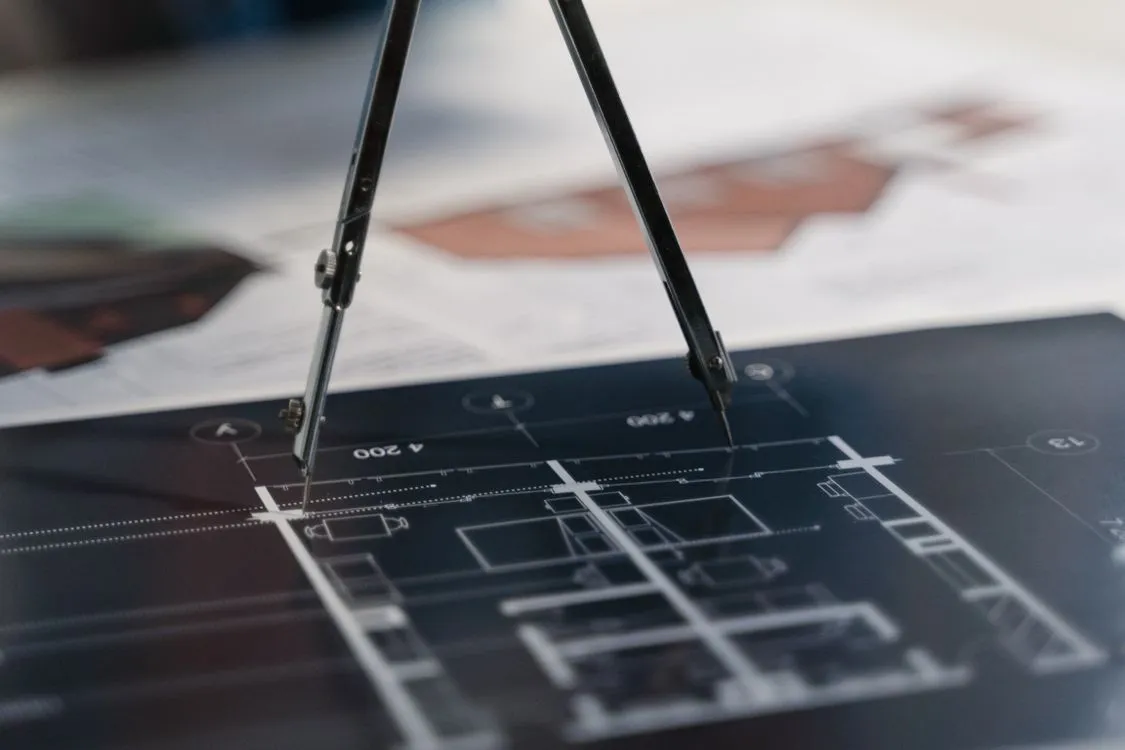
An overseas buyer emails asking for "the specs" on your dining table. You send a full CAD engineering drawing — tolerances, section views, GD&T symbols — and the buyer, who is a furniture retailer's purchasing manager, not a machinist, goes quiet. Or the reverse: you send three marketing photos and a price, and the buyer asks four follow-up questions because they still can't tell if it fits their container or their showroom. Both are the same mistake — sending the wrong document. Spec sheet vs technical drawing is a distinction most suppliers blur, and blurring it either overwhelms the buyer or underinforms them. Getting it right is the difference between a fast quote and a stalled thread.
A spec sheet and a technical drawing answer two different questions for two different readers. One helps a buyer decide to order; the other helps a factory build the part. Confuse them and you hand your buyer the wrong tool for their job.
Spec Sheet vs Technical Drawing: What's the Difference?
A technical drawing (also called an engineering drawing) is a manufacturing document: it specifies every dimension, tolerance, and geometric requirement needed to produce a part, using a formal graphical language defined by standards like ISO 128-1:2020 and ASME Y14.5. A spec sheet (product specification sheet) is a buyer-facing summary: it states the finished product's overall dimensions, materials, weight, packaging, capacity, and certifications so a buyer can evaluate and order it. The reader is the whole difference — a drafter reads the first, a purchasing manager reads the second.
| Technical drawing | Spec sheet | |
|---|---|---|
| Reader | Drafter, machinist, QC inspector | Buyer, purchasing manager, retailer |
| Purpose | Manufacture the part correctly | Decide whether to order |
| Governed by | ISO 128, ISO 129, ASME Y14.5 (GD&T) | No formal standard — clarity is the rule |
| Shows | Every dimension + tolerance, GD&T, section/detail views, surface finish symbols, material callout | Overall size, material, weight, finish options, packaging, MOQ, certifications |
| Precision | Toleranced to hundredths of a mm | Nominal outer dimensions buyers can act on |
| Needs training to read | Yes | No |
| Used during | Production, tooling, inspection | Sales inquiry, catalog, quotation |
The one-line test: if the reader needs drafting training to understand it, it's a technical drawing — and a sales inquiry is the wrong place to send one.
When Each One Matters
Neither document is "better." They serve different stages, and a professional supplier keeps both and sends the right one.
Send a technical drawing when the reader is going to make, tool, or inspect the part: your own factory floor, a subcontractor cutting metal, a QC team checking a sample against tolerances, or a buyer who is contract-manufacturing to your design and explicitly asks for the production drawing. Here, precision is the point — an under-toleranced drawing produces bad parts.
Send a spec sheet when the reader is deciding whether to buy: a distributor evaluating your catalog, a retailer checking whether the sofa clears their showroom door, a purchasing manager comparing your quote to a competitor's, a marketplace listing that has to communicate size at a glance. Here, decision-readiness is the point — an outer dimension the buyer can drop into a container-loading calculation beats a tolerance they don't know how to read.
Most inquiries — especially a first inquiry off Alibaba or at a trade fair — need the spec sheet. The technical drawing comes later, if at all, once the relationship moves to contract manufacturing. This is the same logic behind how to respond to an Alibaba RFQ: the buyer asking for a quote wants to evaluate, not to manufacture.
Common Confusion Points
"A spec sheet is just a simpler technical drawing"
No — it's a different document with a different job, not a dumbed-down drawing. A technical drawing that strips out tolerances is a bad technical drawing; a spec sheet was never trying to be one. The spec sheet's precision lives in the fields a buyer needs — packed dimensions, net and gross weight, material grade, carton coverage — not in geometric tolerancing.
"Buyers want the most detailed document I can send"
Buyers want the document they can act on. A retail purchasing manager who receives a 12-view GD&T drawing has to hunt for the one number they need — the overall height — and often just emails you to ask it. More detail aimed at the wrong reader is less useful, not more. The nominal outer dimensions the buyer can use beat the toleranced ones they can't; see nominal vs actual dimensions for why the number you present has to be the number the reader can use.
"A product photo with some measurements is a technical drawing"
It isn't, and that's a feature, not a shortcoming. A labeled product image — real dimensions marked on the actual photo of the finished product — is a buyer-facing spec diagram. It lives on the spec-sheet side of the line: it answers "how big is this and will it fit," not "how do I machine this." A spec diagram deliberately stops short of engineering drafting, because its reader is a buyer, not a machinist. Drawing that boundary clearly is what keeps a sales document readable.
What Overseas Buyers Actually Ask For
Across furniture, industrial, and building-material inquiries, the "specs" a buyer requests almost always mean the spec-sheet fields, not a production drawing:
- Overall dimensions (L × W × H) in mm and inches
- Net weight and gross (packed) weight
- Packed carton dimensions and how many fit a 20'/40' container
- Material and finish, with options
- Capacity or load rating where relevant
- Certifications (BSCI, FSC, CE, Reach, etc.)
- MOQ, carton pack quantity, and coverage where applicable
Notice what's not on that list: geometric tolerances, GD&T datums, section views. If a buyer genuinely needs those, they'll say "production drawing" or "manufacturing drawing" explicitly — and that request comes from an engineer, not a purchaser. The inspection stage has its own version of this; pre-shipment inspection dimension checks is where toleranced measurement actually earns its keep.
Next Steps
Once you can tell the two apart, the practical move is to build each properly:
- Build a reusable spec-sheet template with the buyer-facing fields above, so every inquiry gets a consistent, decision-ready document instead of an ad-hoc reply.
- Keep technical drawings in a separate library for production and QC, and send them only when the reader is manufacturing or inspecting — never as a first-inquiry attachment.
- Make a buyer-facing spec diagram for the sales side — the finished-product photo with real dimensions marked where the buyer looks. Real before/after results show the payoff: a furniture size-label case study traces how marking the dimensions on the image cut refunds. You can lay this out by hand in a photo editor, but hand-drawn arrows drift when the image is resized and the numbers rarely land at the right spot. A dimension annotation tool that snaps labels to the product's real edges and exports at each platform's spec size keeps the measured dimensions accurate and legible across your catalog, your marketplace listings, and a quick messaging-app quote — which is exactly what a first-inquiry document has to survive.
The tool is one option among several; the principle isn't optional. Match the document to the reader — spec sheet for the buyer deciding, technical drawing for the factory building — and the "can you send more info" threads mostly disappear.
FAQ
What is the difference between a spec sheet and a technical drawing?
A technical drawing is a manufacturing document that specifies every dimension, tolerance, and geometric requirement needed to build a part, governed by standards like ISO 128 and ASME Y14.5 and read by drafters and machinists. A spec sheet is a buyer-facing summary of a finished product's dimensions, materials, weight, packaging, and certifications, meant to help a buyer evaluate and order. The reader and purpose differ: one builds the part, the other sells it.
Does an overseas buyer need a technical drawing to place an order?
Usually no. Most sales inquiries need a spec sheet — overall dimensions, materials, weight, packed carton size, and certifications — so the buyer can evaluate and quote. A technical drawing is only needed when the buyer is contract-manufacturing to your design or inspecting samples against tolerances, and they'll ask for a "production drawing" explicitly when so.
Is a product image with dimensions a technical drawing?
No. A photo of the finished product with real measurements labeled on it is a buyer-facing spec diagram, which sits on the spec-sheet side of the line. It answers "how big is this and will it fit," not "how do I manufacture this," and it deliberately stops short of the geometric tolerancing that defines an engineering drawing.
Which standards govern technical drawings?
Technical drawings follow formal graphical standards: ISO 128 (general principles of representation), ISO 129 (dimensioning), and in the US, ASME Y14.5 for geometric dimensioning and tolerancing (GD&T) and ASME Y14.100 for engineering drawing practices. Spec sheets have no equivalent formal standard — their only rule is that a non-technical buyer can read and act on them.
Can one document serve as both?
Not well. A technical drawing overwhelms a buyer with tolerances they can't use; a spec sheet lacks the geometric detail a factory needs. Keep both and send the one that fits the reader — the buyer deciding whether to order gets the spec sheet, the factory or inspector gets the technical drawing.
Sources & References
- ISO 128-1:2020 — Technical product documentation (TPD): general principles of representation — defines the graphical language of technical drawings
- ASME Y14.5 — Dimensioning and Tolerancing (GD&T) — the US standard for geometric tolerancing on engineering drawings
- ASME Y14 series — Engineering drawing and documentation practices — the family of standards covering drawing format and content
- ISO 129-1:2018 — Technical product documentation: presentation of dimensions and tolerances — how dimensions are indicated on technical drawings