One gauge number means four thicknesses. Pick the metal first.
Mild steel (MSG): 3–30 gauge
16 gauge mild steel
Spread 0.32 mm — 25% of the thinnest.
| Gauge | Mild steel (MSG) | Galvanized | Stainless | Aluminium (B&S) |
|---|---|---|---|---|
| 10 | 3.416 mm | 3.510 mm | 3.571 mm | 2.588 mm |
| 11 | 3.038 mm | 3.134 mm | 3.175 mm | 2.304 mm |
| 12 | 2.657 mm | 2.753 mm | 2.779 mm | 2.052 mm |
| 14 | 1.897 mm | 1.994 mm | 1.984 mm | 1.628 mm |
| 16 | 1.519 mm | 1.613 mm | 1.588 mm | 1.291 mm |
| 18 | 1.214 mm | 1.311 mm | 1.270 mm | 1.024 mm |
| 20 | 0.912 mm | 1.006 mm | 0.953 mm | 0.813 mm |
| 22 | 0.759 mm | 0.853 mm | 0.795 mm | 0.643 mm |
| 24 | 0.607 mm | 0.701 mm | 0.635 mm | 0.511 mm |
| 26 | 0.455 mm | 0.551 mm | 0.475 mm | 0.404 mm |
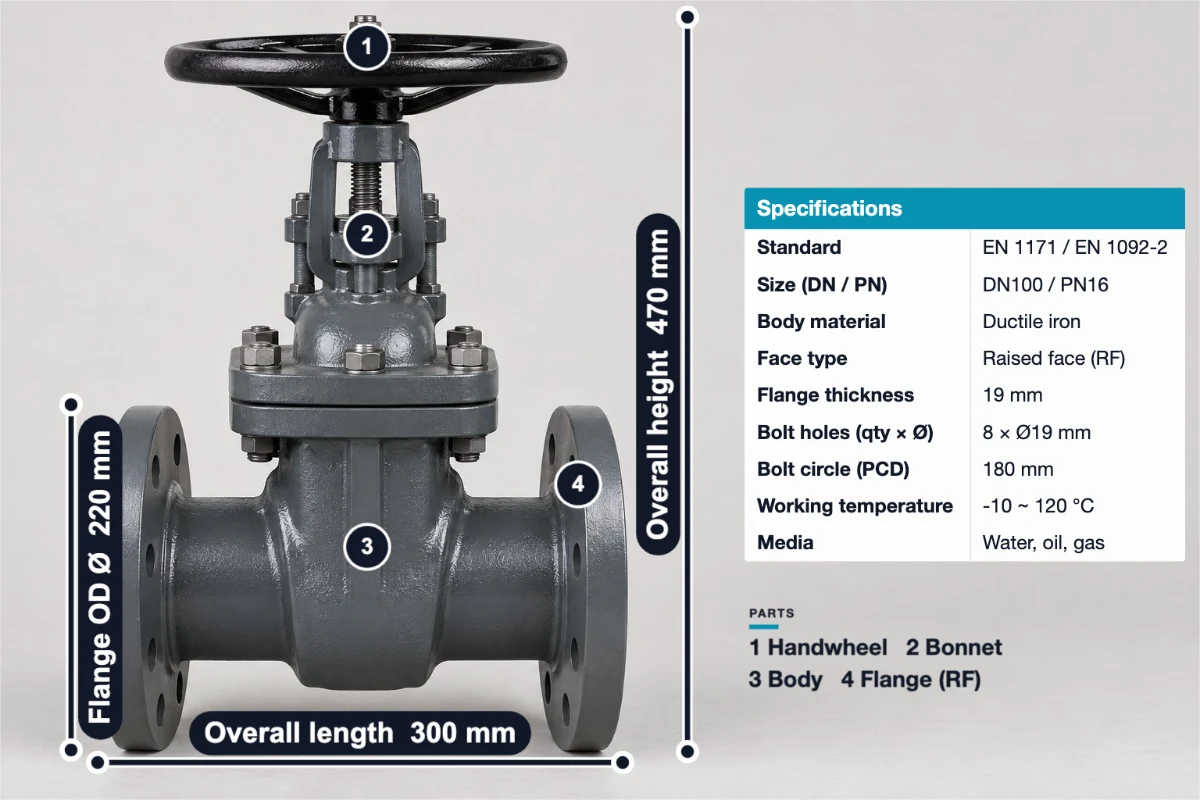
Thickness, tolerance and the standard behind it — marked on the part photo.
A gauge is an index, not a unit. Mild steel uses the Manufacturers' Standard Gauge, worked out from weight per square foot; galvanized sheet adds a zinc allowance of 0.0037 in (0.094 mm) to that weight table; stainless follows its own series; aluminium in North America is quoted on the Brown & Sharpe (AWG) series. So 16 gauge is 1.52 mm in mild steel, 1.61 mm galvanized, 1.59 mm stainless and 1.29 mm aluminium.
The higher the number, the thinner the sheet — and the series drift apart as the metal gets thicker. Between aluminium and galvanized the gap is 0.15 mm at 26 gauge and 0.92 mm at 10 gauge. Quote a buyer "10 gauge" without naming the metal and the part they cost may be a quarter thicker than the one you make.
Mild steel: Manufacturers' Standard Gauge, 41.82 lb per square foot per inch of thickness. Galvanized: the same weight table plus the zinc allowance. Stainless: the US Standard Gauge fractions. Aluminium: Brown & Sharpe, a geometric series built for wire drawing. Inch values follow the common published charts to four decimal places; millimetres are inches × 25.4.
For gauges 10–26 the millimetre values match our article sheet metal gauge to mm: one number, four thicknesses. Related: container loading calculator, volumetric weight calculator.
It depends on the metal: 1.52 mm (0.0598 in) for mild steel, 1.61 mm for galvanized, 1.59 mm for stainless and 1.29 mm for aluminium.
Thinner. 10 gauge mild steel is 3.42 mm; 26 gauge is 0.46 mm.
In mild steel, 1 mm is closest to 19 gauge (1.06 mm), 1.5 mm to 16 gauge (1.52 mm) and 2 mm to 14 gauge (1.90 mm). None is an exact match, which is why a quotation should state millimetres.
Galvanized sheet adds a zinc allowance of 0.0037 in to the steel weight table, and stainless uses its own gauge series. Same number, different thickness.
In North America aluminium sheet is usually quoted on the Brown & Sharpe (AWG) series, which gives thinner values than steel for the same number: 16 gauge aluminium is 1.29 mm.