How many cartons fit in a 20GP, 40GP and 40HQ — counted by space and by payload.
Upright cartons only turn on the floor.
Theoretical maximum from inside dimensions (Hapag-Lloyd, ISO 668). Pallets, dunnage and stacking limits lower real counts.
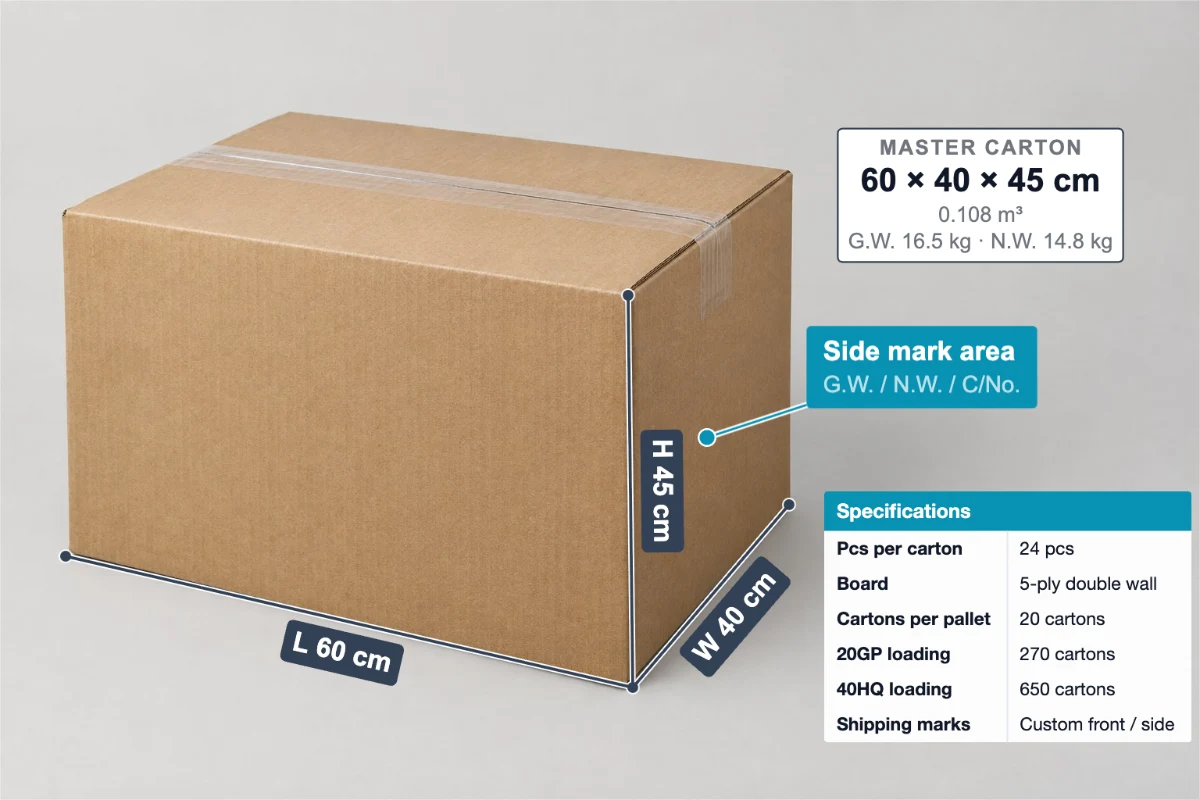
Carton size, gross weight and cartons per container — marked on the photo buyers already look at.
Each container is filled with cartons lying the same way. The calculator divides the container's inside length, width and height by the carton's three sides, rounds each down to whole cartons and multiplies. It tries all six ways a carton can lie — or only the two upright ones if the carton must stay upright — and keeps the one that fits most. A 50 × 40 × 30 cm carton in a 20GP (inside 5,900 × 2,352 × 2,393 mm) fits 14 × 4 × 7 = 392 cartons.
Payload then caps the count: maximum payload ÷ gross weight per carton. A 20GP carries about 30,200 kg, so 18 kg cartons would stop at 1,677 — far above 392, so space is the limit. At 40 kg per carton a 40GP is full by weight at 720 cartons while 840 would still fit. Whichever limit comes first is the answer.
| Container | Inside L × W × H | Inside volume | Max payload |
|---|---|---|---|
| 20GP (20ft standard) | 5,900 × 2,352 × 2,393 mm | 33.2 m³ | 30,200 kg |
| 40GP (40ft standard) | 12,032 × 2,352 × 2,395 mm | 67.7 m³ | 28,800 kg |
| 40HQ (40ft high cube) | 12,032 × 2,352 × 2,700 mm | 76.3 m³ | 28,650 kg |
Typical ISO 668 figures from the Hapag-Lloyd container specification — the same numbers as our shipping container dimensions page. Individual units vary by maker and floor type; check the CSC plate.
| Carton (cm) | Carton volume | 20GP | 40GP | 40HQ |
|---|---|---|---|---|
| 40 × 30 × 30 | 0.036 m³ | 686 | 1,470 | 1,890 |
| 50 × 40 × 30 | 0.060 m³ | 392 | 840 | 1,080 |
| 55 × 40 × 40 | 0.088 m³ | 280 | 600 | 720 |
| 60 × 40 × 40 | 0.096 m³ | 225 | 500 | 600 |
| 70 × 50 × 50 | 0.175 m³ | 132 | 288 | 360 |
| 80 × 60 × 60 | 0.288 m³ | 63 | 135 | 180 |
Same method as the calculator: one orientation per container, any side up, payload not applied. For heavy cartons, enter the gross weight above.
A buyer comparing quotes works out the landed cost per unit, and that starts with how many units ship in one container. Put the carton size, gross weight and cartons per 40HQ on the product photo or spec diagram and the question never comes up.
Related: volumetric weight calculator for air and express, shipping container dimensions, standard pallet sizes, standard carton box sizes.
It depends on the carton. With inside dimensions of 5,900 × 2,352 × 2,393 mm, a 50 × 40 × 30 cm carton fits 392 and a 60 × 40 × 40 cm carton fits 225. Heavy cartons can reach the 30,200 kg payload first — divide the payload by the gross weight per carton and take the smaller number.
A 40HQ is 12,032 × 2,352 × 2,700 mm inside. A 50 × 40 × 30 cm carton fits 1,080 (24 × 5 × 9) and a 60 × 40 × 40 cm carton fits 600. The payload is about 28,650 kg, so 50 × 40 × 30 cm cartons heavier than about 26.5 kg reach the weight limit before the container is full.
Forwarders often quote from a usable volume — commonly around 28 m³ for a 20GP and 68 m³ for a 40HQ — divided by the carton volume, which assumes cartons can be fitted around each other. The calculator only counts whole cartons stacked one way, so its number is one you can rely on; mixed loading may add a little.
The outer carton size as shipped, including any bulge. Containers are loaded with cartons, and a few millimetres per carton can remove a whole row.
Ship it as LCL (less than container load). Sea LCL is billed by W/M: one cubic metre counts as 1,000 kg and you pay for whichever is greater. Compare the LCL quote with a full 20GP once the shipment passes roughly 15 m³.