Express, air and sea LCL charge the greater of actual and volumetric weight.
Divisors vary by carrier and contract — check your rate card.
Charged by volumetric weight — the parcel is light for its size.
| Express | ÷ 5,000 | 24 kg |
|---|---|---|
| Air | ÷ 6,000 | 20 kg |
| Sea LCL | 1 m³ = 1,000 kg | 0.12 W/M |
Packed size, gross weight and pieces per carton — answered before the buyer asks.
Volumetric weight = length × width × height (cm) ÷ divisor, in kilograms. A 60 × 40 × 50 cm parcel is 120,000 cm³: ÷ 5,000 gives 24 kg for express, ÷ 6,000 gives 20 kg for air. If the parcel actually weighs 10 kg, express bills 24 kg.
Carriers bill whichever is greater — actual or volumetric weight. Light, bulky goods such as lamps, foam parts and textiles are billed on volume; dense goods such as hardware, tiles and motors on actual weight. In inches and pounds, express divides by 139 and air by 166 (in³/lb).
| Mode | Divisor | Equals | Typical use |
|---|---|---|---|
| Express | 5,000 cm³/kg · 139 in³/lb | 1 m³ = 200 kg | International express (DHL, FedEx, UPS) |
| Air | 6,000 cm³/kg · 166 in³/lb | 1 m³ ≈ 167 kg | Air cargo (IATA) |
| Sea LCL | 1 m³ = 1,000 kg (W/M) | — | Consolidated ocean freight |
Each carrier and contract sets its own divisor, and the same carrier may use different ones by service. Use these figures to estimate; your rate card decides. Source: gross, net and volumetric weight for export.
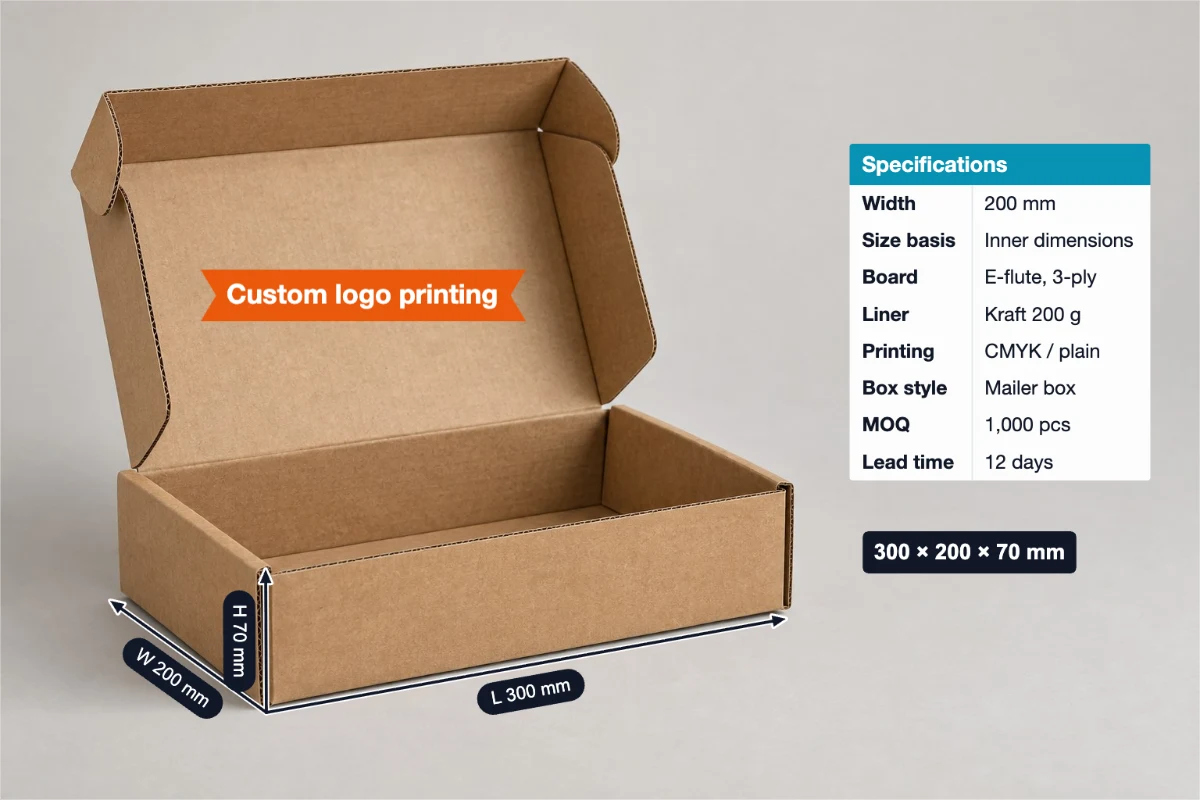
Before a buyer can price freight they need three numbers: packed size, gross weight and pieces per carton. Mark them on the product photo and the buyer can estimate shipping without another round of email.
Related: container loading calculator, standard carton box sizes, shipping container dimensions.
Multiply length × width × height in centimetres and divide by the carrier's divisor — usually 5,000 for express and 6,000 for air. A 60 × 40 × 50 cm parcel is 120,000 cm³, so 24 kg for express and 20 kg for air.
They are conventions of two different industries. 6,000 cm³/kg is the common IATA air cargo factor (1 m³ ≈ 167 kg); international express usually uses 5,000 cm³/kg (1 m³ = 200 kg), which charges bulky parcels more. Your carrier's rate card decides.
Whichever is greater. Bulky, light parcels are billed on volumetric weight; dense parcels on actual weight. The break-even density is 200 kg/m³ at ÷ 5,000 and about 167 kg/m³ at ÷ 6,000.
The packed size as shipped — carton, padding, corner guards and pallet included. That is what the carrier measures, and many round each side up before calculating.
CBM is the geometric volume in cubic metres, used for sea freight under the W/M rule (1 m³ counts as 1,000 kg). Volumetric weight converts volume into kilograms for air and express. Work the two out separately; they are not interchangeable.