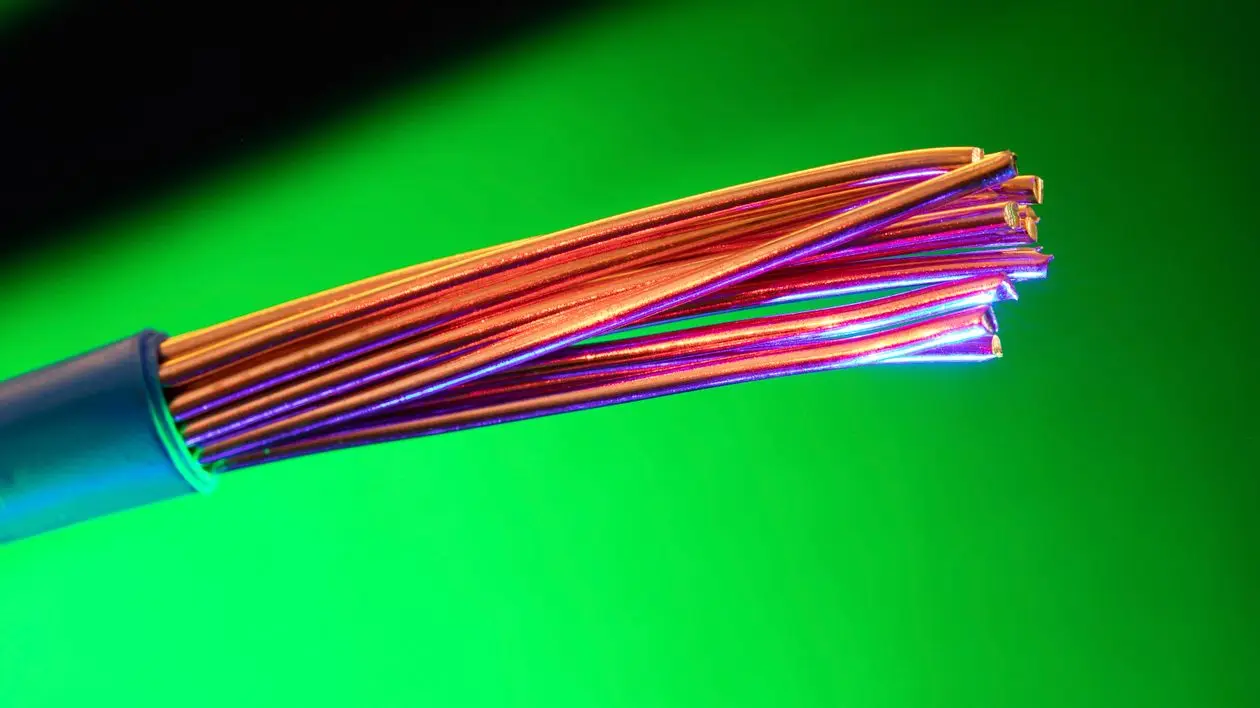
AWG vs mm² cable specifications are not a unit conversion. They are two independent sizing systems that happen to describe the same wire, and no AWG size is exactly equal to any metric nominal size. When your spec sheet says "14" and your buyer's engineer reads "2.5", the two of you may be about 20% apart in copper and neither of you has made a mistake.
Here is the whole comparison first, then what to do about it.
AWG to mm²: The Full Comparison
AWG is defined by conductor diameter. Metric sizing is defined by nominal cross-sectional area. That structural difference is why the numbers never land cleanly on each other.
| AWG |
Solid diameter (mm) |
True area (mm²) |
Nearest metric nominal |
Offset |
Actually sits between |
| 6 |
4.115 |
13.30 |
16 mm² |
+20.3% |
10 and 16 mm² |
| 8 |
3.264 |
8.37 |
10 mm² |
+19.5% |
6 and 10 mm² |
| 10 |
2.588 |
5.261 |
6 mm² |
+14.0% |
4 and 6 mm² |
| 12 |
2.053 |
3.309 |
4 mm² |
+20.9% |
2.5 and 4 mm² |
| 14 |
1.628 |
2.081 |
2.5 mm² |
+20.1% |
1.5 and 2.5 mm² |
| 16 |
1.291 |
1.309 |
1.5 mm² |
+14.6% |
1.0 and 1.5 mm² |
| 18 |
1.024 |
0.823 |
0.75 mm² |
−8.9% |
0.75 and 1.0 mm² |
| 20 |
0.812 |
0.518 |
0.5 mm² |
−3.4% |
0.5 and 0.75 mm² |
Read the "offset" column as the size of the misunderstanding. The nearest metric size to 14 AWG is 20% more copper than 14 AWG actually contains.
Areas above are for solid conductor and match the published tables from SAB Bröckskes and Eland Cables. A stranded conductor sold under the same AWG number has a different actual area.
To be precise rather than dramatic: the two systems are never exactly equal, but they are not always far apart either. 20 AWG is within 3.4% of 0.5 mm². The problem sizes are the ones in the middle of the table, where the gap runs to a fifth of the conductor.
Why the Two Systems Never Line Up
The definitions come from different places and measure different things.
AWG is specified by ASTM B258, "Standard Specification for Standard Nominal Diameters and Cross-Sectional Areas of AWG Sizes of Solid Round Wires Used as Electrical Conductors". It is a geometric progression of diameters — which is also why the gauge number runs backwards, with bigger numbers meaning thinner wire.
Metric conductor sizes come from IEC 60228, "Conductors of insulated cables", now in its 4th edition (2023). It "specifies the nominal cross-sectional areas, in the range 0,5 mm2 to 3 500 mm2, for conductors in electric power cables and cords." Those nominal sizes — 0.5, 0.75, 1.0, 1.5, 2.5, 4, 6, 10, 16, 25, 35, 50 mm² and up — are a chosen series, not a translation of anything.
As Eland Cables puts it, AWG "is dissimilar to the metric system which is based on wire cross sectional area (in square mm)." One system starts from how thick the wire is; the other starts from how much metal is in the cross-section. There is no reason for them to coincide, and they don't.
China's conductor standard, GB/T 3956, carries the same title as IEC 60228 — "Conductors of insulated cables" — and mirrors its scope and class numbering, so a Chinese supplier and an IEC-market buyer are usually working from the same nominal series.
The Substitution Chart Problem
Here is where real money goes missing. Because the two systems don't align, the industry papers over the gap with cross-reference charts that map each AWG size to the nearest commercial metric size. HELUKABEL publishes one that maps, among others:
| AWG |
Chart says |
True area |
| 14 |
2.5 mm² |
2.081 mm² |
| 12 |
4 mm² |
3.309 mm² |
| 10 |
6 mm² |
5.261 mm² |
| 8 |
10 mm² |
8.37 mm² |
These charts are legitimate and useful — for picking a stock size. They are not conversions, and the publisher says so. Printed on HELUKABEL's own chart is the line: "This cross reference list shows equivalent nominal values. Actual cross sections may vary."
So "14 AWG" can legitimately mean two different things depending on which document the reader has in front of them — 2.081 mm² if they compute the geometry, 2.5 mm² if they read a substitution table. That is the 20% gap, and it is entirely invisible in a spec sheet that writes only the bare number.
The fix is one line of discipline: never publish a bare gauge number. Write the system and the value together — "14 AWG (2.081 mm² nominal)" or "2.5 mm² per IEC 60228" — so nobody has to guess which table you were reading. The same discipline that keeps metric vs imperial fastener threads from being ordered wrong applies here, for the same reason: two systems, similar-looking numbers, no valid shortcut between them.
"2.5 mm²" Still Isn't a Complete Spec
Even inside the metric system, the area alone under-specifies the cable. IEC 60228 sorts conductors into classes by construction:
| Class |
Construction |
| Class 1 |
Solid conductors |
| Class 2 |
Stranded conductors |
| Class 5 |
Flexible copper conductors |
| Class 6 |
Extra-flexible copper conductors |
The classes are not marketing labels — they carry hard numbers. In the IEC 60228 class tables, the maximum diameter of the individual wires making up the conductor separates Class 5 from Class 6: at 1.5 and 2.5 mm², Class 5 allows 0.26 mm wires while Class 6 allows only 0.16 mm. That is what "extra-flexible" actually means in a checkable form.
And the class changes the electrical limit at the same nominal size. At 2.5 mm² plain copper, the maximum resistance at 20 °C is 7.41 Ω/km for Class 1 solid, but 7.98 Ω/km for Class 5 and 6 flexible. Same "2.5 mm²", different permitted resistance. A buyer who receives flexible where they specified solid has received a different product, and the spec line as written did not stop it.
Copper vs Aluminium at the Same Cross-Section
Aluminium at the same nominal area does not perform like copper, and IEC 60228's own resistance limits show it cleanly — no installation assumptions required:
| Nominal size |
Copper (Ω/km max) |
Aluminium (Ω/km max) |
| 10 mm² |
1.83 |
3.08 |
| 16 mm² |
1.15 |
1.91 |
| 25 mm² |
0.727 |
1.20 |
| 35 mm² |
0.524 |
0.868 |
| 50 mm² |
0.387 |
0.641 |
At equal cross-section, aluminium's permitted resistance runs roughly 1.65× copper's. If your quotation and your buyer's expectation differ on conductor material, the area matching does not save the order.
Why Nobody Can Give You a Straight Ampacity Number
Buyers ask "how many amps is this cable rated for?" and the honest answer is that the question is missing most of its inputs. Current-carrying capacity is not a property of the conductor size — it is a property of the conductor in an installation.
The clearest proof sits inside a single document. In the NEC ampacity tables, 10 AWG copper reads 30/35/40 A (at the 60/75/90 °C insulation columns) when run in a raceway, and 40/50/55 A for the same conductor in free air. Same copper, roughly a third more current, purely because of how it is installed. The in-raceway table also states its own conditions in its title — "Not More Than Three Current-Carrying Conductors" — and points to separate correction factors when ambient temperature differs from 30 °C or when more conductors are bundled.
The IEC side agrees on the principle. ABB's electrical installation handbook identifies IEC 60364-5-52 as the governing standard and lays out the dependency chain: a base current at a reference ambient, then correction factors for ambient temperature, for cables "installed bunched or in layers," for insulation type (PVC and XLPE/EPR get different correction tables), and for buried runs, for soil thermal resistivity against a reference of 2.5 K·m/W.
That is five independent variables before a number means anything. Which is why a responsible spec sheet states the conductor, the insulation and its temperature rating, and the standard — and leaves circuit sizing to the buyer's own qualified engineer under their local code. A published "X mm² = Y amps" figure stripped of its conditions is not a helpful simplification; it is a liability. Code editions drift too — the same NEC table number has carried different titles and different values across editions, so any code figure needs its edition named or it should not be quoted at all.
Reading a Harmonized Cable Code
European buyers will quote codes like H05VV-F 3G0.75, and suppliers routinely misattribute the system. The cable requirements live in EN 50525; the designation system comes from harmonisation document HD 361, as Interpower's coding chart states on its face and Eland confirms.
Decoding H05VV-F 3G0.75:
| Field |
Code |
Meaning |
| Type |
H |
Harmonized |
| Voltage rating |
05 |
300/500 V |
| Insulation |
V |
PVC |
| Sheath |
V |
PVC |
| Conductor construction |
-F |
Fine wire, flexible conductor of a flexible cable or cord |
| Cores |
3G |
3 cores, green/yellow earth core included |
| Size |
0.75 |
Nominal cross-section in mm² |
Note the last row: the harmonized code's size field is the IEC 60228 nominal area. The systems interlock rather than compete.
One cable can carry several codings at once. A LAPP catalogue page lists a single product as "60227 IEC 02(RV) / H07V-K", rated 450/750 V — an IEC type number, a Chinese-market designation, and a European harmonized code describing one physical cable. If your buyer quotes a code you don't recognise, it is often your own product under a different market's naming.
What a Complete Cable Spec Line Looks Like
Everything above collapses into one habit: state the system, not just the number.
Get the Spec Onto the Product Image
A cable spec sheet has a specific failure mode: it is a wall of codes, and the buyer is looking at a photograph of a reel. Nothing in the photo tells them which of your eight similar-looking products it is.
The practical fix is to label the image itself — the conductor size with its system, the class, the core count and the voltage rating placed against the actual cable in the photo, and the overall diameter marked as a measured value rather than a rounded guess. Overall diameter matters commercially, because it drives the buyer's conduit and gland sizing, and it varies with construction rather than following from the conductor area.
That last point is where measurement discipline earns its keep. Marking a diameter by eye, or letting an AI image tool generate a plausible-looking callout, produces a number that reads fine and is wrong — and on a spec diagram a wrong number is worse than a missing one, because the buyer will order against it. Snapping the measurement to the real edge of the product in the photo, then exporting at the size your buyer's platform or catalogue expects, keeps the number on the image and the number in the contract the same number. The same distinction between a stated size and a measured one runs through nominal vs actual dimensions across every material category.
FAQ
What is the difference between AWG and mm² for cable?
AWG sizes conductors by diameter under ASTM B258; mm² sizes them by nominal cross-sectional area under IEC 60228. They are separate systems, so no AWG size equals a metric nominal size exactly. 14 AWG is 2.081 mm², while 2.5 mm² is a distinct nominal size sitting between 14 and 13 AWG — about 20% more copper.
Can I just convert AWG to mm² with a chart?
Only if you know what the chart is doing. Manufacturer cross-reference charts map each AWG size to the nearest stock metric size — HELUKABEL's maps 14 AWG to 2.5 mm² — and carry the caveat "Actual cross sections may vary." That is a substitution recommendation, not a conversion. If you need the true area, use the geometric value; if you need a stock size, use the chart, and say which one you used.
How many amps can 2.5 mm² cable carry?
There is no single answer, and any source giving you one has dropped the conditions. Ampacity depends on installation method, ambient temperature, how many current-carrying conductors are grouped together, the insulation's temperature rating, and for buried cable the soil's thermal resistivity. The same 10 AWG copper conductor is rated 30 A in a raceway and 40 A in free air at the 60 °C column of the same NEC table. State your conductor, insulation and standard on the spec sheet, and let the buyer's qualified engineer size the circuit under their local code.
What does conductor class mean on a cable spec?
It describes construction, not size. IEC 60228 Class 1 is solid, Class 2 stranded, Class 5 flexible and Class 6 extra-flexible — distinguished by the maximum diameter of the individual wires (at 2.5 mm², 0.26 mm for Class 5 versus 0.16 mm for Class 6). Class also changes the permitted resistance: 2.5 mm² copper is capped at 7.41 Ω/km solid but 7.98 Ω/km flexible. Omitting the class means the buyer can receive a physically different cable that still matches your spec line.
How should I label cable specifications on a product photo?
Put the numbers a buyer decides on directly onto the image: conductor size with its system named, conductor class, core count, voltage rating, and the overall diameter as a measured value. Marking these on the photo with measurements taken from the product's real edges — rather than estimated, or generated by an image tool that invents plausible figures — means the buyer reads the same number your contract states. That is what turns a reel photograph into something they can order from without a follow-up email. If spec mismatches are already causing rejected shipments, the return cost calculator will size what one round-trip costs against the order's margin.
Sources & References