
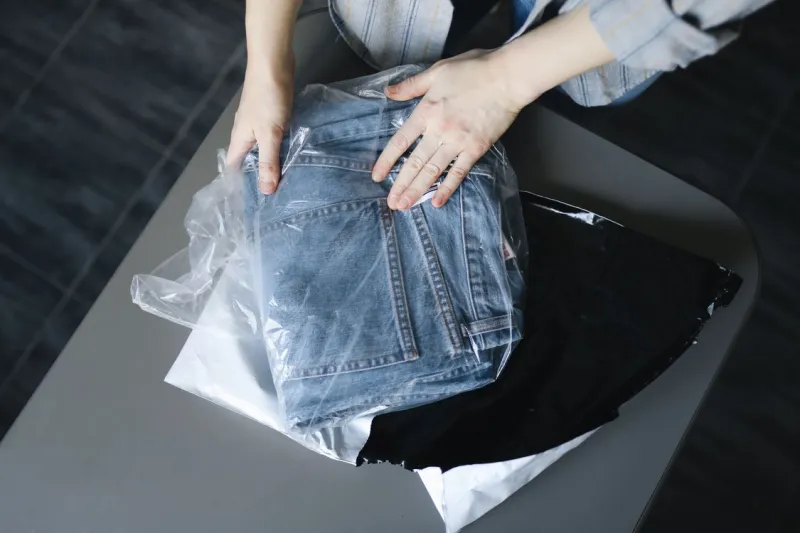
A poly mailer labelled 10 x 13 does not hand you 10 by 13 inches of room. On most bags that second number runs to the tip of the adhesive flap, so the usable length is closer to 11 inches — and because suppliers disagree about whether the flap belongs in the measurement at all, two bags wearing the same label can be two different sizes. You find out when a folded hoodie will not seal, or when the postage steps up a tier on a bag that weighs almost nothing.
How to measure a poly mailer is a three-step method, not a tape-measure habit: measure the product in its packed state, run the fit formula, then confirm which convention the bag in your hand follows. Do that once per product and you stop over-ordering sizes, stop paying to ship trapped air, and stop explaining to a buyer why the "large" mailer arrived looking half empty.
What the printed poly mailer size actually means
A poly mailer is specified as width × length in inches, and the two numbers are not taken the same way. This is the definition most sizing mistakes come from: the printed size describes the film, not the space inside it.
- Width is the seam-to-seam measurement across the opening, taken flat. The side seams take roughly a quarter inch per side, but in practice the stated width is the width you can use.
- Length is the bottom seam to the top of the bag. Whether "top" means the fold line where the flap begins, or the outer tip of the flap itself, depends on the supplier — a 1.5 to 2 inch difference on an identical label.
- The adhesive flap folds over to seal and is not interior space. A 10 × 13 mailer typically leaves 11 to 11.5 inches of usable interior length, not 13.
Here is the same label translated into the number you can actually pack against:
| Printed size | Printed length | Flap | Usable interior length |
|---|---|---|---|
| 6 × 9 in | 9 in | 1.5–2 in | ~7 in |
| 7.5 × 10.5 in | 10.5 in | 1.5–2 in | ~8.5 in |
| 9 × 12 in | 12 in | 1.5–2 in | ~10 in |
| 10 × 13 in | 13 in | 1.5–2 in | ~11 in |
| 12 × 15.5 in | 15.5 in | 1.5–2 in | ~13.5 in |
| 14.5 × 19 in | 19 in | 1.5–2 in | ~17 in |
That table is the whole article in miniature: the usable length is the printed length minus about two inches. One published measuring guide states it flatly — the stated length includes the adhesive flap, and a 10 × 13 mailer has roughly 11 to 11.5 inches of usable internal length. Another size reference says the opposite, that the number describes the usable pouch with the lip beyond it. Both are describing real bags. The convention is not standardised across the industry, so confirm it in writing with the supplier you are buying from. Two suppliers, one label, two sizes.
How to measure a poly mailer: the 3-step method
The method below works whether you are buying stock bags or ordering custom-printed ones, and it takes about a minute per product once the fold is fixed.
Step 1: measure the product packed, not as it sits on the shelf
Measure the item in the exact configuration it will be in when it goes into the bag. A folded T-shirt and a hanging T-shirt are different objects. A stacked three-item order is not three separate items.
Take three numbers:
- Length (L): the longest dimension of the packed item lying flat
- Width (W): the shorter horizontal dimension, perpendicular to the length
- Thickness (T): how tall the item stands when lying flat — a quarter inch for a folded tee, 1.5 to 2 inches for a hoodie, 3 inches or more for a stacked order
Write them down. Eyeballing these three numbers is the single most common cause of ordering the wrong bag.
Step 2: apply the fit formula
The formula converts a three-dimensional product into the flat bag it needs, allowing for the item pushing out on both sides once it is inside:
- Minimum mailer width = product width (W) + product thickness (T) + 1 inch
- Minimum mailer length = product length (L) + product thickness (T) + 2 inches
The extra inch on the width keeps the item off both seams; the extra two inches on the length covers the flap and leaves slack to load and seal without strain.
Step 3: match to a standard size, and round up
Pick the nearest standard size that meets or exceeds both minimums. When the two candidates are close, go up, not down.
| Product (packed) | Min width | Min length | Size that fits |
|---|---|---|---|
| Folded adult T-shirt — 9 × 12 × 0.5 in | 10.5 in | 14.5 in | 12 × 15.5 in (a 10 × 13 works for one standard tee, since film stretches) |
| Folded hoodie — 11 × 13 × 2 in | 14 in | 17 in | 14.5 × 19 in |
| Paperback — 8.5 × 11 × 0.1 in | 9.6 in | 13.1 in | 10 × 13 in |
Two habits make the difference between a size decision that holds and one you revisit in six months: size against your heaviest routine order, not the average one, and include the inserts — the card, the tissue, the returns slip.
For the full stock range in one place, including the bubble-mailer numbered scale, see standard poly mailer sizes.
Poly mailer mil thickness: match the wall to the contents
Thickness is the third measurement, and the one buyers forget. One mil is one thousandth of an inch, and puncture resistance rises with it — a sharp corner is far more likely to punch through 2 mil film than 2.5 mil.
| Thickness | Use it for |
|---|---|
| 1.7–2.0 mil | Folded apparel and soft goods with no sharp edges |
| 2.5 mil | General apparel and mixed soft goods — the industry default |
| 3.0–3.5 mil | Shoes, boxed cosmetics, garments with hangers or rigid inserts |
| 4.0+ mil | Hardware, multi-item shipments over 2 lb, repeated handling |
Myth to drop: several packaging retailers advertise a USPS minimum by weight — "2 mil up to 5 lb, 4 mil above that." That figure traces to an older USPS mailability standard, not to the price list that sets Ground Advantage pricing and eligibility. Notice 123 ties rates to size and weight, not film thickness. Choose the mil for what is inside the bag.
Why the measurement now decides the rate: USPS from 12 July 2026
On 12 July 2026 USPS revised the domestic competitive-products standards, and two of the changes land directly on the numbers you just measured.
Dimensional weight changed divisor. For parcels over 1 cubic foot (1,728 cubic inches), postage is the greater of actual weight or dimensional weight — and the divisor dropped from 166 to 139. USPS also now rounds each dimension up to the nearest whole inch, so a mailer that measures 10.2 × 13.4 in is priced as 11 × 14 in.
Nonstandard length fees stack on the length you measured. Retail amounts from the current price list:
| Trigger | Priority Mail / Priority Mail Express | USPS Ground Advantage |
|---|---|---|
| Length over 22 in, up to 30 in | +$4.50 | +$4.50 |
| Length over 30 in | +$21.00 | +$10.00 |
| Volume over 2 cu ft (3,456 in³) | +$35.00 | +$21.00 |
A 19 × 24 in mailer is 24 inches long, so it collects $4.50 on every piece. A 14.5 × 19 in mailer is 19 inches long and pays nothing extra. Same product inside; one size band apart.
Soft-pack cubic tiers are measured by length plus width. If you qualify for USPS Ground Advantage Commercial Cubic, soft packs and padded envelopes are priced in five tiers based on length plus width — cut from ten tiers on the same July date. Eligibility now allows a longest dimension up to 22 inches, raised from 18.
| Length + width | Cubic tier |
|---|---|
| 0 to 21 in | 0.10 |
| over 21 to 27 in | 0.20 |
| over 27 to 31 in | 0.30 |
| over 31 to 34 in | 0.40 |
| over 34 to 36 in | 0.50 |
| Mailer | Length + width | Tier |
|---|---|---|
| 6 × 9 in | 15 in | 0.10 |
| 9 × 12 in | 21 in | 0.10 |
| 10 × 13 in | 23 in | 0.20 |
| 12 × 15.5 in | 27.5 in | 0.30 |
| 14.5 × 19 in | 33.5 in | 0.40 |
| 19 × 24 in | 43 in | Outside the cubic tiers — priced normally |
The 9 × 12 and the 10 × 13 look like neighbours on the shelf. One sits in the bottom cubic tier and the other does not, and that gap is the entire reason measuring beats eyeballing.
Poly mailer dimensional weight: why it rarely applies to you
Here is the honest answer, and it is the opposite of what most carrier advice implies: dimensional weight almost never bites a poly mailer. The rules are written for boxes.
Run the arithmetic. A 10 × 13 mailer packed to half an inch is 65 cubic inches — nowhere near the 1,728 cubic inch threshold where USPS switches to dimensional weight. Even a stuffed 19 × 24 mailer at 2 inches thick is 912 cubic inches, still under the line. To reach 1,728 cubic inches in a flat bag you would need something like 19 × 24 × 4 inches, which is a parcel that should be in a box — and a carton is judged on its own outer numbers, which is why master carton dimensions are quoted separately from the product inside.
So for poly mailers the fee that actually bites is the length fee, not the weight calculation — and the same flatness is why a mailer beats a box on cost. The one exception is the soft-sided packaging surcharge: UPS and FedEx have applied additional-handling triggers to soft-sided and unencased packaging since January 2026, and the trigger list now includes cubic volume as well as length. A standard mailer stays well under those lines; an overstuffed one can cross them, and the fee is not small. The full trigger table, carrier by carrier, is in additional handling surcharge dimensions.
The measurement block to put on the mailer spec
Every number above is a property of the packed bag, so it belongs on the spec sheet and on the image the buyer looks at — not in a spreadsheet cell nobody re-reads. A packing bench and an overseas buyer should be reading the same figures without re-measuring anything.
That is where a measured spec diagram does work a typed number cannot. Snapping dimension lines to the real edges of the mailer locks the actual measured size onto the photo, so the printed width, the printed length and the usable interior length sit on the same image at once, exported at the size the listing or spec sheet expects. The distinction that matters is measured versus invented: an AI-restyled product photo can produce a plausible-looking number, but it cannot measure the bag, and a number that does not match the film is worse than no number at all. Dimension lines anchored to the edges of the actual object are what make the figure survive a resize, a zoom and a warehouse tape measure.
The measurement block to specify, whichever tool you use:
| Field | What it must say |
|---|---|
| Printed size | width × length, as the supplier states it |
| Measuring convention | flap included, or usable pouch |
| Usable interior length | printed length minus the flap |
| Usable interior width | stated width, seams excluded |
| Film thickness | mil, plus mono-layer or co-extruded |
| Packed product envelope | the largest L × W × T the bag accepts |
Pre-order checklist
- Measure the product packed and folded the way the packer will actually fold it
- Record L, W and T — thickness is not optional
- Min width = W + T + 1 in; min length = L + T + 2 in
- Match to the nearest standard size at or above both, and round up
- Subtract the flap: usable length ≈ printed length − 2 in
- Ask the supplier, in writing, whether their size includes the flap
- Check the printed length against 22 in and 30 in before committing to a large size
- Check length + width against the cubic tiers if you ship Ground Advantage Cubic
- Pick the mil for the contents, not for a carrier rule
- Put all four numbers on the mailer spec image
FAQ
How do I know what size poly mailer I need?
Measure the packed product's length, width and thickness, then apply the fit formula: minimum mailer width = width + thickness + 1 inch, and minimum mailer length = length + thickness + 2 inches. Choose the nearest standard size that meets or exceeds both numbers, and size up when the result lands between two sizes.
Does the stated poly mailer size include the adhesive flap?
It depends on the supplier, and that is the problem. One published guide states that the second number includes the flap and that a 10 × 13 mailer has roughly 11 to 11.5 inches of usable length; another size reference states that the number describes the usable pouch with the lip beyond it. Confirm the convention on the quotation, or measure the bag from the bottom seam to the fold line.
What size poly mailer fits a T-shirt?
A single folded adult T-shirt fits a 9 × 12 or 10 × 13 inch mailer, and a 10 × 13 will take up to about five folded shirts if you accept some stretch in the film. Heavier garments — a folded hoodie at roughly 11 × 13 × 2 inches — need a 14.5 × 19 inch mailer once the thickness is added in.
What mil thickness should a poly mailer be?
2.5 mil is the working default for clothing and mixed soft goods. Drop to 2 mil only for flat, light items with no sharp edges, and move up to 3 to 3.5 mil for shoes, boxed cosmetics, hangers or rigid inserts. Above 4 mil is for hardware and multi-item parcels over 2 lb.
Why is my 10x13 poly mailer too small?
Because 13 inches is the length of the film, not the room inside it. Once the adhesive flap is accounted for, a 10 × 13 mailer gives you roughly 11 to 11.5 inches of usable interior length, and a product packed to 12 inches long plus any thickness will not seal cleanly. Size the bag against usable length, or step up to 12 × 15.5 inches.
Does USPS charge more for a large poly mailer?
Sometimes, and by length rather than weight. Since 12 July 2026 a retail parcel over 22 inches but not over 30 inches long adds $4.50, and over 30 inches adds $10.00 on Ground Advantage or $21.00 on Priority Mail. Dimensional weight needs a parcel over 1,728 cubic inches — a threshold a flat poly mailer essentially never reaches.
Next steps
Three moves, in order of payoff:
- Re-measure your three heaviest routine orders in their packed state, including inserts, and run them through the formula. Most catalogues collapse into two or three bag sizes once this is done.
- Confirm the flap convention in writing with your current supplier, then sample the two candidate sizes and test them with your own packers at pace — a desk fold and a bench fold are different sizes.
- Lock the measured numbers onto the mailer spec image, so the width, the printed length and the usable interior length travel with the photo instead of living in an email thread. A tool that snaps dimension lines to the real edges and exports at the size your listing or spec sheet expects will do this in a couple of minutes; a hand-drawn arrow over a photo will not survive the next resize.
Sources & References
- USPS Notice 123 — Price List, effective 12 July 2026 — nonstandard length and volume fee amounts, the 1,728 cubic inch dimensional weight threshold, and the change of the DIM factor to 139.
- USPS Postal Bulletin 22705 — DMM revision: domestic competitive products pricing and mailing standards changes — the DIM factor change, rounding dimensions up to the nearest whole inch, and the Ground Advantage Cubic soft-pack tier and 22 inch maximum-dimension changes.
- Plus Packaging — How to measure a poly mailer for shipping — the width + thickness + 1 inch / length + thickness + 2 inch fit formula, and the roughly two inch flap allowance used in the usable-length table.
- Shippo — Poly mailer sizes, mil thickness, and carrier rules — mil-thickness bands by contents, and the note that the "2 mil up to 5 lb" figure comes from an older USPS mailability standard rather than Notice 123.
- The Poly Mailers — poly mailer size reference — the statement that flap-versus-usable measurement conventions differ between suppliers, and the size-to-contents fit table.
- UPS — current surcharges and FedEx — additional shipping fees — the additional-handling triggers that apply to soft-sided packaging.