
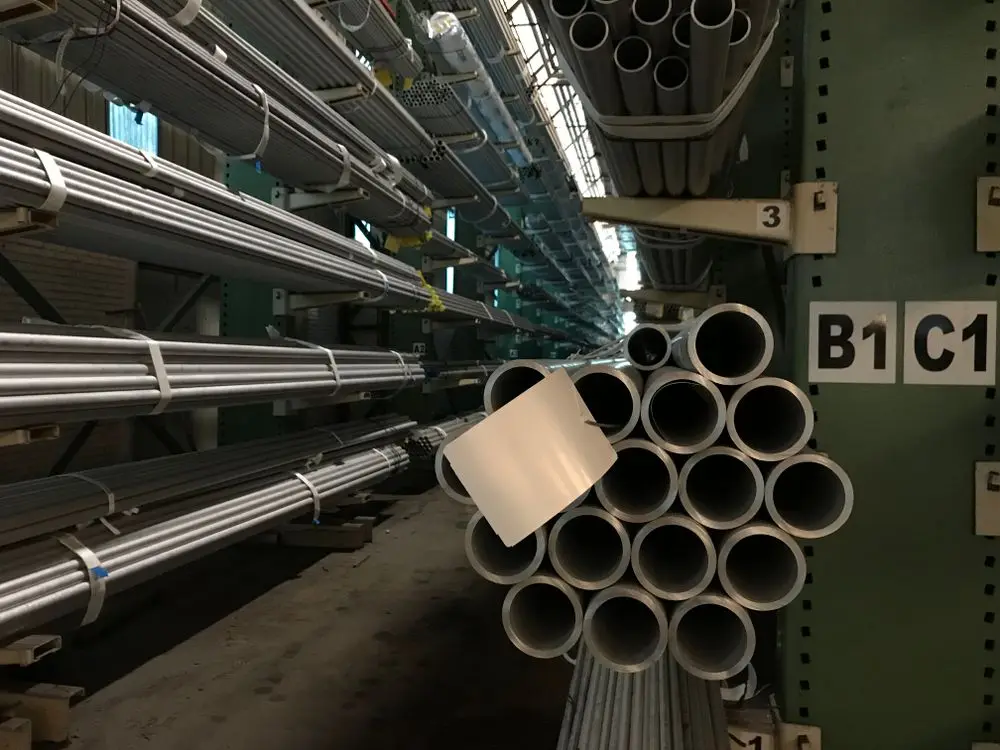
Schedule 40 vs schedule 80 pipe is a comparison that looks settled and isn't. At NPS 2 both are 2.375 inches outside diameter, both take the same thread, and both sit on the same line of your quotation — yet one carries about 14% more flow area and one weighs about 37% more per foot. The only thing that changed is the wall. Quote the schedule without confirming which one the buyer meant, and the error surfaces after the container lands, not before.
This is a working reference for the two schedules that show up on most industrial and export orders, in the sizes buyers actually ask about: NPS 1/2 through NPS 8. Every dimension below is taken from ASME B36.10M, the standard that defines wrought steel pipe.
Schedule 40 vs Schedule 80 pipe: every number side by side
| NPS (DN) | Outside diameter in (mm) | Sch 40 wall in (mm) | Sch 40 bore in (mm) | Sch 80 wall in (mm) | Sch 80 bore in (mm) | Flow area, Sch 40 vs Sch 80 |
|---|---|---|---|---|---|---|
| 1/2 (DN 15) | 0.840 (21.3) | 0.109 (2.77) | 0.622 (15.8) | 0.147 (3.73) | 0.546 (13.9) | +30% |
| 1 (DN 25) | 1.315 (33.4) | 0.133 (3.38) | 1.049 (26.6) | 0.179 (4.55) | 0.957 (24.3) | +20% |
| 2 (DN 50) | 2.375 (60.3) | 0.154 (3.91) | 2.067 (52.5) | 0.218 (5.54) | 1.939 (49.3) | +14% |
| 4 (DN 100) | 4.500 (114.3) | 0.237 (6.02) | 4.026 (102.3) | 0.337 (8.56) | 3.826 (97.2) | +11% |
| 6 (DN 150) | 6.625 (168.3) | 0.280 (7.11) | 6.065 (154.1) | 0.432 (10.97) | 5.761 (146.3) | +11% |
| 8 (DN 200) | 8.625 (219.1) | 0.322 (8.18) | 7.981 (202.7) | 0.500 (12.70) | 7.625 (193.7) | +10% |
Flow area is calculated from the standard bores (area scales with the square of the inside diameter). Three things in that table are worth saying out loud:
- The outside diameter never moves. For any given NPS, Schedule 40 and Schedule 80 share one OD. Change the schedule and you change the wall and the bore — never the size the fittings and threads see.
- The bore gap is widest on small pipe. Schedule 40 carries 30% more flow area than Schedule 80 at NPS 1/2, but only 10% more at NPS 8. If you are quoting small-bore lines, the schedule is a flow decision, not just a strength decision.
- Weight tracks the wall, not the bore. At NPS 2, Schedule 80 pipe is roughly 37% heavier per unit length than Schedule 40; at NPS 6 that gap widens to about 51%. On a tonne-priced quotation, that is the number your buyer will question.
Why the schedule number is not a wall thickness
"Schedule" sounds like a size class. It is a pressure class. The number comes from a ratio of internal working pressure to the material's allowable stress — approximately schedule = 1,000 × (pressure ÷ allowable stress). That one fact explains the two assumptions that cost suppliers money:
- Two pipes with the same schedule are not the same thickness. Schedule 40 wall runs from 0.109 in at NPS 1/2 to 0.322 in at NPS 8 — nearly three times thicker — while the number stays "40."
- Two pipes with the same schedule are not the same pressure rating. Under ASME B31.3, the allowable pressure of a fixed schedule falls as the pipe grows, because the wall-to-diameter ratio drops.
So "Schedule 40" names a wall family, not a wall dimension. If a drawing says "Sch 40" and nothing else, the fabricator still has to open a table to cut, thread, or weld it.
The STD and XS trap: where "Schedule 40" stops meaning "standard wall"
Long before schedule numbers existed, pipe was sold as standard weight (STD), extra strong (XS), and double extra strong (XXS). Those labels are still on purchase orders today, and they only line up with the schedule 40 vs schedule 80 pair across part of the size range:
| NPS | STD wall in | Sch 40 wall in | XS wall in | Sch 80 wall in |
|---|---|---|---|---|
| 8 (DN 200) | 0.322 | 0.322 | 0.500 | 0.500 |
| 10 (DN 250) | 0.365 | 0.365 | 0.500 | 0.594 |
| 12 (DN 300) | 0.375 | 0.406 | 0.500 | 0.687 |
| 14 (DN 350) | 0.375 | 0.437 | 0.500 | 0.750 |
The rule: STD equals Schedule 40 up to and including NPS 10, and XS equals Schedule 80 up to and including NPS 8. Past those points the two naming systems part ways. At NPS 12, "standard wall" is 0.375 in while "Schedule 40" is 0.406 in — a 0.031 in (0.8 mm) difference that quietly changes the bore, the weight, and the price. If a buyer writes "standard wall 12 inch," do not assume Schedule 40.
Does Schedule 40 fit Schedule 80?
For the connection, yes. For the bore, no.
Because the outside diameter is fixed by the NPS, the thread is fixed too: a threaded Schedule 40 pipe and a threaded Schedule 80 pipe of the same NPS take the same fitting and seal the same way. Socket-weld and butt-weld fittings are sized off the OD for the same reason. If the joint is threaded, confirm the thread form as well — the wrong thread family screws together and then leaks, which is exactly what happens with an NPT vs BSP thread mix-up.
What changes is inside the joint. Schedule 80 pipe has a smaller bore, so a Schedule 40 fitting welded onto Schedule 80 pipe leaves a wall step at the joint that a flow or corrosion inspection will flag. Match the fitting schedule to the pipe schedule unless the buyer's specification says otherwise. And note one hard limit: thin-wall stainless in the "S" schedules (5S, 10S) cannot be threaded at all — ASME B36.19 requires fusion welding, brazing, roll grooving, or press fittings — while both Schedule 40 and Schedule 80 can be threaded.
Which schedule should you quote?
Most of the time the schedule 40 vs schedule 80 call lands on Schedule 40, and the exceptions are worth naming so you stop guessing:
- Default to Schedule 40 for general service — water, HVAC, low-pressure air, structural posts, handrails, and any line where the buyer has not specified a pressure class.
- Move up to Schedule 80 when the service pressure is high, the fluid is corrosive or abrasive, the pipe is exposed to mechanical damage, or the buyer needs a corrosion allowance.
- Never upgrade silently. If a buyer wrote "2 inch pipe" with no schedule, ask before quoting. At NPS 2 the Schedule 80 line uses roughly 37% more steel per foot, and an unexplained price jump loses the order.
- Never downgrade to win on price. A failed hydro test on a line that was specified for Schedule 80 costs far more than the steel you saved.
For the full set of pipe and fitting numbers a buyer can send — NPS, DN, OD, and wall — see the breakdown of pipe and fitting dimensions before you reply to the RFQ.
What to put on the spec sheet so the buyer sees it
A wall of text in an email is where pipe specs break. The buyer is comparing three suppliers, and a paragraph of dimensions is harder to check than a picture. Put the numbers on the pipe itself:
- NPS and DN together, so inch and metric buyers read the same line
- Outside diameter, in inches and millimetres
- Wall thickness
- Schedule number
- Inside diameter — the number the pump actually sees
- Material grade and governing standard (for example, ASTM A106 Grade B, ASME B36.10M)
- End finish (threaded, plain end, bevelled)
- OD tolerance (+1/64 in / −1/32 in per ASTM A999) if the buyer machines or threads on site
The fix is a measured spec diagram: real dimension lines locked onto the pipe, snapped to the actual edges, so the OD, the wall, and the bore sit on the same image the buyer is already looking at. The measurement has to be deterministic — taken from the real part — not an AI-restyled photo that invents a plausible-looking number that no mill certificate will match. Export the diagram at the size the spec sheet or marketplace expects and the buyer stops converting units in their head. The same approach works for the standard PVC pipe sizes chart and for the industrial spec diagram format used on metal orders.
FAQ
Is Schedule 40 or Schedule 80 stronger?
Schedule 80 is stronger. For the same NPS its wall is thicker, so it carries a higher pressure rating and absorbs more mechanical abuse. At NPS 6, the Schedule 80 wall is 0.432 in (10.97 mm) against 0.280 in (7.11 mm) for Schedule 40 — about 54% more steel in the wall.
Does Schedule 40 fit Schedule 80?
For the connection, yes: the same NPS means the same outside diameter and the same thread, so threaded fittings interchange. For flow and weld matching, no: the Schedule 80 bore is smaller, so match the fitting schedule to the pipe schedule.
What is the inside diameter of 2-inch Schedule 40 pipe?
2.067 inches (52.5 mm). The same-size Schedule 80 pipe has a 1.939 in (49.3 mm) bore, so Schedule 40 carries about 14% more cross-sectional flow area.
Is Schedule 80 the same as extra strong (XS)?
Only up to NPS 8. From NPS 10 upward the two diverge — at NPS 12, XS is 0.500 in while Schedule 80 is 0.687 in.
Does a higher schedule number mean a bigger pipe?
No. The schedule changes the wall and the bore, never the outside diameter. A Schedule 80 pipe is the same size outside as a Schedule 40 pipe of the same NPS — heavier and narrower inside, not larger.
How do I show the schedule and the bore on a spec sheet without a table?
Draw them on the pipe. A measured dimension diagram puts the OD, the wall, and the bore on the same image, snapped to the real edges, so the number on the picture matches the number in the mill certificate. That is the difference between measured geometry and an AI-generated image, which can restyle the photo but cannot measure a wall — and it is why the buyers who read images fastest get the fewest questions answered twice.
Sources & References
- Wikipedia — Nominal Pipe Size (NPS) tables, from ASME B36.10M and B36.19M — outside diameter, wall thickness, and the STD/XS schedule boundaries used in the tables above.
- ASME B36.10M — Welded and Seamless Wrought Steel Pipe — the standard that defines pipe schedule dimensions.
- The Engineering Toolbox — NPS, Nominal Pipe Size and DN — NPS-to-DN correspondence.
- ASTM A999/A999M — Standard Specification for General Requirements for Alloy and Stainless Steel Pipe — outside-diameter tolerance (+1/64 in, −1/32 in).