
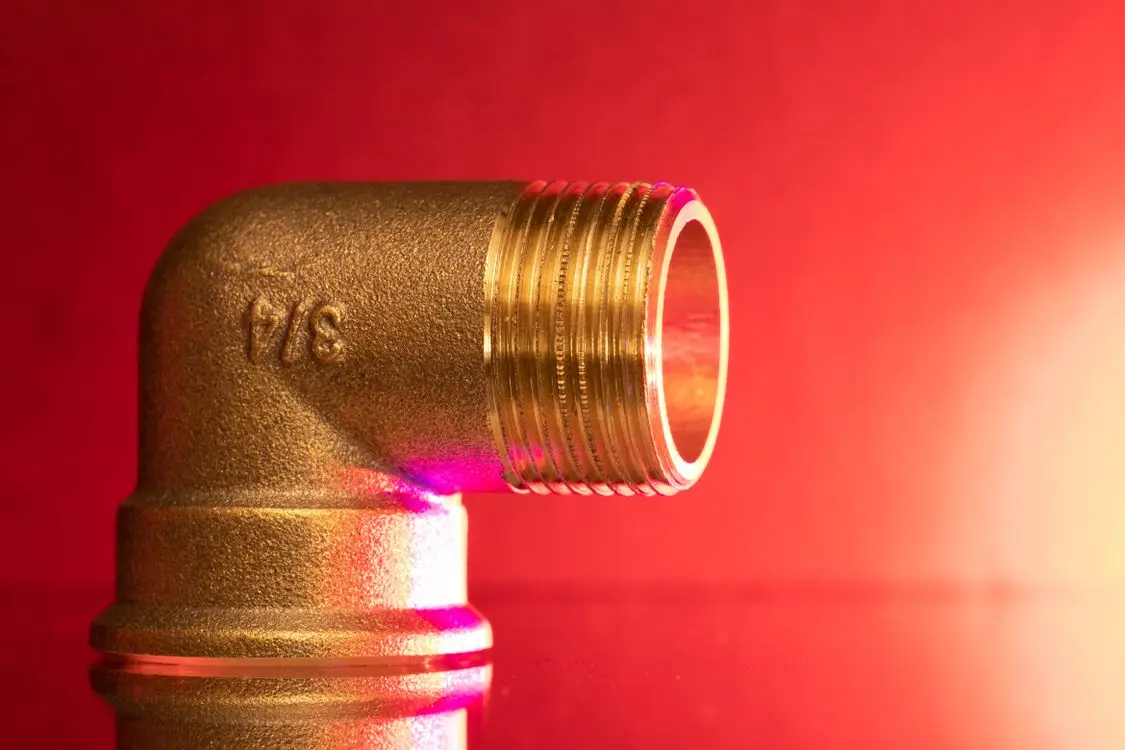
NPT vs BSP thread is the rare spec problem that passes assembly and fails in service. At 1/2 inch and 3/4 inch, both threads run 14 threads per inch. An NPT male will wind into a BSP female, feel tight, and pass a visual check. Then it weeps, because the flank angles differ by five degrees and only the crests are actually touching.
That's the whole failure. Same pitch, different profile, no seal. Below is the callout block that prevents it, field by field, plus how to identify a thread when all you have is the part.
The thread callout template
Every threaded port and fitting on a drawing, a spec sheet or a product image should carry these eight fields. Most carry two.
Field 1 — Thread standard and designation
Not "1/2 inch BSP." Write the designation the standard itself uses:
| You mean | Write | Governing standard |
|---|---|---|
| NPT taper, male or female | 1/2-14 NPT |
ASME B1.20.1 |
| NPT dryseal | 1/2-14 NPTF |
ASME B1.20.3 |
| BSP taper male | R 1/2 |
ISO 7-1 / BS EN 10226 |
| BSP taper female | Rc 1/2 |
ISO 7-1 / BS EN 10226 |
| BSP parallel female (to mate with R) | Rp 1/2 |
ISO 7-1 |
| BSP parallel, both | G 1/2 |
ISO 228-1 |
The R / Rc / Rp / G letters carry information that "BSP" alone destroys — specifically whether the thread is tapered or parallel, which decides where the seal happens.
Field 2 — Taper or parallel, stated in words
Redundant with Field 1, and worth the line anyway. A tapered thread seals on the thread flanks. A parallel thread does not seal on the threads at all — it holds the joint together while a bonded seal or washer does the sealing. A buyer who receives a parallel port and installs it as if it were tapered will torque it until something cracks.
Field 3 — Threads per inch
Write the number. This is the field that exposes a mismatch before anyone cuts metal:
| Nominal size | NPT TPI | BSP TPI | Same? |
|---|---|---|---|
| 1/8 in | 27 | 28 | No |
| 1/4 in | 18 | 19 | No |
| 3/8 in | 18 | 19 | No |
| 1/2 in | 14 | 14 | Yes |
| 3/4 in | 14 | 14 | Yes |
| 1 in | 11.5 | 11 | No |
Read the two "Yes" rows carefully — they are the dangerous sizes. At 1/4 and 3/8, a mismatch binds after a turn or two and someone investigates. At 1/2 and 3/4, it assembles cleanly and ships.
Field 4 — Thread form angle
60° for NPT, 55° for BSP. One line, and it makes the incompatibility explicit to anyone reading the drawing:
- NPT: 60° included angle, flat/sharp crests and roots
- BSP (both BSPT and BSPP): 55° Whitworth form, rounded crests and roots
Because the crests are shaped differently, even a matched-TPI pair contacts on the wrong surfaces. The 5° difference alone prevents proper mating and sealing when the two families are mixed.
Field 5 — Major diameter
The measurement that settles arguments in an inspection bay, because it differs even where TPI doesn't:
| Nominal size | NPT major OD | BSPT major OD | Gap |
|---|---|---|---|
| 1/8 in | 0.405 in | 0.383 in | 0.022 in |
| 1/4 in | 0.540 in | 0.518 in | 0.022 in |
| 3/8 in | 0.675 in | 0.656 in | 0.019 in |
| 1/2 in | 0.840 in | 0.825 in | 0.015 in |
| 3/4 in | 1.050 in | 1.041 in | 0.009 in |
| 1 in | 1.315 in | 1.309 in | 0.006 in |
Note the gap narrowing as size increases. At 1 inch the two differ by six thousandths — measurable with a caliper, invisible to a hand.
Field 6 — Sealing method
State how the joint is meant to seal, because it changes what ships in the box:
- NPT — seals on the thread flanks, with PTFE tape or a thread sealant. Over-tightening or excess sealant can itself cause a leak.
- BSPT (R/Rc) — tapered threads wedge together; the joint is rigid and, correctly cut, does not depend on sealant.
- BSPP (G) — parallel; requires a bonded seal ring or washer at the face. Ship it with the fitting or the buyer will improvise.
Field 7 — Port depth and spot-face
For a female port on a casting or a manifold, give the full thread depth and the spot-face diameter. A bonded seal has nowhere to sit without a flat face, and a thread that bottoms out before it seals is a leak with a torque wrench attached.
Field 8 — Material and plating
Thread class and coating thickness change effective fit. A heavily plated NPT male in a plated female can bind before it seals.
Two filled-in examples
Hydraulic manifold port, European market:
Port: G 1/2 per ISO 228-1, parallel, 55° Whitworth, 14 TPI, major OD 0.825 in, seals on bonded washer at spot-face ⌀28 mm, full thread depth 14 mm, steel, zinc-nickel plated. Bonded seal supplied.
Fitting for a North American assembly:
Male: 1/2-14 NPT per ASME B1.20.1, tapered, 60° form, major OD 0.840 in, seals on flanks with PTFE tape (2–3 wraps), 316 stainless, no plating.
Neither sentence can be delivered two ways. Compare that with "1/2 BSP," which can be delivered four ways.
Identifying a thread when you only have the part
Sometimes the drawing is the thing that's missing. Three steps, in order:
- Measure the major diameter with a caliper. Compare against the table in Field 5. This alone separates NPT from BSP at the small sizes where the gap is 0.019–0.022 in.
- Count threads over one inch, or use a pitch gauge. If you get 19 rather than 18, or 28 rather than 27, you're holding BSP. If you get 14, this step tells you nothing — go to step 3.
- Check taper and crest form. Lay a straight edge along the thread crests: NPT and BSPT taper visibly over the engagement length; BSPP is parallel. Under magnification, NPT crests read flat and sharp, BSP crests read rounded.
Steps 1 and 3 are the ones that resolve the 1/2 and 3/4 inch cases, which is precisely where the counting method gives a false all-clear.
Adapting the template to your product
- Valves and fittings sold on marketplaces: the designation belongs in the title, not only the spec table —
R 1/2and1/2-14 NPTare searched as literal strings by buyers who already know what they need. - Machines with multiple ports: number the ports on the drawing and give each one its own callout row. A single "all ports BSP" note is how a machine ends up with one port nobody can connect to.
- Products sold into both US and EU channels: publish the two variants as separate SKUs with separate images. An adapter mentioned in a footnote will not survive the buyer's procurement system.
- Anything with a parallel port: say in the listing whether the bonded seal is included. This is the single most common post-sale question on parallel-threaded goods.
The same principle governs the pipe body the thread sits on — pipe and fitting dimensions covers why NPS, DN and schedule are three separate fields for the same reason. And on the mechanical side, metric vs imperial fastener threads is the same trap in bolts: close enough to assemble, not close enough to hold.
FAQ
Can you use NPT and BSP together?
No. They are incompatible even at 1/2 and 3/4 inch where the thread count is identical, because NPT is a 60° form with flat crests and BSP is a 55° Whitworth form with rounded ones. The pair will assemble and appear tight, then leak in service. There is no amount of sealant that fixes a flank-angle mismatch.
How do I tell NPT from BSP by measuring?
Measure the major diameter first — at 1/4 in, NPT is 0.540 in against BSPT's 0.518 in, a difference a caliper catches immediately. Then count threads: NPT is 18 TPI at 1/4 and 3/8 where BSP is 19. At 1/2 and 3/4 inch both are 14 TPI, so fall back on major diameter and crest shape.
What is the difference between BSPT and BSPP?
BSPT (R male, Rc female) is tapered and seals on the threads themselves. BSPP (G) is parallel — the threads only hold the joint, and the seal is made by a bonded washer at the face. Both use the 55° Whitworth form, so the distinction is taper, not profile.
What does R 1/2 mean on a drawing?
A BSP tapered male thread of 1/2 inch nominal size, per ISO 7-1 / BS EN 10226. Its female counterpart is Rc 1/2 (tapered) or Rp 1/2 (parallel). It is not interchangeable with 1/2-14 NPT, despite both running 14 threads per inch.
How should thread specs appear on a product listing image?
Put the designation, TPI and major diameter on the image at the thread they describe — buyers filter listings on the image before they open a spec sheet, and a threaded port photographed straight on carries no scale at all. The workable method is to pin each callout to the measured geometry of the actual port and export at the size the marketplace or catalogue requires, so the numbers stay attached to the feature. This is a measurement job rather than an image-editing one, and it's the specific thing generative image tools get wrong: a model will render a crisp "1/2 NPT" against a port it never measured, which on a pressure fitting is a number someone will build a system around. Measured dimensions beat convincing ones here — and if you want the cost side before investing the time per SKU, the return cost calculator prices what one wrong-thread consignment takes out of the margin.
Sources & References
- NPT and BSP thread comparison — TPI and major diameter by nominal size, governing standards, R/G designations
- Anglo Stainless — the difference between BSPT, NPT and BSPP threads (60° vs 55° form, why the 5° difference prevents sealing)
- StrongFlex — NPT vs BSP thread fittings: differences, identification and selection
- How to differentiate between BSPP, BSPT and NPT threads (identification method and sealing behaviour)