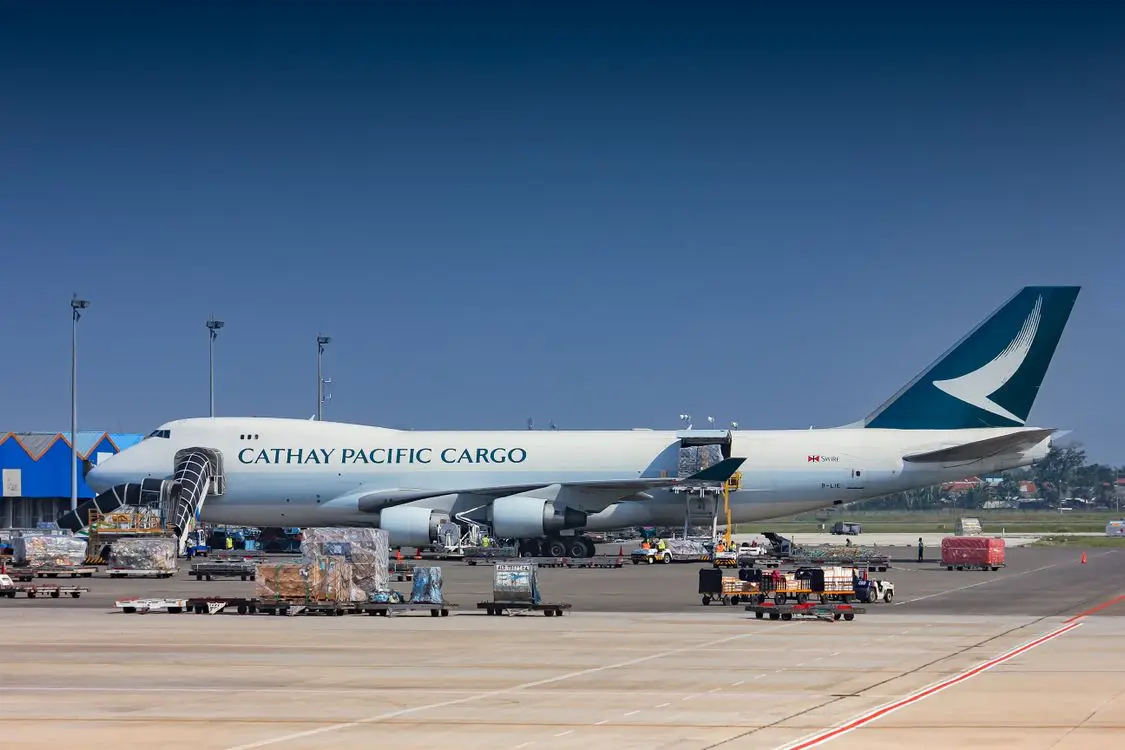
Air freight maximum dimensions are not set by the aircraft. They are set by the aluminium pallet or container your cargo rides in — and on most passenger widebodies that ceiling is 163 cm, not the three-metre hold you pictured. A carton at 170 cm does not get squeezed in. It gets rolled off the build, rebooked onto a freighter two or three days later, and rebilled at a rate you did not quote.
Air freight maximum dimensions are the number most export quotations never mention, and the one that turns a two-day sample shipment into a two-week apology. Here is where the real ceilings are, why a pallet rated for 244 cm will still reject a 244 cm crate, and what has to be on the drawing you send your forwarder.
Air freight maximum dimensions are set by the ULD, not the aircraft
A unit load device (ULD) is a certified aluminium pallet or container that holds cargo as a single unit inside an aircraft. IATA is explicit that these are not packaging: ULDs "are removable aircraft parts subject to strict civil aviation authorities' requirements from design, testing, production, and operations, to repair and maintenance," and roughly one million of them are in service worldwide.
That one sentence explains every rejection at the build station. Your shipment does not have to fit the aeroplane. It has to fit a 163 cm box that fits the aeroplane.
Two consequences follow, and both are billable:
- Nothing is "close enough." A ULD is an airworthiness-certified part with a published contour. Ground handlers cannot make an exception for 4 cm the way a trucker can shove a crate sideways.
- The limit travels with the aircraft type, not the route. The same lane flown on a passenger widebody one day and a freighter the next has two completely different size ceilings.
Lower deck or main deck: two ceilings, 137 cm apart
Almost all air freight that leaves Asia and Europe on a passenger flight rides in the belly — the lower deck. Lower-deck holds are shaped by the fuselage curve, so the containers built for them are short and have cut-away corners.
| Deck |
What it is |
Height ceiling in practice |
Typical max gross per unit |
| Lower deck (belly of a passenger widebody) |
Contoured containers and low-contour pallets |
About 163 cm (64 in) |
1,588 kg for an LD-3; 6,033 kg for an LD-9 |
| Main deck (freighter, or a converted freighter) |
Full-height pallets and boxes |
244 cm at Q6 contour, 300 cm at Q7 |
6,804 kg for a PMC; up to 13,608 kg on a 20-ft main-deck pallet |
Sources: published ULD specifications from Thai Airways Cargo and the ULD contour reference used by air cargo load planners.
The practical read: if your finished crate is taller than 160 cm, you have quietly booked a freighter, whether or not anyone told you. Belly capacity flies whenever the passenger flight flies. Freighter capacity does not, which is why a height problem almost always surfaces as a schedule problem first.
The contour code, not the base size, is what limits your height
This is where most suppliers get caught. A PMC pallet has a 96 × 125 in (2.44 × 3.18 m) base and is rated to 6,804 kg. Sellers read that and assume they have a 2.44 m tall box to fill. They do not.
A pallet is a flat aluminium base and a net — not an enclosure. The height comes from the contour code the airline builds that pallet to, and each contour is a sloped profile, not a rectangle:
| Contour |
Maximum build height |
Where it flies |
| LD contour |
1.63 m (64 in) |
Lower deck of passenger widebodies |
| Q6 |
2.44 m (96 in) |
Main deck, standard freighter build |
| Q7 |
3.00 m (118 in) |
Main deck, full height on 747F / 777F class freighters |
The contour slopes inward toward the top and the edges. The full height only exists over the middle of the pallet. A crate that is 2.40 m tall and sits at the edge of a Q6 build will still foul the contour, because the profile has already tapered by the time it reaches that corner. Load planners quote usable volume for a given contour build, not base area multiplied by height — which is why two shipments with identical cube can get different answers.
If you have ever been told "it fits the pallet but not the contour," this is that.
ULD reference table: base sizes, heights and weight limits
These are the figures Thai Airways Cargo publishes for its fleet. Treat them as representative, not universal — base dimensions and tare weights vary by carrier and by ULD manufacturer, and the max gross weight is often reduced further by the aircraft's floor loading limits on a given sector. Always confirm the exact unit with the airline before you cut plywood.
| ULD |
Base dimensions |
Height |
Max gross weight |
Deck |
| LD-3 / AKE container |
78.3 / 61.5 in L × 60.4 in W |
63.4-64 in (~1.62 m) |
1,588 kg (3,500 lb) |
Lower |
| LD-6 container |
160 / 125 in L × 60.4 in W |
64 in |
3,175 kg (7,000 lb) |
Lower |
| LD-9 / AAP container |
125 in L × 88 in W |
63.6-64 in |
6,033 kg (13,300 lb) |
Lower |
| LD-26 container |
160 / 125 in L × 88 in W |
64 in |
6,033 kg (13,300 lb) |
Lower |
| LD-36 container |
160 / 125 in L × 96 in W |
64 in |
6,804 kg (15,000 lb) |
Lower |
| PLA pallet with net |
60.4 × 125 in |
By contour |
3,175 kg (7,000 lb) |
Lower |
| PAG / PAP / P1P pallet |
88 × 125 in |
By contour |
6,033 kg (13,300 lb) |
Lower or main |
| PMC pallet with net |
96 × 125 in |
By contour |
6,804 kg (15,000 lb) |
Lower or main |
| 20-ft main-deck pallet (PAG extra) |
96 × 238.5 in |
By contour |
13,608 kg (30,000 lb) |
Main deck only |
Notice the two-number entries — "160 / 125 in" — those are the top and bottom lengths of a container whose lower corners are cut away to follow the fuselage curve. An LD-6 is 160 in across at the top but only 125 in along the floor, so a long crate can clear the opening and still refuse to sit down. Read both numbers, every time.
Chargeable weight is the second size limit, and it bites earlier
Even when your cargo fits, its dimensions decide the invoice. Air freight bills on chargeable weight: the greater of actual gross weight and volumetric weight, where IATA's recommended divisor is 6,000 cm³ per kilogram — 1 m³ counts as 167 kg. Express integrators such as DHL, FedEx and UPS commonly use 5,000 instead, which makes the same box about 20% heavier on paper.
Run it on a real knock-down furniture carton at 120 × 60 × 40 cm:
| Line |
Figure |
| Volume |
288,000 cm³ (0.288 m³) |
| Actual gross weight |
26 kg |
| Volumetric weight at 6,000 (IATA air freight) |
48 kg |
| Volumetric weight at 5,000 (express courier) |
57.6 kg |
| Chargeable weight, air freight |
48 kg |
You paid for 48 kg and shipped 26 kg. That gap is why the same cubic metre is priced differently by air, by sea and by road, and it is the same arithmetic behind volumetric weight on your export documents and behind density-based freight class on US domestic trucking.
The uncomfortable version: for most furniture, lighting and building-material products, air freight is billed on air, not on goods. Shaving 4 cm off a carton height is often worth more than shaving 4 kg off the product.
Where the 163 cm ceiling actually bites
Furniture samples. An upholstered chair crated upright will usually break the 163 cm lower-deck ceiling. The same chair with the legs removed and the back laid flat usually will not — and that single packing decision is the difference between a daily passenger service and waiting for a freighter.
Machinery and industrial equipment. These usually exceed lower-deck height on purpose, so the real question is whether the built unit clears Q6 at 244 cm or needs Q7 at 300 cm. That single answer changes which airports and which aircraft can take the shipment at all.
Panels and long profiles. Length, not height, is the constraint. A 3.1 m panel against a 125 in (3.18 m) pallet base leaves almost nothing for net tension and the edge taper, even though the raw numbers look like a fit. Confirm that one with the carrier before you build the crate.
In all three cases the decision is made weeks before booking, at the moment someone chooses the crate. Which is exactly when nobody has the ULD limits in front of them.
What has to be on the drawing you send the forwarder
A forwarder cannot quote a shipment from a photo and a sentence. The fix is not a longer email — it is a spec image that carries the measured outer dimensions of the packed unit, marked on the image itself: length, width, height of the crate as it will be presented, plus gross weight and the stacking direction. Not an estimate typed into a cell, and not an AI-generated visual that invents a plausible-looking number; a dimension locked to the actual measured edge of the crate, exported at a size the forwarder can read on a phone.
The reason is boring and expensive: the forwarder's build decision, the contour choice and the rate all come from those three numbers. Get them onto the image once, and the same file answers the buyer, the airline and the customs broker. The same discipline applies on the sea-freight side, where standard pallet sizes determine container fit rather than contour fit.
Pre-booking dimension checklist
FAQ
What is the maximum size for air freight?
Air freight maximum dimensions depend on the deck. On a passenger widebody it is roughly 163 cm high, because that is the ceiling of lower-deck ULDs such as the LD-3 and LD-9. On a freighter main deck it rises to 244 cm at Q6 contour and 300 cm at Q7. Base footprint is capped by the pallet: 96 × 125 in (2.44 × 3.18 m) for a PMC, up to 96 × 238.5 in for a 20-ft main-deck pallet.
How tall can a pallet be for air freight?
The pallet itself is flat; the build height comes from the contour code. LD contour allows 1.63 m, Q6 allows 2.44 m and Q7 allows 3.00 m — but each contour tapers toward the edges, so the maximum height is only available over the centre of the pallet.
What is the difference between an LD3 and a PMC?
An LD-3 (AKE) is an enclosed container with cut-away lower corners, about 1.62 m high and rated to 1,588 kg, built for the lower deck. A PMC is a flat 96 × 125 in pallet with a net, rated to 6,804 kg, whose height depends entirely on the contour it is built to. One is a box; the other is a floor.
How do I calculate chargeable weight for air freight?
Multiply length × width × height in centimetres, divide by 6,000 to get volumetric weight in kilograms, then compare with actual gross weight and pay on the larger figure. Express couriers typically divide by 5,000, which raises the volumetric figure by 20%.
Why does my forwarder keep asking for dimensions I already sent?
Usually because the numbers arrived as text in an email and could not be tied to the object they describe — so nobody knows whether 120 cm was the product or the crate. Marking the measured dimensions directly onto a photo of the packed unit removes that ambiguity in one step, which is why spec-diagram software that snaps measurements to the actual edges of the item and exports at a readable size ends this loop faster than another spreadsheet does.
Does air freight have a maximum weight per piece?
Yes, and it is per ULD, not per shipment. An LD-3 tops out at 1,588 kg, an LD-9 and PAG at 6,033 kg, a PMC at 6,804 kg and a 20-ft main-deck pallet at 13,608 kg. Aircraft floor-loading limits on a specific sector can reduce all of these.
Sources & References