
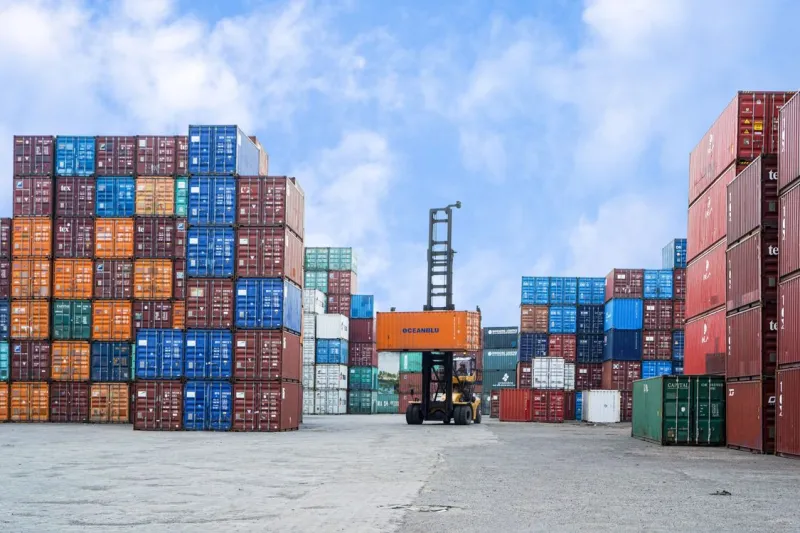
Container loading quantity is the number your buyer actually places the order against — not CBM, not carton count, but how many sellable units land per container. Get it wrong by 8% and you've either quoted freight the buyer won't honor or left a container a fifth empty. Yet most suppliers still answer "how many fit?" with a shrug and a promise to check with the forwarder.
Here are the questions every buyer asks before committing to a container order, answered with the actual arithmetic — so you can state the number with the confidence of a supplier who's shipped it before.
How many units fit in a 20ft, 40ft, or 40HC container?
Container loading quantity is the number of sellable units that physically fit inside a shipping container once carton size, stacking, and payload limits are accounted for. It always comes in under the theoretical volume, and the gap is where suppliers lose money.
Start from the internal volume, not the container's name:
| Container | Internal dimensions (approx.) | Total volume | Usable volume (85–90%) | Max payload |
|---|---|---|---|---|
| 20ft standard | 5.90 × 2.35 × 2.39 m | ~33 CBM | 28–30 CBM | ~28,000 kg |
| 40ft standard | 12.03 × 2.35 × 2.39 m | ~67 CBM | 57–60 CBM | ~26,500 kg |
| 40ft high cube (40HC) | 12.03 × 2.35 × 2.69 m | ~76 CBM | 65–68 CBM | ~26,300 kg |
The usable-volume column is the one that matters. You never fill a container to 100% — cartons don't divide evenly into the space, and the last layer rarely fits. Plan against 85–90% and you'll quote a number you can actually hit.
How do I calculate container loading quantity from carton size?
Three steps, no software required.
- CBM per carton = length × width × height, all in meters. A carton of 0.60 × 0.40 × 0.40 m = 0.096 CBM.
- Cartons per container = usable container volume ÷ CBM per carton. For a 20ft at 28 CBM usable: 28 ÷ 0.096 = 291 cartons theoretical.
- Apply the reality factor. Knock off 10–15% for stacking loss unless your cartons tile the floor cleanly: 291 × 0.85 ≈ 247 cartons. At 10 units per carton, that's ~2,470 units in a 20ft.
That reality factor is the whole game. A supplier who quotes 291 and ships 247 has a very unhappy buyer and a renegotiated freight cost. The master carton dimensions you print on the box are the same numbers that drive this math — get the carton right and the container number follows.
Why does the real number always come in under the theoretical maximum?
Four reasons, and knowing them lets you recover most of the loss:
- Cartons don't tile the space. A 0.6 m carton leaves 0.55 m of dead width against a 2.35 m wall (3 cartons = 1.8 m, 0.55 m wasted). Rotating cartons or mixing orientations recovers some of it.
- You can't stack to the ceiling with heavy goods. Crushing risk caps your stack height below the physical maximum.
- Weight caps out before volume for dense products. Tiles, stone, hardware, and machinery hit the ~28,000 kg payload limit while the container is still half empty. For these, container loading quantity is a weight calculation, not a volume one.
- Pallets cost you volume. Palletized cargo loses the space under and between pallets — but saves loading labor and damage. It's a trade, not a free choice.
Should I load loose or on pallets?
It depends on which constraint binds first — space or handling.
| Approach | 20ft capacity | Best when |
|---|---|---|
| Floor-loaded (loose) | Maximum cartons, ~28–30 CBM used | Volume is the limit; labor at destination is cheap |
| EUR pallets (1200 × 800 mm) | ~10–11 pallets, one layer | Buyer's warehouse is pallet-in; damage matters |
| US pallets (1219 × 1016 mm) | ~9–10 pallets, one layer | Shipping to US distribution |
A 40ft standard roughly doubles the pallet count to 20–22 EUR pallets. If the buyer's DC only accepts palletized freight, the pallet number is your real container loading quantity — the loose maximum is irrelevant.
How do I show loadability to a buyer so they trust the number?
State the number, then show the work. A buyer doesn't order by CBM — they order by how many pieces land per container, and the supplier who states that number confidently looks like the one who's shipped it before. A one-image loading summary does more for buyer trust than a paragraph of promises: carton dimensions, units per carton, cartons per container, units per container, and gross weight, laid out where the buyer can check your math.
That clarity is the same discipline that makes an export quotation win against a cheaper competitor — you're not just quoting a price, you're proving you've thought through the shipment. You can see how a clean, dimensioned supplier image reads to a buyer in this dimensioned product-image case study.
Quick-Reference Summary
| Container | Usable CBM | Cartons at 0.096 CBM (85%) | EUR pallets | Payload |
|---|---|---|---|---|
| 20ft | 28–30 | ~247 | 10–11 | ~28,000 kg |
| 40ft | 57–60 | ~500 | 20–22 | ~26,500 kg |
| 40HC | 65–68 | ~575 | 20–22 (taller stack) | ~26,300 kg |
FAQ
How many CBM are in a 20ft and 40ft container?
A 20ft container holds about 33 CBM total and a 40ft about 67 CBM, but usable volume is only 85–90% of that once you account for stacking loss — roughly 28–30 CBM for a 20ft and 57–60 CBM for a 40ft. A 40HC adds about 9 CBM of height over a 40ft standard.
How do I calculate how many units fit in a container?
Multiply each carton's length × width × height in meters to get CBM per carton, divide the container's usable volume by that figure, then reduce the result by 10–15% for real-world stacking loss. Multiply by units per carton for the final container loading quantity.
Why is my actual container loading quantity lower than the calculator says?
Calculators divide volume by volume and assume perfect packing. Real cartons leave gaps against the walls, can't always stack to full height, and — for dense goods like tiles or hardware — hit the weight limit long before the space fills. Plan against 85–90% of theoretical volume.
What's the maximum weight I can load in a container?
A 20ft standard tops out around 28,000 kg of payload and a 40ft around 26,500 kg, though road and legal limits at destination are often lower. For dense products, weight — not volume — sets your container loading quantity.
Should I ship floor-loaded or palletized?
Floor-loading fits the most cartons; palletizing loses volume but cuts damage and loading labor. If the buyer's warehouse only accepts palletized freight, the pallet count is your real capacity — a 20ft holds about 10–11 EUR pallets on one layer.