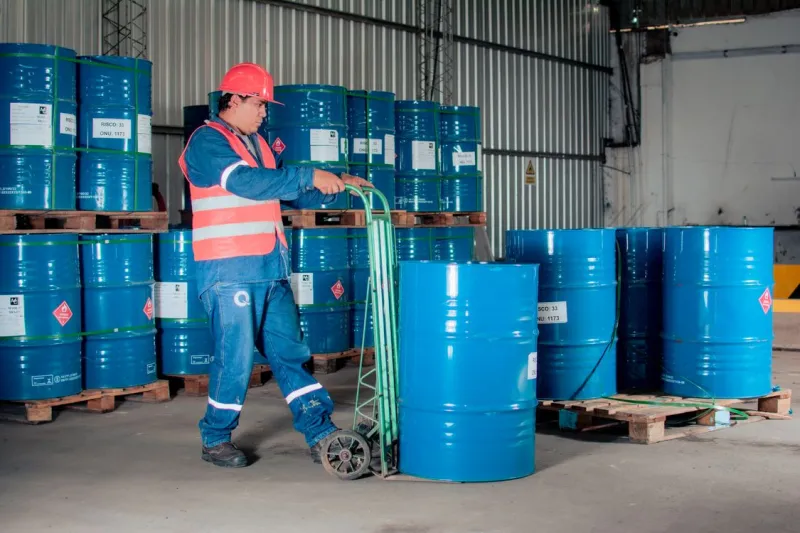
A UN packaging code is the string stamped on the side of a drum that looks like a licence plate: 1A1/Y1.4/150/26/USA/M5678. Buyers ask for it, forwarders reject shipments over it, and most export sales teams can read exactly one field of it — the first.
Here is the sentence that saves the most arguments: a UN packaging code tells you what the empty package survived in a laboratory. It tells you nothing about what is inside it. The contents are identified elsewhere, by the UN number and the hazard label. The code is a performance certificate for the container.
Below: every field decoded against the regulation that defines it, the four tests the code stands for, and where the mark quietly goes wrong on documents you have already sent. The rules are set internationally in the UN Model Regulations and enacted in the United States as 49 CFR Part 178, the freely readable authoritative text quoted throughout.
What a UN packaging code is
A UN packaging code is a sequence of marks, separated by slashes, that identifies the package type and material of construction, the packing group whose tests the design passed, the density or gross mass it was tested to, the pressure test or a solids designation, and where and when it was made.
49 CFR 178.503(a) requires the marks to be durable, legible, and placed where they are readily visible. They may run on a single line or several, provided the correct sequence is kept, and slash marks should separate the information. Sequence is the rule; layout is not.
One clause catches reconditioners out: reusable packagings that may go through a reconditioning process capable of obliterating the marks must carry the elements in paragraphs (a)(1) through (a)(6) and (a)(9) in permanent form — embossed, for example — so they survive the process.
Fields 1 and 2: the packaging identification code
The opening block — 1A1, 4G, 3H1, 6HA1 — is three pieces of information, not one.
The first character is the kind of packaging, per 49 CFR 178.502(a)(1):
| Numeral |
Kind of packaging |
| 1 |
Drum |
| 2 |
Wooden barrel |
| 3 |
Jerrican |
| 4 |
Box |
| 5 |
Bag |
| 6 |
Composite packaging |
| 7 |
Pressure receptacle |
The capital letter is the material of construction, per 178.502(a)(2):
| Letter |
Material |
| A |
Steel (all types and surface treatments) |
| B |
Aluminum |
| C |
Natural wood |
| D |
Plywood |
| F |
Reconstituted wood |
| G |
Fiberboard |
| H |
Plastic |
| L |
Textile |
| M |
Paper, multi-wall |
| N |
Metal other than steel or aluminum |
| P |
Glass, porcelain or stoneware |
The trailing numeral is the category within that kind. For steel drums (1A), 1 means a non-removable head — a tight-head drum — and 2 means a removable head, an open-head drum. So 1A1 and 1A2 are not two brands of the same thing; one is closed and one is not, and the difference decides whether your filling line can even use it.
Two rules that trip people up. For composite packagings, two capital letters sit in the second position: the first is the inner receptacle material, the second the outer. A plastic receptacle inside a steel drum is 6HA1. And for combination packagings — inner packagings inside an outer — only the outer packaging's code is marked, which is why the fibreboard carton is 4G and the bottles inside it carry no code of their own.
You may also see a letter appended: 4GV marks a packaging tested under 178.601(g)(2), and a W marks one covered by a special approval under 178.601(h).
Field 3: X, Y or Z is the packing group, and it reads downward
One letter, and it is cumulative rather than exclusive:
| Letter |
Packing groups the design passed |
| X |
Packing Group I, II and III |
| Y |
Packing Group II and III |
| Z |
Packing Group III only |
An X package may be used for a Packing Group III material; a Z package may not be used for Packing Group I. Buyers asking for "X-rated drums" usually want one part number to cover their whole range.
Field 4: the same digits mean two different things
This is where a code gets misread most often. After the letter comes a number — and whether it is a density or a mass depends on what the packaging is for.
| If the packaging is for |
The number is |
Example |
| Liquids, with no inner packagings |
The specific gravity it was tested to, rounded down to the first decimal |
Y1.4 |
| Solids, or inner packagings |
The maximum gross mass in kilograms |
Y145 |
There is a gap in the first row worth knowing: for liquid packagings, the specific gravity designation may be omitted when it does not exceed 1.2. So a code reading 1A1/Y/150/… is not a mark with a missing field; it is a package tested to a relative density of 1.2 or lower.
Field 5: kilopascals, or the letter S
Same fork in the road:
- For single and composite packagings intended to contain liquids, the field is the hydrostatic test pressure in kilopascals, rounded down to the nearest 10 kPa, that the design type passed.
150 means 150 kPa.
- For packagings intended for solids or for inner packagings, the field is simply the letter
S.
So 4G/Y145/S/… is a fibreboard box qualified to Packing Group II and III for a maximum gross mass of 145 kg of solids or inner packagings, and 1A1/Y1.4/150/… is a tight-head steel drum qualified for liquids up to a relative density of 1.4, having passed a 150 kPa hydrostatic test.
Fields 6, 7 and 8: when, where, who
- Year: the last two digits of the year of manufacture. Types
1H and 3H — plastic drums and plastic jerricans — must also carry the month of manufacture, and that month may be marked somewhere else on the packaging.
- State: the country authorising allocation of the mark.
USA means the packaging was made and marked in the United States in compliance with the subchapter.
- Maker: the name and address, or a symbol, of the manufacturer or approval agency. A symbol must be registered with the Associate Administrator, which is why a two-character code you cannot resolve is still traceable.
The thickness mark nobody reads
Metal or plastic drums and jerricans intended for reuse or reconditioning carry one more element: the thickness of the packaging material in millimetres, rounded to the nearest 0.1 mm. For metal drums it is the nominal thickness of the body — and when either head is thinner than the body, all three are marked, which is what produces those triplets like 1.0-1.2-1.0 or 0.9-1.0-1.0. The unit of measure does not have to be marked.
New metal drums over 100 L capacity carry a second, permanent copy of the core marks on the bottom, and the top-head or side information must match it. That bottom mark is the drum's birth certificate: it survives repainting and relabelling, which is the point. Physical drum sizes, wall thicknesses and capacity families are laid out separately under standard steel drum dimensions.
Two more rules run the other way. Rated capacity in litres may be marked — permitted, not mandatory, so its absence is not a defect. And on a removable-head packaging the marks may not be applied only to the removable head: a lid can be swapped, and the certificate cannot ride on it.
What the code actually proves: four tests
The letters and numbers are shorthand for a test programme. Knowing the numbers behind them makes it obvious why a "similar" unmarked drum is not a substitute.
| Test |
What it does |
Key figures (49 CFR) |
| Drop test |
Drops the filled package onto a rigid, non-resilient, flat, horizontal target |
PG I 1.8 m (5.9 ft); PG II 1.2 m (3.9 ft); PG III 0.8 m (2.6 ft). Drums use six samples, three per drop orientation; boxes use five, one per drop |
| Leakproofness test |
Internal air pressure applied under water, on packagings for liquids |
PG I not less than 30 kPa (4 psi); PG II and III not less than 20 kPa (3 psi); minimum five minutes other than production testing |
| Hydrostatic pressure test |
Pressurises the receptacle; this pressure is what gets marked in field 5 |
Metal and non-plastic composite five minutes; plastic and plastic composite 30 minutes; PG I a minimum of 250 kPa (36 psig) |
| Stacking test |
Loads the top surface with the weight that would be stacked on it in transport |
Minimum stack height including the sample 3.0 m (10 ft), for 24 hours; plastic drums, jerricans and 6HH for liquids, 28 days at not less than 40 °C (104 °F) |
Note the drop test's small print for dense liquids: when the test is run with water and the material to be carried has a specific gravity above 1.2, the drop height is calculated from that specific gravity — SG × 1.5 m for Packing Group I, SG × 1.0 m for II, SG × 0.67 m for III. Density is not a detail here. It is a test parameter, and it is why field 4 exists at all.
Reconditioned drums: the R and the L
Reconditioned packagings get a second block of marks applied by the reconditioner, near the original ones: the country where the reconditioning was done, the reconditioner's name and address or registered symbol, the last two digits of the year of reconditioning, the letter R, and — for every packaging that passed a leakproofness test — the additional letter L.
The rule that matters commercially: after reconditioning, the re-applied marks may identify a different performance capability than the original design type, but never a greater one. A reconditioned drum can be downgraded. It cannot be upgraded by a coat of paint.
Where the code goes wrong on your paperwork
Almost none of the failures are manufacturing failures. They are documentation failures, and three keep recurring: a code transcribed from a purchase order rather than read off the drum, which is how Y1.4 becomes Y14 and a density turns into a mass; a product photo in which the stamped mark is legible on the physical drum and unreadable at catalogue size; and a spec sheet that says "UN approved" with no code at all, a phrase that means nothing to a compliance officer.
The fix for the last two is the same, and it is not more text. It is a spec image where the code is transcribed as a legible callout pointing at the place it is actually stamped, next to the measured dimensions of the drum: outside diameter, overall height, closure size, capacity. That is an industrial spec diagram doing its job — real measurements locked onto the photograph of the real container and exported at the size a buyer's spec-sheet template expects, rather than dimensions typed into a caption or produced by an image tool that generates a number it never measured. The compliance team can then check the code against the dangerous-goods declaration without sending anyone back to the warehouse with a torch.
It is also not the only mark that stops containers. Wooden pallets and crates under the same load carry their own stamp, covered in ISPM 15 marking requirements, and the choice between formats for bulk liquids is worked through in IBC tote vs steel drum.
Decode-before-you-load checklist
FAQ
What does the UN packaging code on a drum mean?
It identifies the package, not the contents. Reading 1A1/Y1.4/150/26/USA/M5678 left to right: a steel drum with a non-removable head; tested to Packing Group II and III performance; qualified for liquids with a specific gravity up to 1.4; having passed a 150 kPa hydrostatic pressure test; made in 2026; marked in the United States; by the manufacturer holding registered symbol M5678.
What is the difference between X, Y and Z on UN packaging?
They are cumulative performance levels, not categories. X means the design passed the Packing Group I, II and III tests, Y the Packing Group II and III tests, and Z the Packing Group III tests only. A higher-rated package can be used for a lower packing group, never the reverse.
Why does one UN packaging code end in a number and another in the letter S?
Because the field means different things for liquids and for solids. For single and composite packagings for liquids, that position holds the hydrostatic test pressure in kilopascals, rounded down to the nearest 10 kPa. For packagings intended for solids or for inner packagings, the position holds the letter S instead.
Does the UN packaging code have to include the capacity in litres?
No. The regulation says rated capacity expressed in litres may be marked, so a drum without a litre figure in the mark is not defective. Capacity is normally given separately in the product specification, alongside the dimensions.
What do R and L mean on a reconditioned drum?
R identifies the packaging as reconditioned and appears with the country of reconditioning, the reconditioner's name or registered symbol, and the year of reconditioning. L is added for every packaging that passed a leakproofness test. The re-applied marks may show a different performance capability from the original, never a greater one.
Next steps
Three moves, in order of payback:
- Photograph the mark on each SKU you stock, straight on and in focus, and transcribe the code into your product data. A blurred stamp is the most common reason a buyer emails back.
- Put the code and the measured dimensions on one spec image per drum type. The compliance check and the fit check happen at the same desk, and that diagram is what gets forwarded internally.
- Reconcile the code against your dangerous-goods paperwork before the booking, not at the terminal — particularly field 4, where a density and a gross mass look alike and mean nothing like the same thing.
Sources & References
- eCFR — 49 CFR 178.502, Identification codes for packagings (kind, material, category, composite and combination rules)
- eCFR — 49 CFR 178.503, Marking of packagings (full mark sequence, X/Y/Z, density vs gross mass, thickness, reconditioning marks)
- eCFR — 49 CFR 178.601, General requirements for performance-oriented packaging testing
- eCFR — 49 CFR 178.603, Drop test (drop heights by packing group, sample counts, specific-gravity formulas)
- eCFR — 49 CFR 178.604, Leakproofness test (air pressures by packing group, test duration)
- eCFR — 49 CFR 178.605, Hydrostatic pressure test (durations by material, Packing Group I minimum 250 kPa)
- eCFR — 49 CFR 178.606, Stacking test (3.0 m stack height, 24 hours, 28 days at 40 °C for plastics)