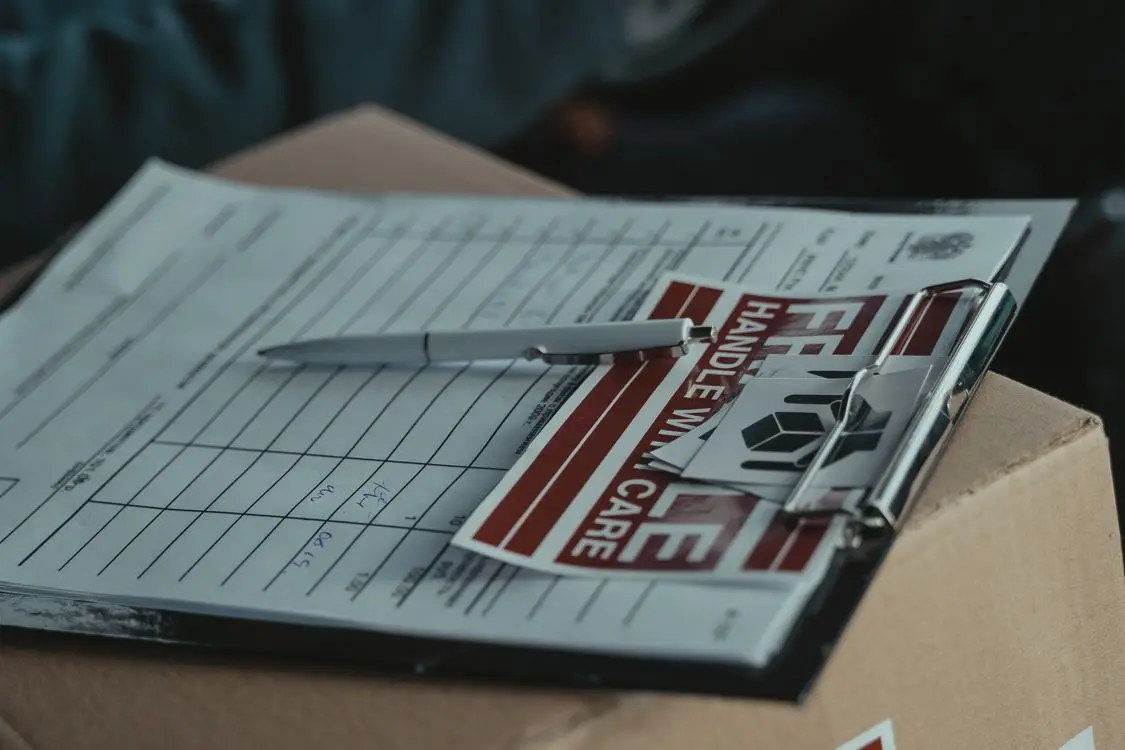
Packing list vs commercial invoice is the wrong question for most suppliers, because the two documents are not two versions of the same file. One is a money document and one is a physical document, and the five numbers they share — package count, marks, net weight, gross weight and measurement — are read by four different parties who each reject the shipment for a different reason.
Here is a field-by-field map of which number belongs on which document, a packing list block you can copy, and the consistency check that stops the mismatch before it reaches a customs officer.
Packing list vs commercial invoice: what each document is for
A commercial invoice is the statement of what was sold and for how much: it establishes value, origin and classification so customs can assess duty and the buyer can pay. A packing list is the statement of how the goods are physically packed: how many packages, marked how, weighing what, occupying how much space, so the shipment can be handled, loaded, counted and inspected.
The split matters because US customs law never actually asks for a packing list. Title 19 of the Code of Federal Regulations, section 141.86, sets out what an invoice must contain — and paragraph (e) requires that "each invoice must state in adequate detail what merchandise is contained in each individual package." The packing list exists because no exporter wants a 40-carton breakdown printed inside a commercial invoice. It is a convention that solves a legal requirement, not a legal requirement of its own.
Two of the required invoice items are dimensional, and both come straight from the statute behind the regulation, 19 U.S.C. 1481: "the marks and numbers of the packages in which the merchandise is packed", and "the quantities in the weights and measures of the country or place from which the merchandise is shipped, or in the weights and measures of the United States."
Your local weights and measures are acceptable: kilograms and centimetres are fine for a US entry. What is not acceptable is a quantity that disagrees with the document beside it.
The field map: which number goes where
| Field |
Commercial invoice |
Packing list |
Who reads it |
| Invoice number and date |
Required |
Reference it |
Customs, buyer's finance |
| Seller and buyer, full legal names and addresses |
Required |
Usually repeated |
Customs |
| Incoterm and named place |
Required |
No |
Customs, buyer, insurer |
| Unit price, line total, currency |
Required |
Never |
Customs valuation, bank |
| HS code per line |
Required |
Optional, helps |
Customs broker |
| Country of origin |
Required |
Optional |
Customs, preference claims |
| Goods description |
Required, commercial name and grade |
Required, may be shorter |
Customs, inspector |
| Quantity in units or pieces |
Required |
Required, must match |
Customs, buyer's receiving |
| Number of packages |
Required |
Required, broken down by package |
Customs, carrier, warehouse |
| Marks and numbers on packages |
Required |
Required, in full |
Customs, warehouse, inspector |
| Net weight |
Optional on the invoice |
Required, per line and total |
Customs, buyer, duty by weight |
| Gross weight |
Optional on the invoice |
Required, per package and total |
Carrier, terminal, airline |
| Carton dimensions, L x W x H |
No |
Required |
Carrier, warehouse, loading plan |
| Total measurement in CBM |
No |
Required |
Freight quotation, container plan |
| Pallet count and pallet dimensions |
No |
Required when palletised |
Carrier, warehouse |
| Container and seal number |
No |
Added after stuffing |
Customs, terminal |
| Verified gross mass of the container |
No |
Declared separately to the carrier |
Terminal, ship's master |
The packing list vs commercial invoice split follows one pattern: everything about value goes left, everything about physical form goes right, and the columns overlap on exactly four rows — quantity, package count, marks, and net weight. Those four are where mismatches originate.
How to fill the five physical fields
Number of packages
Count shipping packages, not inner boxes and not selling units. If 24 retail boxes go into one export carton, the packing list says one carton, and the inner count belongs in a separate "pieces per carton" column. A buyer who reads 24 packages and receives one carton will open a shortage claim before anyone checks the arithmetic.
Partial cartons get their own line. Nineteen full cartons of 24 plus one carton of 11 is two lines, not "19.46 cartons".
Marks and numbers
The marks on the box and the marks on the paperwork are the same string, character for character. This is the field customs uses to tie a physical package to a paper line, and it is the field most often retyped from memory. Case number ranges — 1/20 through 20/20 — belong here too, because that is how a warehouse verifies nothing is missing. The full convention for what belongs on the carton face is covered in export carton shipping marks.
Net weight and gross weight
Net weight is the goods. Gross weight is the goods plus their packaging — carton, dunnage, pallet, strapping. Both belong on the packing list, per line and as a total. Net weight also belongs on the invoice whenever duty is assessed by weight rather than by value, which is more product categories than most suppliers expect.
The number that trips exporters is the third one, the weight the carrier actually charges on. Air freight bills on the greater of actual gross weight and volumetric weight, so a light, bulky carton is priced on the space it occupies. That calculation is worked through in gross weight vs net weight vs volumetric weight, and it is why the dimensions on your packing list are not decoration.
Carton dimensions and total measurement
Give outer carton dimensions — the outside of the packed, sealed, strapped box — in one unit system, in a fixed L x W x H order, per carton type. Then give the total measurement in cubic metres.
Measure the packed carton, not the flat carton spec. A carton nominally 600 x 400 x 300 mm that bulges to 615 mm when full will load 3 percent worse than your calculation says, which is the difference between fitting the last row and paying for a second container. The full set of carton figures buyers ask for is in master carton dimensions.
Verified gross mass
If the shipment moves in a container by sea, one more weight exists that appears on neither document. Under the SOLAS amendment in force since 1 July 2016, the shipper must provide the verified gross mass of the packed container, state it in a shipping document signed by the shipper, and get it to the master and the terminal in time for the stowage plan. Without it, the container is not loaded — the International Maritime Organization is explicit that a verified gross mass is a condition of loading.
Two methods are allowed: weigh the packed container on calibrated equipment, or weigh every package plus pallets, dunnage and securing material and add the container tare. Method 2 is the one that depends on your packing list being right, because it is your packing list, summed.
The five numbers that must match
| Number |
Appears on |
Fails if it disagrees with |
| Quantity in units |
Invoice, packing list, bill of lading |
Any of the other two — customs treats it as a misdeclaration |
| Number of packages |
Invoice, packing list, bill of lading, VGM declaration |
The carrier's count at the terminal |
| Marks and numbers |
Invoice, packing list, the actual cartons |
The physical box, at inspection |
| Net weight |
Packing list, invoice where duty is by weight |
The certificate of weight, if one is issued |
| Gross weight |
Packing list, bill of lading, VGM declaration |
The weighbridge — and the weighbridge always wins |
Where a mismatch actually bites
A packing list vs commercial invoice mismatch does not fail in one place. It fails in four, and each one charges a different price.
At the terminal. A verified gross mass that disagrees with the weighbridge gets the container set aside. The cost is a re-weigh fee and a missed sailing, and the sailing is the expensive half.
At customs. An importer of record in the US is required to use reasonable care in declaring imported goods. When the invoice and the packing list contradict each other, the broker cannot exercise reasonable care on your paperwork, so the entry stops until you re-issue. The delay is yours even though the legal duty is the importer's.
At the bank. Under a documentary credit, the bank checks the documents against each other rather than against the goods. A gross weight that reads 1,240 kg on the invoice and 1,204 kg on the packing list is a discrepancy on its face, and a discrepancy is grounds to refuse payment even when the shipment is perfect.
At the buyer's warehouse. Receiving counts packages and reads marks. Everything else is your problem later; a package count that does not match is a shortage claim the same afternoon.
A packing list block you can copy
Keep one table per carton type. Repeat the block per SKU, then total it.
| Item |
Value |
| SKU / model |
ABC-1200 |
| Description |
Wall cabinet, white, flat pack |
| Pieces per carton |
1 set |
| Carton quantity |
20 cartons |
| Marks and numbers |
ORDER 4471 / ABC-1200 / C-NOS 1-20 / MADE IN CHINA |
| Carton dimensions L x W x H |
1,210 x 420 x 180 mm |
| Net weight per carton |
18.6 kg |
| Gross weight per carton |
21.4 kg |
| Net weight total |
372.0 kg |
| Gross weight total |
428.0 kg |
| Measurement per carton |
0.0915 CBM |
| Measurement total |
1.830 CBM |
| Pallet |
2 pallets, 1,200 x 1,000 x 1,150 mm, 10 cartons each |
Two habits inside that block save more time than the block itself: one unit system throughout, and a fixed L x W x H order stated in the header so nobody has to guess whether 1,210 is the length or the height.
Consistency check before you send
FAQ
Do dimensions go on the commercial invoice or the packing list?
Carton dimensions go on the packing list. The commercial invoice carries quantities in weights and measures and the marks and numbers of the packages, as required by 19 U.S.C. 1481, but it does not carry per-carton L x W x H — the carrier, the warehouse and the loading plan all read those from the packing list.
Is a packing list legally required for US customs?
Not as a separate document. What US regulation requires is that the invoice state in adequate detail what is contained in each individual package, under 19 CFR 141.86(e). A packing list is the practical way to satisfy that without turning the invoice into a manifest, and every broker will ask for one, so the distinction is academic in practice.
Where should the carton dimensions on my packing list come from?
From a measured, packed carton, and from the same source as the numbers on your spec sheet and product images — not from three separate spreadsheets. Suppliers who keep dimensions in one place and publish them everywhere else stop getting the mismatch entirely; software that locks a measured dimension to the product photo and exports the same figure to a spec sheet, a catalogue page and a listing image is doing exactly that job, which is more reliable than an arrow drawn by hand or a number an image generator produced because it looked plausible.
What is the difference between gross weight and verified gross mass?
Gross weight is the weight of a package including its packaging, and it appears per package on your packing list. Verified gross mass is the weight of an entire packed container including the container's own tare, verified by weighing or by calculation, and declared to the carrier under the SOLAS requirement in force since 1 July 2016. One is a document field; the other is a condition of the box being loaded.
Can the packing list use kilograms if the buyer is American?
Yes. The statute allows quantities in the weights and measures of the country of shipment or those of the United States. Kilograms and centimetres are acceptable for a US entry. What causes problems is mixing the two — pounds on the invoice and kilograms on the packing list forces someone to convert, and conversions are where the mismatches come from.
Sources & References