Dimensions / Building materials / Bricks / Brick pavers
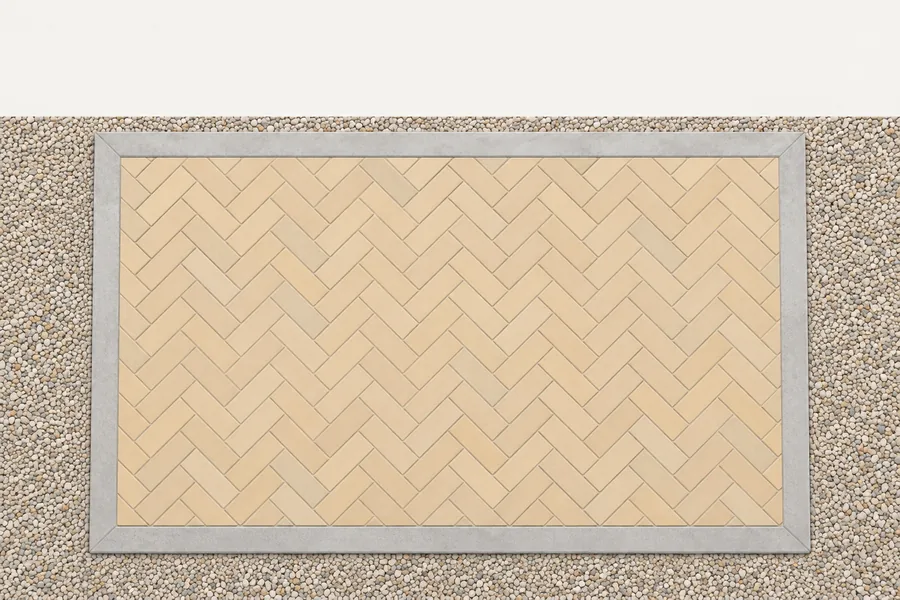
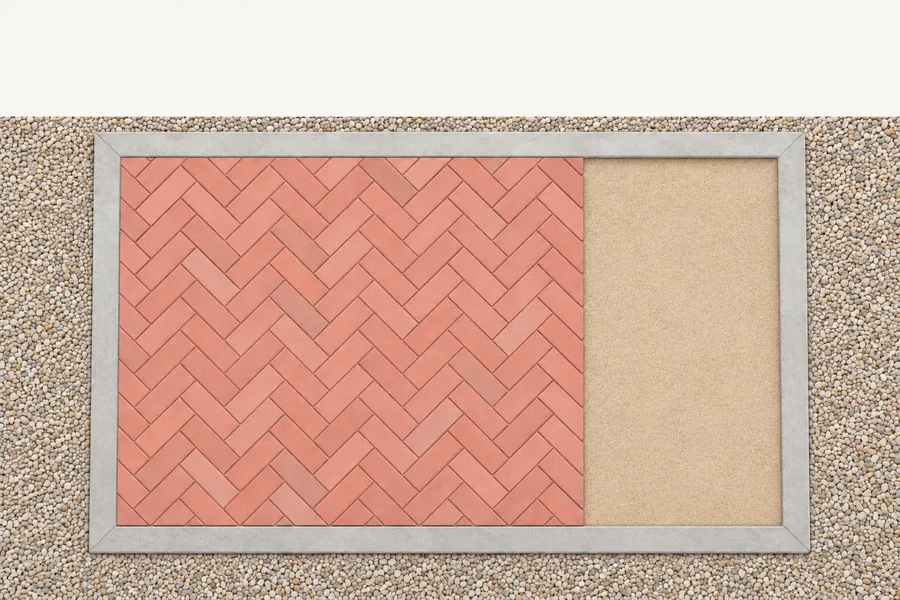
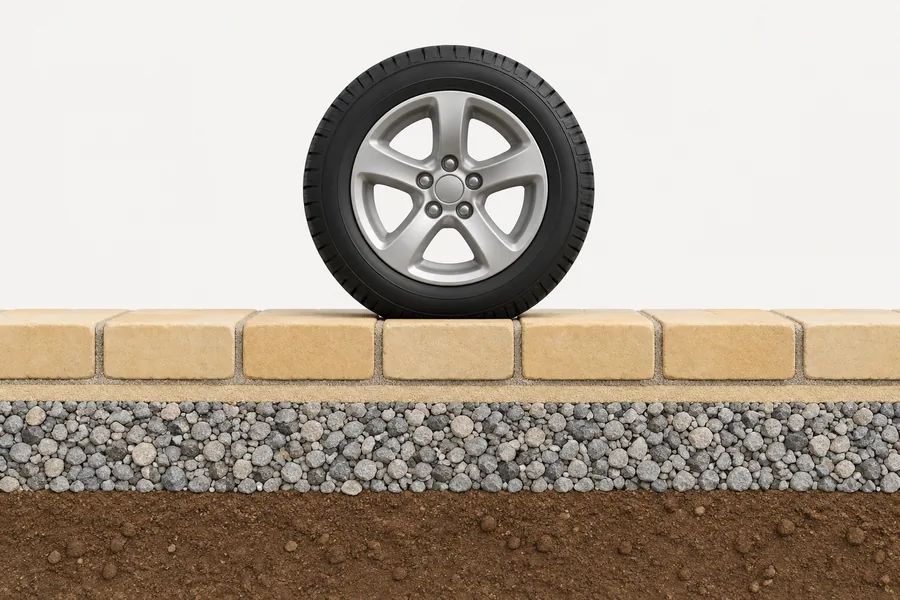
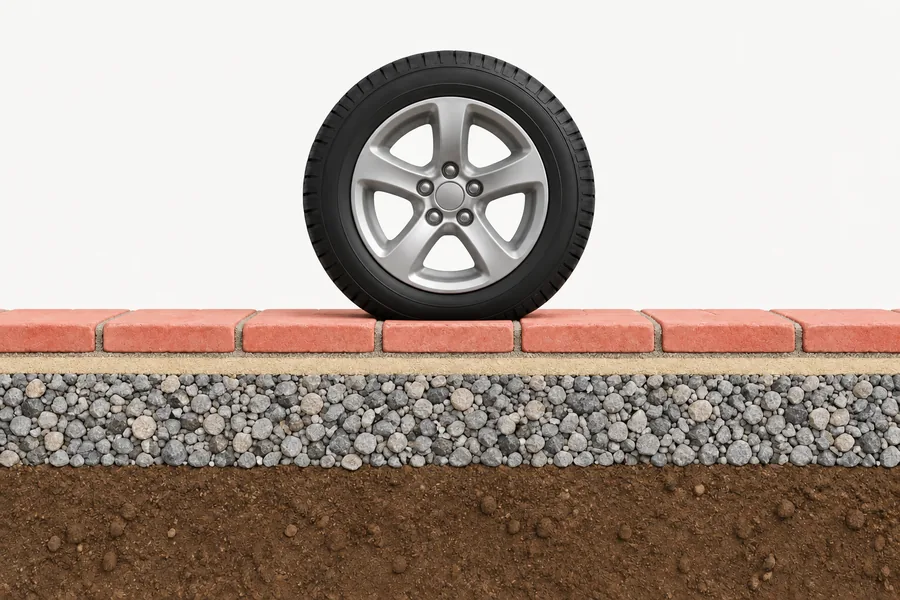
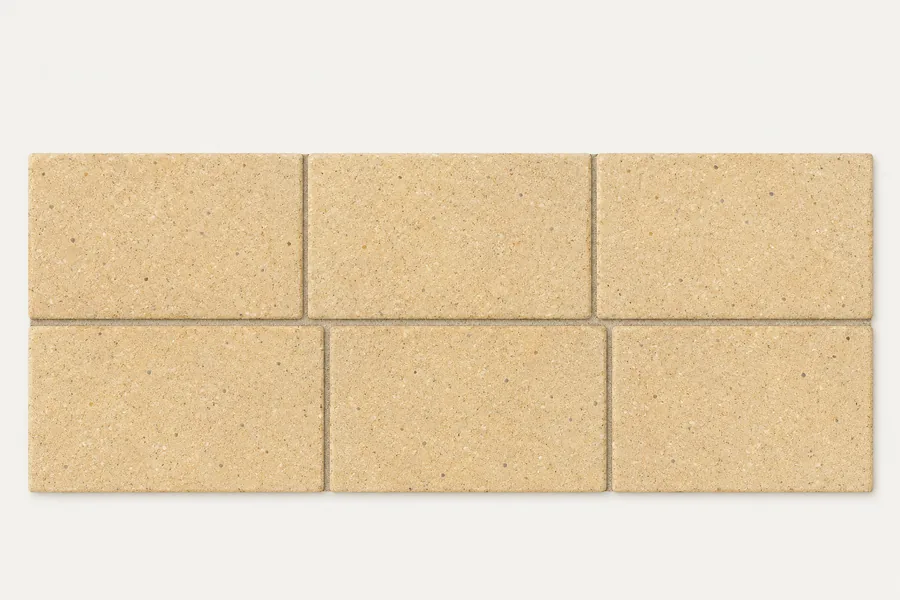
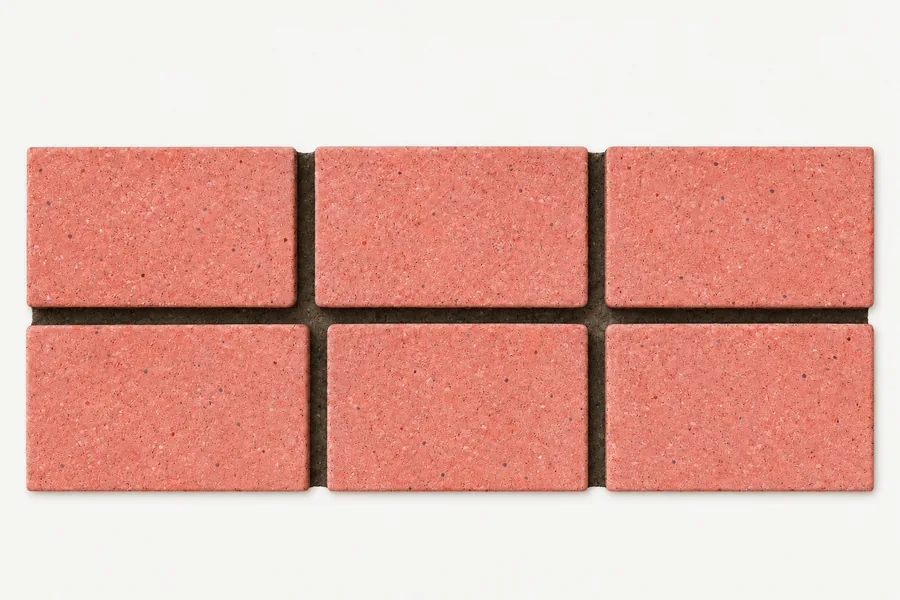
Clay pavers are sized as plan × thickness. The two common US sizes are 4 × 8 in (102 × 203 mm), made for sand-set paving with a joint of about 1/8 in, and 3-5/8 × 7-5/8 in (92 × 194 mm), which fills an 8 in module with a 3/8 in mortar joint. Thickness follows the traffic: BIA suggests 1-1/2 in for light foot traffic, 2-1/4 in for heavy foot traffic or light vehicles and 2-5/8 in for heavy vehicles, which also need a length under three times the thickness. On sand the joint is 1/16–3/16 in, and herringbone needs a paver twice as long as it is wide. UK clay pavers are mostly 200 × 100 mm, laid with 2–5 mm joints on sand.
| Common US paver (BIA) | Thickness for heavy foot traffic or light vehicles (BIA) | Common UK paver (Wienerberger, Ketley) |
|---|---|---|
| 4 × 8in102 × 203 mm | 2-1/4in57 mm | 200 × 100mm |
Sources: BIA, Wienerberger. Checked October 2026.
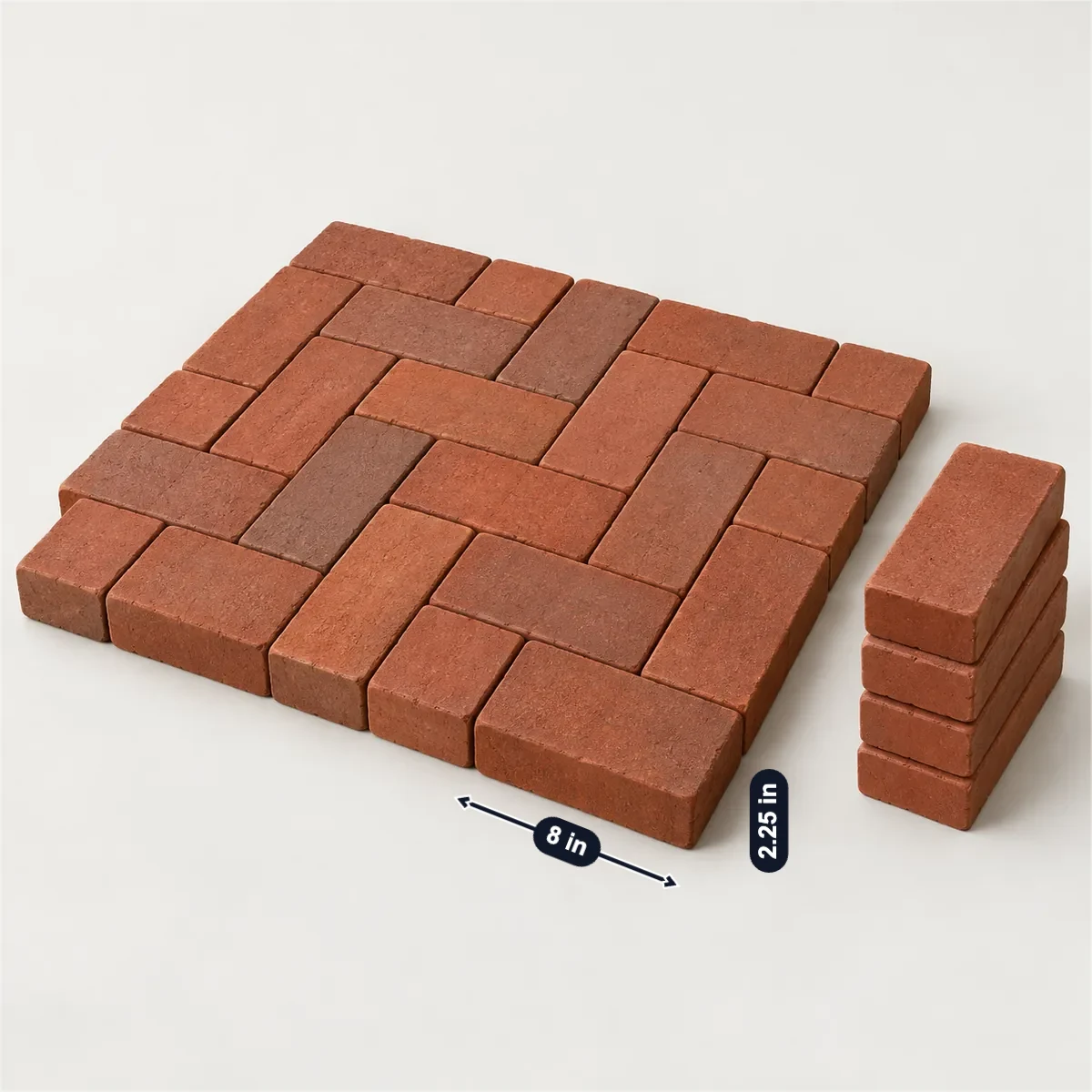
Pine Hall’s 4 × 8 in paver on sand is filled in. Enter your area, the paver, the traffic and the joint, or switch to UK sizes; each check follows a figure on this page.
If the stated size includes spacer lugs, take the lug off the size and enter it as the joint. Thickness is measured without the chamfer.
200 sq ft of 8 × 4 in pavers with 1/8 in joints, at 4.3 a sq ft, is 859.3; with 5% waste you need 903, or 3 packs of 445. 950 ordered covers it.
Pine Hall’s 4 × 8 in Pathway paver with a 1/8 in sand joint, over 200 sq ft as an example; Glen-Gery cubes 445 KF pavers, General Shale figures about 5% waste.
Busy foot traffic or light vehicles: at least 2-1/4 in, and 2-1/4 in meets it.
BIA suggests 2-1/4 in for heavy foot traffic or light vehicles; heavy vehicles need 2-5/8 in and a length under 3 times the thickness.
Sand: 1/16–3/16 in; 1/8 in is inside.
On sand the joint is 1/16–3/16 in (BIA Technical Note 14A); Pine Hall finds 1/8 in gives the strongest interlock.
Selling clay pavers? Photograph a paver on its face and edge, mark the size, the thickness, the lugs and the class in SizeMarker and send it with your quote.
Mark a photoMaker sheets; sizes as each prints them. Spacer lugs on one side or end are counted in the stated size.
| Paver | Size, as printed | Per sq ft or m²; pack | Standard, class; weight |
|---|---|---|---|
| Pine Hall PathwayThis page | 4 × 8 × 2.25 in | — | C902 class SX, type I, application PX; under 8% cold-water absorption |
| Pine Hall heavy vehicular | 4 × 8 × 2.75 in | — | C1272, application PA; under 6% |
| Pine Hall English Edge | 2-1/4 × 4 × 8 in, spacer nibs included | — | C902 SX, type 1, PX |
| Glen-Gery KF 4x8 | 4 × 2-1/4 × 8 in | 4.50 a sq ft; 445 a cube | C902 SX, type I; 5.7 lb |
| Glen-Gery Lawrenceville modular paver | 2-1/4 × 3-9/16 × 7-5/8 in | 4.57 a sq ft; 525 a cube | C902 SX, PS, type I; 4.9 lb |
| Glen-Gery Hometown modular paver | 3-1/2 × 2-1/4 × 7-5/8 in | 4.2 a sq ft; 525 a cube | C902 SX, PS, type II; 4.7 lb |
| Whitacre Greer | 4 × 8 × 2-1/4 and 4 × 8 × 2-3/4 in bevel lug; 4 × 12 × 2-1/4; 8 × 8 × 2-1/4 in | — | — |
| Wienerberger Sycamore Ares 52UK | 200 × 100 × 52 mm | 50 per m²; 624 a pack | T4, U3, A1; 2.33 kg |
| Wienerberger Essen Red 62UK | 200 × 100 × 62 mm | 560 a pack | T4, U3, A3; 2.80 kg |
| Ketley Staffordshire ClassicUK | 200 × 100 × 50 mm chamfered; 200 × 100 × 65 mm square edged; 215 × 102.5 × 50 mm | 48 per m² at a 3 mm joint, 43 at 10 mm; packs of 500, 400 and 500 | T4, U3, A3 |
| Blockleys Hadley RedUK | 210 × 105 × 65 mm, 3 mm spacer nibs included | — | T4 |
Sources: Pine Hall · Pine Hall · Pine Hall · Glen-Gery · Glen-Gery · Glen-Gery · Whitacre Greer · Wienerberger · Wienerberger · Ketley · Blockleys
| Use | Thickness |
|---|---|
| Light foot trafficBIA, flexible paving | 1-1/2 in (38 mm) |
| Medium or heavy foot traffic, light vehiclesBIA | 2-1/4 in (57 mm) |
| Heavy vehiclesBIA | 2-5/8 in (67 mm); length less than 3 times the thickness |
| ASTM C1272 type F, sand bedBIA TN 14 | At least 2-5/8 in, not counting the chamfer |
| ASTM C1272 type R, mortar or asphalt bedBIA TN 14 | At least 2-1/4 in |
| Mortar bedBIA TN 14C | Light vehicles 1-1/4 in (32 mm), heavy vehicles 2-1/4 in |
| Bituminous bedBIA TN 14B | 2-1/4 in and up; 1-1/2 in for foot traffic over concrete |
| UK car park, no heavy trafficWienerberger, BS EN 1344 | 62–65 mm |
| UK occasional heavy trafficWienerberger | 70 mm |
| UK regular heavy traffic, lorries up to 35 mphWienerberger | 85 mm |
| Clay against concrete blockKetley | A 65 mm clay paver performs like an 80 mm concrete block |
| Heavy dutyBIA TN 14 | Over 251 equivalent single axle loads a day; only C1272 pavers |
Sources: BIA · BIA · BIA · BIA · BIA · Wienerberger · Ketley
| Setting | Joint | Bed |
|---|---|---|
| SandBIA TN 14A | 1/16–3/16 in (1.6–4.8 mm); 1/4 in is too wide | Screeded 1 in, compacted 3/4–1 in |
| Sand, under vehiclesBIA TN 14A; Pine Hall | 1/16–1/8 in; 1/8 in is optimum | — |
| MortarBIA TN 14C | 3/8 in typical, 1/4–5/8 in | 3/8–1-1/2 in |
| BituminousBIA TN 14B | Caution over 1/4 in | 3/4 in |
| PermeableBIA TN 14D | At least 1/4 in | 2 in |
| Accessible routeBIA TN 14E | Sand up to 3/16 in, mortar up to 1/2 in | — |
| UK flexibleWienerberger; Ketley | 2–5 mm | 25–40 mm sand; Ketley 30–35 mm, at most 50 mm |
| UK rigidWienerberger | 6–10 mm | — |
Sources: BIA · BIA · BIA · BIA · BIA · Pine Hall · Wienerberger · Ketley
| Item | Figure |
|---|---|
| Common sizesBIA TN 14 | 4 × 8 in (102 × 203 mm) and 3-5/8 × 7-5/8 in (92 × 194 mm); 1-1/4, 1-1/2, 2-1/4, 2-5/8 and 2-3/4 in thick |
| Herringbone and basket weaveBIA TN 14A | Need a length of 2 or 3 widths; pavers sized for a 3/8 in mortar joint go on sand in running, stack or chevron bond only |
| Under vehiclesBIA TN 14; TN 14A | Herringbone recommended; up to 30 mph on a sand bed |
| SlopeBIA TN 14; Ketley | Up to a 10% grade (1 in 10); at least a 2% fall |
| LugsBIA; Pine Hall; Blockleys | Usually 1/8 in; counted in the stated length or width when on one side or end |
| Chamfers; lippingBIA | Chamfers up to 3/16 in; lipping up to 1/8 in with chamfers, 1/16 in square edged |
| BaseBIA TN 14A; Pine Hall | 4 in under foot traffic, 8 in under driveways; add 4 in on clay or silt |
| ClassesBIA TN 14 | C902 SX freezing, MX exterior without freezing, NX interior; types I, II, III by abrasion; applications PS, PX, PA by size tolerance |
| ChinaSAMR | GB/T 26001-2010 fired paving brick, under revision; GB/T 28635-2012 concrete paving units |
| QuantitiesGeneral Shale | 4.5 pavers a sq ft for 4 × 8 in, about 5% for waste; 2 tons of base material per 100 sq ft at 4 in |
| In the check aboveOur calculation | 144 ÷ (8-1/8 × 4-1/8) = 4.30 a sq ft; 200 sq ft = 859.3 + 5% = 902.3, so 903 pavers, 3 cubes of 445; 2-1/4 in meets 2-1/4 in; 1/8 in within 1/16–3/16 in |
Sources: BIA · BIA · Ketley · BIA · Pine Hall · Blockleys · Pine Hall · Pine Hall · General Shale · SAMR · SAMR
The two commonly specified clay paver sizes are 4 × 8 in (102 × 203 mm) and 3-5/8 × 7-5/8 in (92 × 194 mm), 1-1/4, 1-1/2, 2-1/4, 2-5/8 or 2-3/4 in thick (BIA Technical Note 14). UK clay pavers are mostly 200 × 100 mm, 50 to 65 mm thick.
BIA suggests 2-1/4 in for light vehicles and 2-5/8 in for heavy vehicles, with a length under three times the thickness; pavers under heavy vehicles must meet ASTM C1272. In the UK Wienerberger gives 62–65 mm for car parks without heavy traffic, 70 mm for occasional and 85 mm for regular heavy traffic.
On sand, 1/16–3/16 in (1.6–4.8 mm); at 1/4 in the pavers no longer interlock, and 1/16–1/8 in is best under vehicles. Mortar joints run 1/4–5/8 in, typically 3/8 in, and permeable joints at least 1/4 in (BIA).
Only pavers two or three times as long as wide, so the joints line up. Pavers sized for a 3/8 in mortar joint, such as 3-5/8 × 7-5/8 in, should go in running, stack or chevron bond on sand (BIA Technical Note 14A).
For 4 × 8 in pavers General Shale and Glen-Gery give 4.5 a sq ft, plus about 5% for waste. Counted with a 1/8 in sand joint between 4 × 8 in pavers it is 4.30.
Buyers ask for the length, width and thickness and whether lugs are counted in them, the chamfer, the standard and class (C902 or C1272, BS EN 1344 T, U and A classes), the water absorption and strength, pavers per sq ft or m², and pavers, weight and area per cube or pack. Mark them on a photo of your own paver in SizeMarker, as in the picture at the top, and send one product card for WhatsApp or WeChat.