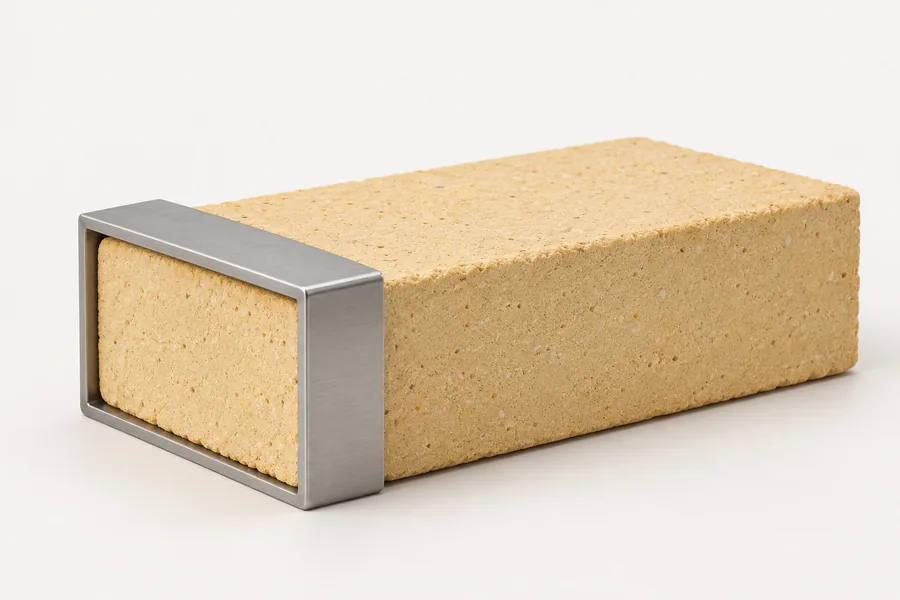
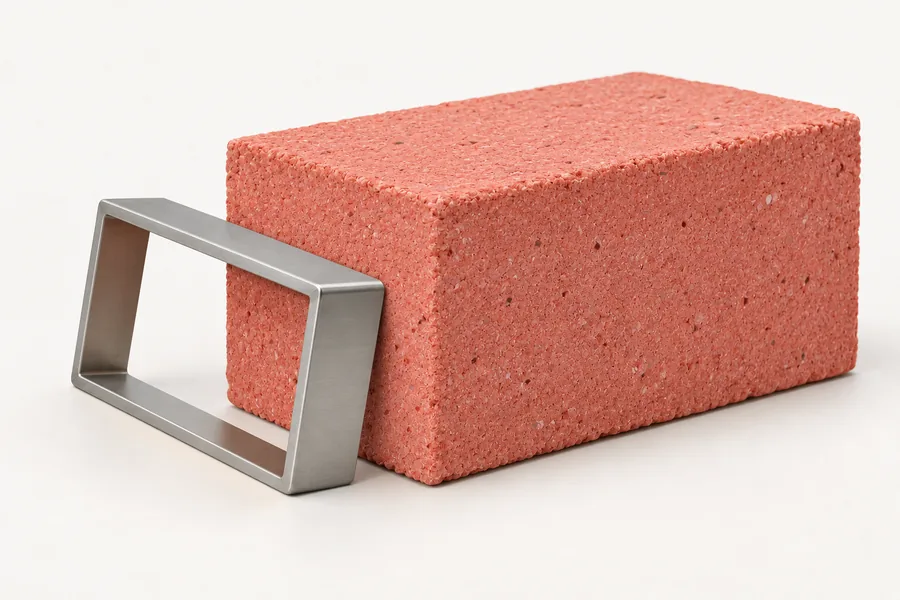
Dimensions / Building materials / Bricks
A US modular brick is specified 3-5/8 × 2-1/4 × 7-5/8 in (92 × 57 × 194 mm); with a 3/8 in joint it takes up a nominal 4 × 2-2/3 × 8 in, so three courses rise 8 in. The most widely used UK brick is 215 × 102.5 × 65 mm, 225 × 112.5 × 75 mm with its 10 mm joint, though BS EN 771-1 sets no standard size. China’s fired common brick is 240 × 115 × 53 mm under GB/T 5101-2017.
| US modular brick, length; width × height (BIA) | UK brick, length; width × height (BDA) | China fired common brick, length; width × height (GB/T 5101-2017) |
|---|---|---|
| 7-5/8in3-5/8 × 2-1/4 in | 215mm102.5 × 65 mm | 240mm115 × 53 mm |
Sources: BIA, BDA, GB/T 5101. Checked October 2026.
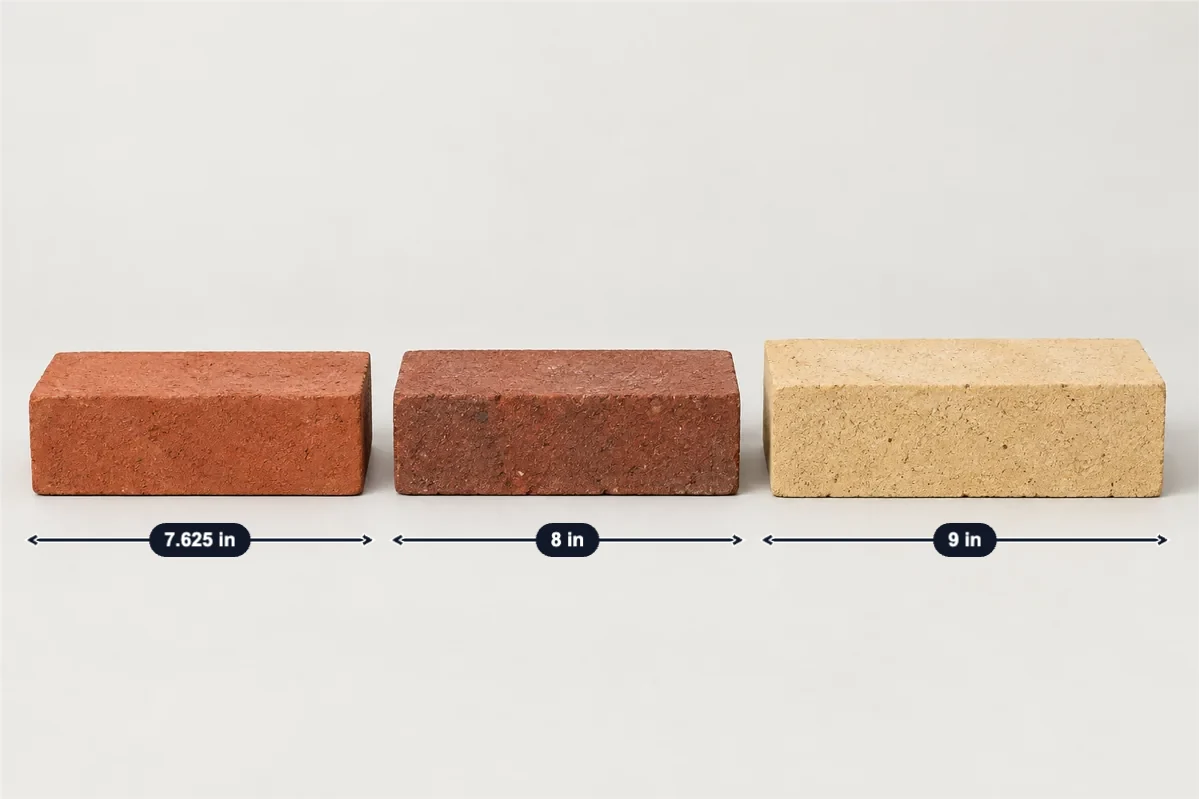
Modular 3-5/8 × 2-1/4 × 7-5/8 in; UK 215 × 102.5 × 65 mm
Wall brick graded for weathering and appearance, laid to a coursing module.
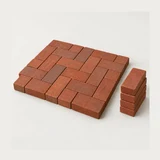
4 × 8 in, 2-1/4 in thick; UK 200 × 100 mm
Solid clay units for patios, walks and driveways, thicker as the traffic gets heavier.

9 × 4-1/2 × 2-1/2 in, one nine-inch equivalent
Refractory brick for fireboxes, kilns and furnaces, classed by the cone it withstands.
Pick wall brick, pavers or firebrick, then enter the job and a measurement; each check rests on a standard or a maker figure from the tables below.
US counts are the BIA Technical Note figures, net of waste; UK counts take the brick plus one joint. Measure one US brick; for the UK classes, average a sample.
500 sq ft of wall in Queen brick, at 5.5 a sq ft, is 2750; with 5% waste you need 2888, or 7 packs of 460. 2900 ordered covers it.
BIA: Queen 550 to 100 sq ft, net.
82 in is 25.63 courses of Queen (5C = 16 in); the nearest heights on whole courses are 80 in (25 courses) and 83.2 in (26).
Queen courses 5C = 16 in.
FBS: 2-3/4 ± 3/32 in, so 2-21/32–2-27/32 in; 2.8 in is inside.
C216 FBS: ±3/32 in on a 2-3/4 in height.
Quoting brick for export? Photograph a brick on its face and end, mark the specified size, the grade and the pack count in SizeMarker, and attach the picture to your quote.
Mark a photo| Size | Nominal W × H × L, in | Specified W × H × L, in (mm) | Coursing |
|---|---|---|---|
| Modular | 4 × 2-2/3 × 8 | 3-5/8 × 2-1/4 × 7-5/8 (92 × 57 × 194); 3-1/2 × 2-1/4 × 7-1/2 with a 1/2 in joint | 3C = 8 in |
| Engineer Modular | 4 × 3-1/5 × 8 | 3-5/8 × 2-13/16 × 7-5/8 (92 × 71 × 194) | 5C = 16 in |
| Closure Modular | 4 × 4 × 8 | 3-5/8 × 3-5/8 × 7-5/8 (92 × 92 × 194) | 1C = 4 in |
| Norman | 4 × 2-2/3 × 12 | 3-5/8 × 2-1/4 × 11-5/8 (92 × 57 × 295) | 3C = 8 in |
| Utility | 4 × 4 × 12 | 3-5/8 × 3-5/8 × 11-5/8 (92 × 92 × 295) | 1C = 4 in |
| Queen | — (non-modular) | 2-3/4 × 2-3/4 × 7-5/8 (70 × 70 × 194) | 5C = 16 in |
| King | — (non-modular) | 2-3/4 × 2-5/8 × 9-5/8 (70 × 67 × 244) | 5C = 16 in |
| Standard | — (non-modular) | 3-5/8 × 2-1/4 × 8 (92 × 57 × 203) | — |
Sources: Brick Industry Association — Technical Note 10, Tables 1 and 2 · Glen-Gery — extruded brick product profile
| Size | mm | in |
|---|---|---|
| UK work size | 215 × 102.5 × 65 | 8.46 × 4.04 × 2.56 |
| UK coordinating size, 10 mm joint | 225 × 112.5 × 75 | 8.86 × 4.43 × 2.95 |
| Germany, normal format NF | 240 × 115 × 71 | 9.45 × 4.53 × 2.80 |
| Germany, thin format DF | 240 × 115 × 52 | 9.45 × 4.53 × 2.05 |
| China, GB/T 5101-2017 | 240 × 115 × 53 | 9.45 × 4.53 × 2.09 |
| China, companion brick | 175 × 115 × 53 | 6.89 × 4.53 × 2.09 |
| India modular, IS 1077:1992 | 190 × 90 × 90; 190 × 90 × 40 | 7.48 × 3.54 × 3.54 |
| India non-modular, IS 1077:1992 | 230 × 110 × 70; 230 × 110 × 30 | 9.06 × 4.33 × 2.76 |
Sources: Brick Development Association — Designing to Brickwork Dimensions · GIMA — Klinker-Fassaden (heinze.de) · GB/T 5101-2017, clause 4.3 (re-hosted by zhulouren.com) · SAMR — GB/T 5101-2017 status · BIS — IS 1077:1992 (Public.Resource.Org)
| Item | Figure |
|---|---|
| Bricks per area | Modular 675, Queen 550, King 455 to 100 sq ft, net, plus at least 5% waste (BIA); about 60 per m² of UK half-brick wall (Michelmersh) |
| Joints | US 3/8 in typical; UK nominal 10 mm; China 10 mm, not under 8 or over 12 mm (GB 50203-2011) |
| Size tolerance | C216 type FBS ±3/32 in on heights of 3 in and under, FBX ±1/16 in (BIA TN 9A); UK class T2 65 ±2 mm, T1 ±3 mm (BDA) |
| Brick pavers | 4 × 8 in and 3-5/8 × 7-5/8 in; 2-1/4 in thick for busy foot traffic or light vehicles, 2-5/8 in for heavy vehicles with a length under 3 times the thickness; sand joints 1/16–3/16 in, 1/8 in optimum; UK pavers mostly 200 × 100 mm |
| Firebrick | 9 × 4-1/2 × 2-1/2 in straight, one nine-inch equivalent; 9 × 4-1/2 × 3 in most widely used, 10.7 a sq ft of 9 in wall; super duty PCE cone 33 or higher (HarbisonWalker) |
| Standards | BS EN 771-1 sets no standard sizes; IS 1077:2025 supersedes the 1992 edition, its sizes not yet checked here |
Sources: BIA — Technical Note 9A, Specifications for and Classification of Brick · Michelmersh — Hampshire Stock Dark Multi data sheet (MKM) · GB 50203-2011, clause 5.3.2 (jianbiaoku) · BIA — Technical Note 14, Paving Systems Using Clay Pavers · BIA — pedestrian flexible brick paving guide (Pine Hall) · BIA — Technical Note 14A, sand setting bed · Pine Hall — technical bulletin 4 · HarbisonWalker — Brick Installation Guide (SSFBS) · BSI — BS EN 771-1:2011+A1:2015 · NSAI shop — IS 1077:2025
In the US, the modular brick: specified 3-5/8 × 2-1/4 × 7-5/8 in (92 × 57 × 194 mm), nominal 4 × 2-2/3 × 8 in. In the UK, 215 × 102.5 × 65 mm. In China, 240 × 115 × 53 mm (GB/T 5101-2017). There is no single European size: BS EN 771-1 sets none, and German bricks are 240 × 115 × 71 mm (NF).
Per BIA Technical Note 10, the nominal size is the specified size plus the intended mortar joint, rounded to a 4 in or 8 in module; the specified size is the brick without mortar, used on drawings and purchase orders; the actual size is the brick as made, within a tolerance of the specified size.
92 × 57 × 194 mm specified (3-5/8 × 2-1/4 × 7-5/8 in), with a 3/8 in joint; nominal 4 × 2-2/3 × 8 in. With a 1/2 in joint the specified size is 3-1/2 × 2-1/4 × 7-1/2 in (BIA).
BIA counts 675 modular bricks to 100 sq ft, 550 Queen and 455 King, before waste; add at least 5%. A UK half-brick wall of 215 × 65 mm bricks takes about 60 per m² (Michelmersh).
China: 240 × 115 × 53 mm, with a 175 × 115 × 53 mm companion brick (GB/T 5101-2017), on 10 mm joints. India: IS 1077:1992 gave 190 × 90 × 90 mm modular and 230 × 110 × 70 mm non-modular bricks; the 2025 edition replaces it.
US practice, as BIA asks, gives width × height × length of the brick laid as a stretcher, so a modular brick is ordered 3-5/8 × 2-1/4 × 7-5/8 in. UK makers such as Wienerberger and Michelmersh print length × width × height, 215 × 102.5 × 65 mm. Check the order on any quote before comparing two bricks.
No. BS EN 771-1, the European standard for clay masonry units, fixes no sizes; each maker declares a work size with a tolerance and range class. The UK settled on 215 × 102.5 × 65 mm, Germany on formats such as NF 240 × 115 × 71 mm and DF 240 × 115 × 52 mm.
Clay pavers are commonly 4 × 8 in or 3-5/8 × 7-5/8 in, 2-1/4 in thick for light vehicles and 2-5/8 in for heavy ones (BIA). A standard firebrick is 9 × 4-1/2 × 2-1/2 in, and 9 × 4-1/2 × 3 in is the most widely used size (HarbisonWalker).
Before ordering, buyers want the specified size and which way it is written, the tolerance class, the weathering or freeze-thaw grade, the water absorption and strength, cores or frog and the void share, the weight, and bricks per pack and packs per truck or container; for firebrick the duty class or PCE and the shapes. Label these on a photo of your own brick in SizeMarker and send buyers the spec diagram over WhatsApp or WeChat.