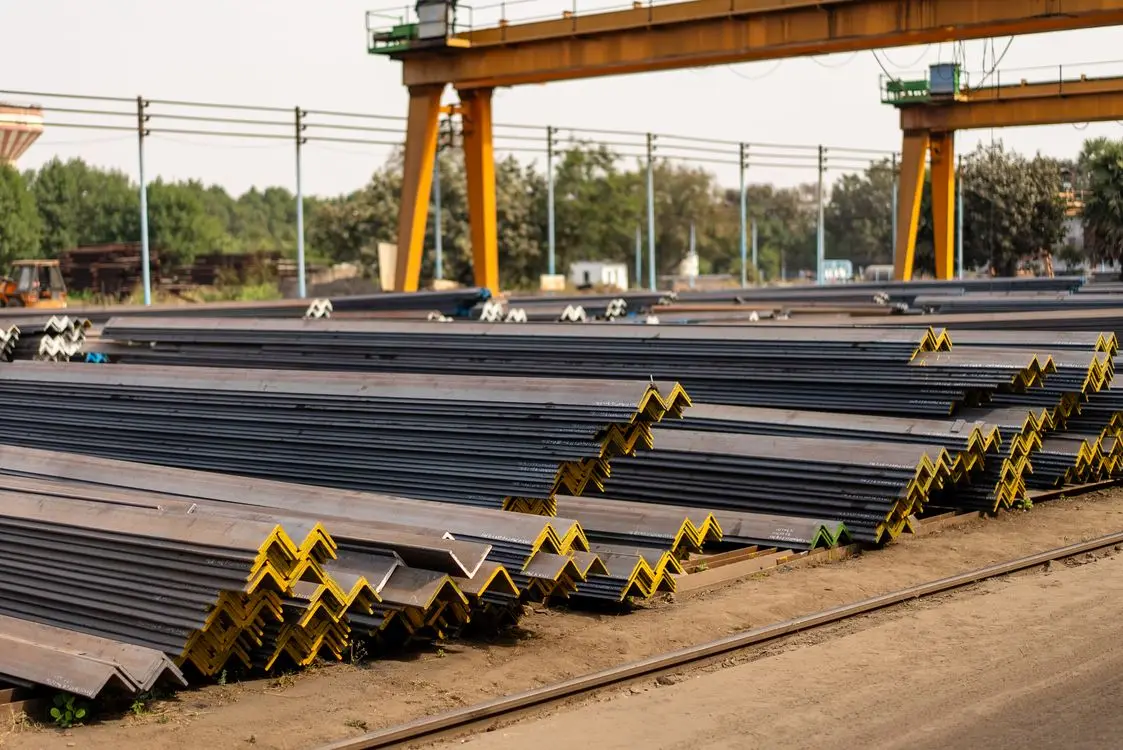
Steel profile dimensions are the first thing an overseas buyer checks before a purchase order clears: what is the actual outside size of this section, and what does one metre of it weigh? An engineer in Rotterdam ordering "100×100 box, 5 mm wall" and a stockist in Houston quoting "HSS 4×4×3/16" can be pointing at nearly the same steel — or at two sections that differ by a few millimetres and a few kilos per metre, which is exactly where mill-cert disputes and rejected loads begin.
This reference puts the section sizes overseas buyers ask for in one place — equal and unequal angle, channel, square and rectangular hollow section, and round tube — then explains the three things buyers reliably get wrong: designation versus real outside dimension, EU versus US naming, and how much the weight on the mill certificate is allowed to move.
Steel profile dimensions at a glance: the master reference table
Every value below is a designation per standard with a theoretical mass per metre. Section masses in EN tables are calculated from cross-sectional area at a steel density of 7850 kg/m³ — they are nominal figures, not the weight on your scale. Always confirm the exact section table and the mill's dimensional and mass tolerances against the current standard or the mill certificate before you quote.
| Profile type |
Designation (example) |
Key dimensions (mm) |
Typical wall / thickness (mm) |
Theoretical mass (kg/m) |
Governing standard |
| Equal angle |
L 50×50×5 |
legs 50 × 50, t 5 |
3–16 across the family |
3.77 |
EN 10056-1 |
| Equal angle |
L 100×100×10 |
legs 100 × 100, t 10 |
— |
15.0 |
EN 10056-1 |
| Equal angle |
L 200×200×16 |
legs 200 × 200, t 16 |
— |
48.5 |
EN 10056-1 |
| Unequal angle |
L 100×50×8 |
legs 100 × 50, t 8 |
6–15 across the family |
8.97 |
EN 10056-1 |
| Unequal angle |
L 150×90×10 |
legs 150 × 90, t 10 |
— |
18.2 |
EN 10056-1 |
| Unequal angle |
L 200×150×15 |
legs 200 × 150, t 15 |
— |
39.6 |
EN 10056-1 |
| Channel (U) |
UPN 80 |
h 80, b 45 |
flange 8.0 |
8.64 |
EN 10365 (dims), EN 10279 (tol.) |
| Channel (U) |
UPN 100 |
h 100, b 50 |
flange 8.5 |
10.6 |
EN 10365 |
| Channel (U) |
UPN 200 |
h 200, b 75 |
flange 11.5 |
25.3 |
EN 10365 |
| Channel (U) |
UPN 300 |
h 300, b 100 |
flange 16.0 |
46.2 |
EN 10365 |
| Square hollow (SHS) |
SHS 40×40 |
40 × 40 |
wall 2.5–5.0 |
2.89–5.28 |
EN 10210 / EN 10219; ASTM A500 |
| Square hollow (SHS) |
SHS 100×100 |
100 × 100 |
wall 3.6–10 |
10.8–27.4 |
EN 10210 / EN 10219; ASTM A500 |
| Square hollow (SHS) |
SHS 150×150 |
150 × 150 |
wall 5–16 |
22.6–65.2 |
EN 10210 / EN 10219; ASTM A500 |
| Rectangular hollow (RHS) |
RHS 50×25 |
50 × 25 |
wall 2.5–3.0 |
2.69–3.17 |
EN 10210 / EN 10219; ASTM A500 |
| Rectangular hollow (RHS) |
RHS 100×60 |
100 × 60 |
wall 3.0–8.0 |
7.18–17.5 |
EN 10210 / EN 10219; ASTM A500 |
| Rectangular hollow (RHS) |
RHS 200×100 |
200 × 100 |
wall 4.0–16.0 |
18.1–65.2 |
EN 10210 / EN 10219; ASTM A500 |
| Round tube (CHS) |
CHS 48.3 |
OD 48.3 |
wall 2.6–4.0 |
2.93–4.37 |
EN 10210 / EN 10219; ASTM A500 |
| Round tube (CHS) |
CHS 60.3 |
OD 60.3 |
wall 3.2–5.0 |
4.51–6.82 |
EN 10210 / EN 10219; ASTM A500 |
| Round tube (CHS) |
CHS 114.3 |
OD 114.3 |
wall 5.0–8.0 |
13.5–21.0 |
EN 10210 / EN 10219; ASTM A500 |
| Round tube (CHS) |
CHS 219.1 |
OD 219.1 |
wall 8.0–12.5 |
41.6–63.7 |
EN 10210 / EN 10219; ASTM A500 |
Hollow-section families run wider than the rows above: EN circular hollow sections span roughly OD 21.3 mm to 457 mm with walls from 2.6 mm to 40 mm, and SHS/RHS wall thicknesses commonly reach 16 mm on larger sizes. The rows are representative sizes so you can sanity-check a quote at a glance, not the full section table.
Key differences buyers get wrong
Most steel profile dimensions arguments are not about quality — they are about vocabulary. Four traps cause almost all of them.
Designation vs actual outside dimension: tube is honest, pipe is not
A structural hollow section's designation is its real outside dimension. A 100×100 SHS genuinely measures about 100 mm across each face, and a CHS 60.3 really is 60.3 mm outside diameter — the steel tube OD you order is the steel tube OD you receive, within tolerance. Structural pipe does not work this way. Nominal Pipe Size (NPS) and Diameter Nominal (DN) are labels, not measurements: NPS 2 / DN 50 pipe has an outside diameter of 60.3 mm, not 50 mm and not 2 inches, and the bore shrinks as the schedule (wall) climbs.
A structural tube is honest about its size; a pipe is not. If a drawing says "2-inch tube," ask whether the buyer means a 2 in (50.8 mm) structural CHS or NPS 2 pipe at 60.3 mm OD — the two are almost 10 mm apart. For the full pipe logic, see how pipe and fitting dimensions (NPS, DN, schedule and OD) diverge from tube, and the wider pattern of nominal vs actual dimensions across product families.
EU vs US naming (and why 100×100 SHS is not "HSS 4×4")
European steel section sizes are metric and dimensional: L 100×100×10 angle, UPN 200 channel, SHS 100×100. American structural tubing uses the HSS series to ASTM A500 in inches — HSS 4×4×1/4 — and American channels use the C / MC series. The sizes are close but not interchangeable: HSS 4×4 is 101.6 mm nominal, a hair over a 100×100 SHS, and the wall thicknesses come off different gauge tables. When a buyer quotes an inch designation, convert it explicitly and confirm the governing standard rather than assuming the nearest metric section is "the same."
Channel adds its own naming fork. UPN (taper-flange) and UPE (parallel-flange) are both European channels standardised for dimensions and masses in EN 10365, with tolerances carried in EN 10279 — a UPN 200 and a UPE 200 share the 200 mm depth but differ in flange width and thickness, so "200 channel" alone is not a spec.
Weight and mass tolerance: theoretical kg/m is not what lands on the mill cert
Every kg/m figure in a section table is theoretical, derived from the nominal cross-section and 7850 kg/m³. The formula is honest and simple: mass per metre = cross-sectional area (mm²) × 7850 ÷ 1,000,000, which is why the same 100×100×10 angle is always listed at 15.0 kg/m. Real bars vary. Rolling and forming tolerances on dimensions — and therefore on the weight per meter of steel you actually receive — are set by the standard: EN 10056 for angles, EN 10365/EN 10279 for channels, EN 10210/EN 10219 for hollow sections, and ASTM A6/A6M for rolled US shapes, plates and bars. ASTM A6/A6M is not a grade; it is the general-requirements standard that defines the permissible variations in dimension, mass, straightness and camber that ride alongside a grade such as A36 or A572. For A500 tubing, wall thickness at any point may not fall below 90% of nominal, so structural design applies 0.93 × nominal wall. Order by section and grade, price on theoretical mass, but reconcile the delivered weight against the mill certificate — not against the catalogue.
Hot-finished vs cold-formed (EN 10210 vs EN 10219; ASTM A500)
The same SHS/RHS/CHS size exists in two process families, and buyers who only quote a size leave this open. EN 10210 covers hot-finished structural hollow sections; EN 10219 covers cold-formed welded ones. Hot-finished sections have more uniform through-thickness properties and tighter corner profiles; cold-formed sections have harder, work-hardened corners and a larger corner radius (for A500, the outside corner radius may reach up to three times the wall thickness). Dimensions and masses are near-identical between the two, but corner geometry, ductility and certification differ — so "EN 10210 or EN 10219?" belongs on the enquiry, and for US work the equivalent question is the grade of ASTM A500 tubing (Grade C, with a 50 ksi yield, is the predominant supply).
What to lock onto the profile spec label
A buyer-facing spec diagram removes ambiguity when it carries the numbers that matter, measured and stated in the buyer's units. For each SKU, put these on the label:
The reason these disputes start is that the number in the buyer's head rarely matches the number on the steel: a "50 tube," a "200 channel," a "4-inch box" all mean two or three different sections depending on who is speaking. A spec diagram that carries the measured outside dimension, wall thickness and per-metre weight — pinned to the actual photo or drawing of the section and exported at the size the buyer will read it at — settles the question before it becomes a claim. That is a different exercise from dropping a product photo into an AI image tool, which will render a clean-looking "100 mm" callout that was never measured and can be wrong by millimetres. On steel, a plausible-but-wrong number is worse than no number, because it reads as a promise. The mechanics of how to label metal product specifications go a level deeper, and you can see finished spec-diagram examples in the showcase.
Which section to spec
Match the steel profile dimensions to the load and the buyer's standard, not to what is on the shelf. Angles (EN 10056 angle families) suit brackets, frames and edge trims where two faces meet at 90°. Channels carry bending as purlins, rails and frames where one open face is useful for fixing. SHS and RHS hollow-section sizes give efficient bending and torsion for columns, booms and trailer frames, with RHS favoured where the load acts mainly in one plane. Round tube (CHS) is the choice for torsion, fluid-adjacent structures and anywhere appearance and uniform strength matter. Whichever family, quote the governing standard, the grade, and the hot-finished/cold-formed process alongside the dimensions.
Next steps
- Confirm the exact section table, dimensional tolerances and mass tolerance against the current EN or ASTM standard, or the mill certificate, before you commit a price.
- Build a one-page spec sheet per SKU that states designation, actual outside dimensions, wall thickness, theoretical kg/m and the governing standard — in the buyer's units.
- Cross-check the buyer's naming against yours: translate every inch/HSS/NPS designation to the metric section you will actually ship, and vice versa.
- Turn the spec sheet into a buyer-facing diagram: lock the measured outside dimensions, wall thickness and per-metre weight onto the profile's photo or drawing and export it at spec size, so the number the buyer sees is the number you measured — one option among the tools that do this without inventing values.
FAQ
Does a 100×100 SHS actually measure 100 mm across?
Yes. Structural hollow section designations are real outside dimensions, so a 100×100 SHS measures about 100 mm across each face and a 60.3 CHS is 60.3 mm outside diameter, within the standard's tolerance. This is the opposite of structural pipe, where NPS/DN is a nominal label rather than the measured size.
What does a metre of steel angle, channel or tube weigh?
It depends only on the cross-section: mass per metre = cross-sectional area (mm²) × 7850 kg/m³ ÷ 1,000,000. Worked examples from EN tables: L 100×100×10 equal angle is 15.0 kg/m, UPN 200 channel is 25.3 kg/m, SHS 100×100 runs from 10.8 kg/m at 3.6 mm wall to 27.4 kg/m at 10 mm wall, and CHS 60.3×3.2 is 4.51 kg/m. These are theoretical; the delivered bar varies within tolerance.
Is steel tube OD the same as pipe NPS?
No. A structural tube's outside diameter is the actual measured OD you order, but pipe NPS (and metric DN) is a nominal designation, not a dimension — NPS 2 / DN 50 pipe is 60.3 mm OD, not 50 mm. Never treat a tube OD and a pipe NPS number as interchangeable on the same drawing.
What is the weight tolerance on a steel section?
Catalogue masses are theoretical, so the real weight moves within the tolerances the standard allows: EN 10056 for angles, EN 10365/EN 10279 for channels, EN 10210/EN 10219 for hollow sections, and ASTM A6/A6M for US rolled shapes, plates and bars. For A500 tubing, wall thickness may not drop below 90% of nominal at any point. Reconcile delivered weight against the mill certificate, not the catalogue.
EN 10210 or EN 10219 — which hollow section should I quote?
EN 10210 is hot-finished and EN 10219 is cold-formed welded; sizes and masses are near-identical, but corner radius, through-thickness uniformity and ductility differ. Quote hot-finished (EN 10210) where corner properties and tighter geometry matter, cold-formed (EN 10219) where cost and availability lead, and use the grade of ASTM A500 tubing for US-standard work.
Sources & References