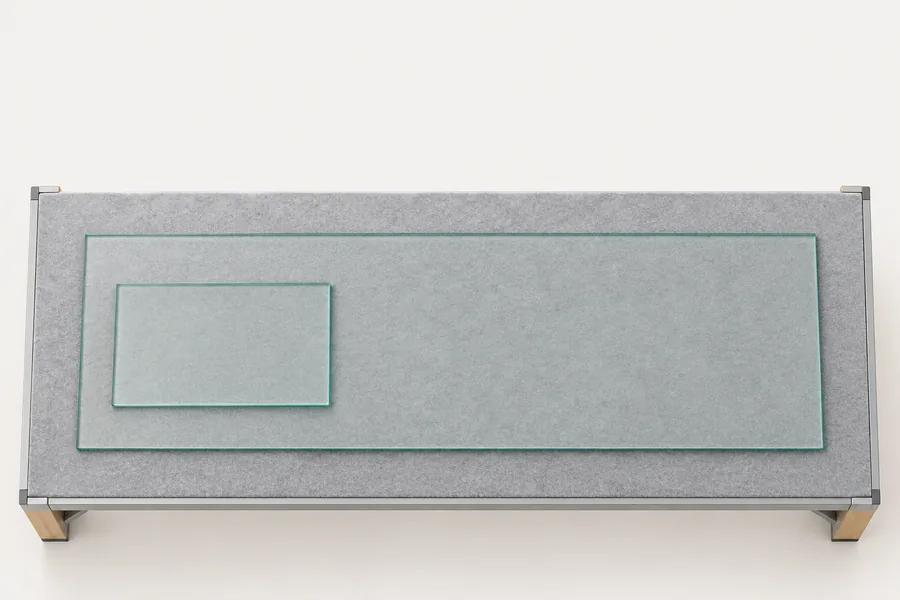
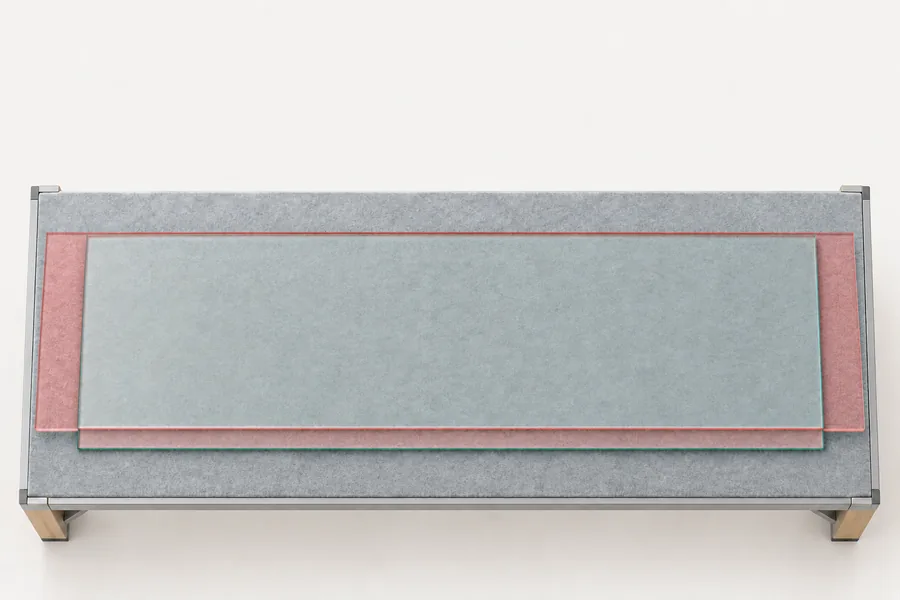
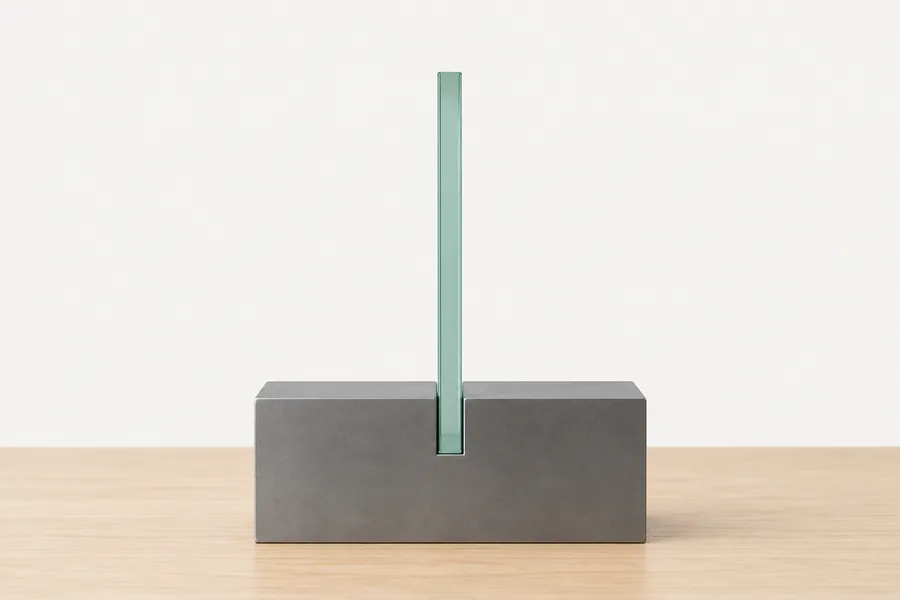
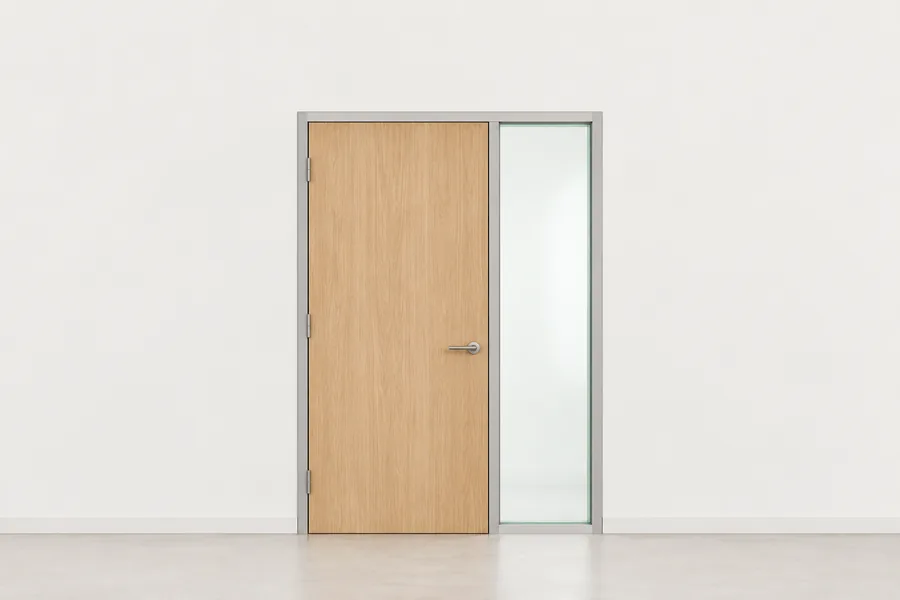
Dimensions / Building materials / Flat glass / Clear float glass
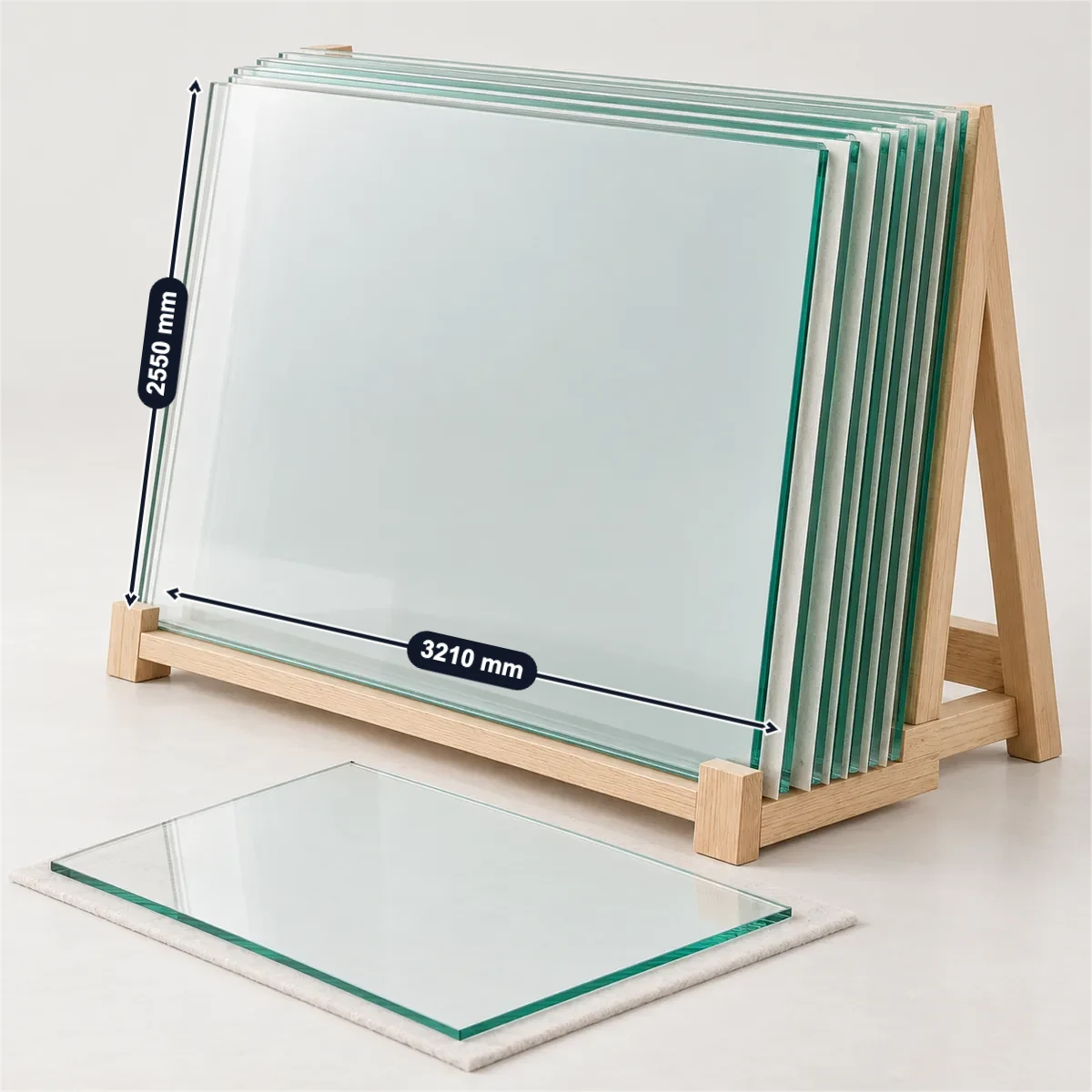
Clear float glass is ordered by nominal thickness, 2 to 25 mm in Europe, and weighs 2.5 kg/m² per mm: 6 mm is 15 kg/m². EN 572-2 allows ±0.2 mm from 2 to 6 mm, ±0.3 mm from 8 to 12 mm, ±0.5 mm at 15 mm and ±1.0 mm at 19 mm. It is cut to size from jumbo sheets of 6000 × 3210 mm or split sizes such as 3210 × 2550 mm. US sizes are fractions of an inch: 1/4 in is 6.0 mm (0.219–0.235 in), and 5/8 in is 16 mm, not 15. Annealed float breaks into large shards, so doors and other hazardous locations need tempered or laminated glass.
| Weight, 6 mm | EN 572-2, 6 mm | LES sheet |
|---|---|---|
| 15kg/m² | ±0.2mm5.8–6.2 mm | 3210 × 2550mm |
Sources: Saint-Gobain, AGC Glass Poland, Pilkington. Checked October 2026.
Forty 900 × 1200 mm panes of 6 mm float cut from LES sheets, a thickness reading and a window 600 mm off the floor are filled in; change the sheet, the size, the reading or where the glass goes.
Weights at 2.5 kg/m² per mm of glass (Saint-Gobain) and 1.07 g/cm³ for PVB (Trosifol). No trim allowance, no wind-load or strength calculation.
6 panels of 900 × 1200 mm come out of one LES sheet (3210 × 2550 mm), turned whichever way gives more, so 40 panels take 7 sheets. Each panel is 1.08 m² and weighs 16.2 kg at 6 mm; all 40 weigh 648 kg.
LES sheets are 3210 × 2550 mm; nothing is taken off for trim, as no maker prints a figure.
EN 572-2 allows 6 mm float glass ±0.2 mm, so 5.8–6.2 mm; you measured 6.1 mm.
EN 572-2: ±0.2 mm from 2 to 6 mm, ±0.3 mm from 8 to 12 mm.
A window pane is a hazardous location only when it is over 0.84 m² (9 ft²), its bottom edge is below 457 mm (18 in) and its top above 914 mm (36 in) (IBC 2406.4.3); this 1.08 m² pane from 600 to 1800 mm misses at least one of those. Annealed float is allowed here.
IBC 2406.4.3 counts a window pane only when all four of its conditions hold.
Selling float glass? Photograph a stack edge beside the label, mark thickness, sheet size and the EN 572-2 tolerance in SizeMarker, and send the picture with your price list.
Mark a photoWeights at 2.5 kg/m² per mm: Saint-Gobain prints 5, 10, 15 and 30 kg at 2, 4, 6 and 12 mm, the other rows are our calculation. Tolerances are EN 572-2 as AGC Glass Poland and Wutkowski print them.
| Nominal | Weight | EN 572-2 tolerance | Nearest US name (Vitro) |
|---|---|---|---|
| 2 mm | 5 kg/m² | ±0.2 mm | Picture glass, 0.071–0.084 in |
| 3 mm | 7.5 kg/m² | ±0.2 mm | 1/8 in, 0.115–0.134 in |
| 4 mm | 10 kg/m² | ±0.2 mm | 5/32 in, 0.150–0.164 in |
| 5 mm | 12.5 kg/m² | ±0.2 mm | 3/16 in, 0.180–0.193 in |
| 6 mmThis page | 15 kg/m² | ±0.2 mm (5.8–6.2 mm) | 1/4 in, 0.219–0.235 in |
| 8 mm | 20 kg/m² | ±0.3 mm | 5/16 in, 0.292–0.332 in |
| 10 mm | 25 kg/m² | ±0.3 mm | 3/8 in, 0.355–0.406 in |
| 12 mm | 30 kg/m² | ±0.3 mm | 1/2 in, 0.469–0.531 in |
| 15 mm | 37.5 kg/m² | ±0.5 mm | None: 5/8 in is 16 mm, 0.595–0.656 in |
| 19 mm | 47.5 kg/m² | ±1.0 mm | 3/4 in, 0.719–0.781 in |
| 25 mmTolerance as Wutkowski prints it | 62.5 kg/m² | ±1.0 mm | 1 in, 0.969–1.031 in |
Sources: Saint-Gobain · AGC Glass Poland · Wutkowski · Vitro
Vitro packs glass under a designation while it stays inside the range shown; the ranges are Vitro’s trade ranges, not ASTM C1036 limits. Weights: Vitro first, NGA second.
| Designation | Metric name | Thickness range | Weight |
|---|---|---|---|
| 3/32 inSingle strength | 2.5 mm | 0.085–0.101 in | 1.164 lb/ft²; 1.2 |
| 1/8 inDouble strength | 3.0 mm | 0.115–0.134 in | 1.557 lb/ft²; 1.6 |
| 3/16 in | 5.0 mm | 0.180–0.193 in | 2.407 lb/ft²; 2.4 |
| 1/4 inThis page | 6.0 mm | 0.219–0.235 in | 2.918 lb/ft²; 3.0 |
| 3/8 in | 10.0 mm | 0.355–0.406 in | 4.932 lb/ft²; 5.0 |
| 1/2 in | 12.0 mm | 0.469–0.531 in | 6.411 lb/ft²; 6.4 |
| 5/8 in | 16 mm | 0.595–0.656 in | 8.020 lb/ft²; 8.1 |
| 3/4 in | 19 mm | 0.719–0.781 in | 9.734 lb/ft²; 9.8 |
| Item | Size or rule | Who prints it |
|---|---|---|
| Jumbo (PLF) | 6000 × 3210 mm, 19.26 m² (our calculation) | Pilkington, Saint-Gobain |
| LESA split size (DLF) | 3210 × 2550 mm | Pilkington, Saint-Gobain |
| Split | 3210 × 2250 mm | Saint-Gobain |
| Chinese lines | Widths 3050, 3300 and 3660 mm, up to 18000 mm long; 2–19 mm thick | CSG |
| Cut-size toleranceEN 572-8 | 2–6 mm glass ±1.0, ±1.5 or ±2.0 mm for sides up to 1500, to 3000 or over 3000 mm; 8–12 mm ±1.5, ±2.0 or ±2.5 mm | AGC Glass Poland |
| Measuring thickness | Mean of readings at the four side centres, taken to 0.01 mm and rounded to 0.1 mm | Wutkowski |
| Trim | No maker prints a trim allowance; the check above takes none off | — |
| Standards | EN 572-2:2012 current, under review; ASTM C1036-25 current; in China GB 11614-2022, mandatory, in force since 2023-08-01 | BSI; ASTM; SAMR |
Sources: Pilkington · Saint-Gobain · CSG · AGC Glass Poland · Wutkowski · BSI · ASTM · SAMR
US model codes as adopted by Seattle in 2021: hazardous locations need safety glazing, tempered or laminated glass that passes 16 CFR 1201 or ANSI Z97.1.
| Location | Rule |
|---|---|
| DoorsIBC 2406.4.1, IRC R308.4.1 | All door glass is a hazardous location: tempered or laminated only |
| Next to a doorIBC 2406.4.2 | Within 610 mm (24 in) of the door edge with the bottom below 1524 mm (60 in): safety glazing |
| WindowsIBC 2406.4.3 | Safety glazing only if the pane is over 0.84 m² (9 ft²), its bottom is below 457 mm (18 in), its top above 914 mm (36 in) and a walking surface is within 914 mm |
| Tubs and showersIBC 2406.4.5 | Bottom edge below 1524 mm (60 in): safety glazing |
| Guards and railingsIBC 2406.4.4, 2407.1 | Safety glazing at any height, and laminated |
| Framed panes in ChinaJGJ 113 table 7.1.1-2 | 3 mm up to 0.1 m², 4 mm 0.3, 5 mm 0.5, 6 mm 0.9, 8 mm 1.8, 10 mm 2.7, 12 mm 4.5 m² |
| When it breaksHong Kong Buildings Department | Large jagged shards |
| Cutting16 CFR 1201 | Cooled slowly so it can still be cut and worked after it is made |
Sources: City of Seattle · City of Seattle · JGJ 113-2015 · Hong Kong Buildings Department · eCFR
European makers list 2, 3, 4, 5, 6, 8, 10, 12, 15, 19 and 25 mm. US names are inch fractions: 1/8 in is 3.0 mm, 1/4 in 6.0 mm and 1/2 in 12.0 mm.
15 kg/m², at 2.5 kg/m² per mm (Saint-Gobain). A US 1/4 in pane is 2.918 lb/ft² in Vitro’s table and 3.0 in NGA’s.
Under EN 572-2, ±0.2 mm from 2 to 6 mm, ±0.3 mm from 8 to 12 mm, ±0.5 mm at 15 mm and ±1.0 mm at 19 and 25 mm, so a 6 mm pane may measure 5.8–6.2 mm.
6000 × 3210 mm. Pilkington’s LES size is 3210 × 2550 mm and Saint-Gobain also stocks 3210 × 2250 mm; CSG in China runs widths of 3300 and 3660 mm.
No. US 5/8 in glass is 16 mm, 0.595–0.656 in thick (Vitro); 15 mm is a European thickness with no US name.
No. IBC 2406.4.1 and IRC R308.4.1 make all door glass a hazardous location, so it must be tempered or laminated safety glazing.
Importers ask for the nominal thickness and the standard (EN 572-2, ASTM C1036, GB 11614), the measured thickness, the sheet size (jumbo, LES or cut sizes), the weight per m² and per crate, the edge work and the packing: interleaving, A-frames or wooden cases. Mark those on a photo of your own glass with SizeMarker, like the picture at the top, and share one card in WhatsApp or WeChat.