Dimensions / Building materials / Flat glass / Laminated glass
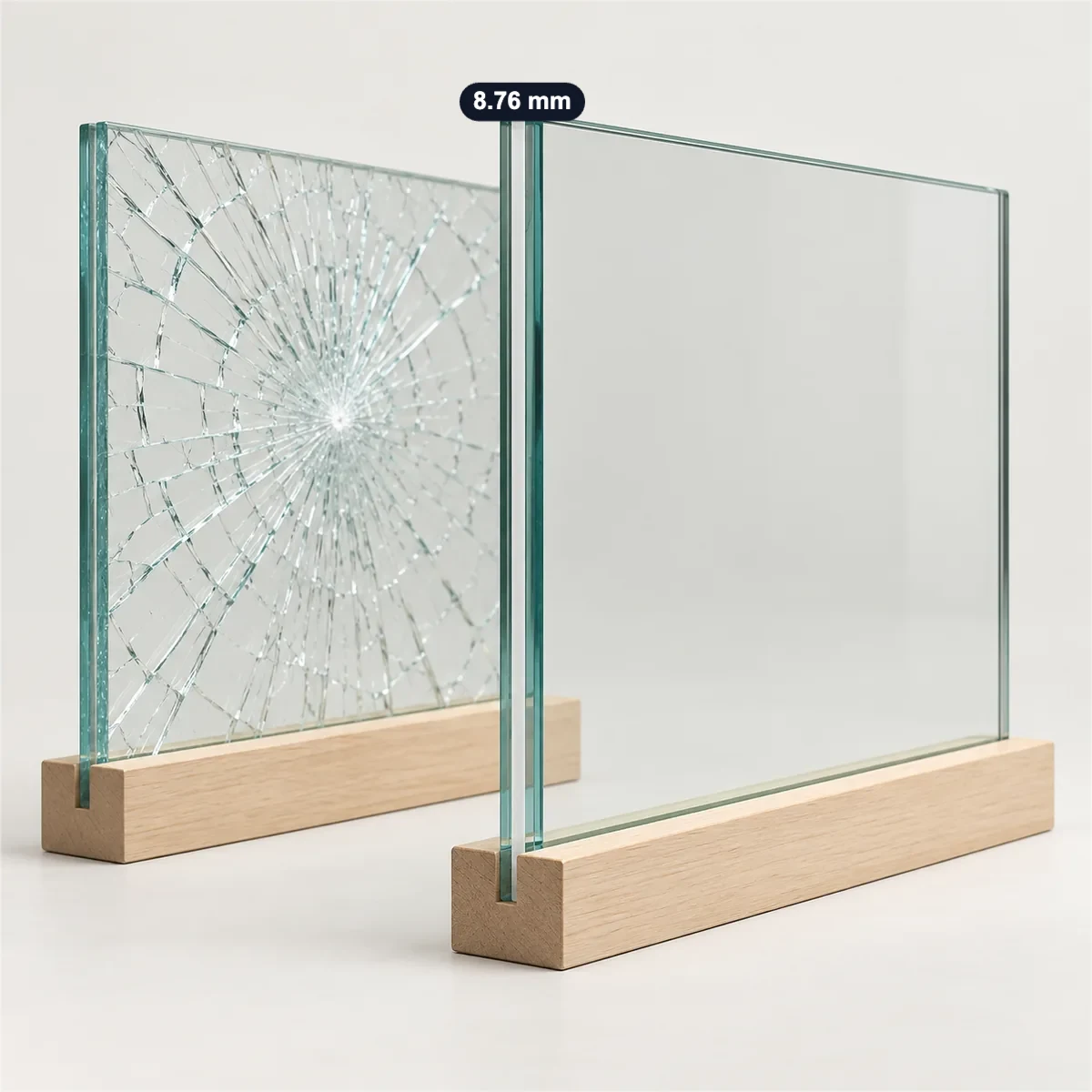
Laminated glass is two or more panes bonded by an interlayer, so its thickness is a sum: 6.38 mm is 3 + 3 mm of glass and 0.38 mm of PVB, 8.76 mm is 4 + 4 mm and 0.76 mm. PVB comes in 0.38 mm steps (0.38, 0.76, 1.14, 1.52, 2.28 mm) at 1.07 g/cm³, and SentryGlas ionoplast in 0.89, 1.52 and 2.28 mm sheets. The thickness tolerance is the panes’ tolerances plus ±0.1 mm for an interlayer up to 2 mm, so 8.76 mm is ±0.5 mm. Broken, the pieces stay on the interlayer: US codes ask for laminated glass in guards (IBC 2407.1), and Chinese codes in floors and balustrades.
| 6.38 mm makeup | PVB step | Tolerance, 8.76 mm |
|---|---|---|
| 3 + 3 + 0.38mm | 0.38mm1.07 g/cm³ | ±0.5mm8.26–9.26 mm |
Sources: JGJ 113-2015, Kuraray, Wutkowski. Checked October 2026.
Twelve 1200 × 1500 mm panels of 8.76 mm laminate for a glass guard, made of tempered panes, and a thickness reading are filled in; change the makeup, the size, the reading, the panes or where it goes.
Weights at 2.5 kg/m² per mm of glass (Saint-Gobain) and 1.07 g/cm³ for PVB (Trosifol). No trim allowance, no wind-load or strength calculation.
CSG laminates from 300 × 300 mm up to 3300 × 12000 mm, and 1200 × 1500 mm is inside that. The 8.76 mm laminate (two 4 mm panes and 0.76 mm PVB) weighs 20.8 kg/m², so each panel is 37.5 kg and all 12 weigh 450 kg.
CSG laminates 300 × 300 to 3300 × 12000 mm; PVB weighs 1.07 g/cm³ (Kuraray).
This 8.76 mm laminate may be off by both panes’ tolerance and the interlayer’s: ±0.2 mm for each 4 mm pane (EN 572-2) and ±0.1 mm for the 0.76 mm PVB (EN ISO 12543-5), ±0.5 mm in all, so 8.26–9.26 mm; you measured 8.8 mm.
Each 4 mm pane ±0.2 mm, the 0.76 mm PVB ±0.1 mm: ±0.5 mm in all.
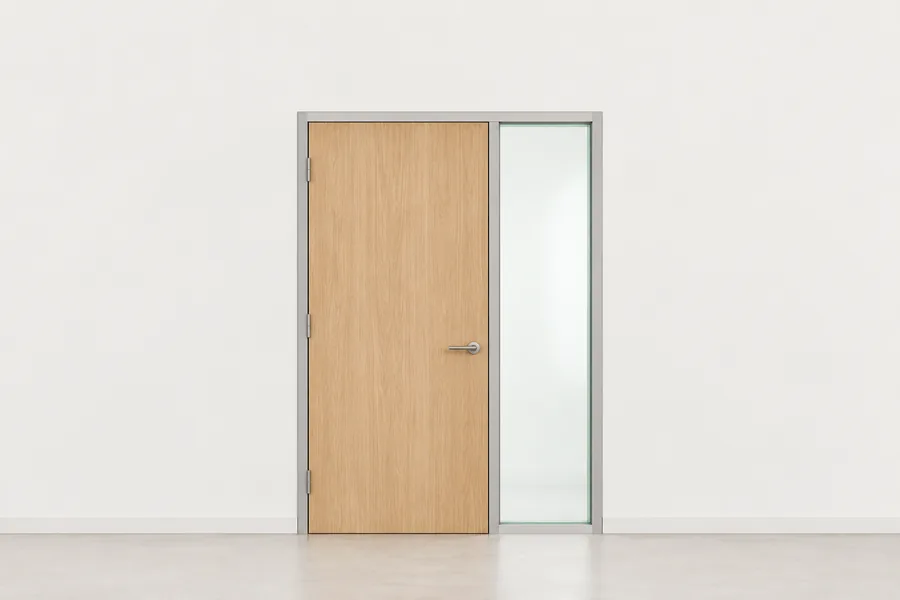
Glass in a guard or railing is a hazardous location at any height (IBC 2406.4.4). A laminate of tempered or heat-strengthened panes is what IBC 2407.1 asks for in a guard.
IBC 2407.1: guard glass is laminated, made of tempered or heat-strengthened panes.
Selling laminated glass? Photograph a cut edge so the layers show, mark the makeup, interlayer, size and safety class in SizeMarker, and send the picture with your offer.
Mark a photoWeights are Romag’s where it prints them; the rest are our calculation at 2.5 kg/m² per mm of glass and 1.07 g/cm³ of PVB.
| Makeup | Glass and interlayer | Weight, name and class |
|---|---|---|
| 6.38 mmJGJ 113 table 7.1.1-1 | 3 + 3 mm glass, 0.38 mm PVB | 15.4 kg/m² (our calculation) |
| 6.4 mmRomag; Pilkington Optilam | 3 + 3 mm glass, 0.38 mm PVB | 15.5 kg/m² (Romag); EN 12600 class 2(B)2 (Pilkington) |
| 6.76 mmSaint-Gobain STADIP 33.2, 6.8 mm | 3 + 3 mm glass, 0.76 mm PVB | 15.8 kg/m² (Romag, 6.8 mm) |
| 8.76 mmThis page | 4 + 4 mm glass, 0.76 mm PVB | 20.8 kg/m² (Romag, 8.8 mm) |
| 10.76 mmSTADIP 55.2, 10.8 mm | 5 + 5 mm glass, 0.76 mm PVB | 25.8 kg/m² (Romag, 10.8 mm) |
| 12.76 mmSTADIP 66.2, 12.8 mm | 6 + 6 mm glass, 0.76 mm PVB | 30.8 kg/m² (our calculation) |
| How the names workOur reading of Saint-Gobain’s pairs | Glass, glass, then the number of 0.38 mm PVB layers: 44.2 is 4 + 4 mm with two layers, 0.76 mm | China writes it out (8.76), the UK rounds it (8.8) |
| Weight ruleSaint-Gobain; Kuraray | Glass 2.5 kg/m² per mm, PVB 1.07 g/cm³ | 1 g/cm³ over 1 mm is 1 kg/m² (our calculation) |
Sources: JGJ 113-2015 · Romag · Pilkington · Saint-Gobain · Saint-Gobain · Kuraray
| Interlayer | Thicknesses | Width, density and notes |
|---|---|---|
| Trosifol PVBKuraray | 0.38, 0.76, 1.14, 1.52 and 2.28 mm (15 to 90 mil) | Rolls 600–3300 mm wide; 1.07 g/cm³ |
| SentryGlasKuraray ionoplast | 0.89, 1.52 and 2.28 mm sheets (35, 60 and 90 mil) | Rolls 1050–3300 mm; 0.95 g/cm³; five times stronger and up to 100 times stiffer than conventional interlayers |
| Usual rangeHong Kong code | 0.38 to 6.0 mm | — |
| US safety classesSyracuse Glass | .015 in PVB: CPSC Category I; .030 in: Category II | Stock sheets carry safety labels in opposite corners |
Sources: Kuraray · Kuraray · Hong Kong Buildings Department · Syracuse Glass
| Item | Figure |
|---|---|
| ThicknessWutkowski, EN ISO 12543-5 | Sum of the panes’ tolerances, plus ±0.1 mm for an interlayer up to 2 mm, ±0.2 mm above |
| On 8.76 mmOur calculation | ±0.2 + ±0.2 + ±0.1 = ±0.5 mm, so 8.26–9.26 mm |
| On 6.38 mmOur calculation | ±0.2 + ±0.2 + ±0.1 = ±0.5 mm, so 5.88–6.88 mm |
| Pane offsetWutkowski | 2.0 mm up to 1000 mm, 3.0 mm to 2000 mm, 4.0 mm to 4000 mm, 6.0 mm above |
| Size rangeCSG | 300 × 300 to 3300 × 12000 mm; 8 to 80 mm thick; PVB or SGP |
| US stock sheetsSyracuse Glass | 1/4 in clear 80 × 120 in; 3/8 and 1/2 in clear 72 × 130 in; cut to size from stock |
| EdgesSyracuse Glass | Keep edges out of prolonged contact with water or moisture |
| StandardsASTM; Standard Norge; SAMR | ASTM C1172-24e1 current; EN ISO 12543-5 in its 2021 edition; in China GB/T 15763.3-2025 replaces the mandatory GB 15763.3-2009 on 2026-08-01 |
Sources: Wutkowski · CSG · Syracuse Glass · ASTM · Standard Norge · SAMR
| Location | Rule |
|---|---|
| Guards and railingsIBC 2407.1 | Laminated of tempered or heat-strengthened glass, at least 1/4 in (6.4 mm) nominal; single tempered only with no walking surface below |
| SkylightsIRC R308.6.2 | PVB at least 0.38 mm for panes up to 1.5 m² (16 ft²) whose top is no higher than 3658 mm (12 ft) above a walking surface; 0.76 mm otherwise |
| Elevator hoistwaysIBC 2409.2 | Laminated glass |
| Floors in ChinaJGJ 113 9.1.2, 9.1.5 | Laminated, interlayer at least 0.76 mm; point-supported floors tempered laminated |
| Roofs and canopies in ChinaJGJ 113 8.2.2 | Laminated or laminated insulating glass, interlayer at least 0.76 mm |
| Balustrades in ChinaGB 55031 6.6.2 | Laminated glass |
| Largest pane in ChinaJGJ 113 table 7.1.1-1 | 6.38–7.52 mm 3.0 m², 8.38–9.52 mm 5.0, 10.38–11.52 mm 7.0, 12.38–13.52 mm 8.0 m² |
| When it breaksPilkington; Hong Kong code | The broken pieces stay bonded to the interlayer |
Sources: City of Seattle · City of Seattle · JGJ 113-2015 · GB 55031-2022 · Pilkington · Hong Kong Buildings Department
Two 3 mm panes and one 0.38 mm PVB interlayer: 3 + 3 + 0.38 = 6.38 mm. UK makers round it to 6.4 mm; Saint-Gobain’s 33.2 is 3 + 3 mm with two 0.38 mm layers, 6.76 mm.
Trosifol PVB comes in 0.38, 0.76, 1.14, 1.52 and 2.28 mm, SentryGlas ionoplast in 0.89, 1.52 and 2.28 mm; the Hong Kong glass code gives 0.38 to 6.0 mm as the usual range.
Add the glass at 2.5 kg/m² per mm and the PVB at 1.07 g/cm³: 8.76 mm comes to about 20.8 kg/m², the figure Romag prints for its 8.8 mm.
The panes’ tolerances added up, plus ±0.1 mm for an interlayer up to 2 mm (EN ISO 12543-5 as Wutkowski prints it): an 8.76 mm laminate of two 4 mm panes is ±0.5 mm, 8.26–9.26 mm.
In the US, glass in guards and railings must be laminated tempered or heat-strengthened glass (IBC 2407.1) and hoistway glass laminated (IBC 2409.2). In China floors, roofs, canopies and balustrades must be laminated.
The pieces stay bonded to the interlayer, so the pane stays in its frame; that is why codes send it to guards, floors and overhead glazing.
Buyers want the makeup written out (6.38, 8.76 or 44.2), the interlayer and its thickness (PVB, acoustic PVB, SentryGlas), whether the panes are annealed, heat-strengthened or tempered, the size and offset tolerance, the safety class (EN 12600, CPSC 16 CFR 1201 Category I or II), the edge work and the packing. Mark those on a photo of your own laminate with SizeMarker, like the picture at the top, and share one card in WhatsApp or WeChat.