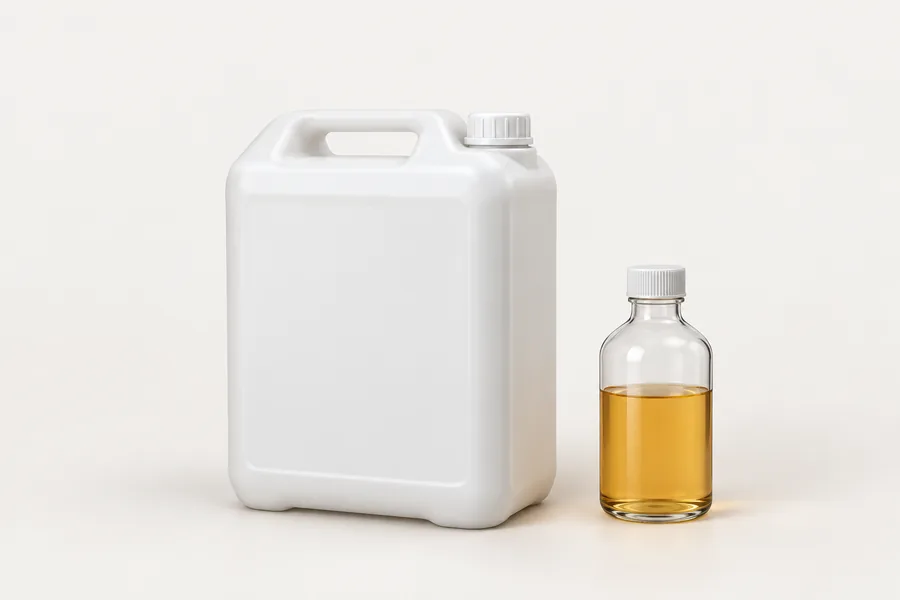
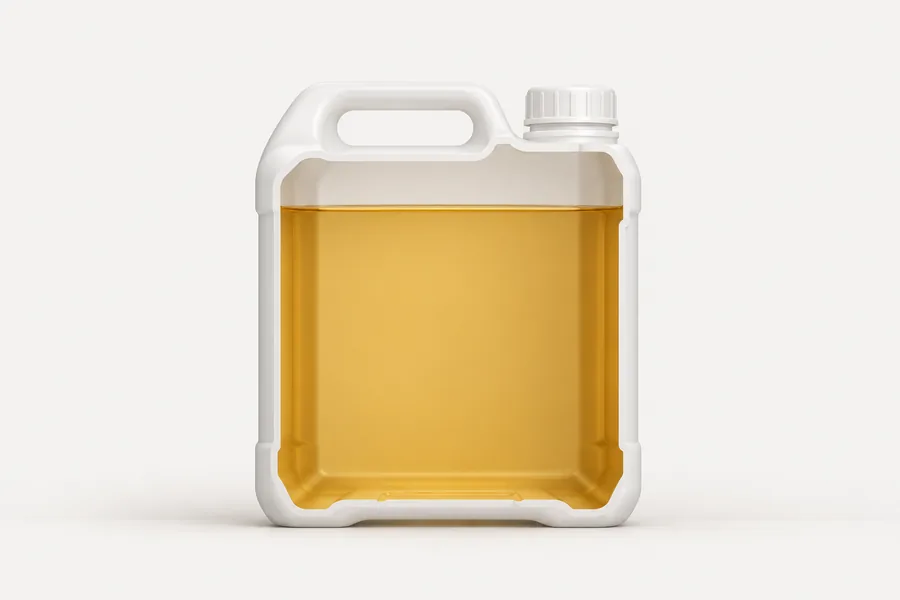
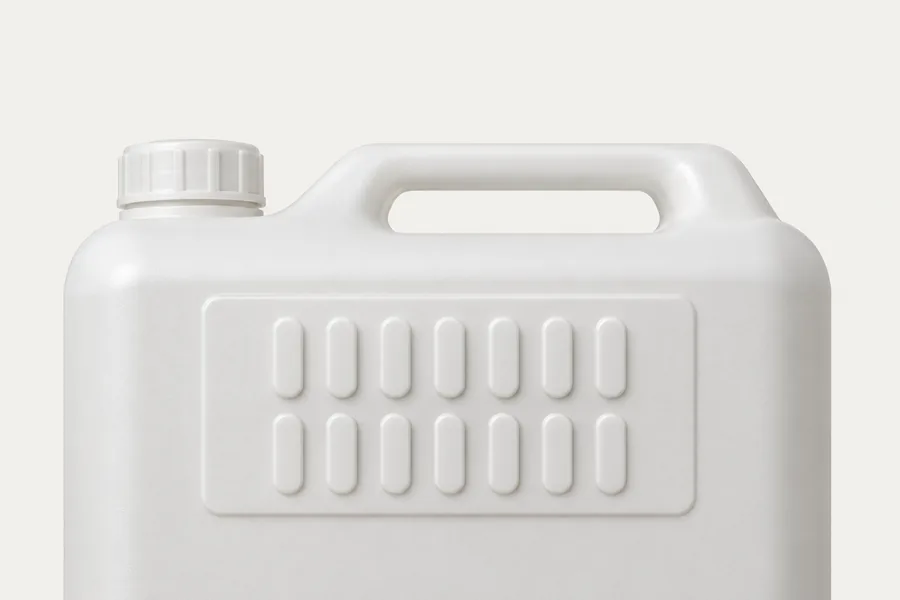
Dimensions / Industrial & logistics / Jerry cans / Plastic jerrican
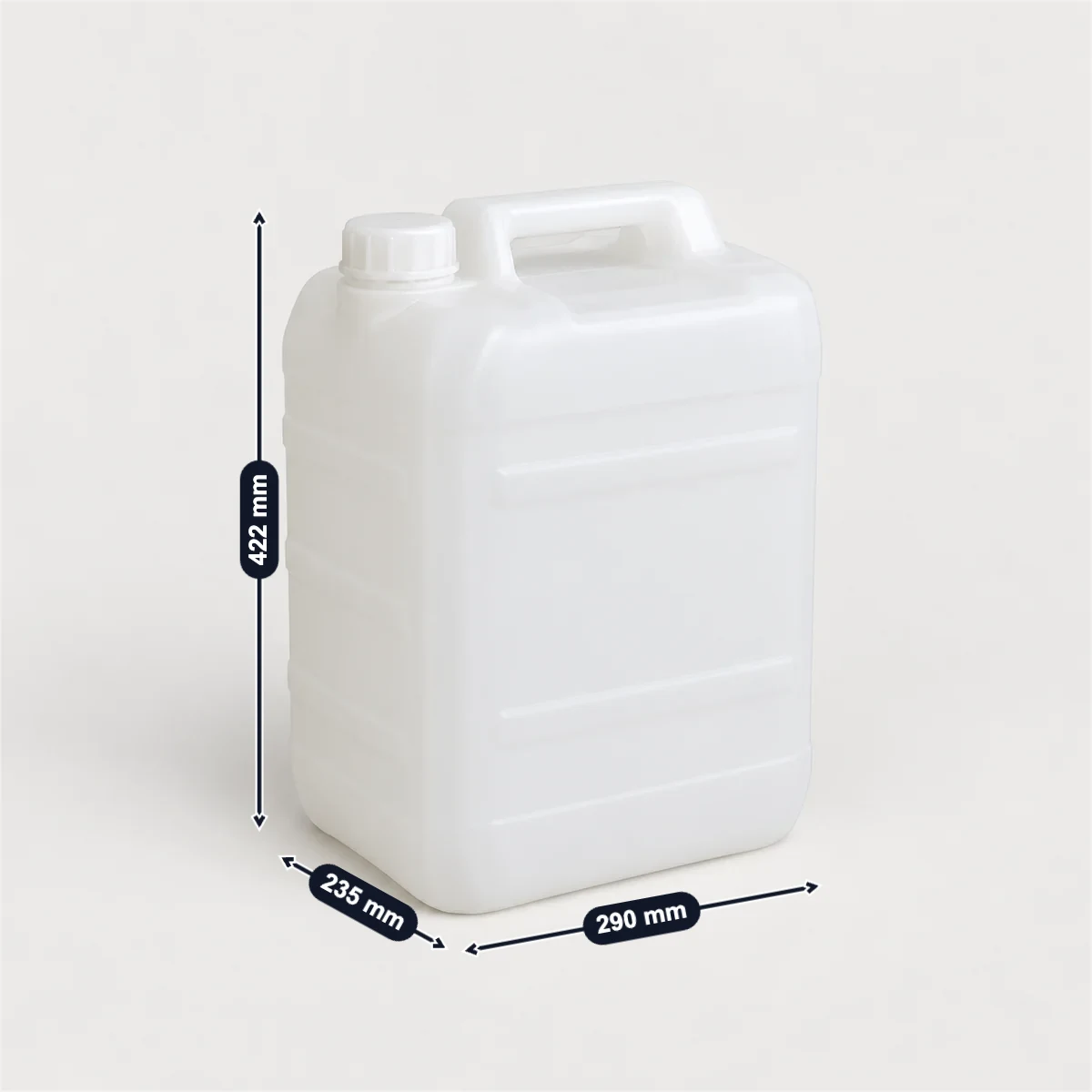
A plastic jerrican is a UN 3H1 packaging: 3 for jerrican, H for plastics, 1 for a non-removable head. A 20 L one measures about 290 × 235 × 422 mm and weighs 900 g (WERIT), holds 22.2 L to the brim and carries a mark such as 3H1/Y1.9/200: packing groups II and III, liquids up to relative density 1.9, tested at 200 kPa. AST’s 5 L can is 195 × 145 × 255 mm. A plastic jerrican may carry dangerous goods for five years from the month it was made, and its stacking test runs 28 days at 40 °C.
| 20 L jerrican, L × W × H (WERIT); stacking height | Brimful volume; empty weight | Hydraulic test pressure; full mark |
|---|---|---|
| 290 × 235 × 422mm399 mm | 22.2L900 g | 200kPa3H1/Y1.9/200 |
Sources: WERIT. Checked October 2026.
WERIT’s 20 L can and toluene are filled in. Enter the mark on your can and your liquid; each check follows a rule on this page.
Copy the mark moulded or embossed on the can, such as 3H1/Y1.9/200: the letter, the relative density it was tested at (left off at 1.2 or less, so enter 0) and the hydraulic test pressure in kPa. The packing group and boiling point are on the liquid’s safety data sheet.
3H1/Y1.9/200 covers packing group II up to a relative density of 1.9; this liquid is 0.87. Keep its vapour pressure at 50 °C below 171.4 kPa absolute, four-sevenths of 200 + 100 kPa (RID 4.1.1.10).
Filled in: WERIT’s 20 L can, marked 3H1/Y1.9/200, carrying toluene (UN 1294), a packing group II liquid. Switch to group I and the Y mark no longer covers it.
An initial boiling point of 110.6 °C allows 94% of the 22.2 L capacity at a 15 °C fill (RID 4.1.1.4 (a)): 20.86 L at most, so 20 L leaves 0.86 L in hand.
NIST puts toluene’s boiling point at 110.60 °C, inside the 100 to 200 °C band, so 94% of the 22.2 L brimful volume.
On a 22.2 L can the letters and figures of the mark must be at least 6 mm high (RID 6.1.3.1); these are 6 mm.
The 6 mm here is the legal minimum for a can of 30 litres or less; measure the letters on your own mould.
Selling HDPE jerricans? Photograph the can, mark its size, stacking height, cap and UN mark in SizeMarker and send it with your quote.
Mark a photoMakers’ sheets first, then distributors. Sizes as each sheet prints them; AST and WERIT give the stacking height separately.
| Can | L × W × H; stacking height | Brimful; empty weight | UN mark; neck |
|---|---|---|---|
| WERIT 20 L, 282-P800430This page | 290 × 235 × 422 mm; 399 mm | 22.2 L; 900 g | 3H1/Y1.9/200; 60 mm cap |
| WERIT 20 L lightweight, 282-P800800 | 291 × 232 × 408 mm; 399 mm | 22 L; 750 g | UN approved; 60 mm cap |
| WERIT 10 L, 282-P800720 | 224 × 196 × 319 mm; 310 mm | 10.8 L; 400 g | UN approved; 51 mm cap |
| WERIT 25 L, 282-P800814 | 291 × 232 × 490 mm; 485 mm | 27 L; 900 g | 60 mm cap |
| AST EST 20, 900 gSheet of 29 April 2017 | 294 × 258 × 385 mm; 378 mm | 22.2 L; 900 g | 3H1/X1.9/250; 48.5 mm inside the neck |
| AST EST 10LT, 435 g | 230 × 203 × 306 mm; 300 mm | 11.0 L; 435 g | 3H1/Y1.9/200; DIN 51 cap |
| AST ST 5LT, 280 g | 195 × 145 × 255 mm; 247 mm | 5.7 L; 280 g | 3H1/X1.9/250; DIN 51 cap |
| Taylor-Davis Dynostack 20 L, HB20-0L017Distributor; walls at least 1.3 mm | 294 × 245 × 399 mm; 389 mm | 21.0 L; 830 g | Tested at 200 kPa; DIN 61 cap |
| U.S. Plastic 20 L, item 79577Distributor; maker not listed | 11.496 × 9.685 × 15.315 in | 1.816 lbs, not said to be empty | 3H1/Y1.9/200; 61 mm mouth |
| U.S. Plastic 20 L, 8120-60-001Spec sheet | 29.21 × 24.76 × 39.05 cm | 21.5 L overflow; 1240 g | 3H1/Y1.9/100; 60 mm opening |
Sources: WERIT · WERIT · WERIT · WERIT · AST · AST · AST · Taylor-Davis · U.S. Plastic · U.S. Plastic
RID 2025 (the same paragraphs as ADR and the UN Model Regulations) and 49 CFR 178.
| Rule | What it says |
|---|---|
| CodeRID 6.1.2.7; 49 CFR 178.509 | 3H1 non-removable head, 3H2 removable head; openings in a 3H1 no wider than 7 cm |
| Largest sizeRID 6.1.4.8 | 60 litres capacity; 120 kg net mass |
| Letter on the markRID 6.1.3.1 (c) | X: packing groups I, II and III; Y: II and III; Z: III only |
| Density on the mark | Rounded to the first decimal; may be left off when it does not exceed 1.2 |
| One group lowerRID 6.1.3, Note 3 | A packing group I can tested at 1.2 may carry group II liquids up to 1.8 and group III up to 2.7: factors 1.5 and 2.25 |
| Month of manufactureRID 6.1.3.1 (e); 49 CFR 178.503 | 3H jerricans carry the month as well as the year they were made |
| Period of useRID 4.1.1.15 | Five years from the date of manufacture for dangerous goods, unless the authority approves otherwise; two years for hydrofluoric acid of 60 to 85% and nitric acid above 55% (PP 81) |
| Stacking testRID 6.1.5.6.2 | 28 days at 40 °C or more under the weight of a 3 m stack; steel jerricans 24 hours |
| Drop testRID 6.1.5.3 | Cooled to −18 °C or lower first; 1.8 m for packing group I, 1.2 m for II, 0.8 m for III |
| Hydraulic testRID 6.1.5.5 | Held 30 minutes for plastics, 5 for metal; at least 100 kPa, and 250 kPa for packing group I |
| PermeabilityRID 6.1.4.8.7 | No more than 0.008 g per litre per hour at 23 °C for flammable liquids |
| Recycled plasticRID 6.1.3.10 | Marked REC |
| Letter heightRID 6.1.3.1 | At least 12 mm; 6 mm on cans of 30 litres or less; an appropriate size at 5 litres or less |
Sources: RID 2025 · 49 CFR 178
| Rule or figure | What it says |
|---|---|
| Highest fill at 15 °CRID 4.1.1.4 (a) | By initial boiling point: below 60 °C 90%; 60 to 100 °C 92%; 100 to 200 °C 94%; 200 to 300 °C 96%; 300 °C or more 98% |
| Never liquid-fullRID 4.1.1.4; 49 CFR 173.24a | Not completely full at 55 °C |
| Vapour pressureRID 4.1.1.10 (b) | At 50 °C below four-sevenths of the marked test pressure plus 100 kPa: 171.4 kPa for a 200 kPa mark |
| Toluene, UN 1294RID Table A; NIST | Packing group II; boils at 110.60 °C; 871.53 kg/m3 at 15 °C |
| Toluene in the check aboveOur calculation | 94% of 22.2 L is 20.86 L; 20 L leaves 0.86 L |
| Brimful above nominalAST; WERIT; Taylor-Davis | 5.7 L for a 5 L can; 10.8 and 11.0 L for 10 L; 21.0 to 22.2 L for 20 L; 27 L for 25 L |
| CapsAST; WERIT; Taylor-Davis | DIN 51 or 51 mm on 5 and 10 L cans; DIN 60, DIN 61 or 60 mm on 20 and 25 L |
Sources: RID 2025 · NIST · AST · WERIT · Taylor-Davis
| Can | Per layer; layers; total |
|---|---|
| WERIT 20 L | 17 per layer, 3 layers: 51 cans; 1206 × 1000 × 1380 mm |
| WERIT 10 L | 26 per layer, 4 layers: 104 cans; 1206 × 1000 × 1399 mm |
| AST 20 L | 12 per layer on 800 × 1200 or 16 on 1000 × 1200, 7 layers: 84 or 112 cans; about 2.81 m high |
| AST 5 L | 40 per layer, 5 layers: 200 cans on 1200 × 1000; 2.68 m high |
| U.S. Plastic 20 L | 96 per 40 × 48 in skid, 94 in high; 30 skids, 2880 cans per 53 ft truck |
| EN 12712Status valid; size table not public | Plastics jerricans of 20 l to 60 l sized for 800 mm × 1200 mm, 1000 mm × 1200 mm and 1140 mm × 1140 mm pallets |
Most 20 L HDPE jerricans are 290 to 294 mm long, 232 to 258 mm wide and 385 to 422 mm high: WERIT’s is 290 × 235 × 422 mm and 900 g, AST’s 294 × 258 × 385 mm. They hold 21.0 to 22.2 L to the brim.
3 is a jerrican, H plastics and 1 a non-removable head (a 3H2 has a removable one). Y means packing groups II and III, 1.9 is the highest relative density it was tested for, and 200 is the hydraulic test pressure in kPa.
Five years from the date of manufacture under RID 4.1.1.15, which is why 3H cans also show the month they were made. Steel jerricans have no such limit.
Under RID 4.1.1.4 (a), at a 15 °C fill: 90% of capacity for liquids boiling below 60 °C, rising to 98% at 300 °C or more. Toluene boils at 110.60 °C, so 94%: 20.86 L in a 22.2 L can.
WERIT puts 51 on a 1206 × 1000 mm pallet (17 per layer, 3 layers) and AST 112 on 1000 × 1200 (16 per layer, 7 layers); U.S. Plastic ships 96 per 40 × 48 in skid.
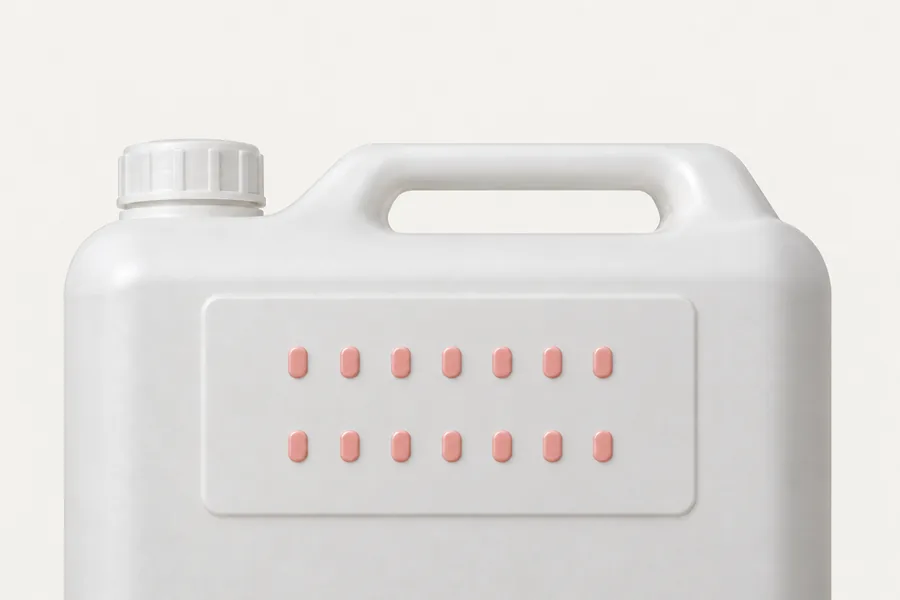
Buyers of chemicals, lubricants and agrochemicals ask for the outside size and stacking height, the brimful volume, the empty weight, the full UN mark and its month, the cap and its torque, and how many cans go on a pallet. Mark the real can, its mark and its cap on your own photo in SizeMarker, as in the picture at the top, and send one product card for WhatsApp or WeChat.