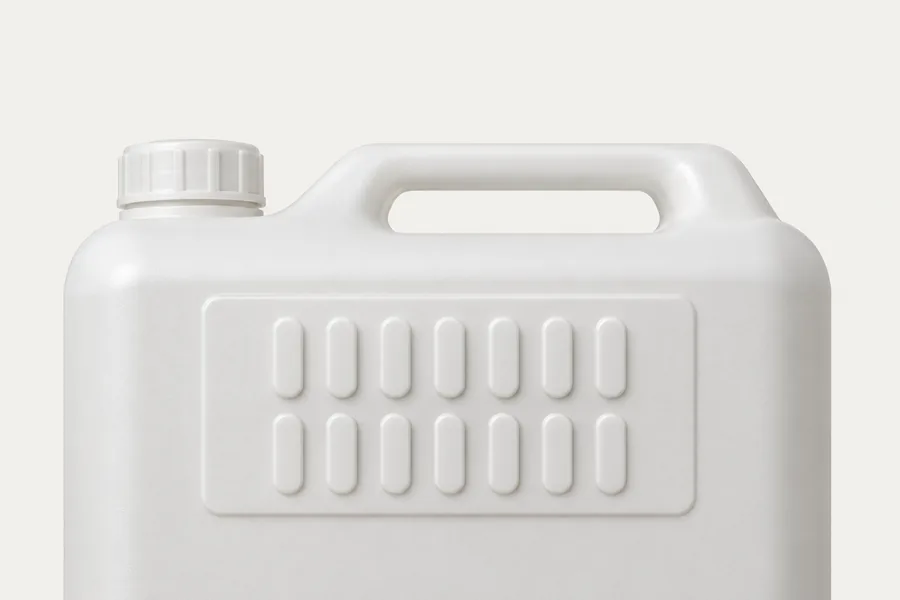
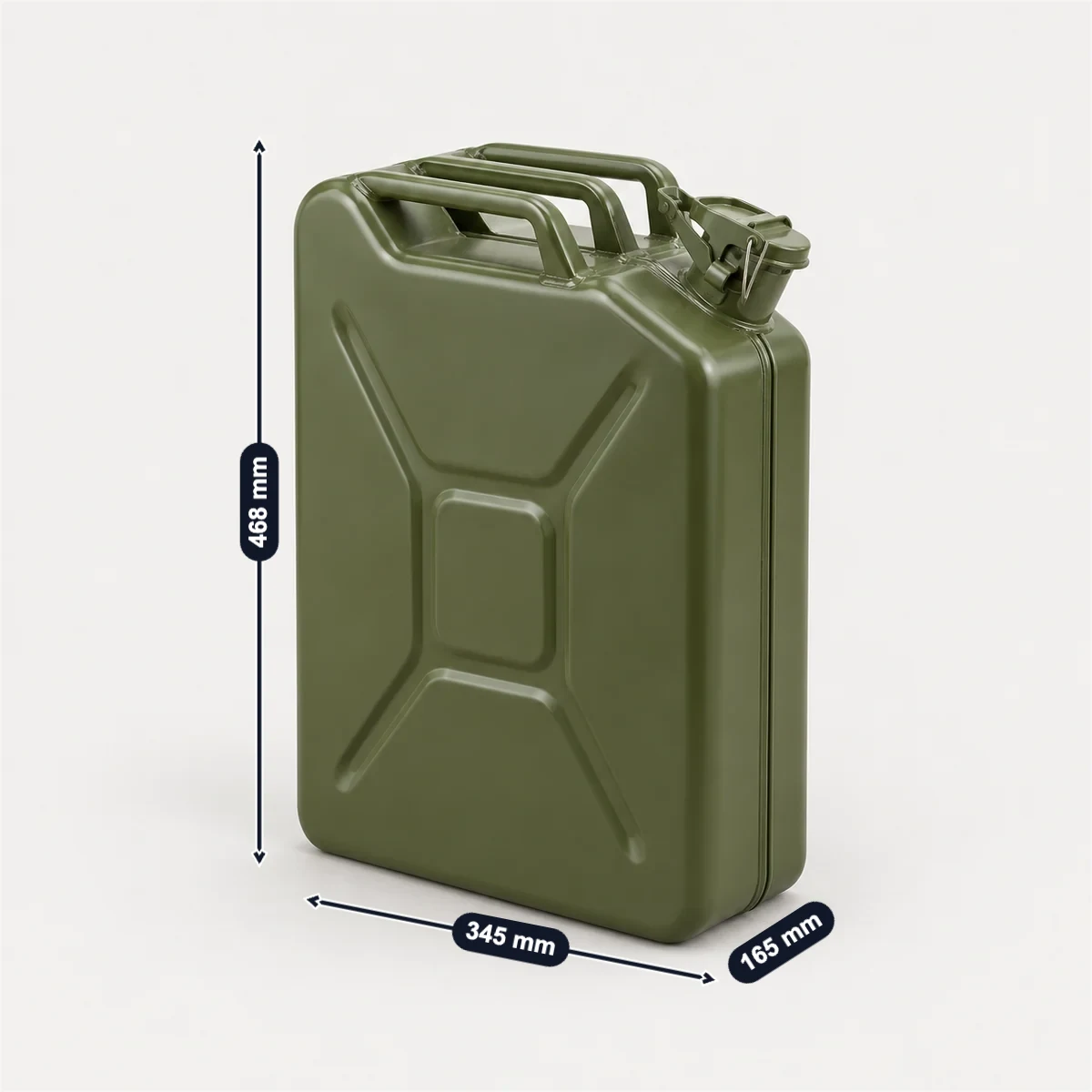
Dimensions / Industrial & logistics / Jerry cans / Steel jerry can
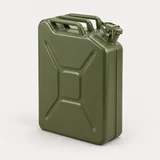
A steel jerry can is a UN 3A1 packaging: A for steel, 1 for a non-removable head. The 20 L NATO pattern is 345 × 165 × 468 mm on Valpro’s BAM approval, with 20.5 l capacity and the mark 3A1/X/250, so it may carry packing group I to III liquids up to relative density 1.2. It is pressed from 0.9 mm steel, weighs 4.3 kg empty and has three handles and a bayonet cap. RID caps steel jerricans at 60 litres and 120 kg net, and above 40 litres the seams must be welded.
| 20 L can, L × W × H (Valpro BAM approval) | Capacity; empty weight | Hydraulic test pressure; body steel |
|---|---|---|
| 345 × 165 × 468mm13.5 × 6.5 × 18.5 in | 20.5L4.3 kg | 250kPa0.9 mm |
Sources: Valpro. Checked October 2026.
Valpro’s 20 L can and gasoline are filled in. Enter the mark on your can and your liquid; each check follows a rule on this page.
Copy the mark moulded or embossed on the can, such as 3H1/Y1.9/200: the letter, the relative density it was tested at (left off at 1.2 or less, so enter 0) and the hydraulic test pressure in kPa. The packing group and boiling point are on the liquid’s safety data sheet.
3A1/X/250 covers packing group II up to a relative density of 1.8 (1.2 × 1.5); this liquid is 0.75. Keep its vapour pressure at 50 °C below 200 kPa absolute, four-sevenths of 250 + 100 kPa (RID 4.1.1.10).
Valpro’s 20 L can and its BAM mark 3A1/X/250 are filled in, with gasoline: the mark gives no density, so 1.2 applies, and 1.8 one group down.
An initial boiling point of 26.7 °C allows 90% of the 20.5 L capacity at a 15 °C fill (RID 4.1.1.4 (a)): 18.45 L at most, so 18 L leaves 0.45 L in hand.
Delek’s safety data sheet has gasoline boiling from 26.7 °C, which caps a 20.5 l steel can at 90%, 18.45 L.
On a 20.5 L can the letters and figures of the mark must be at least 6 mm high (RID 6.1.3.1); these are 6 mm.
A 20.5 l steel can falls in the 6 mm class; embossed metal may show the letters UN instead of the symbol.
Supplying steel fuel cans? Photograph the can, mark its size, handles, cap and UN mark in SizeMarker and send it with your quote.
Mark a photoValpro’s figures come from its BAM approvals and datasheets; the others are as each seller prints them.
| Can | L × W × H | Capacity; empty weight | UN mark or approval; steel |
|---|---|---|---|
| Valpro 20 L Classic, 537.00.00This page | 345 × 165 × 468 mm | 20.5 l; 4.3 kg | 3A1/X/250; 0.9 mm |
| Valpro 10 L Classic, 1257.00.00Approval D/BAM 16375/3A1 | 345 × 165 × 276 mm | 10.4 l; 3.0 kg | 3A1/X/250 |
| Valpro 5 L Classic, 1219.00.00Approval D/BAM 16223/3A1 | 230 × 120 × 310 mm | 6.2 l; 1.75 kg | 3A1/X/250 |
| Valpro 20 L Military Line, 364.00.000Made to TL 7240-0022 | 345 × 165 × 468 mm | 4.4 kg | X, packing groups I to III; aluminium-silicon coated steel, RAL 6031 |
| Wavian 20L NATOMade in Latvia | 13.5 × 6.5 × 18.5 in | 20 L; 9.5 lb (4.3 kg) | 0.9 mm steel, fully welded recessed seams |
| Uline H-12449Distributor | 14 × 6 × 19 in | 5 gal; 10 lbs | D.O.T., EPA and CARB approved |
| Aspli 036015, redUK retailer | 460 × 346 × 166 mm | 20 L | 3A1/X1.2/250/24/GB/6631; 0.8 mm |
| Midwest Can 5810Catalogue 2025 | 13.5 × 6.5 × 18.25 in | 5 gallons and 4 ounces | Auto shut-off spout; case pack of 4 |
Sources: Valpro · Valpro · Valpro · Valpro · Valpro · Valpro · Valpro · Wavian · Uline · Aspli Safety · Midwest Can
RID 2025 (the same paragraphs as ADR and the UN Model Regulations), 49 CFR 178 and 173.
| Rule | What it says |
|---|---|
| CodeRID 6.1.2.7; 49 CFR 178.511 | 3A1 non-removable head, 3A2 removable head; 3B1 and 3B2 are aluminium |
| OpeningsRID 6.1.4.4.3 | No wider than 7 cm on a 3A1 |
| SeamsRID 6.1.4.4.2 | Welded on jerricans for more than 40 litres; at 40 litres or less mechanically seamed or welded |
| Inside coatingRID 6.1.4.4.4; Aspli; Valpro | Required where the steel would react with the contents: Aspli’s coating is 150 microns, Valpro’s military can at least 30 μm |
| Largest sizeRID 6.1.4.4.5 and .6 | 60 litres; 120 kg net mass |
| Mark on embossed metalRID 6.1.3.1 (a) | The capital letters UN may stand in for the UN symbol |
| Period of useRID 4.1.1.15 | The five-year limit covers plastic drums and jerricans only; steel has none |
| Reused in the US49 CFR 173.28 (b)(4) | At least 0.63 mm of steel at 20 L, 0.73 mm at 30 and 40 L, 0.92 mm at 60 L |
| Stacking testRID 6.1.5.6.2 | 24 hours under the weight of a 3 m stack; plastic jerricans 28 days |
| Old German standardDIN Media | DIN 7274-1 and 7274-2:1981-09, steel canisters of 5, 10 and 20 l, are withdrawn; retailers still quote them |
Sources: RID 2025 · 49 CFR 178 · 49 CFR 173 · Aspli Safety · Valpro · DIN Media
| Item | Figure |
|---|---|
| Liquids allowedBAM 12276 | Packing groups I, II and III; density up to 1.2 kg/l |
| Gauge pressure in the can | 167 kPa |
| Vapour pressure limit | 200 kPa at 50 °C and 233 kPa at 55 °C, absolute |
| The same limits from RID 4.1.1.10Our calculation | 4/7 × (250 + 100) = 200 kPa; 2/3 × (250 + 100) = 233.3 kPa |
| Maker’s testsDatasheet; tests of 2016 | Internal pressure up to 2.5 bar; drop from 1.8 m; a 3 m stack test that puts 155 kg on the can |
| Box of 5 | 854 × 358 × 488 mm; 23.1 kg gross |
| Pallet | 70 cans in 14 boxes, 1.2 × 0.85 × 2.60 m, 348 kg gross; in boxes of 4, 56 cans |
| Rule or figure | What it says |
|---|---|
| Gasoline, UN 1203RID Table A | Class 3, packing group II |
| Gasoline dataDelek US safety data sheet, 2022 | Boils from 26.7 to 255 °C; specific gravity 0.75 |
| Highest fill at 15 °CRID 4.1.1.4 (a) | Initial boiling point below 60 °C: 90% of capacity |
| In a 20.5 l Valpro canOur calculation | 18.45 L at most; 18 L leaves 0.45 L |
| Does 3A1/X/250 cover it?Our calculation | No density on the mark means 1.2; one group lower 1.2 × 1.5 = 1.8, above 0.75 |
| Private carriageRID 1.1.3.1 (a) | Flammable liquids filled by or for a private person: up to 60 litres per refillable receptacle |
| US work vehicles49 CFR 173.6 | Materials of trade: up to 30 L (8 gal) per packaging, 200 kg in all; gasoline in metal or plastic that meets the HMR or OSHA rules |
| An older canAustralian War Memorial | 20 litre (5 gallon) pressed welded steel petrol can made by Rheem, Australia, about 1970, like the Australian Army issue can |
Sources: RID 2025 · Delek US · 49 CFR 173 · Australian War Memorial
Valpro’s BAM approval gives 345 × 165 × 468 mm for the 20 L can, with 20.5 l capacity; Wavian lists 13.5 × 6.5 × 18.5 in. The 10 L Valpro keeps the 345 × 165 mm side and stands 276 mm high.
4.3 kg for the 20 L Valpro and 9.5 lb (4.3 kg) for the Wavian; the 10 L Valpro is 3.0 kg and the 5 L 1.75 kg. The military version, with its aluminium-silicon coating, is 4.4 kg.
Gasoline starts boiling at 26.7 °C, so RID allows 90% of capacity at a 15 °C fill: 18.45 L in Valpro’s 20.5 l can. Its 3A1/X/250 mark covers packing group II, where gasoline (UN 1203) sits.
Not under RID: the five-year period of use in 4.1.1.15 applies to plastic drums and jerricans. A steel can reused for dangerous goods in the US must still have 0.63 mm of steel at 20 L.
No. DIN 7274-1 and 7274-2 of 1981 are withdrawn; makers now point to a UN approval instead, such as Valpro’s 3A1/X/250 from BAM.
Buyers ask for the size against the NATO pattern, the steel thickness and coating, the empty weight, the UN approval and its density and pressure, the closure, the colour and how many cans go in a box and on a pallet. Mark the real can, its handles, cap and mark on your own photo in SizeMarker, as in the picture at the top, and send one product card for WhatsApp or WeChat.