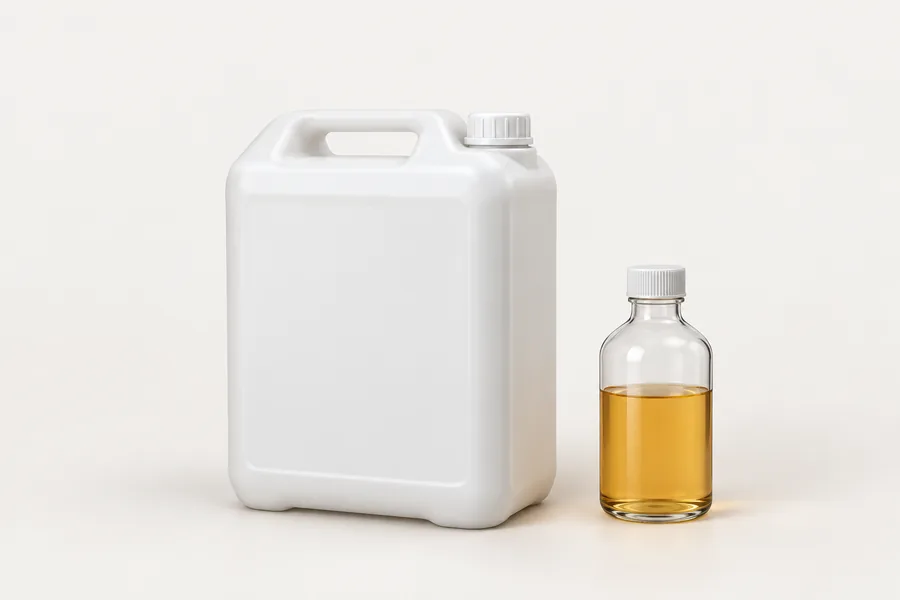
Dimensions / Industrial & logistics / Jerry cans
A 20 L plastic jerrican is about 290 × 235 × 422 mm and weighs 900 g (WERIT); the 20 L NATO steel can is 345 × 165 × 468 mm and 4.3 kg (Valpro); a US 5 gallon gas can such as Midwest Can’s 5610 is 13 × 10 × 14.5 in. Under UN rules a jerrican holds at most 60 litres and 120 kg, and a 15 °C fill stops at 90 to 98% of capacity depending on the liquid’s boiling point.
| 20 L plastic jerrican: height; L × W (WERIT) | 20 L steel jerry can: height; L × W (Valpro) | Largest jerrican under UN rules; net mass |
|---|---|---|
| 422mm290 × 235 mm | 468mm345 × 165 mm | 60L120 kg |
Sources: WERIT, Valpro, RID 2025. Checked October 2026.
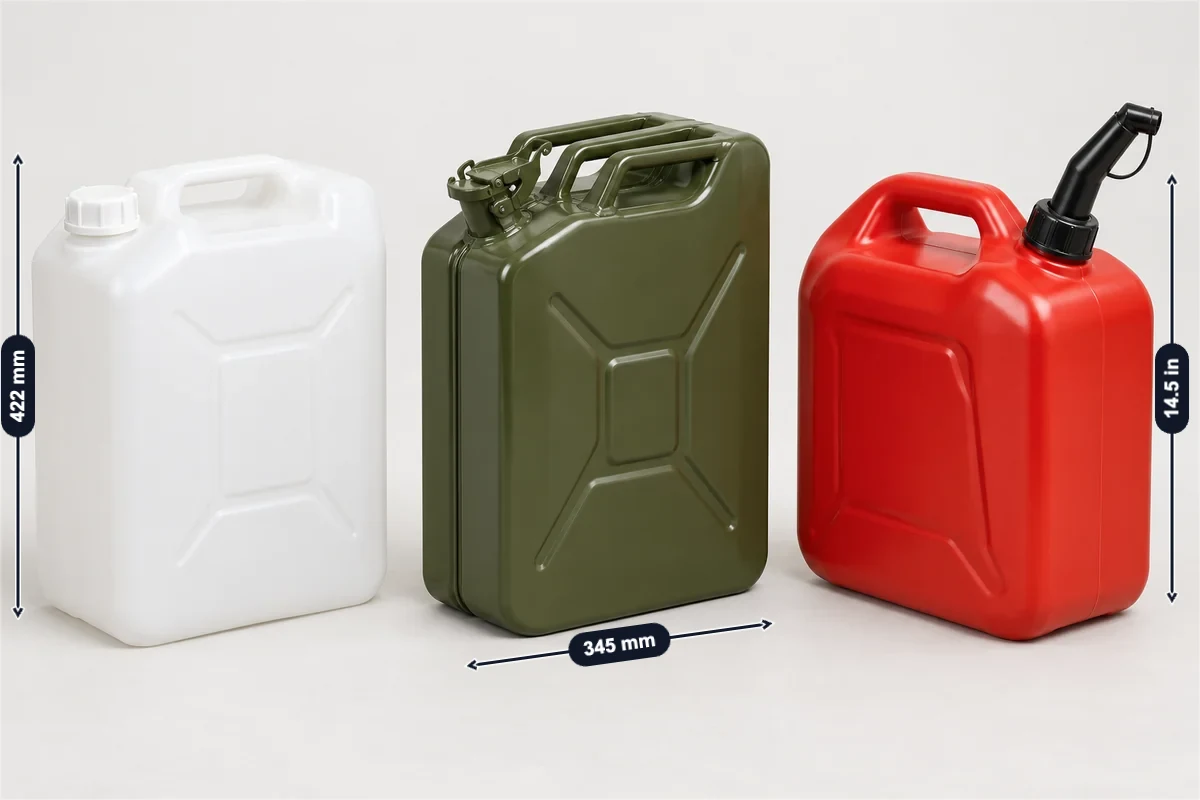
20 L: 290 × 235 × 422 mm, 900 g (WERIT)
HDPE, UN 3H1, light and stackable: the can for chemicals and lubricants.
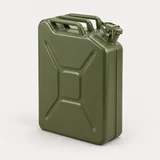
20 L: 345 × 165 × 468 mm, 4.3 kg (Valpro)
The three-handle NATO pattern in 0.9 mm steel, UN 3A1, with a bayonet cap.
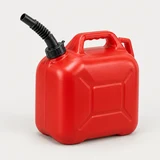
5 gal: 13 × 10 × 14.5 in (Midwest Can)
The US consumer fuel can: colour-coded by fuel, with a spout that closes by itself.
Pick a can, then enter its mark or label and your liquid. Each check follows a rule in the tables below.
Copy the mark moulded or embossed on the can, such as 3H1/Y1.9/200: the letter, the relative density it was tested at (left off at 1.2 or less, so enter 0) and the hydraulic test pressure in kPa. The packing group and boiling point are on the liquid’s safety data sheet.
3H1/Y1.9/200 covers packing group II up to a relative density of 1.9; this liquid is 0.87. Keep its vapour pressure at 50 °C below 171.4 kPa absolute, four-sevenths of 200 + 100 kPa (RID 4.1.1.10).
WERIT 20 L, 3H1/Y1.9/200; toluene.
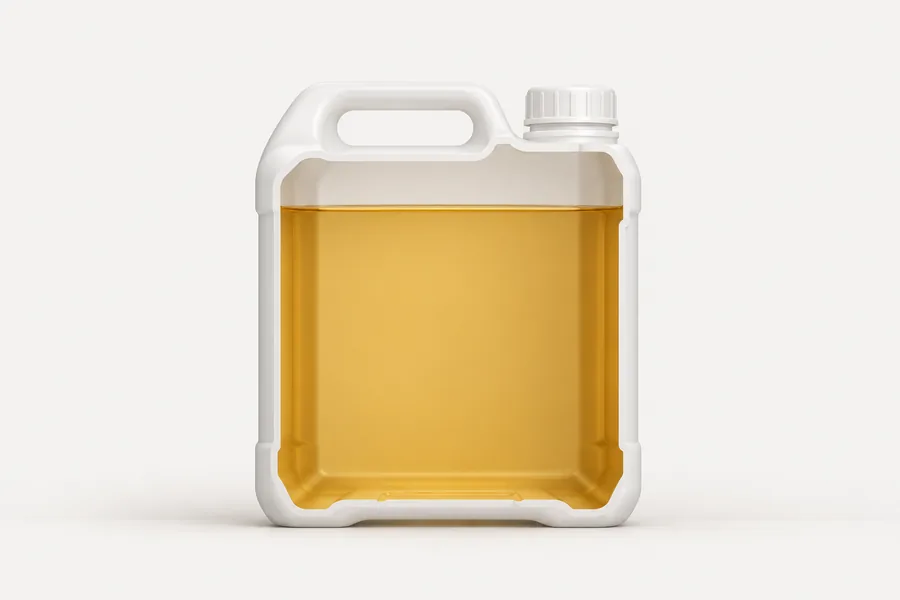
An initial boiling point of 110.6 °C allows 94% of the 22.2 L capacity at a 15 °C fill (RID 4.1.1.4 (a)): 20.86 L at most, so 19.5 L leaves 1.36 L in hand.
Toluene boils at 110.60 °C: 94%.
On a 22.2 L can the letters and figures of the mark must be at least 6 mm high (RID 6.1.3.1); these are 6 mm.
6 mm letters up to 30 L.
Selling jerricans or liquids in them? Photograph the can, mark its size, cap and UN mark in SizeMarker and send it with your quote.
Mark a photo| Type | Real can | L × W × H | Mark or rules |
|---|---|---|---|
| Plastic jerrican | WERIT 20 L: 900 g, 22.2 L to the brim | 290 × 235 × 422 mm | 3H1/Y1.9/200: packing groups II and III |
| Steel jerry can | Valpro 20 L: 4.3 kg, 20.5 l | 345 × 165 × 468 mm | 3A1/X/250: packing groups I to III |
| Gasoline can | Midwest Can 5610: 5 gal | 13 × 10 × 14.5 in | EPA and CARB: 0.25 to 10 gal, 0.3 g per gallon a day, red for gasoline |
Sources: WERIT — 20 L UN canister, 282-P800430 (sheet hosted by Kingfisher Direct) · Valpro — BAM approval D/BAM 12276/3A1, 20 L Classic · Valpro — datasheet, 20 L Classic 537.00.00 · Midwest Can — 2025 catalogue
| Size | Can | L × W × H | Brimful; empty weight |
|---|---|---|---|
| 5 L | AST ST 5LT | 195 × 145 × 255 mm | 5.7 L; 280 g |
| 10 L | WERIT 282-P800720 | 224 × 196 × 319 mm | 10.8 L; 400 g |
| 20 L | WERIT 282-P800430 | 290 × 235 × 422 mm | 22.2 L; 900 g |
| 25 L | WERIT 282-P800814 | 291 × 232 × 490 mm | 27 L; 900 g |
| 30 L | U.S. Plastic 79581 | 12.480 × 11.024 × 17.480 in | Not listed |
Sources: WERIT — 10, 20 and 25 L canister sheets (hosted by Kingfisher Direct) · AST — ST 5LT 280 g jerrican, sheet Q0033 · WERIT — 10 L canister, 282-P800720 · WERIT — 25 L canister, 282-P800814 · U.S. Plastic Corp. — 30 L HDPE jerrican, item 79581
| Can | Approval or origin | L × W × H | Capacity; empty weight |
|---|---|---|---|
| Valpro Classic 20 L | BAM 12276 | 345 × 165 × 468 mm | 20.5 l; 4.3 kg |
| Wavian NATO 20 L | Made in Latvia | 13.5 × 6.5 × 18.5 in | 20 L; 9.5 lb |
| Valpro Classic 10 L | BAM 16375 | 345 × 165 × 276 mm | 10.4 l; 3.0 kg |
| Valpro Classic 5 L | BAM 16223 | 230 × 120 × 310 mm | 6.2 l; 1.75 kg |
Sources: Valpro — BAM approvals and datasheets, Classic line · Valpro — BAM approval D/BAM 16375/3A1, 10 L · Valpro — BAM approval D/BAM 16223/3A1, 5 L · Valpro — Classic line fuel cans · Wavian — 20L NATO jerry can
| Rule | What it says |
|---|---|
| Codes | 3H1 and 3H2 plastic, 3A1 and 3A2 steel, 3B1 and 3B2 aluminium; 1 is a non-removable head, 2 a removable one |
| Largest jerrican | Plastic or steel, no jerrican may hold more than 60 litres or carry more than 120 kg net |
| Letter on the mark | The letter sets the packing groups: X takes I to III, Y takes II and III, Z takes III alone |
| Filling at 15 °C | 90, 92, 94, 96 or 98% of capacity as the initial boiling point passes 60, 100, 200 and 300 °C; never full at 55 °C |
| Plastic period of use | A plastic can carries dangerous goods for five years after it was made; a steel can is not time-limited |
| Mark letter height | Characters of the mark 12 mm high, or 6 mm on cans of up to 30 litres |
| US consumer gas cans | EPA and CARB cover cans of 0.25 to 10.0 gallons and allow 0.3 grams of evaporation per gallon a day; empty cans of 5 gallons or less also need a flame mitigation device |
Sources: OTIF — RID 2025, Chapters 4.1 and 6.1 (UN packaging provisions) · eCFR — 40 CFR Part 59 Subpart F, portable fuel containers · eCFR — 16 CFR Part 1461, Portable Fuel Container Safety Act regulation
A 20 L plastic jerrican is about 290 × 235 × 422 mm (WERIT); a 20 L NATO steel can is 345 × 165 × 468 mm (Valpro), flatter and taller, with 20.5 l capacity.
A 20 L HDPE jerrican weighs 900 g (WERIT) and a 5 L 280 g (AST); a 20 L steel can weighs 4.3 kg and the 10 L 3.0 kg (Valpro).
In 3H1/Y1.9/200, 3 is a jerrican, H plastic and 1 a non-removable head; Y means packing groups II and III, 1.9 the highest relative density tested and 200 the test pressure in kPa. Steel cans read 3A1, as in Valpro’s 3A1/X/250.
Makers sell 5, 10, 20, 25 and 30 L: from 195 × 145 × 255 mm at 5 L (AST) to 291 × 232 × 490 mm at 25 L (WERIT); U.S. Plastic’s 30 L is 12.480 × 11.024 × 17.480 in.
Midwest Can’s 5610 is 13 × 10 × 14.5 in. US rules treat cans of 0.25 to 10 gal as portable fuel containers, and CARB wants them red for gasoline.
Buyers ask for the outside size and stacking height, the brimful volume, the empty weight, the full UN mark, the cap, and how many cans go on a pallet; US retailers also ask for the colour, the spout and the EPA and CARB certificates. Mark the real can, its mark and its cap on your own photo in SizeMarker and send buyers the spec diagram over WhatsApp or WeChat.