Dimensions / Industrial & logistics / ISO tank containers / T11 tank
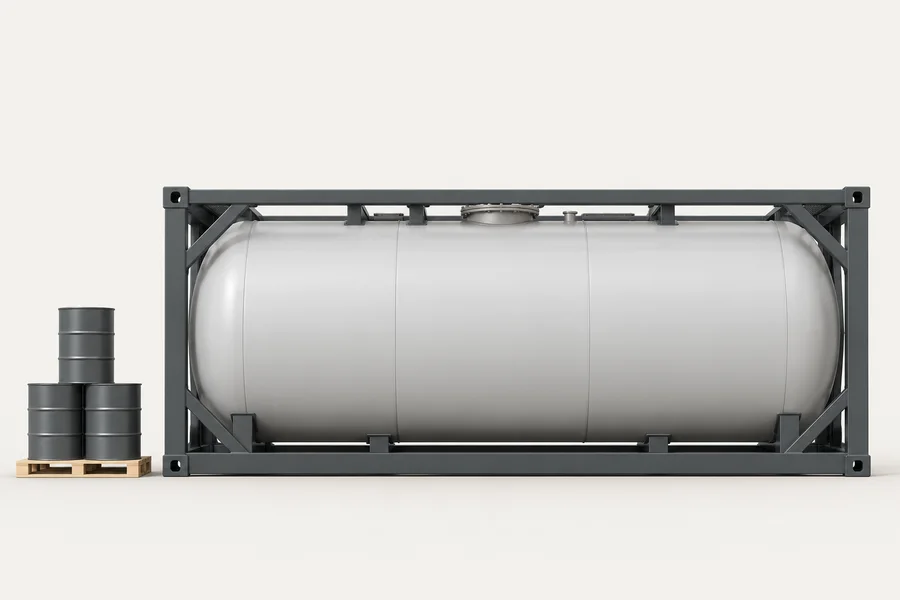
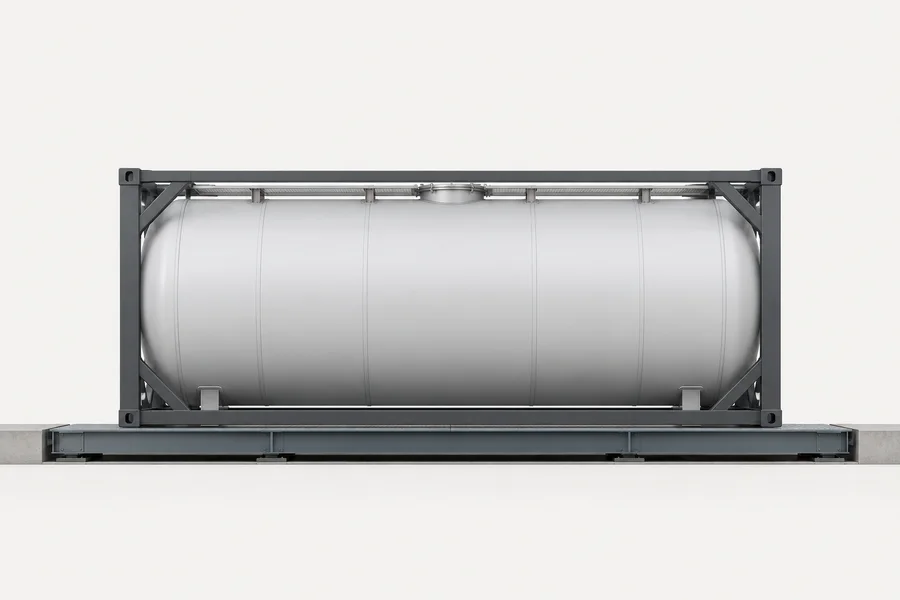
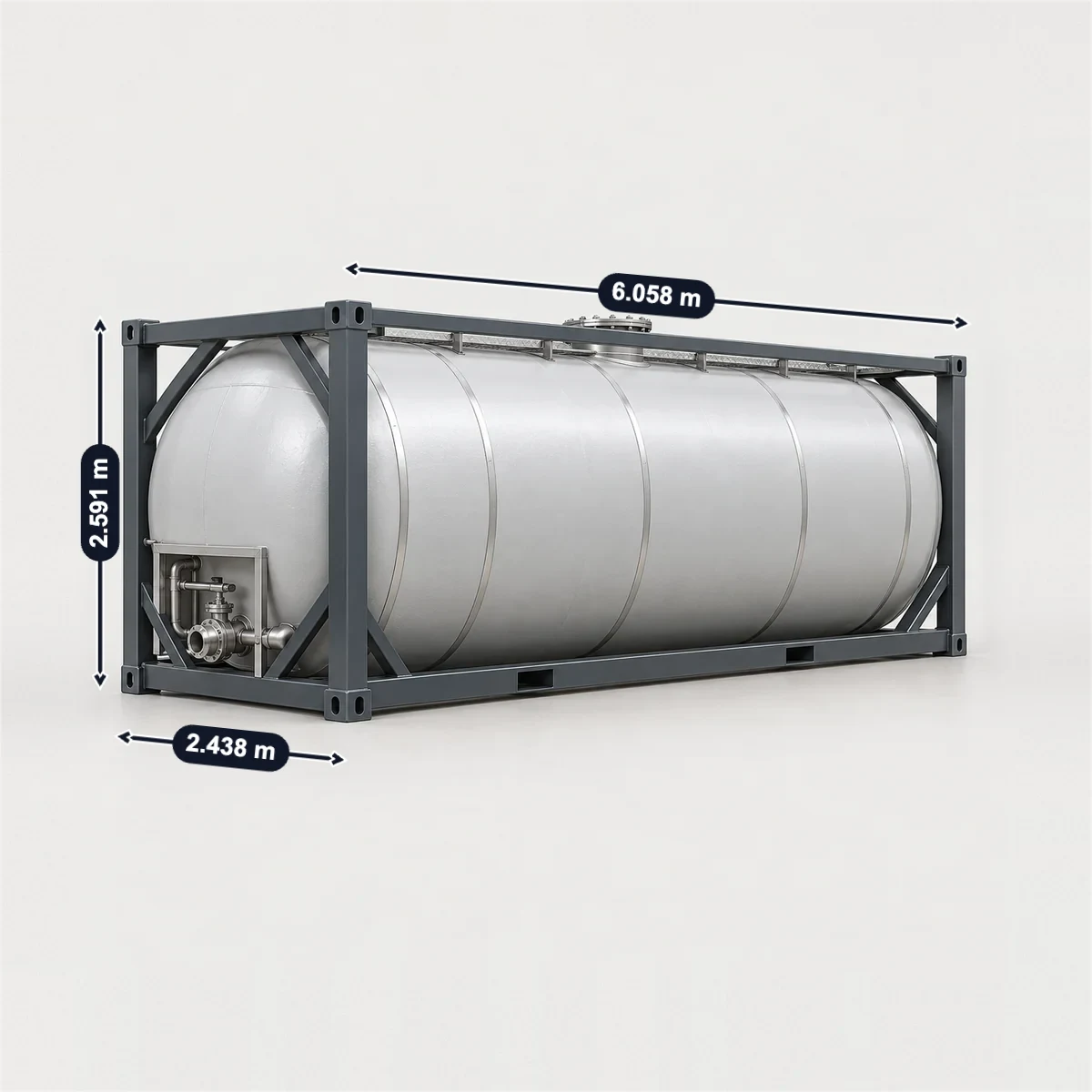
A T11 is the UN portable tank instruction for liquids with a 6 bar minimum test pressure, normal pressure relief and a bottom outlet behind three closures (RID 4.2.5.2.6). Lessors build it as a 20 ft tank in the 6,058 × 2,438 × 2,591 mm frame: Seaco’s standard T11 holds 21,000 to 26,000 litre, tares 3,460 to 3,800 kg and is plated at 36,000 kg, working at 4 bar. A T11 may carry cargo assigned T1, T2, T3, T4, T6, T7 or T11, such as methanol, acetone or caustic soda solution, but not T8 acids such as sulphuric acid. Without surge plates fill it to at least 80%, and to no more than 97 / (1 + α(tr − tf)) percent for TP1 cargo.
| Test pressure, RID minimum; working pressure on lessor sheets | Capacity, Seaco standard T11; tare | Minimum fill without surge plates, RID |
|---|---|---|
| 6bar4 bar | 21,000–26,000L3,460–3,800 kg | 80% |
Sources: RID 2025, Seaco. Checked October 2026.
Seaco’s 24,000 litre T11 and toluene are filled in. Enter your cargo and your tank’s plate figures; each check follows a rule on this page.
Capacity in litres, masses in kilograms, densities in kg/L. The T code and TP code are in Columns 10 and 11 of the dangerous goods list (RID / ADR Table A, IMDG); RID takes the hottest mean temperature as 50 °C unless the authorities agree otherwise.
A T11 tank may carry a T4 cargo: under RID 4.2.5.2.5 it stands in for T1, T2, T3, T4, T6, T7, T11.
Filled in: toluene (UN 1294), which RID Table A assigns T4; a T11 also stands in for T1, T2, T3, T6 and T7 cargoes, but not for T8 acids.
19000 kg at 0.87153 kg/L is 21801 L, 90.8% of the 24000 L tank: under the 93.3% limit and above 80%, so the load cannot surge.
NIST gives toluene 871.53 kg/m3 at 15 °C and 838.76 kg/m3 at 50 °C; its TP1 code means the 97 formula.
19000 kg of cargo and the 3620 kg tank make 22620 kg, 13380 kg under the 36000 kg maximum permissible gross mass.
Seaco’s 24,000 litre T11 weighs 3,620 kg and is plated at 36,000 kg gross.
Selling chemicals by the tank load? Photograph the tank, mark its frame size, bottom valve and plate in SizeMarker and send it with your quote.
Mark a photoLessors’ and makers’ own sheets, all in the 20 ft frame. Tare and payload are each sheet’s own figures.
| Tank | Tare; maximum gross; payload | Working; test pressure |
|---|---|---|
| Seaco 21,000 litre20 ft (6,058 mm) × 8 ft (2,438 mm) × 8 ft 6 in (2,591 mm) | 3,460 kg; 36,000 kg; 32,540 kg | 4 bar; 6 bar |
| Seaco 24,000 litre | 3,620 kg; 36,000 kg; 32,380 kg | 4 bar; 6 bar |
| Seaco 25,000 litre | 3,750 kg; 36,000 kg; 32,250 kg | 4 bar; 6 bar |
| Seaco 26,000 litreRelief valve set 4.4 bar; 500 mm manlid | 3,800 kg; 36,000 kg; 32,200 kg | 4 bar; 6 bar |
| Eurotainer T11, 21000 / 24000 / 26000 L | 3460 / 3620 / 3730 kg; 36000 kg | 4 bar; 6 bar |
| Exsif standard, 21,000 to 26,000 L | 3,520 to 3700 kgs; payload 32,480 to 32,300 kgs | 4.0 bar; 6.0 bar |
| NT Tank, 21,000 to 26,000 LitresMaker, Nantong | 3,550 to 3,800 kg; 36,000 kg; 32,450 to 32,200 kg | 4 Bar design; 6 Bar |
| Danteco, 25000 LTR | 3680 KG; 34000 KG | 4.0 bar; 6.0 bar |
| SeaCube, 25,000 Liters | 3,700 kg; 36,000 kg; 32,300 kg | 4 bar; 6 bar |
| VTG, 24,000 l, electrically heatedArchived sheet | 3,810 kg; 36,000 kg | 4.00 bar; 6.00 bar |
Sources: Seaco · Eurotainer · Exsif · NT Tank · Danteco · SeaCube · VTG (Wayback)
RID 4.2.5.2.6, the T11 row, and the paragraphs it points to.
| Requirement | What RID says |
|---|---|
| Test it must pass | 6 bar at least; the 4 bar instructions are T6 to T10 |
| Shell thickness | See 6.7.2.4.2: 5 mm reference steel up to 1.80 m across, 6 mm above |
| Relief valves | Normal: spring-loaded valves, no bursting disc required |
| Outlet underneath | Allowed, with three closures in series: a self-closing internal valve, an external valve and a blank flange or cap |
| What a T11 may carry4.2.5.2.5, read in reverse | Cargo assigned T1, T2, T3, T4, T6, T7 or T11 |
| What it may not | Cargo assigned T5, T8 to T10, or T12 to T22; a T14 takes the T8 to T10 acids |
| Code on RID / ADR platesVTG; Exsif | L4BN: liquid, 4 bar, bottom openings with 3 closures, no breather |
| US version49 CFR 172.102 | T11: 6 bar test, normal relief, bottom outlet allowed |
Sources: RID 2025 · 49 CFR 172.102 · VTG (Wayback) · Exsif
RID Table A, Column 10. A T11 takes the first six; the last three need a T14 or another higher code.
| Cargo | T code; TP code |
|---|---|
| Toluene, UN 1294 | T4; TP1 |
| Acetone, UN 1090 | T4; TP1 |
| Methanol, UN 1230 | T7; TP2 |
| Sodium hydroxide solution, UN 1824, PG II | T7; TP2 |
| Acetic acid, glacial, UN 2789 | T7; TP2 |
| Corrosive liquid, n.o.s., UN 1760, PG II | T11; TP2 |
| Sulphuric acid, more than 51%, UN 1830 | T8; TP2 |
| Hydrochloric acid, UN 1789, PG II | T8; TP2 |
| Nitric acid, UN 2031, PG I | T10 |
Sources: RID 2025
| Rule or figure | What it says |
|---|---|
| Highest fill, TP1 cargoRID 4.2.1.9.2 | 97 / (1 + α(tr − tf)) percent, for cargo such as toluene or acetone |
| Highest fill, TP2 cargoRID 4.2.1.9.3 | 95 / (1 + α(tr − tf)) percent, for Class 6.1 and 8 liquids in PG I and II and liquids above 1.75 bar at 65 °C |
| Working out αRID 4.2.1.9.4 | From the densities at 15 and 50 °C: α = (d15 − d50) / (35 d50); tr is taken as 50 °C |
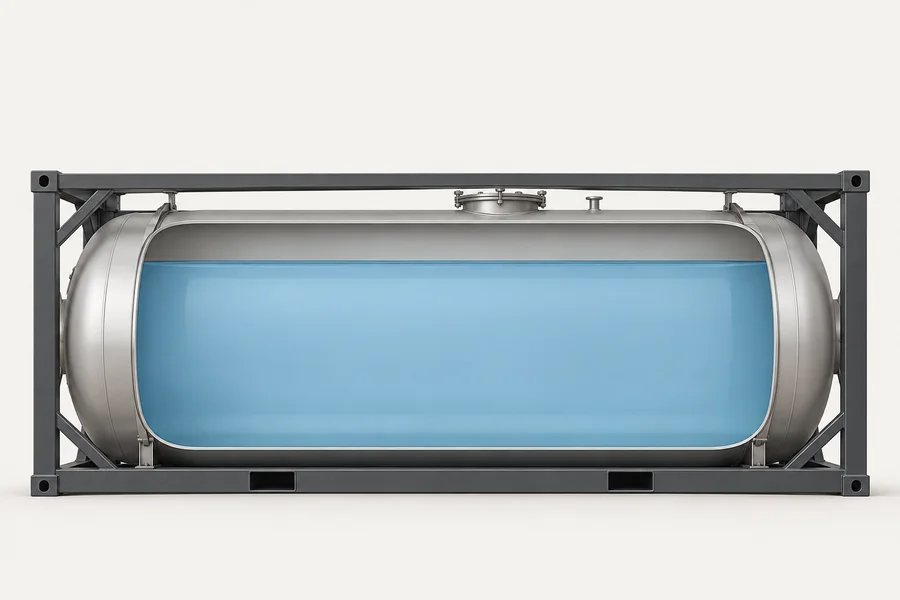
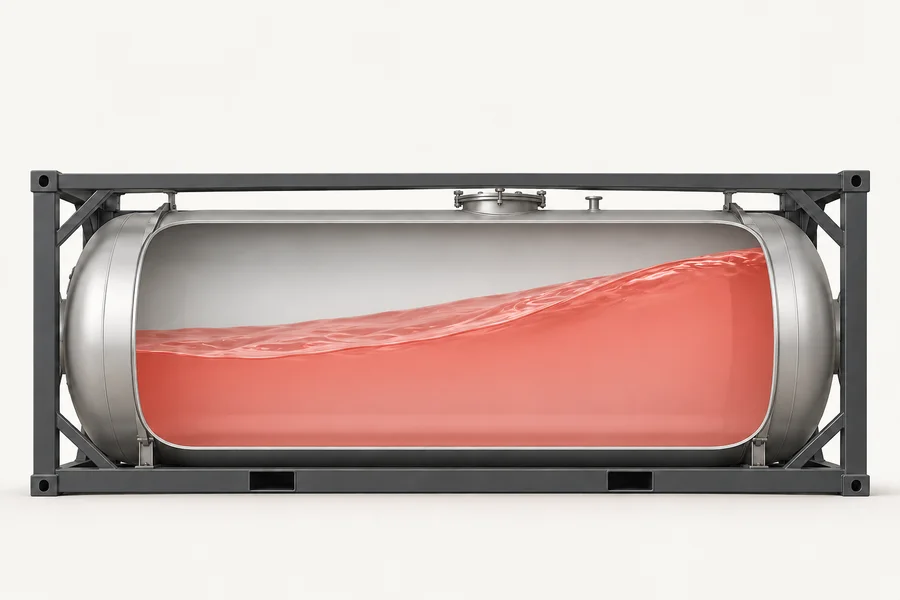
| Half-full tanksRID 4.2.1.9.6 | Liquids thinner than 2 680 mm²/s may not travel between 20% and 80% full, unless surge plates split the shell into sections of 7 500 litres or less |
| Steam-heated cargoRID 4.2.1.9.5 | Kept above 50 °C, a temperature regulator holds it to 95% full; Seaco and Eurotainer T11s have 10.0 to 10.5 m² of steam heating |
| Cargo that is not dangerousITCO | ITCO suggests filling it to 95% |
| Food gradeSeaco; Eurotainer; Exsif | Offered on T11 fleets: hazardous, non-hazardous and food grade cargoes |
| Toluene densityNIST | 871.53 kg/m3 at 15 °C; 838.76 kg/m3 at 50 °C |
| Toluene in the check aboveOur calculation | α = 0.00112; maximum 93.3%; 19,000 kg is 21,801 L, 90.8% of 24,000 litre |
Sources: RID 2025 · ITCO · Seaco · Eurotainer · NIST
Lessors build the T11 in the 20 ft frame: 20 ft (6,058 mm) × 8 ft (2,438 mm) × 8 ft 6 in (2,591 mm). Seaco’s hold 21,000, 24,000, 25,000 or 26,000 litre and tare 3,460 to 3,800 kg.
The minimum test pressure for T11 is 6 bar (RID 4.2.5.2.6); 4 bar instructions are T6 to T10. The 4 bar on lessor sheets is the working pressure, and their relief valves are set at 4.4 bar.
No. Sulphuric acid with more than 51% acid (UN 1830) is assigned T8, which allows no bottom openings for liquids. A T11 may carry only cargo assigned T1, T2, T3, T4, T6, T7 or T11; a T14 may carry it.
A T11 without surge plates travels at 80% or more (20% or less is also allowed, nothing in between), and toluene or another TP1 cargo stops at 97 / (1 + α(tr − tf)) percent. Cargo that is not dangerous goes to 95% on ITCO’s advice.
Yes, if it is a food-grade tank: Seaco designs its T11s for hazardous, non-hazardous and food grade cargoes, and Exsif’s are acid cleaned and certified for the carriage of foodstuffs.
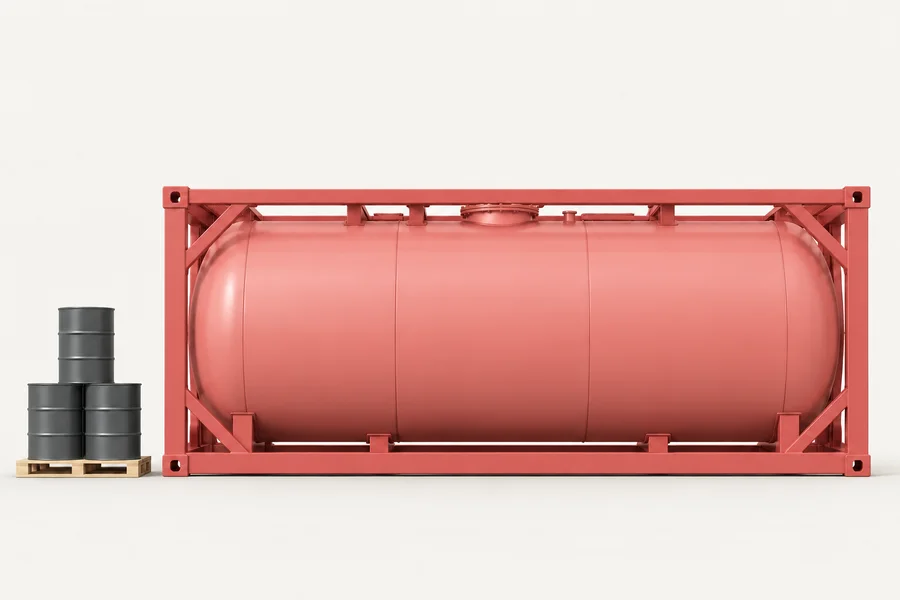
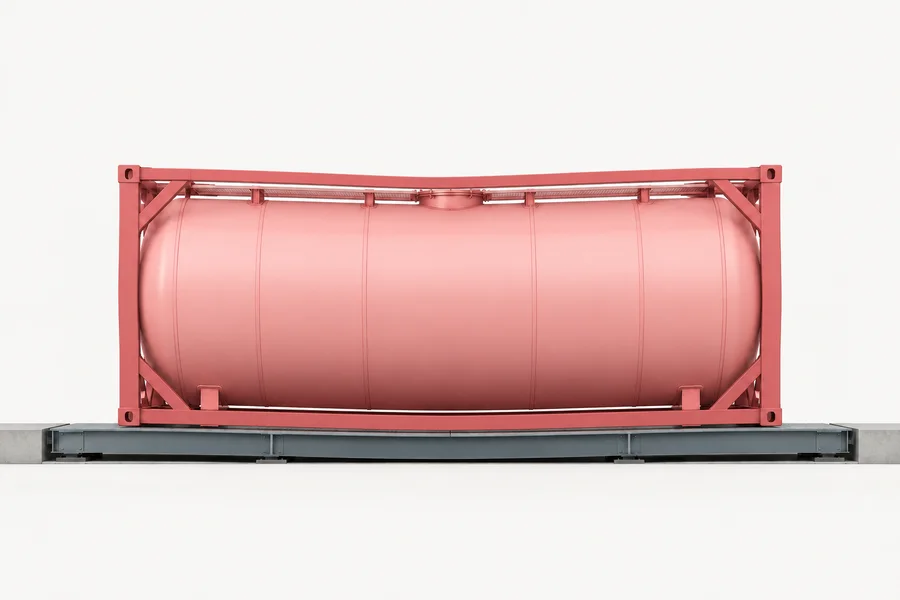
Buyers of chemicals and food liquids ask which T code their cargo is assigned, how many litres one T11 holds at the allowed filling, whether it is heated and food grade, and where the bottom valve sits. Mark the real tank, valve and plate on your own photo in SizeMarker, as in the picture at the top, and send one product card for WhatsApp or WeChat.