Dimensions / Industrial & logistics / ISO tank containers
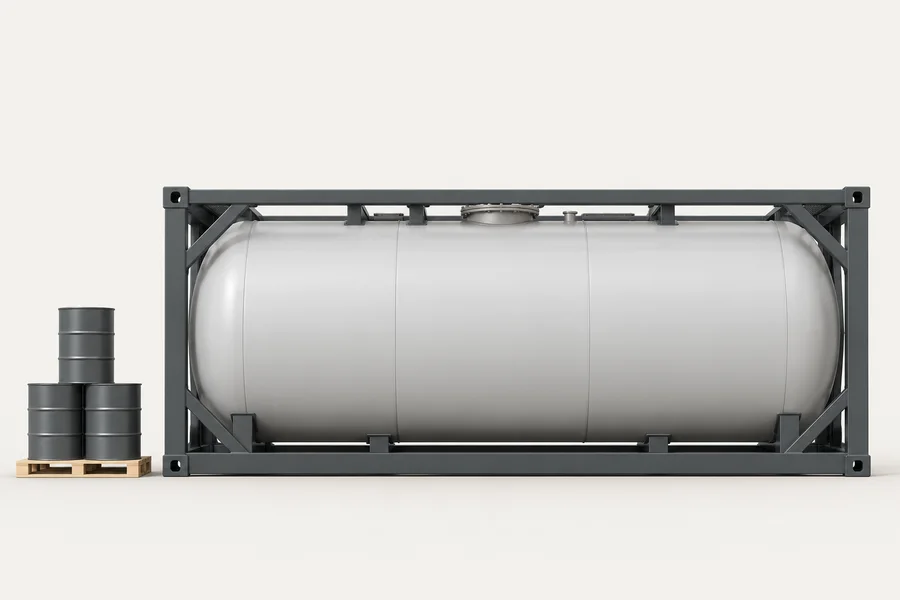
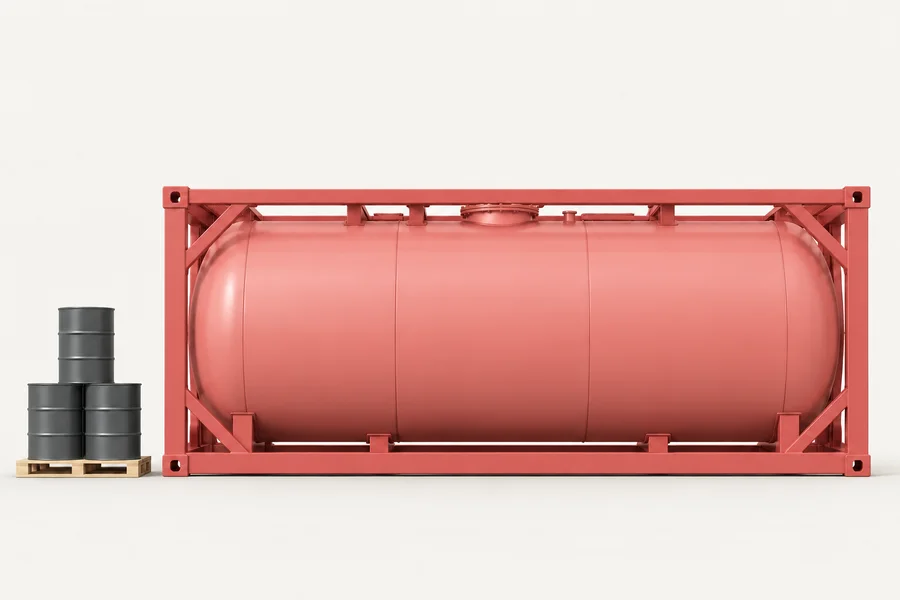
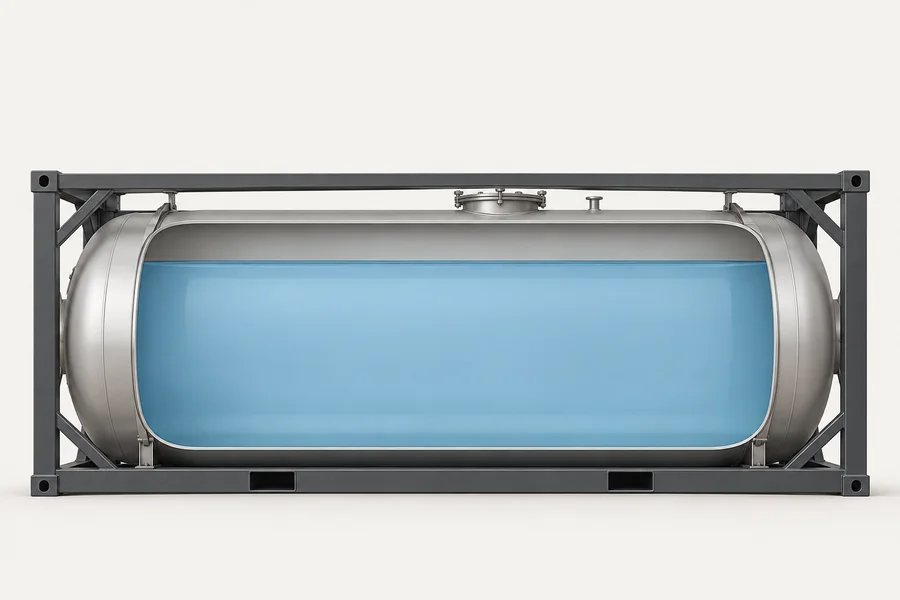
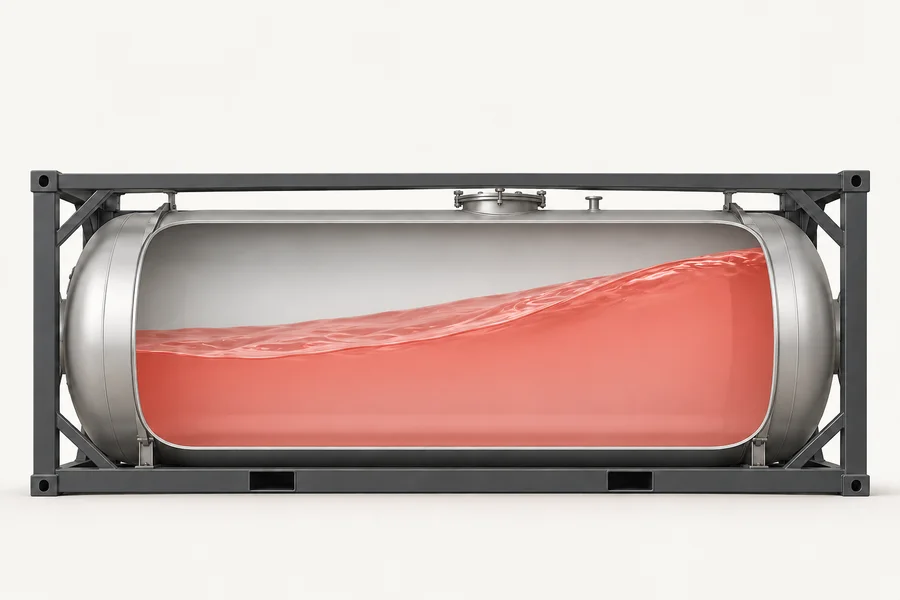
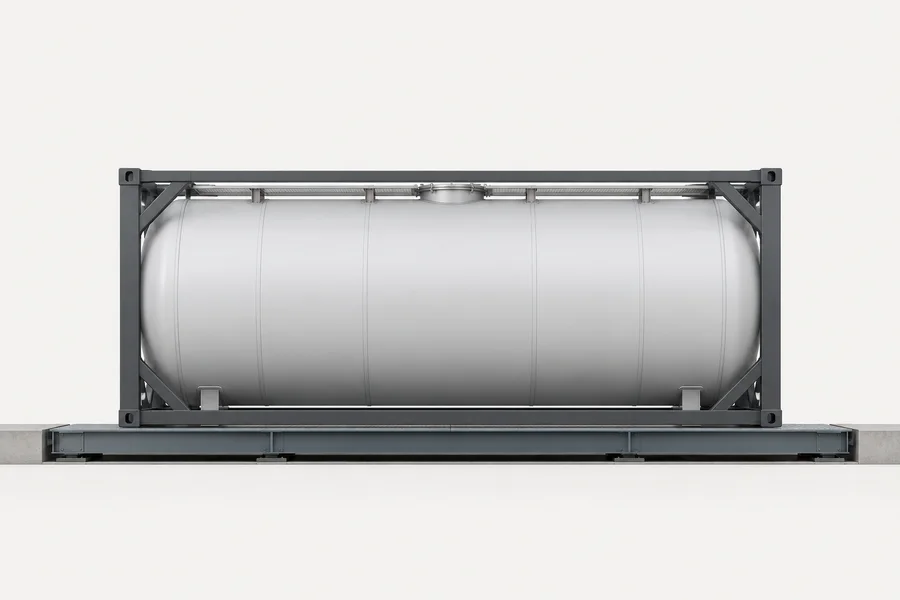
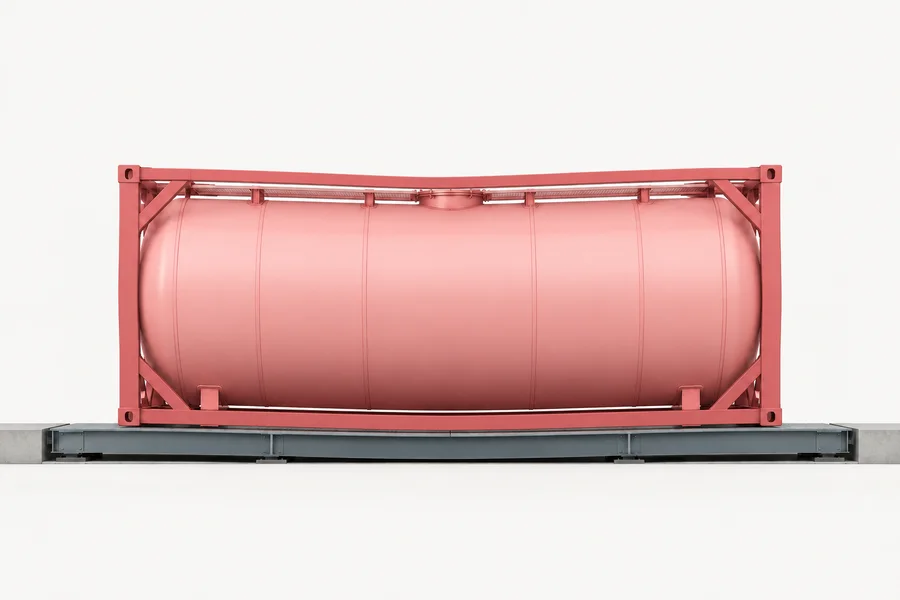
A 20 ft ISO tank container sits in the 6,058 × 2,438 × 2,591 mm frame of ISO 668 1CC. The standard T11 holds 21,000 to 26,000 litre, tares 3,460 to 3,800 kg and is tested at 6 bar (Seaco); a T14 adds a bursting disc and gives up the bottom outlet to carry acids; a T50 gas tank holds about 24,600 litre inside a thick steel shell. Without surge plates a liquid tank must be at least 80% full.
| 20 ft frame, outside: ISO 668 1CC | Minimum fill without surge plates; surge-plate sections up to | Gross on current 20 ft lessor plates; ISO rating in IMO’s 2014 text |
|---|---|---|
| 6,058 × 2,438 × 2,591mm20 ft × 8 ft × 8 ft 6 in | 80%7 500 L | 36,000kg30,480 kg |
Sources: IMO MSC.1/Circ.1498, RID 2025. Checked October 2026.
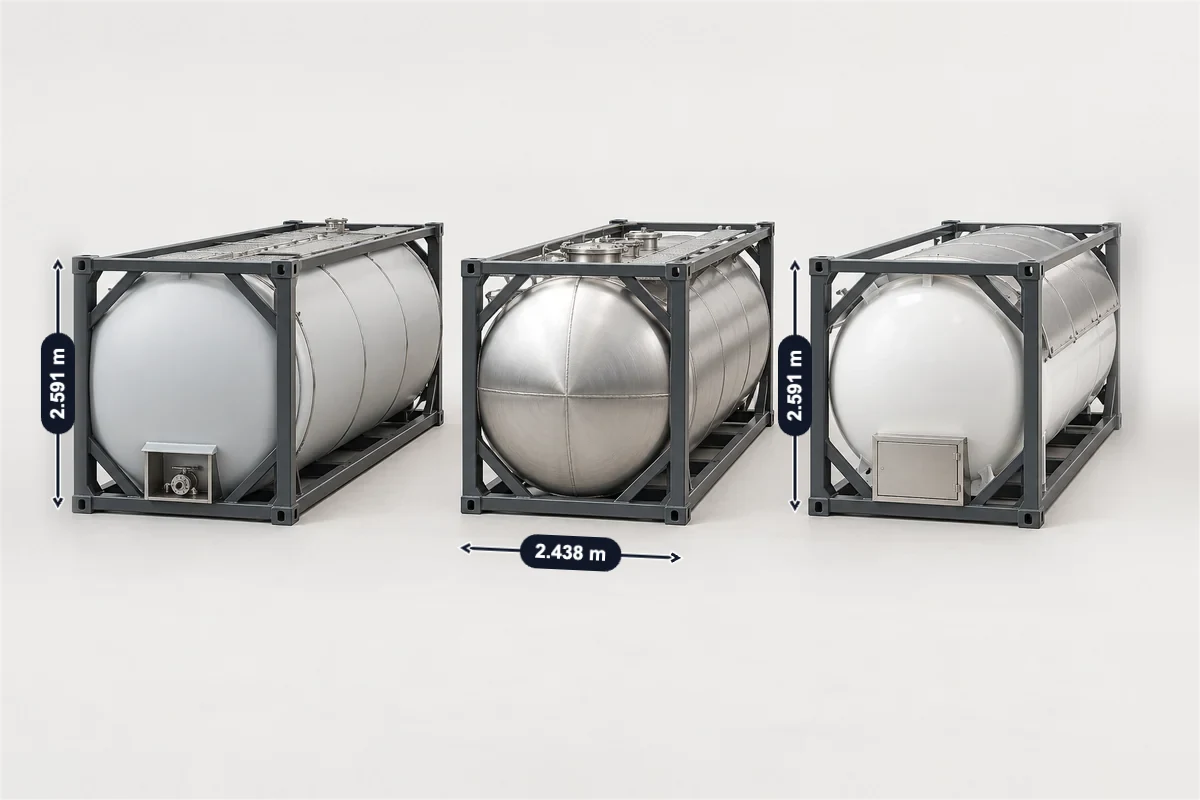
21,000–26,000 litre, 6 bar test (Seaco)
The standard liquid tank: bottom outlet, normal relief, often food grade.
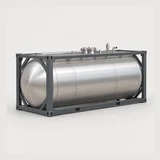
21,000 or 24,000 litre, top discharge only (Seaco)
For acids and other T8 to T14 liquids: bursting disc, no bottom outlet.
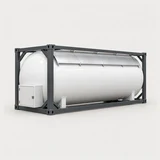
24,300–24,600 litre, 22.0–34.4 bar (Seaco)
Thick steel pressure vessel for liquefied gases, filled by kg per litre.
Pick a tank, then enter your cargo and the figures on the tank’s plate. Each check follows a rule in the tables below.
Capacity in litres, masses in kilograms, densities in kg/L. The T code and TP code are in Columns 10 and 11 of the dangerous goods list (RID / ADR Table A, IMDG); RID takes the hottest mean temperature as 50 °C unless the authorities agree otherwise.
A T11 tank may carry a T4 cargo: under RID 4.2.5.2.5 it stands in for T1, T2, T3, T4, T6, T7, T11.
T11 takes T1–T4, T6, T7, T11.
18500 kg at 0.87153 kg/L is 21227 L, 88.4% of the 24000 L tank: under the 93.3% limit and above 80%, so the load cannot surge.
Toluene, TP1, from NIST.
18500 kg of cargo and the 3620 kg tank make 22120 kg, 13880 kg under the 36000 kg maximum permissible gross mass.
Seaco 24,000 litre T11.
Quoting a liquid by the tank? Photograph the tank, mark its frame size, outlets and plate figures in SizeMarker and send it with your quote.
Mark a photo| Type | Carries | Test pressure; outlets | Real 20 ft tanks (Seaco) |
|---|---|---|---|
| T11 | Liquids assigned T1, T2, T3, T4, T6, T7 or T11 | 6 bar; bottom outlet behind three closures | 21,000 to 26,000 litre; 3,460 to 3,800 kg tare; 36,000 kg gross |
| T14 | Liquids assigned T1 to T14, such as T8 to T10 acids | 6 bar and a 6 mm shell; bursting disc; no bottom openings for liquids | 21,000 or 24,000 litre; 3,160 or 3,400 kg tare |
| T50 | Liquefied gases: propane, butane, ammonia, LPG | MAWP set by gas and shell class, at least 7 bar | 24,600 litre at 22.0 bar, 7,100 kg tare; 24,300 litre at 34.4 bar, 8,800 kg |
Sources: OTIF — RID 2025, Chapters 4.2 and 6.7 (UN portable tank provisions) · Seaco — T11 and T14 tank containers · Seaco — T50 gas tank containers
| Rule | What it says |
|---|---|
| Maximum, general (TP1) | 97 / (1 + α(tr − tf)) percent; α = (d15 − d50) / (35 d50); tr is 50 °C |
| Maximum, toxic, corrosive or high vapour pressure (TP2) | 95 / (1 + α(tr − tf)) percent |
| Surge | Not offered for carriage more than 20% but less than 80% full, unless surge plates divide the shell into sections of 7 500 litres or less |
| Heated cargo | Not more than 95% full at any time |
| Liquefied gases (T50) | A maximum filling ratio per gas: propane 0.42, butane 0.51, ammonia 0.53 kg per litre; propane also needs 18.0 bar in a sun-shielded shell |
| Minimum, IMO guidance | Fill to a minimum of 80% of the total volume, and choose the tank capacity to achieve this |
| Non-hazardous cargo, ITCO | A 95% filling ratio is suggested, in line with many operators’ policies |
Sources: OTIF — RID 2025, 4.2.1.9 and 4.2.5.2.6 · IMO — MSC.1/Circ.1498, informative material related to the CTU Code · ITCO — Technical guidance for shipping bulk liquids
| Item | Size or figure |
|---|---|
| 20 ft frame, ISO 668 1CC | 6,058 × 2,438 × 2,591 mm (20 ft × 8 ft × 8 ft 6 in) |
| Rating | 30,480 kg under ISO in IMO’s 2014 text; current 20 ft lessor plates show 36,000 kg |
| Tank volumes | 9,000 to 27,000 litres; most of the fleet is 20 ft long and 8 ft 6 in high (IMO) |
| 10 ft tank (CIMC) | 2991x2438x2591 mm; 16000 kg; 7, 8, 10 m³ |
| 30 ft tank (CIMC) | 9125x2438x2591 mm; 36000/39000 kg; 33 to 39 m³ |
| 40 ft tank (CIMC) | 12192x2438x2591 mm; 42000 kg; 40 to 50 m³ |
| Swap-body tank (Exsif) | 31,000 L at 7,150 mm and 35,000 L at 7,820 mm long; 2,550 mm wide, 2,670 mm high |
| Inspections (RID 6.7.2.19) | Before first use, then every 5 years with an intermediate test at 2.5 years |
Sources: IMO — MSC.1/Circ.1498, informative material related to the CTU Code · CIMC Safeway — 10 ft tank container · CIMC Safeway — 30 ft tank container · CIMC Safeway — 40 ft tank container · Exsif — Swap body tank container
The frame is 6,058 × 2,438 × 2,591 mm (20 ft × 8 ft × 8 ft 6 in), the ISO 668 1CC size, with the tank inside it; Seaco’s T11s hold 21,000 to 26,000 litre.
IMO gives 9,000 to 27,000 litres; standard 20 ft T11s hold 21,000 to 26,000 litre and T50 gas tanks about 24,300 to 24,600 litre. CIMC builds 30 ft tanks of 33 to 39 m³.
Seaco’s T11s tare 3,460 to 3,800 kg and its T50s 7,100 to 8,800 kg, all plated at 36,000 kg gross; IMO’s 2014 text gives the ISO rating as 30,480 kg.
T11 names the UN portable tank instruction the tank was built to: tested at 6 bar or more, ordinary relief valves, and an outlet underneath. It can take any cargo whose dangerous goods entry lists T1 to T4, T6, T7 or T11.
Both are tested at 6 bar; a T14 adds a 6 mm shell and a bursting disc and has no bottom openings for liquids, so it may carry cargo assigned T1 to T14, including T8 to T10 acids. T50 tanks are for liquefied gases.
Buyers ask which tank code the cargo needs, how many litres and kilograms one tank carries, whether it discharges from the top or bottom, whether it is heated or lined, and what the plate says about gross mass and test dates. Mark the real tank, its valves and plate on your own photo in SizeMarker and send buyers the spec diagram over WhatsApp or WeChat.