Dimensions / Industrial & logistics / Shipping containers
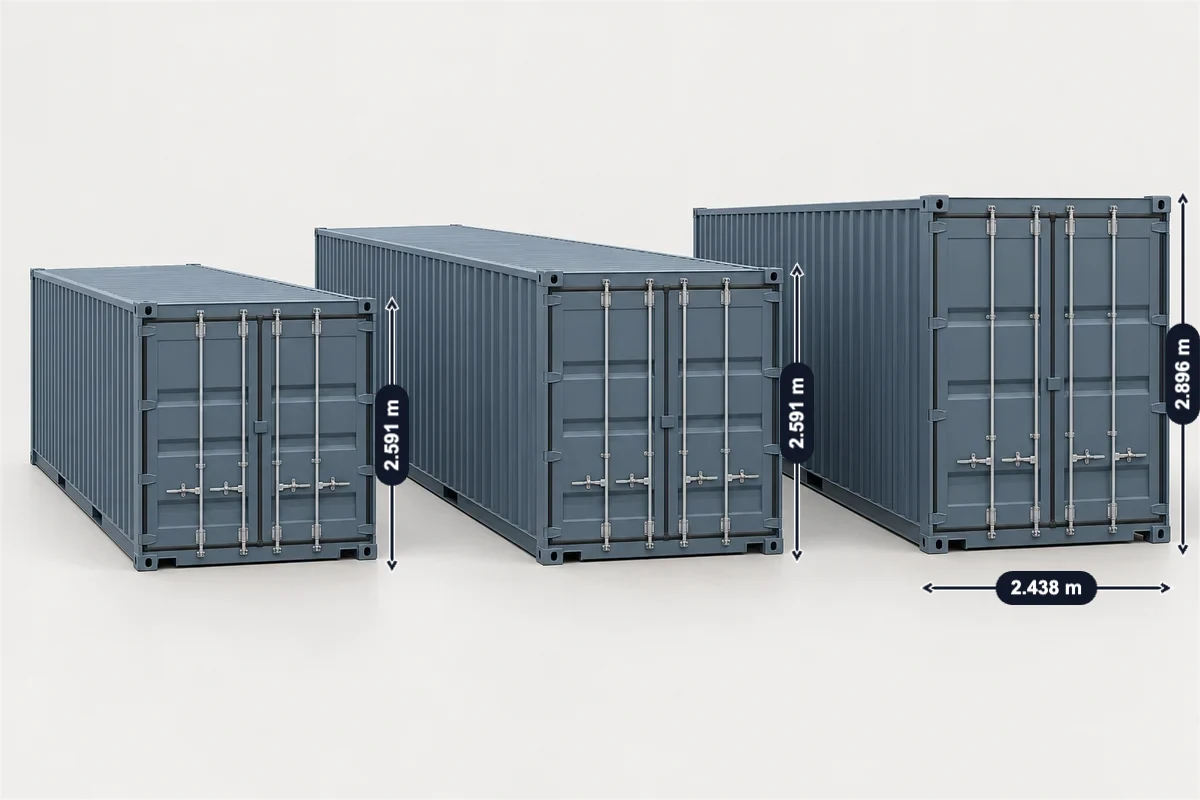
Shipping containers follow ISO 668: a 20 ft is 6,058 × 2,438 × 2,591 mm outside, a 40 ft 12,192 mm long, and a 40 ft high cube 2,896 mm tall (IMO). Inside, a typical 20 ft is 5,898 × 2,352 × 2,393 mm with 33.2 m³, a 40 ft 12,032 mm long with 67.7 m³, and a high cube 2,698 mm high with 76.4 m³ (Triton).
| 20 ft, inside length | 40 ft, inside length | High cube, inside height |
|---|---|---|
| 5,898mm | 12,032mm | 2,698mm |
Sources: Triton (20ft), Triton (40ft), Triton (40ft high cube). Checked October 2026.
5,898 × 2,352 × 2,393 mm inside
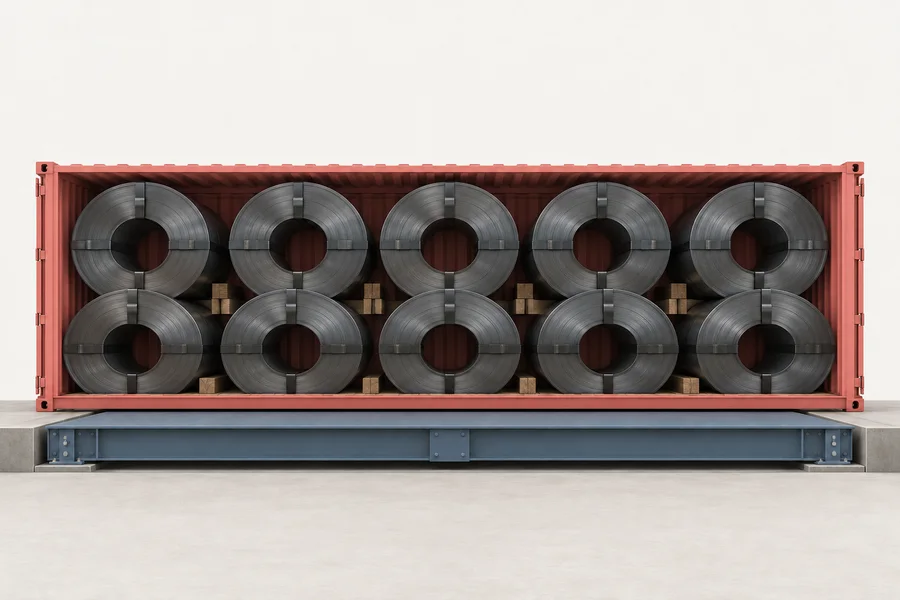
The box for heavy, dense cargo: about the payload of a 40 ft on half the floor.
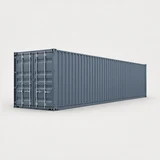
12,032 × 2,352 × 2,393 mm inside
Twice the floor of a 20 ft through the same door, for lighter and bulkier loads.
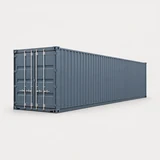
12,032 × 2,352 × 2,698 mm inside
One foot taller than a standard 40 ft, for tall or light cargo.
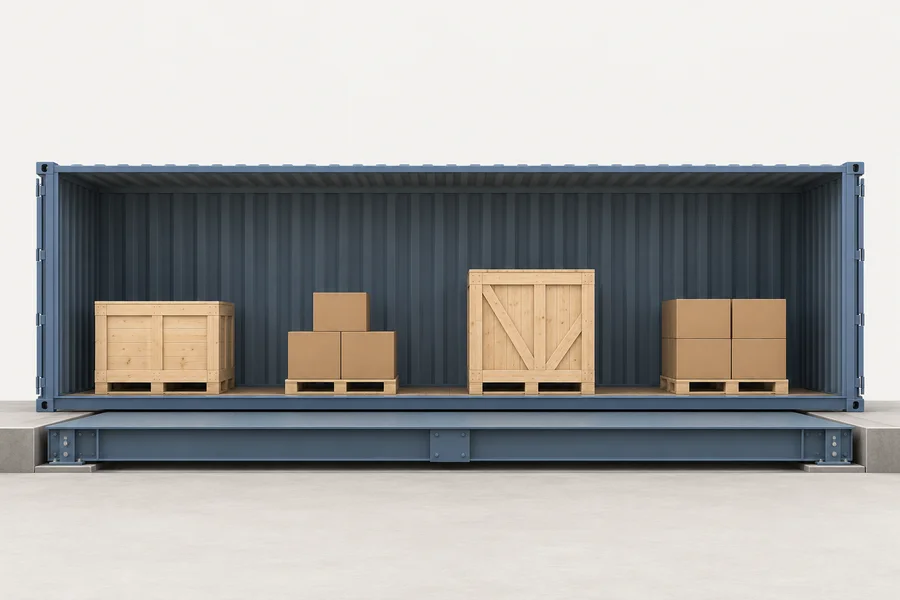
Pick a container, then enter your pallets. The container figures are Triton’s; change them to match your booking.
Sizes in millimetres, weights in kilograms. 1 in = 25.4 mm, 1 lb = 0.454 kg.
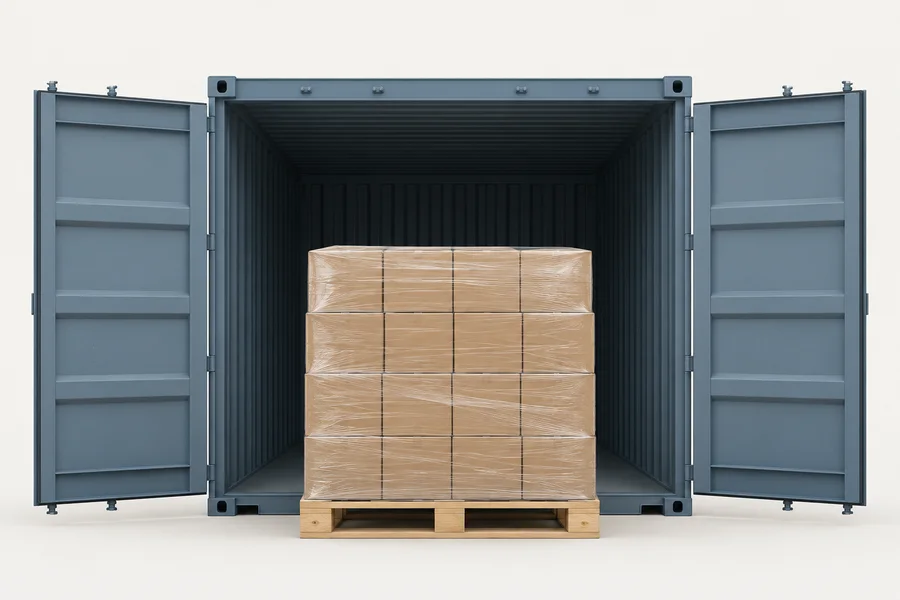
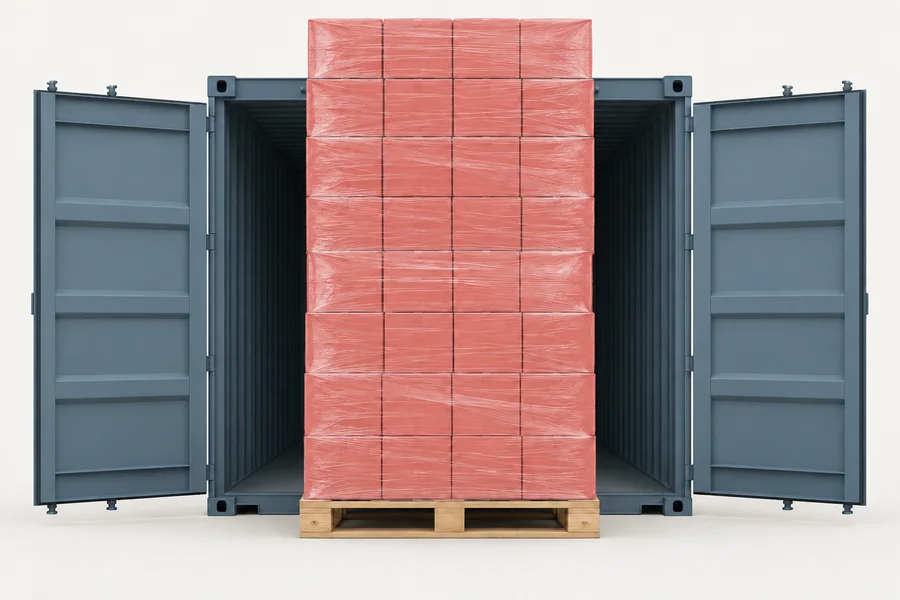
Its 800 mm side goes through the 2340 mm door with 1540 mm to spare, and its 1500 mm height clears the 2280 mm opening by 780 mm.
Same door as the 20 ft.
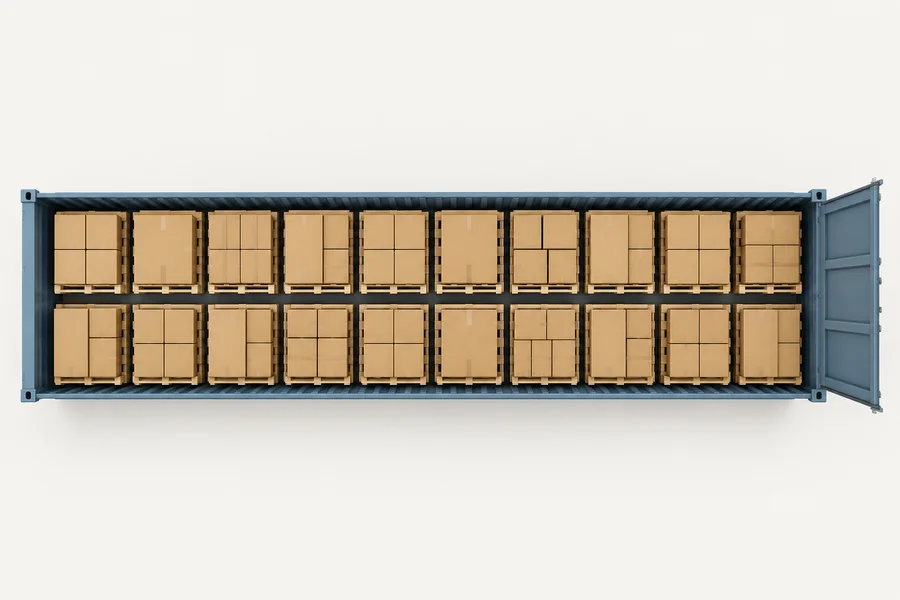
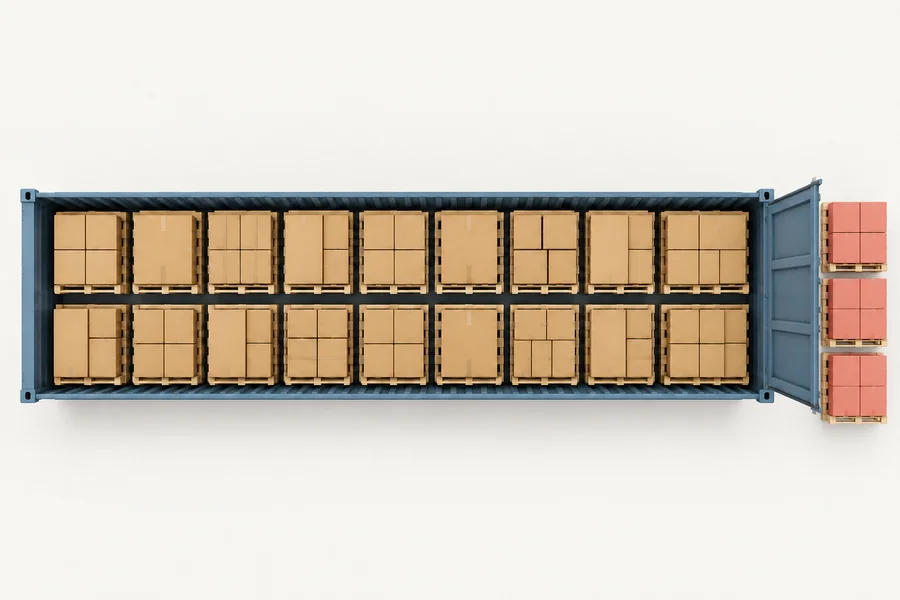
One layer takes 25 pallets of 1200 × 800 mm in straight rows; 1 high that is 25, enough for your 24.
Triton: up to 25 Euro or 20 metric pallets per layer.
24 pallets × 700 kg = 16800 kg, 12160 kg under the 28960 kg maximum payload.
Road and rail limits can be lower than the box rating (IMO).
Sending a loading plan to a buyer? Photograph a loaded pallet, mark its size in SizeMarker and send it with the container type.
Mark a photo| Container | ISO 668 designation, size code | Length | Width × height |
|---|---|---|---|
| 20 ft | 1CC, 22 | 6,058 mm (19 ft 10½ in) | 2,438 × 2,591 mm (8 ft × 8 ft 6 in) |
| 40 ft | 1AA, 42 | 12,192 mm (40 ft) | 2,438 × 2,591 mm (8 ft × 8 ft 6 in) |
| 40 ft high cube | 1AAA, 45 | 12,192 mm (40 ft) | 2,438 × 2,896 mm (8 ft × 9 ft 6 in) |
| 45 ft high cube | 1EEE, L5 | 13,716 mm (45 ft) | 2,438 × 2,896 mm (8 ft × 9 ft 6 in) |
Sources: IMO MSC.1/Circ.1498 — Informative material to the CTU Code (ISO 668 sizes) · BIC — ISO 6346 size and type codes
| Container | Inside, L × W × H | Door, W × H | Volume; payload |
|---|---|---|---|
| 20 ft (Triton) | 5,898 × 2,352 × 2,393 mm | 2,340 × 2,280 mm | 33.2 m³; 28,380 kg |
| 40 ft (Triton) | 12,032 × 2,352 × 2,393 mm | 2,340 × 2,280 mm | 67.7 m³; 28,960 kg |
| 40 ft high cube (Triton) | 12,032 × 2,352 × 2,698 mm | 2,340 × 2,585 mm | 76.4 m³; 28,800 kg |
| 45 ft high cube (ONE) | 13,556 × 2,352 × 2,697 mm | 2,340 × 2,585 mm | 86.0 m³; 27,850 kg |
Sources: Triton International — 20ft dry containers · Triton International — 40ft dry containers · Triton International — 40ft high cube dry containers · Ocean Network Express — Dry containers
| Rule | What it says |
|---|---|
| ISO rating, all lengths except 10 ft (IMO) | 30,480 kg; 20, 40 and 45 ft boxes may be rated 32,500 or 34,000 kg |
| CSC safety approval plate | Maximum operating gross mass, in kg and lbs |
| Door markings (CTU Code) | Tare and payload |
| Weighing before loading (SOLAS, since 1 July 2016) | No packed container goes on a ship without its verified gross mass |
| Cargo along the length (CTU Code) | Not more than 60% of the cargo’s mass in half the length |
| Forklift inside (CSC floor test) | 5,460 kg axle load |
| US road, federal (23 CFR 658.17) | 80,000 lb gross vehicle weight |
| EU road, intermodal container (Directive 96/53/EC) | 44 t on a five- or six-axle articulated vehicle |
Sources: IMO MSC.1/Circ.1498 — Informative material to the CTU Code · IMO MSC.355(92) — CSC amendments (Dutch Treaty Series 2014 No. 145) · IMO MSC.1/Circ.1497 — CTU Code · IMO MSC.1/Circ.1475 — Verified gross mass guidelines · 23 CFR 658.17 — Weight (Cornell LII) · Council Directive 96/53/EC, Annex I (legislation.gov.uk)
| Container | Seaco | Triton |
|---|---|---|
| 20 ft | About 11 Euro pallets (1.2 × 0.8 m) | Up to 11 Euro pallets |
| 40 ft | About 23 Euro pallets, or 20 North American (1.016 × 1.219 m) | Up to 25 Euro pallets |
Sources: Seaco — 20ft dry freight container · Seaco — 40ft dry freight container · Triton International — 20ft dry containers · Triton International — 40ft dry containers
Usually 5,898 × 2,352 × 2,393 mm for a 20 ft and 12,032 × 2,352 × 2,393 mm for a 40 ft, both with a 2,340 × 2,280 mm door (Triton). Owners differ by a few millimetres, so check the box you are booked on.
Only the height: 2,896 mm (9 ft 6 in) outside instead of 2,591 mm (8 ft 6 in). Inside that is 2,698 mm instead of 2,393 mm, with a 2,585 mm door, and 76.4 m³ instead of 67.7 m³ (Triton).
In one layer, about 11 Euro pallets (1.2 × 0.8 m) in a 20 ft; in a 40 ft about 23 (Seaco) or up to 25 (Triton), or 20 North American pallets (Seaco).
Most are rated 30,480 or 32,500 kg gross; subtract the tare for the payload, 28,380 kg for Triton’s 20 ft and 28,960 kg for its 40 ft. Road limits can be lower: 80,000 lb for the whole truck on US federal roads, 44 t for an intermodal container vehicle in the EU.
On the box: the CSC safety approval plate gives its maximum operating gross mass, and the door its tare and payload (CTU Code). Since 1 July 2016 a packed container also needs a verified gross mass before it is loaded onto a ship.
Buyers booking a container ask how many of your cartons or pallets it takes, the carton size and gross weight, and the weight per container. Mark the real carton and pallet sizes on your own product photo in SizeMarker and send buyers the spec diagram over WhatsApp or WeChat.
Planning the load
CBM calculatorGet the cubic metres for one carton or a whole shipment, plus LCL revenue tons.Product spec sheet generatorMark the dimensions on a product photo and download a one-page PDF.Container loading calculatorHow many cartons fit in a 20GP, 40GP or 40HQPallet calculatorHow many pallets fit on the floor, and how many cartons per palletDimensional weight calculatorChargeable weight for a sample carton by air