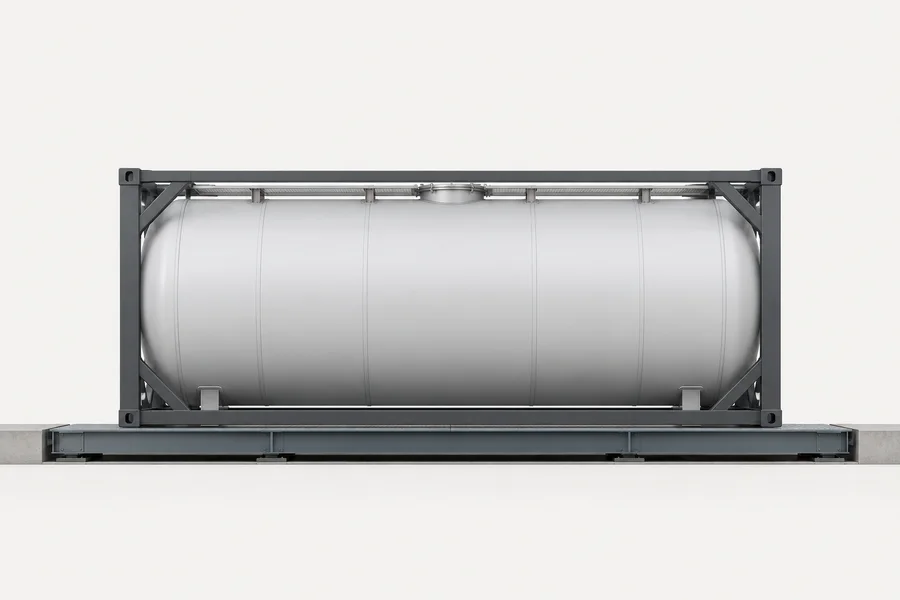
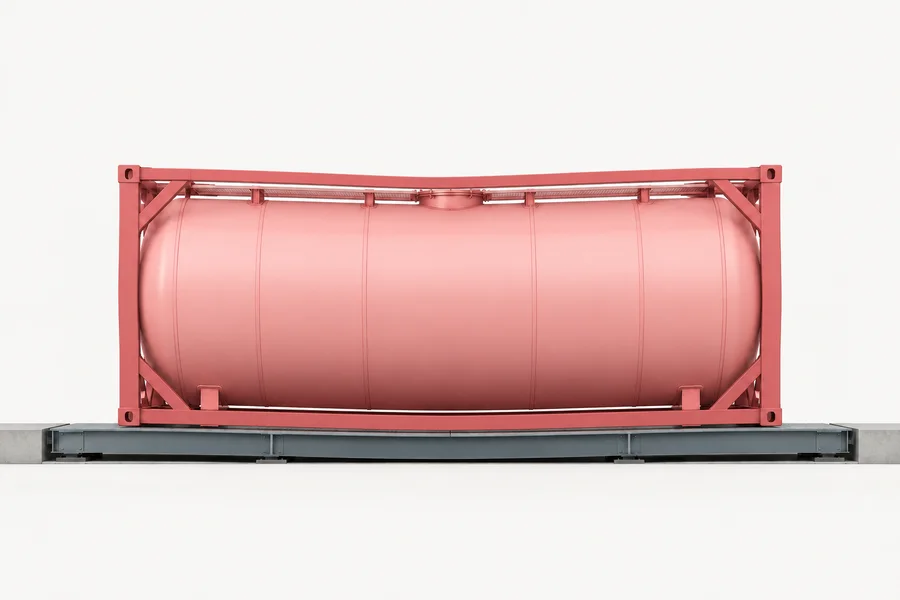
Dimensions / Industrial & logistics / ISO tank containers / T14 tank
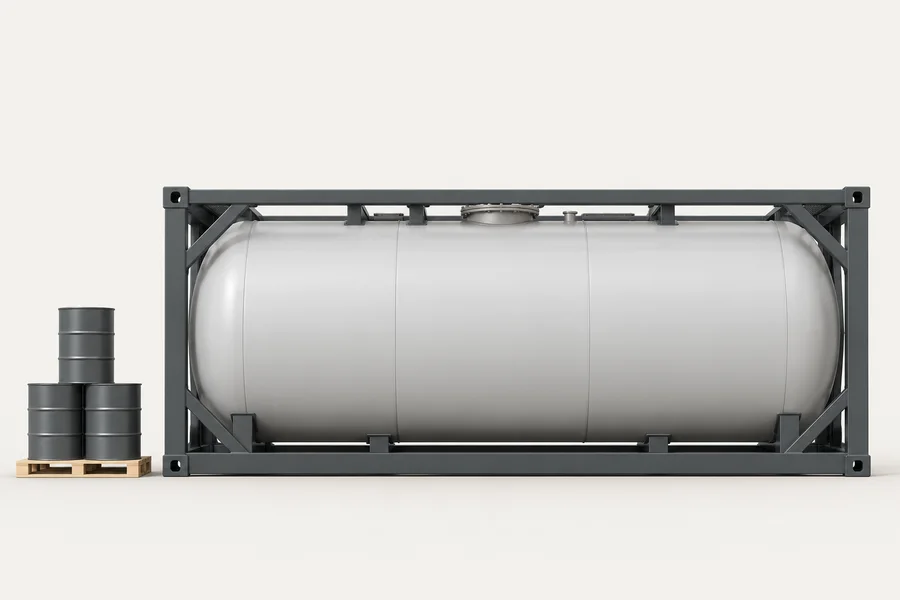
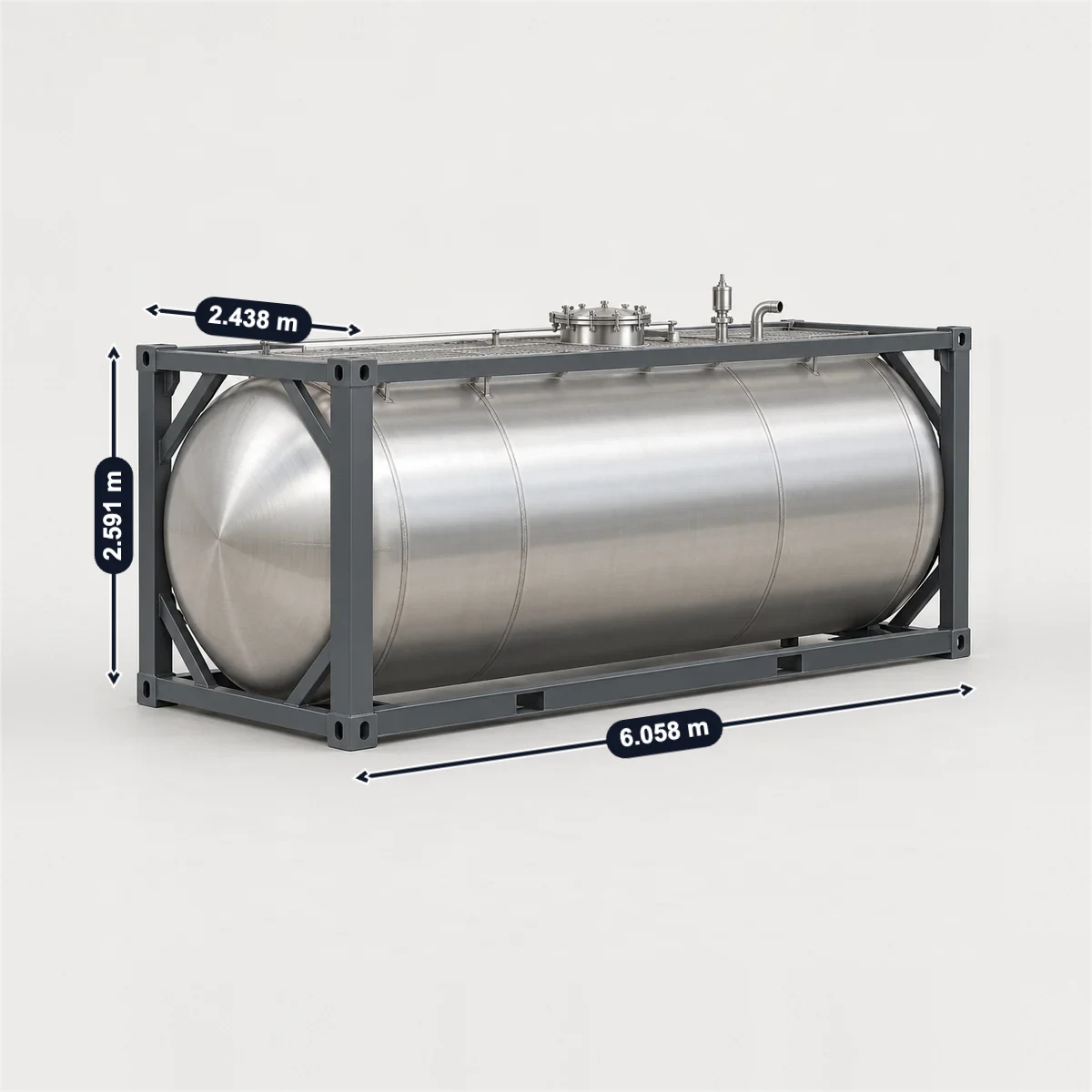
A T14 is the UN portable tank instruction for more dangerous liquids: a 6 bar minimum test pressure, a stated 6 mm minimum shell in reference steel, a bursting disc ahead of the relief valve and no bottom openings for liquids (RID 4.2.5.2.6). Real 20 ft T14s keep the 6,058 × 2,438 × 2,591 mm frame and discharge from the top through a siphon tube: Seaco’s hydrogen peroxide T14 holds 21,000 or 24,000 litre at 3,160 or 3,400 kg tare. A T14 may carry cargo assigned anything from T1 to T14, including the T8 to T10 acids a T11 cannot take, such as sulphuric acid (UN 1830, T8). Linings such as rubber or PTFE follow the cargo, not the code.
| Test pressure; minimum shell in reference steel, RID T14 | Bursting disc; relief valve, Exsif T14 | Capacity, Seaco T14; tare |
|---|---|---|
| 6bar6 mm | 4.84bar4.4 bar | 21,000 / 24,000L3,160 / 3,400 kg |
Sources: RID 2025, Exsif, Seaco. Checked October 2026.
Seaco’s 24,000 litre T14 and methanol are filled in. Enter your cargo and your tank’s plate figures; each check follows a rule on this page.
Capacity in litres, masses in kilograms, densities in kg/L. The T code and TP code are in Columns 10 and 11 of the dangerous goods list (RID / ADR Table A, IMDG); RID takes the hottest mean temperature as 50 °C unless the authorities agree otherwise.
A T14 tank may carry a T7 cargo: under RID 4.2.5.2.5 it stands in for T1, T2, T3, T4, T5, T6, T7, T8, T9, T10, T11, T12, T13, T14.
Methanol (UN 1230, T7) is filled in. Change the code to 8 for sulphuric acid (UN 1830): a T14 still takes it, a T11 would not.
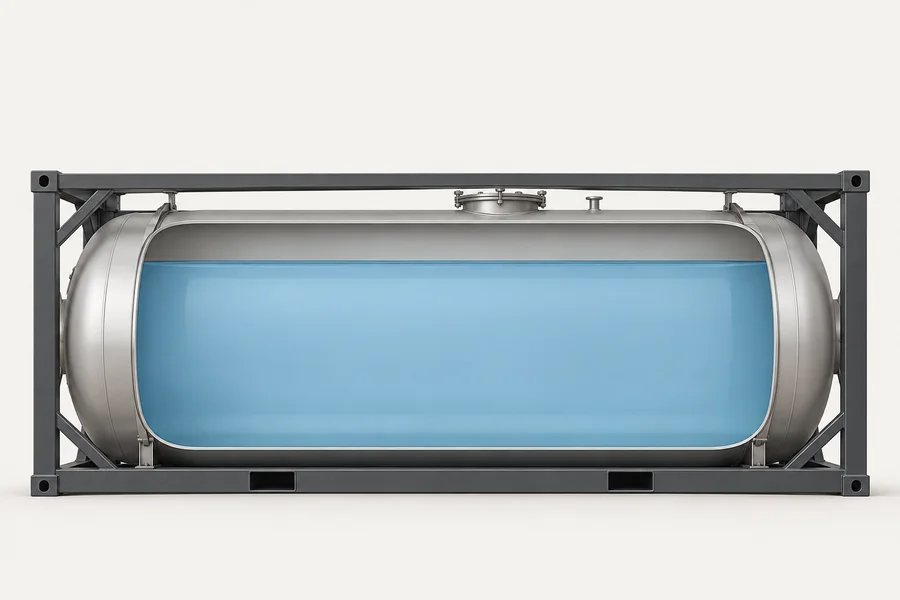
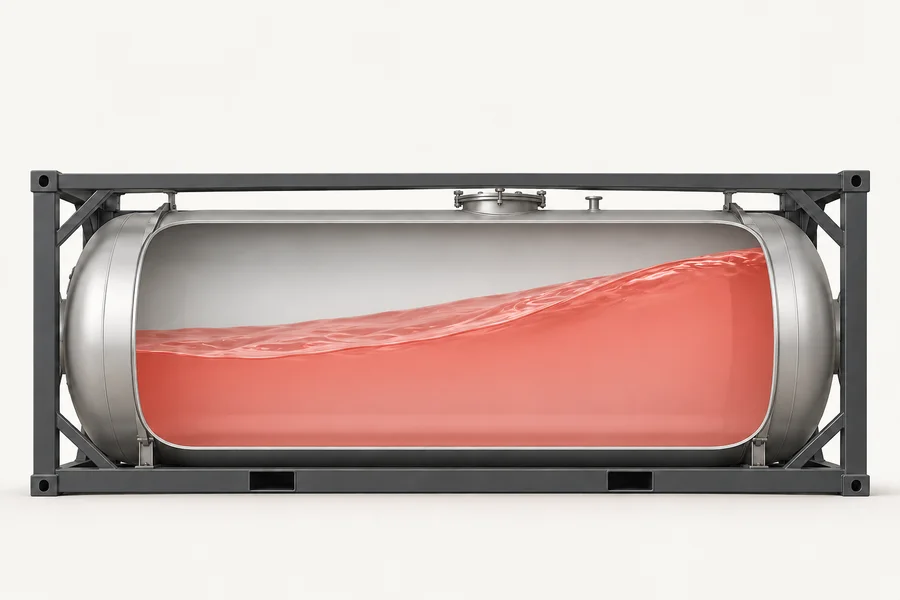
17000 kg at 0.79569 kg/L is 21365 L, 89% of the 24000 L tank: under the 91% limit and above 80%, so the load cannot surge.
Methanol’s TP2 code means the 95 formula; NIST prints 795.69 and 762.58 kg/m3 at 15 and 50 °C.
17000 kg of cargo and the 3400 kg tank make 20400 kg, 15600 kg under the 36000 kg maximum permissible gross mass.
Seaco’s 24,000 litre T14, with no insulation on its sheet, tares 3,400 kg against 3,620 kg for its insulated T11.
Shipping acids or peroxide? Photograph the tank, mark its top fittings, bursting disc and plate in SizeMarker and send it with your quote.
Mark a photoLessors’ and makers’ own sheets. All discharge from the top; ratings are each sheet’s own.
| Tank | Capacity; size | Tare; maximum gross; payload |
|---|---|---|
| Seaco T14, hydrogen peroxideNo insulation listed; 250 mm bursting disc; 50 mm top discharge with siphon tube | 21,000 / 24,000 litre6,058 × 2,438 × 2,591 mm | 3,160 / 3,400 kg; 36,000 kg; 32,840 / 32,600 kg |
| Eurotainer H2O2, T9 to T14 | 17500 / 21000 / 24000 / 25000 L | 3100 / 3160 / 3350 / 3355 kg; 36000 kg |
| Exsif Chemco, T14Bursting disc set at 4.84 bar, relief valve 4.4 bar; bottom outlet N/A | 21,000 to 26,000 L | 3,600 to 3810 kgs; payload 32,400 to 32,190 kgs |
| NT Tank, hydrochloric acid4mm chlorobutyl rubber lining; no insulation | 21,000 Litres | 3,900 kg; 36,000 kg; 32,100 kg |
| NT Tank, PTFE lined3 mm PTFE; for >95% H2SO4 | 20,000 Litres6058 x 2438 x 2591 mm | 4,780 kg without lining; 30,480 kg; 25,700 kg |
| VTG ISOPA, T14Archived sheet; top discharge | 26,000 l6,096 × 2,438 × 2,621 mm | 3,900 kg; 36,000 kg; 32,100 kg |
| OEG offshore acid tank, T14 | 6000 Litre2,438 × 2,438 × 2,750 mm | 3,100 kg; 13,000 kg; 9,900 kg |
Sources: Seaco · Eurotainer · Exsif · NT Tank · NT Tank · VTG (Wayback) · OEG
RID 4.2.5.2.6, the T14 row, and the paragraphs it points to.
| Requirement | What RID says |
|---|---|
| Minimum test pressure | 6 bar, the same as T11 |
| Minimum shell | 6 mm reference steel; T11 asks for 6 mm too once a shell is over 1.80 m across |
| Bottom openings | Not allowed for liquids: no opening below the liquid level at the maximum fill; an old opening is closed by welding a plate inside and out |
| Pressure relief6.7.2.8.3 | A bursting disc ahead of the spring-loaded valve, with a gauge between them; the disc ruptures 10% above the valve’s start-to-discharge pressure |
| Cargo it may carry4.2.5.2.5 | Cargo assigned any of T1 to T14 |
| Tanks that may stand in for it | T19, T20 and T22 only |
| RID / ADR code on dual-certified tanksExsif; VTG | L4BH (Exsif) or L4DH (VTG), not the L4BN of a T11 |
| Same table in US rules49 CFR 172.102 | T14: 6 bar, 6 mm, bottom outlets prohibited |
Sources: RID 2025 · 49 CFR 172.102 · Exsif · VTG (Wayback)
RID Table A, Column 10. Each of these may go in a T14.
| Cargo | T code; TP code |
|---|---|
| Sulphuric acid, more than 51%, UN 1830 | T8; TP2 |
| Hydrochloric acid, UN 1789, PG II | T8; TP2 |
| Nitric acid, UN 2031, PG I / PG II | T10 / T8 |
| Hydrogen fluoride, anhydrous, UN 1052 | T10; TP2 |
| Hydrogen peroxide, UN 2015, PG I | T9; TP2 |
| Acrylonitrile, stabilized, UN 1093 | T14; TP2 |
| Carbon disulphide, UN 1131 | T14 |
| Corrosive liquid, n.o.s., UN 1760, PG I | T14; TP2 |
Sources: RID 2025
| Point | What the source says |
|---|---|
| LiningRID 6.7.2.2.2; NT Tank | Chosen for the substance, not the code: 4mm chlorobutyl rubber for hydrochloric acid, 3 mm PTFE for >95% H2SO4 |
| Shell on real tanksSeaco | The same 4.4 / 4.6 mm 316L barrel for its T11 and T14 |
| WeightSeaco | 21,000 litre T14 with no insulation listed: 3,160 kg, against 3,460 kg for its insulated T11 |
| Filling, TP2RID 4.2.1.9.3 | 95 / (1 + α(tr − tf)) percent; still at least 80% without surge plates |
| Methanol densityNIST | 795.69 kg/m3 at 15 °C; 762.58 kg/m3 at 50 °C |
| Methanol in the check aboveOur calculation | α = 0.00124; maximum 91.0%; 17,000 kg is 21,365 L, 89.0% of 24,000 litre |
Both are tested at 6 bar. A T14 adds a 6 mm minimum shell, a bursting disc ahead of the relief valve and no bottom openings for liquids, so it can carry T8, T9 and T10 cargoes, such as sulphuric acid, that a T11 cannot.
RID allows a T14 no opening below the liquid level when it carries liquids; an existing opening has to be closed by welding a plate inside and out. Seaco’s T14 discharges from the top through a 50 mm ball valve and siphon tube.
Yes. A T14 may carry cargo assigned any instruction from T1 to T14; only a T19, T20 or T22 may stand in for a T14 itself.
The same 20 ft frame, 6,058 × 2,438 × 2,591 mm. Seaco’s T14 holds 21,000 or 24,000 litre; NT Tank’s PTFE-lined T14 holds 20,000 Litres and is plated at 30,480 kg; OEG’s offshore acid tank holds 6000 Litre.
No. RID picks the shell material or lining by the substance, not the code: NT Tank lines its hydrochloric acid T14 with 4mm chlorobutyl rubber, while Seaco’s hydrogen peroxide T14 is bare 316L.
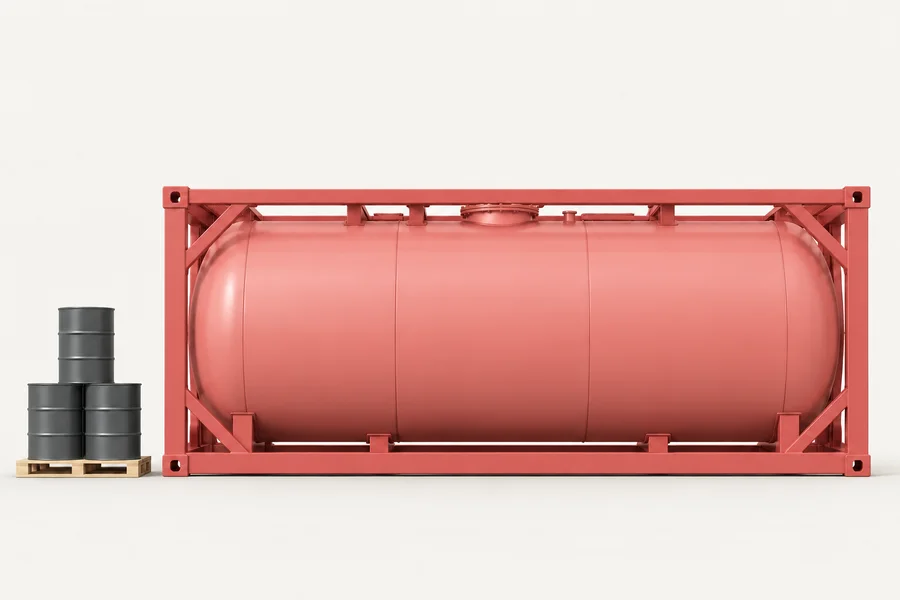
Buyers of acids and peroxide ask whether the tank is a T14 or only a T11, how it is lined, where the top discharge and bursting disc are, and how many kilograms one tank carries at the allowed filling. Mark the real tank, fittings and plate on your own photo in SizeMarker, as in the picture at the top, and send one product card for WhatsApp or WeChat.