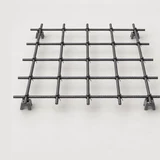
Dimensions / Building materials / Rebar / #4 rebar
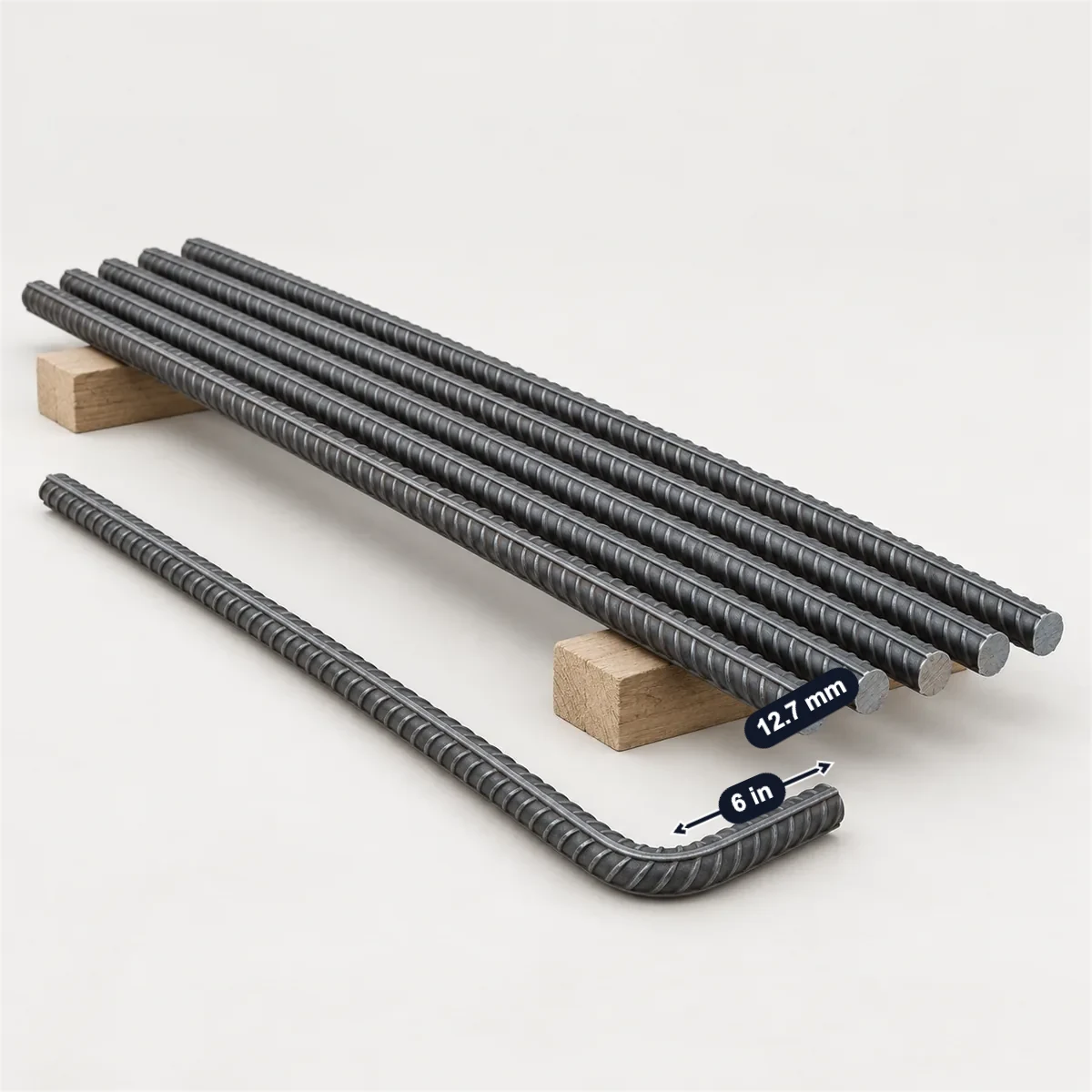
A #4 bar is 1/2 in in nominal diameter (0.500 in, 12.7 mm), with 0.20 in² (129 mm²) of steel, and weighs 0.668 lb/ft (0.994 kg/m), so a 20 ft bar is 13.36 lb. In the soft-metric naming of ASTM A615M the same bar is No. 13, though it is 12.7 mm across. Mills cut it to 20, 40 and 60 ft, and WSDOT gives 40 ft as its mill length. The IRC laps #4 20 in at Grade 40 and 30 in at Grade 60, and a standard hook bends round 3 in with a 6 in extension at 90°. Its nearest metric bars are Ø12 (113.1 mm²) and 10M (100 mm²); neither is the same bar.
| Nominal diameter | Weight (Caltrans, Nucor) | A 20 ft bar |
|---|---|---|
| 0.500in12.7 mm | 0.668lb/ft0.994 kg/m | 13.36lb6.06 kg |
Sources: Caltrans, Steel Supply LP. Checked October 2026.
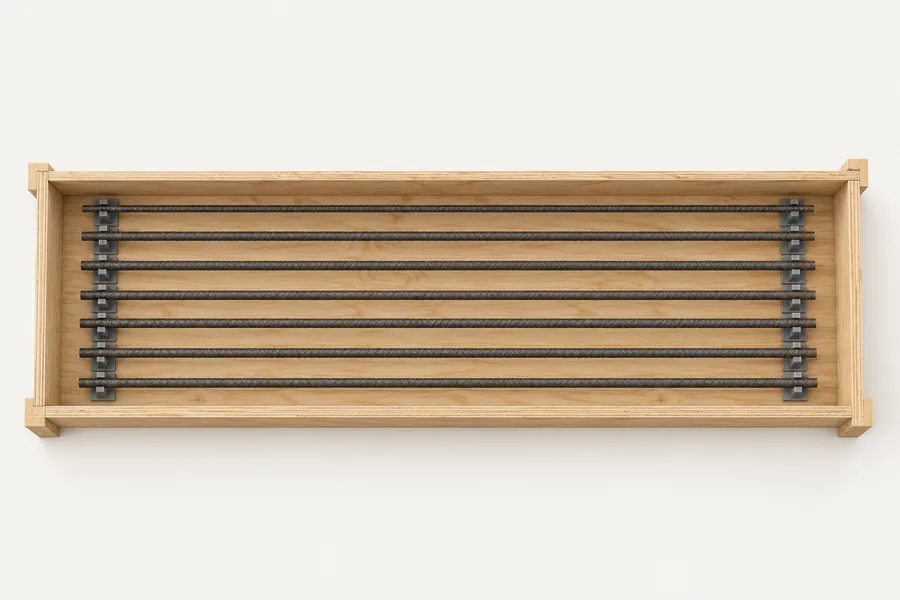
A house footing laid with #4 bars, spliced at Grade 60 and finished with a right-angle hook is filled in; change the run, the bars you order, the lap or the hook and the three checks redo themselves.
Weights are theoretical, the way state DOTs pay for rebar: no allowance for epoxy, galvanizing or rolling tolerance.
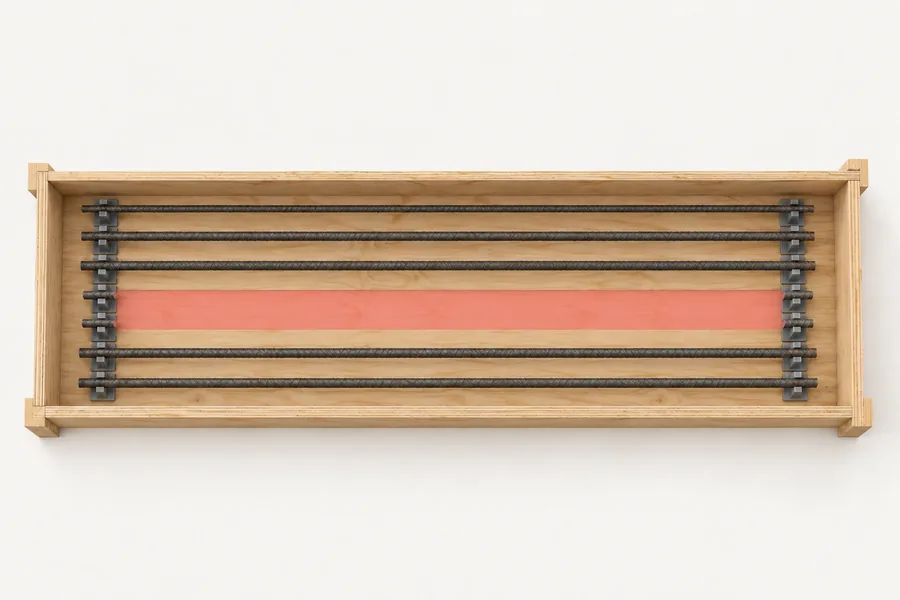
20 ft less 3 in clear at each end, at 12 in, takes 20 #4 bars with one at each end; you have 20. At 0.668 lb/ft the 20 bars of 20 ft weigh 267.2 lb, 13.36 lb each.
A 20 ft run with #4 bars 12 in apart and 3 in clear at each end is filled in; a bar at each end is our geometry, not a code rule.
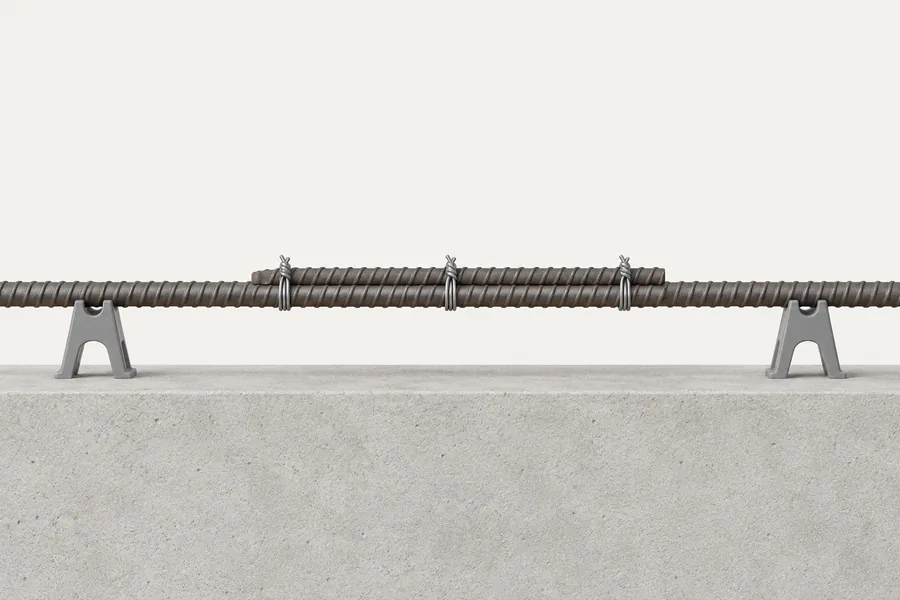
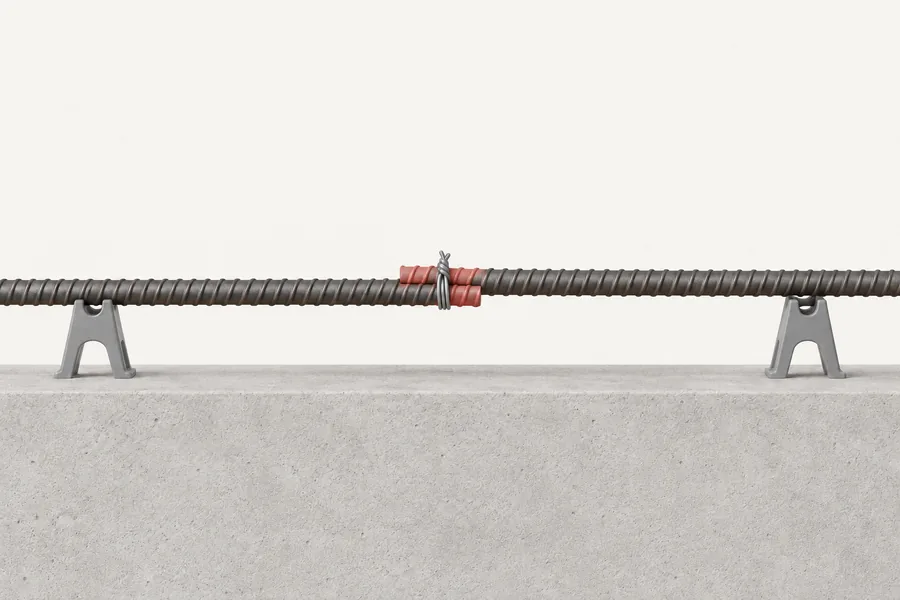
IRC Table R608.5.4(1) asks for 30 in on a #4 bar at Grade 60, 60 bar diameters; your 30 in lap is enough, and the 0 in gap is within 6 in.
IRC Table R608.5.4(1) laps #4 20 in at Grade 40 and 30 in at Grade 60.
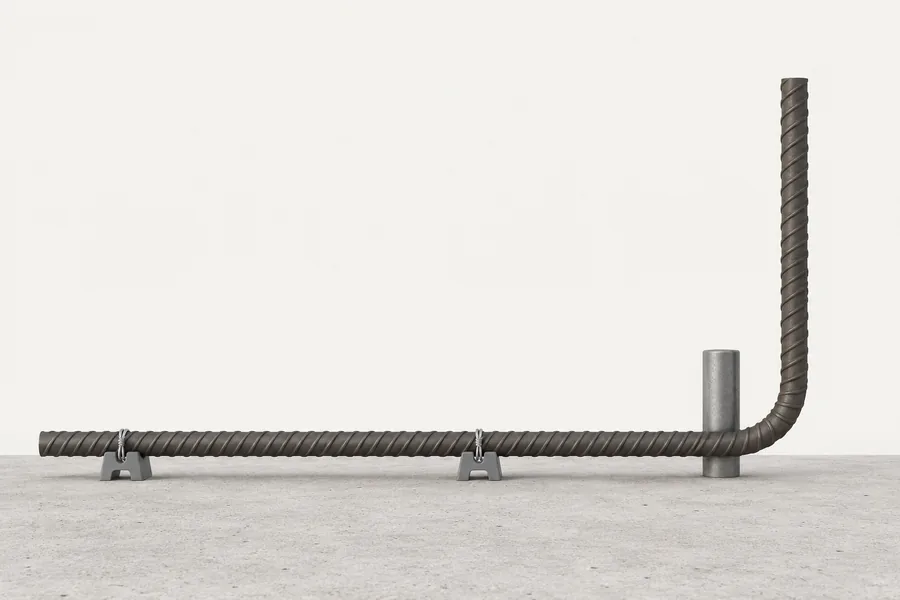
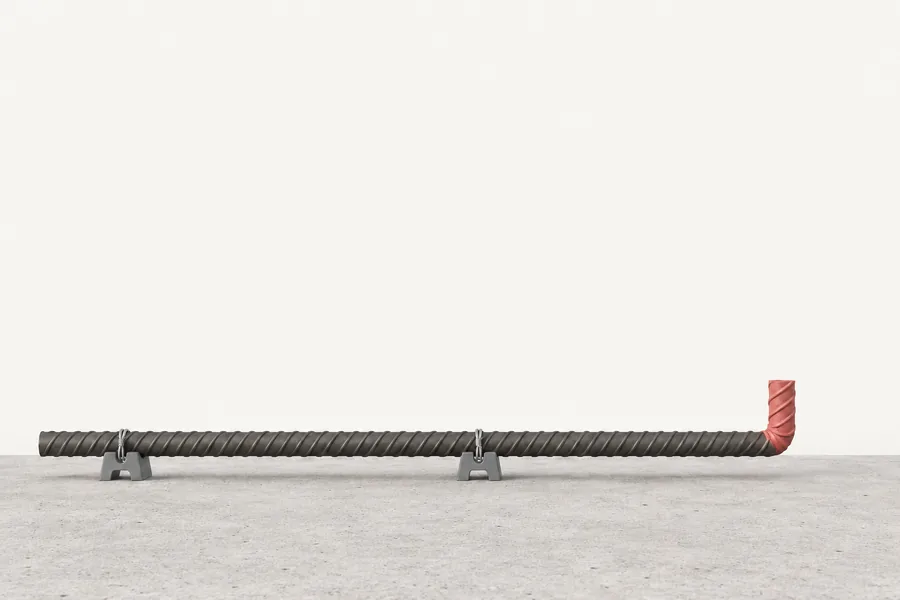
A #4 bar (1/2 in) bends round at least 6 bar diameters, 3 in, and a 90° hook runs on 12 diameters, 6 in; your 3 in bend and 6 in extension meet both ACI minimums.
A #4 bar bends round 3 in, 6 bar diameters, and a 90° hook runs on 6 in.
Selling half-inch bar? Shoot the bundle tag beside a cut end, label size, grade, cut length and the rolled letters in SizeMarker, then attach the picture when you quote.
Mark a photoGovernment tables and mill sheets; weights are theoretical. Steel Supply LP and Weyerhaeuser are distributors.
| Source | Diameter, area | Weight | Lengths; bundle |
|---|---|---|---|
| Caltrans Bridge Design Details 13.1This page | 0.500 in; 0.20 in²; outside the ribs 0.56 in | 0.668 lb/ft | — |
| Ohio DOT Item 509, metric table | 12.7 mm; 129 mm² | 0.994 kg/m | Listed as #13M, the ASTM A615M soft-metric name |
| Steel Dynamics catalog (2025) | 0.500 [12.7]; 0.20 [129] | 0.668 [0.994] | 20–60 ft; spools 4,400–11,000 lb |
| Steel Dynamics Roanoke | — | 0.668 lb/ft | 150 pieces, 2,004 lb a bundle of 20 ft bars |
| Nucor | 1/2 in | 0.668 lb/ft | 20, 40 and 60 ft; Grades 40, 60 and A706 |
| Gerdau | 4 (13) | 0.668 lb/ft | 20, 30, 40 and 60 ft |
| Byer Steel | 1/2 in, 0.500 in | 0.668 lb/ft | 10, 20, 40 ft; 150 pieces: 1,002 / 2,004 / 4,008 lb |
| Weyerhaeuser Distribution | 1/2 in | 13.36 / 20.04 / 26.72 lb a bar | 20, 30, 40 ft; 150 / 150 / 220 pieces |
| Steel Supply LPHouston | — | 13.36 lb (6.06 kg) a 20 ft bar, at Grade 40 and Grade 60 alike | 240 in |
Sources: Caltrans · Ohio DOT · Steel Dynamics · Steel Dynamics · Nucor · Gerdau · Byer Steel · Weyerhaeuser · Steel Supply LP
IRC 2021 prescriptive rules for houses; engineered work follows the design.
| Place | Rule |
|---|---|
| Stem wallsR403.1.3, Seismic Design Categories D0–D2 | One #4 vertical at most 4 ft apart, 14 in into the wall; one #4 within 12 in of the top and one 3 to 4 in above the bottom of the footing |
| Turned-down footingsR403.1.3.3 | One #4 at the top and the bottom, or one #5 or two #4 in the middle third of the depth |
| Basement wallsTable R404.1.2(1) | One #4 within 12 in of the top of the wall story and one near mid-height |
| Construction joints | One #4 across the joint at most 24 in apart |
| SteelR403.1.3.5.1 | Yield strength at least 40,000 psi (Grade 40) |
| Bar spacing in walls | Not less than half the wall thickness and not more than 48 in on centre |
Splice lengths come from the IRC table; bend and hook sizes from the Deer Park and Caltrans tables, which follow ACI.
| Item | Grade 40 | Grade 60 |
|---|---|---|
| Tension lap spliceIRC Table R608.5.4(1) | 20 in, 40 bar diameters | 30 in, 60 bar diameters |
| Straight developmentIRC | 15 in | 23 in |
| Hooked developmentIRC | 6 in with the cover in note a or b, 8 in with less | 9 in, or 12 in with less cover |
| Inside bend diameterDeer Park 440 | 6 bar diameters: 3 in | 6 bar diameters: 3 in |
| 90° hookCaltrans 13.2 | 12 bar diameters: 6 in extension, 8 in J, 6-3/4 in allowance | The same |
| 180° hookCaltrans 13.2; IRC | 2-1/2 in, which is more than 4 bar diameters (2 in) | The same |
| Stirrup bendDeer Park 440; CRSI via ASPIRE | 4 bar diameters, 2 in; CRSI fabricators use 2-1/2 in | The same |
| Lap with the bars apartIRC | At most one-fifth of the lap or 6 in, whichever is less | The same |
Sources: IRC · City of Deer Park · Caltrans · ASPIRE
| Bar | Diameter | Area | Weight |
|---|---|---|---|
| #4No. 13 in ASTM A615M | 12.7 mm | 129 mm² | 0.994 kg/m |
| 10MCSA; Alberta substitutes it for #4, which has 1.29 times its area | 11.3 mm | 100 mm² | 0.785 kg/m |
| Ø12GB 1499.2-2024 | 12 mm | 113.1 mm² | 0.888 kg/m |
| Ø14GB 1499.2-2024 | 14 mm | 153.9 mm² | 1.21 kg/m |
| 15MCSA; the twin of #5, not #4 | 16.0 mm | 200 mm² | 1.570 kg/m |
Sources: Ohio DOT · CBSA · Alberta Transportation · Russel Metals · GB 1499.2-2024
| Item | Figure |
|---|---|
| Mill lengthWSDOT | 40 ft for #3 and #4; 60 ft for #5 and larger |
| Rolled marksCRSI | Mill letter, bar size, steel type (S for A615, W for A706), then the grade: 60 or one line for Grade 60; Grade 40 carries no grade mark |
| GradesCRSI | A615 covers Grades 40, 60, 80 and 100; Grade 75 left the main body in 2018 |
| How weight is paidOhio DOT; Iowa DOT | Number × length × theoretical weight, with no allowance for coating or tolerance |
| Retail lengthsKuhlman | 10 and 20 ft; 6.68 lb for 10 ft (our calculation) |
| In the check aboveOur calculation | (240 − 2 × 3) ÷ 12 = 19.5, so 19 spaces and 20 bars; 20 × 20 ft × 0.668 = 267.2 lb; lap 30 in at Grade 60; bend 3 in, 90° extension 6 in |
Sources: WSDOT · CRSI · CRSI · Ohio DOT · Iowa DOT · Kuhlman
1/2 in nominal (0.500 in, 12.7 mm), with 0.20 in² (129 mm²) of steel. Its soft-metric name is No. 13, though the bar is 12.7 mm, not 13 mm (ASTM A615M, as Ohio DOT prints it).
0.668 lb/ft (0.994 kg/m): 13.36 lb for a 20 ft bar and 2,004 lb for Steel Dynamics’ bundle of 150 bars. Grade 40 and Grade 60 weigh the same.
20 in at Grade 40 and 30 in at Grade 60 in IRC Table R608.5.4(1), which is 40 and 60 bar diameters. Lapped bars that do not touch may be one-fifth of the lap or 6 in apart, whichever is less.
At least 6 bar diameters, 3 in, for main bars (Deer Park 440, following ACI), and 4 diameters, 2 in, for stirrups. A 90° hook runs on 12 diameters, 6 in; a 180° hook on 2-1/2 in, more than 4 diameters.
None exactly. The nearest are Ø12 (113.1 mm², 0.888 kg/m) and 10M (100 mm²); #4 has 129 mm². Alberta substitutes 10M for #4 in bridge design, though #4 has 1.29 times its area.
Mills cut 20, 40 and 60 ft (Nucor), Gerdau also 30 ft, and retailers sell 10 and 20 ft. WSDOT gives 40 ft as the mill length for #3 and #4.
A builder ordering #4 wants to see it called No. 13 as well, to know whether it is Grade 40 or Grade 60 to A615 (or weldable A706), how long each piece is cut, what 150 pieces weigh, and which letters the mill rolls on it. Put those on a picture of your own bundle with SizeMarker, the way the photo at the top is set out, and share it as one card in WhatsApp or WeChat.