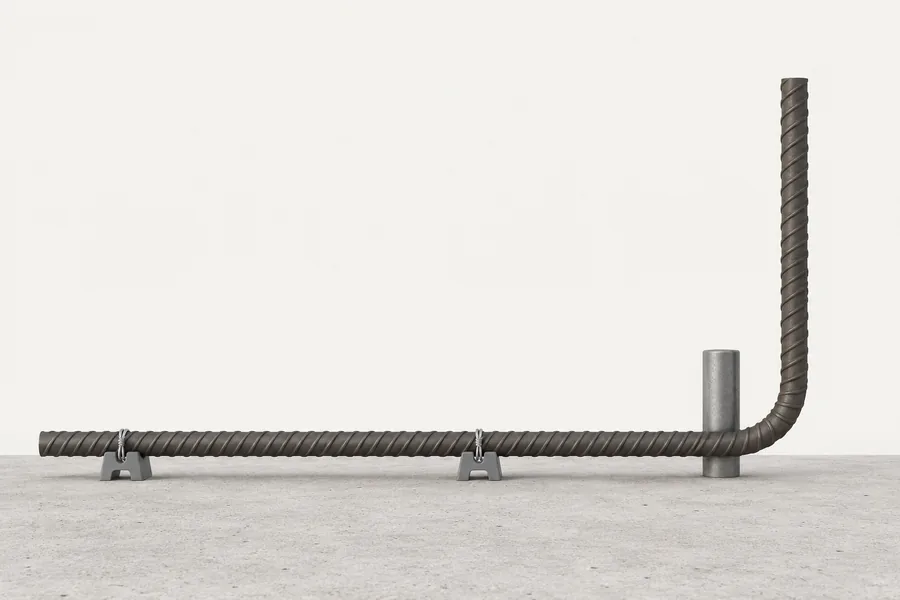
Dimensions / Building materials / Rebar / #5 rebar
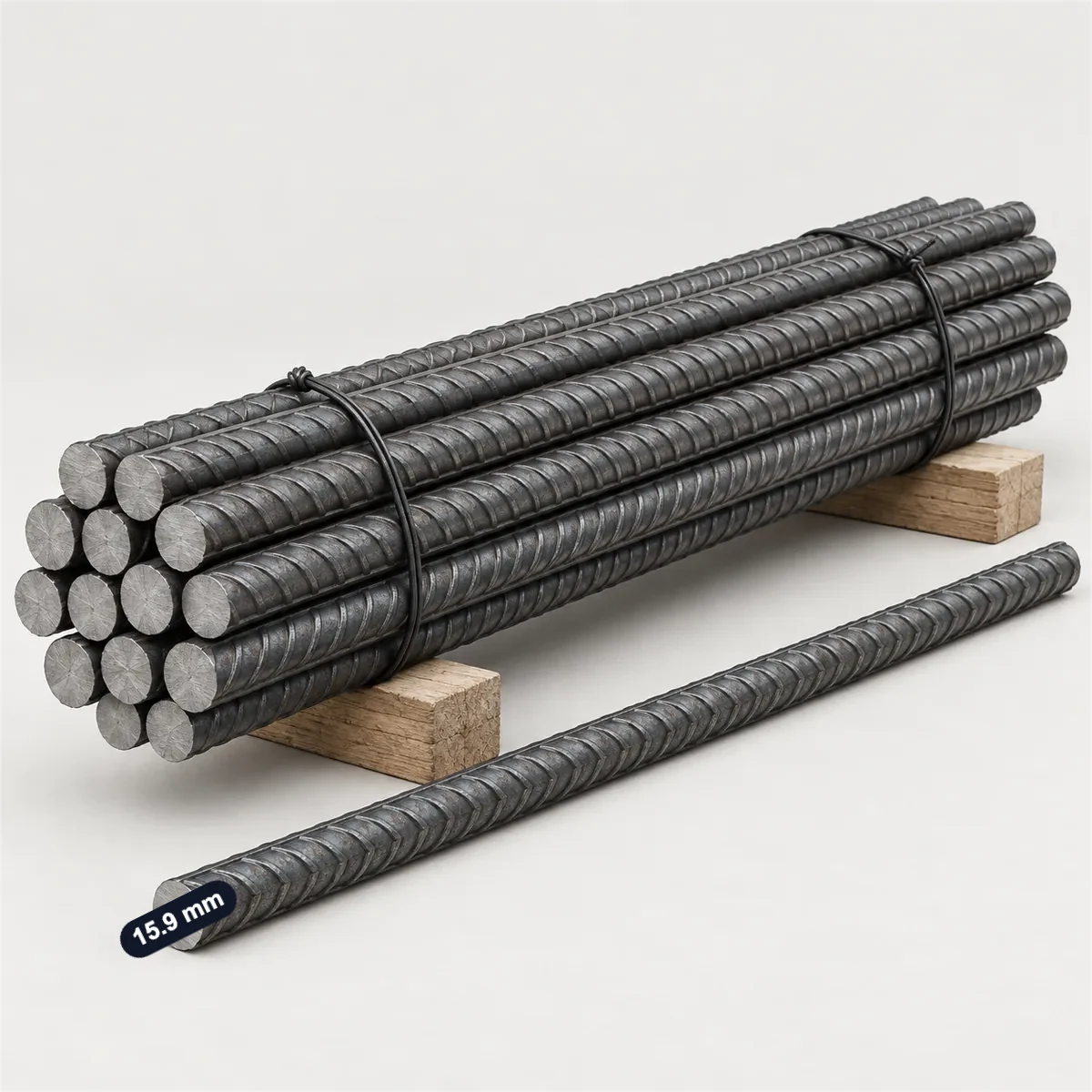
A #5 bar is 5/8 in nominal (0.625 in, 15.9 mm), with 0.31 in² of steel (199 mm², not the 200 some tables print) and 1.043 lb/ft (1.552 kg/m): 20.86 lb for a 20 ft bar. It is the US size with a near twin abroad: Canada’s 15M (200 mm²) and the Ø16 bar (201.1 mm²) are within 1% of its area. The IRC laps #5 25 in at Grade 40 and 38 in at Grade 60, and #5 is the largest bar in the 1-1/2 in cover class for formed concrete exposed to earth or weather. WSDOT’s mill length for #5 and up is 60 ft.
| Nominal diameter | Steel area (A615M) | Weight |
|---|---|---|
| 0.625in15.9 mm | 0.31in²199 mm² | 1.043lb/ft1.552 kg/m |
Sources: Caltrans, Ohio DOT. Checked October 2026.
Twenty-one #5 bars across a 30 ft footing, a Grade 60 splice with a small gap and a U-shaped hook are filled in. Type your own figures to test an order, a splice or a bend.
Weights are theoretical, the way state DOTs pay for rebar: no allowance for epoxy, galvanizing or rolling tolerance.
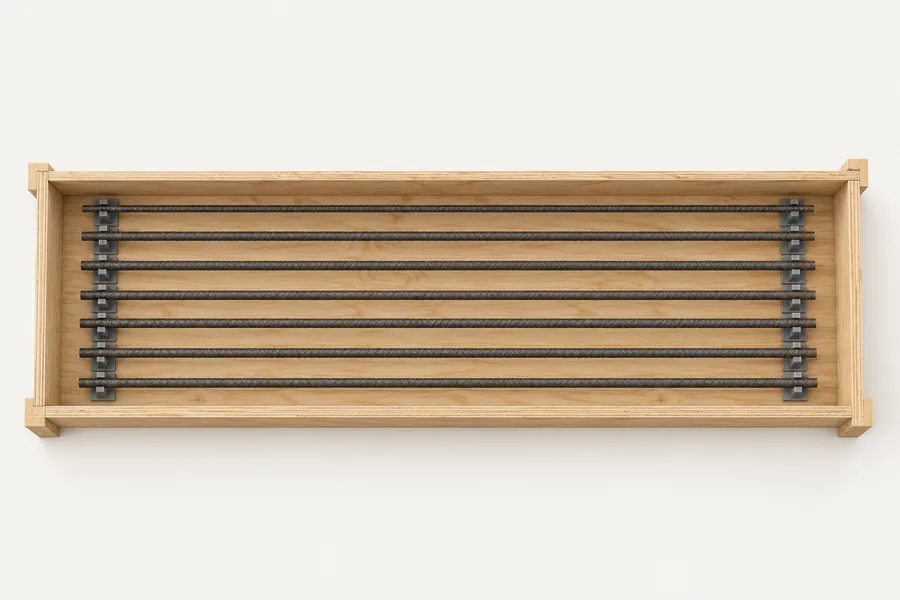
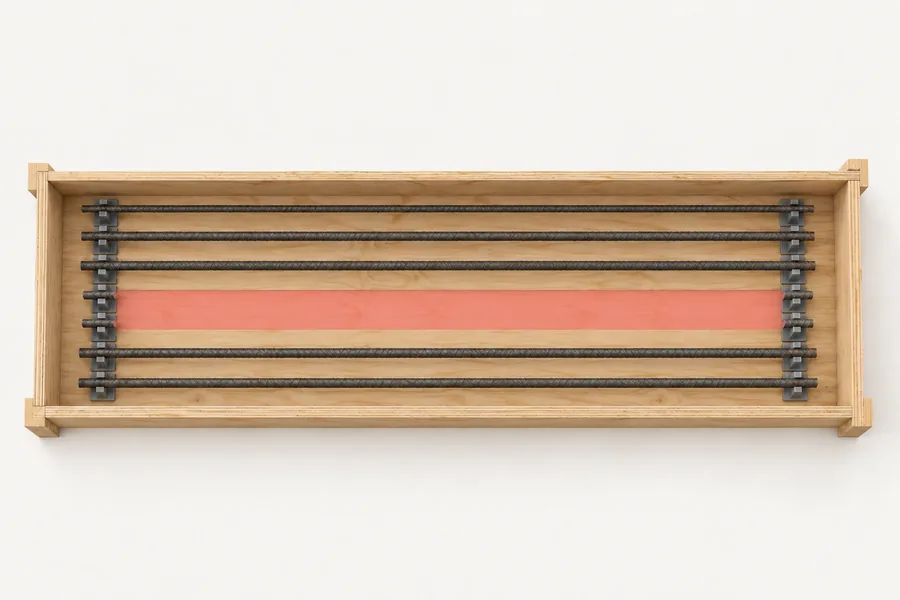
30 ft less 3 in clear at each end, at 18 in, takes 20 #5 bars with one at each end; you have 21. At 1.043 lb/ft the 20 bars of 20 ft weigh 417.2 lb, 20.86 lb each.
A 30 ft run with #5 bars 18 in apart is filled in, in 20 ft bars of 20.86 lb.
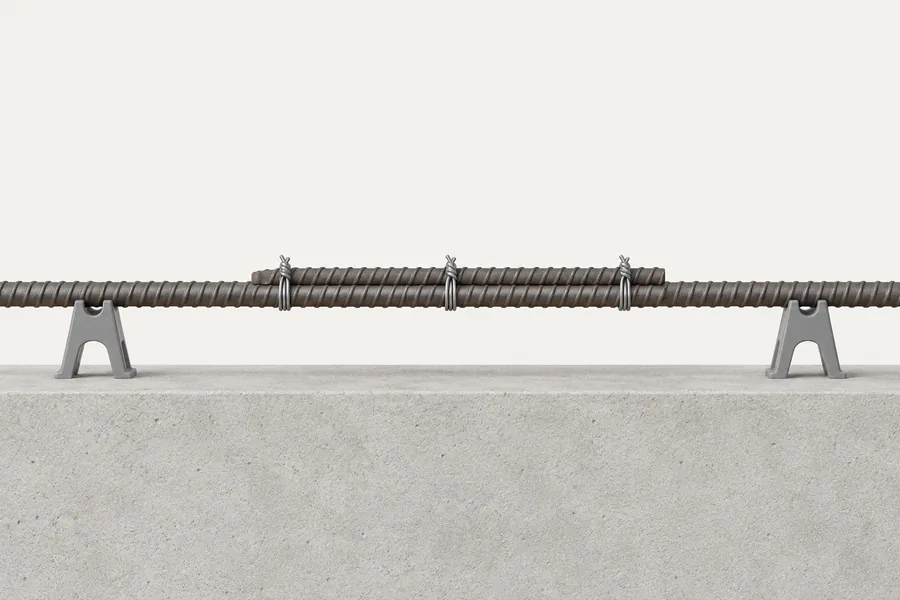
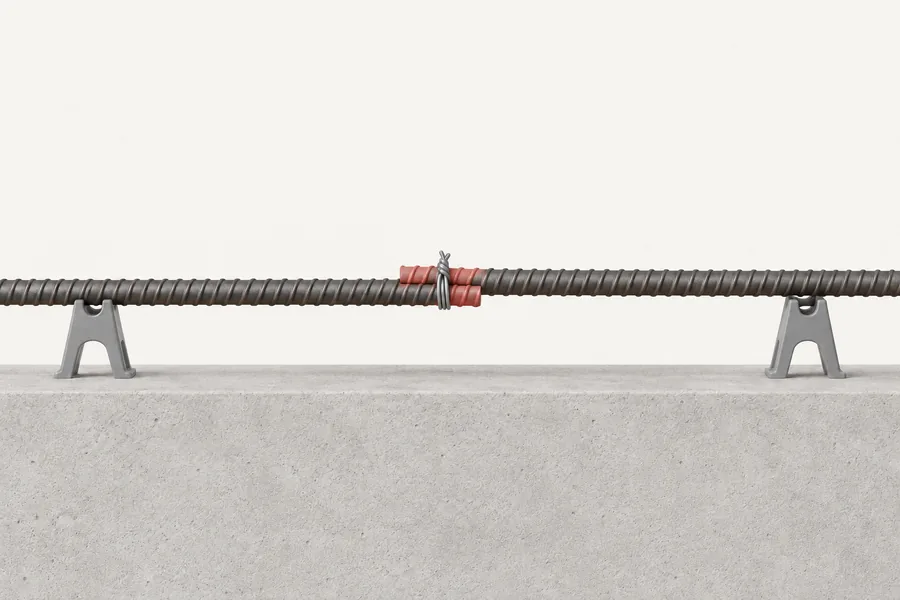
IRC Table R608.5.4(1) asks for 38 in on a #5 bar at Grade 60, 60.8 bar diameters; your 38 in lap is enough, and the 2 in gap is within 6 in.
IRC laps #5 25 in at Grade 40 and 38 in at Grade 60; bars lapped apart may be 6 in apart at most.
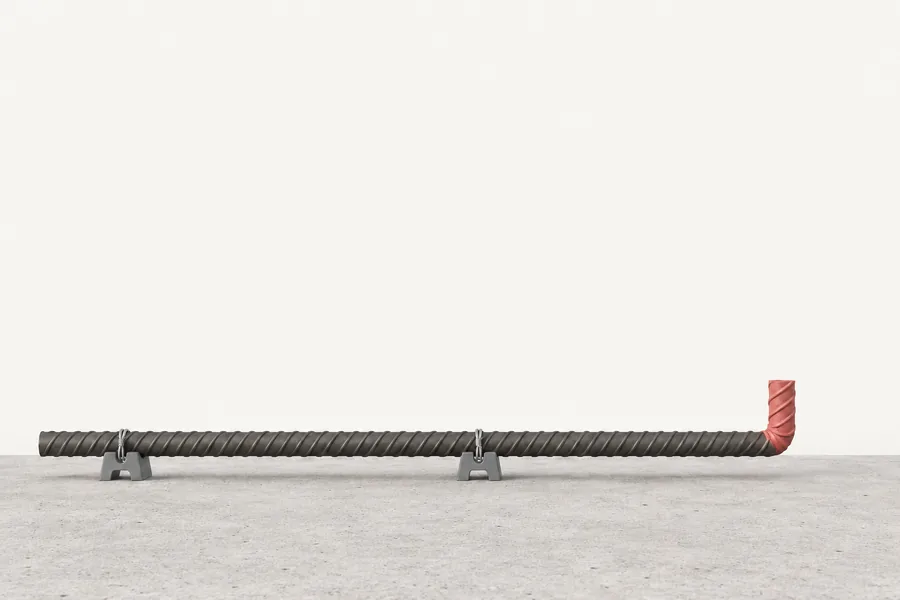
A #5 bar (5/8 in) bends round at least 6 bar diameters, 3-3/4 in, and a 180° hook runs on 4 diameters, 2-1/2 in; your 3-3/4 in bend and 2-1/2 in extension meet both ACI minimums.
For #5 the 180° extension is 4 bar diameters and 2-1/2 in alike.
Exporting 5/8 in bar? Put a photo of a tied bundle into SizeMarker, mark the diameter, grade and the rolled letters on one cut end, and add it to the offer.
Mark a photoGovernment tables and mill sheets; weights are theoretical. Weyerhaeuser is a distributor.
| Source | Diameter, area | Weight | Lengths; bundle |
|---|---|---|---|
| Caltrans Bridge Design Details 13.1This page | 0.625 in; 0.31 in²; outside the ribs 0.69 in | 1.043 lb/ft | — |
| Ohio DOT Item 509, metric table | 15.9 mm; 199 mm² | 1.552 kg/m | Listed as #16M, the soft-metric name |
| Steel Dynamics catalog (2025) | 0.625 [15.9]; 0.31 [199] | 1.043 [1.552] | 20–60 ft |
| Steel Dynamics Roanoke | — | 1.043 lb/ft | 96 pieces, 2,003 lb a bundle of 20 ft bars |
| Nucor | 5/8 in | 1.043 lb/ft | 20, 40 and 60 ft |
| Gerdau | 5 (16) | 1.043 lb/ft | 20, 30, 40 and 60 ft |
| Byer Steel | 5/8 in, 0.625 in; printed “15mm” | 1.043 lb/ft | 100 pieces: 1,043 / 2,086 / 4,172 lb |
| Weyerhaeuser Distribution | 5/8 in | 20.86 / 31.29 / 41.72 lb a bar | 20, 30, 40 ft; 96 / 160 / 144 pieces |
| CMC | Coiled #3 to #5 at Jacksonville; spooled #3 to #6 | Coils about 2,600 lb | — |
Sources: Caltrans · Ohio DOT · Steel Dynamics · Steel Dynamics · Nucor · Gerdau · Byer Steel · Weyerhaeuser · CMC · CMC
Cover and splice rows quote the IRC; bend and hook rows quote two public tables, from a Texas city and from Caltrans.
| Item | Grade 40 | Grade 60 |
|---|---|---|
| Lap, bars in tensionIRC Table R608.5.4(1) | 25 in, that is 40 diameters | 38 in: 60 diameters is 37.5, rounded up |
| Development, straight barIRC | 19 in | 28 in |
| Development, hooked barIRC | 7 in; thin cover 10 in | 11 in; thin cover 15 in |
| Cover, formed and exposedIRC R403.1.3.5.3 | 1-1/2 in for #5 and smaller; 2 in for #6 and larger | No change |
| Cover, cast against earthIRC; ACI | 3 in | 3 in |
| Cover, not exposedIRC | 3/4 in | 3/4 in |
| Bend, main barDeer Park 440 | 3-3/4 in inside, six times the bar | No change |
| Hook at 90°Caltrans 13.2 | Tail 7-1/2 in (12 diameters); J 10 in | No change |
| Hook at 180°Caltrans 13.2 | Tail 2-1/2 in, where 4 diameters and the minimum meet | No change |
| Bend, stirrups and tiesDeer Park 440; CRSI via ASPIRE | 2-1/2 in by the code minimum; 3-1/4 in at CRSI shops | No change |
Sources: IRC · IRC · ACI · City of Deer Park · Caltrans · ASPIRE
| Bar | Diameter | Area | Weight |
|---|---|---|---|
| #5No. 16 in ASTM A615M | 15.9 mm | 199 mm² | 1.552 kg/m |
| 15MCSA; Alberta: within 0.5%, a direct swap | 16.0 mm | 200 mm² | 1.570 kg/m |
| Ø16GB 1499.2-2024 | 16 mm | 201.1 mm² | 1.58 kg/m |
| #4For comparison | 12.7 mm | 129 mm² | 0.994 kg/m |
| #6For comparison | 19.1 mm | 284 mm² | 2.235 kg/m |
Sources: Ohio DOT · Alberta Transportation · Russel Metals · GB 1499.2-2024
| Item | Figure |
|---|---|
| Turned-down footingsIRC R403.1.3.3 | One #5, or two #4, in the middle third of the footing depth |
| Basement wallsIRC Table R404.1.2(2) | An 8 ft wall with 6 ft of backfill: #5 at 39 in, or #6 at 48 in |
| Bar swapsIRC Table R404.1.2(9) | #4 Grade 60 every 12 in = #5 every 19 in = #6 every 26 in: the same steel area per foot |
| Mill lengthWSDOT; Colorado DOT | 60 ft, but both plan #5 in 40 ft lengths |
| In the check aboveOur calculation | (360 − 2 × 3) ÷ 18 = 19.7, so 19 spaces and 20 bars; 20 × 20 ft × 1.043 = 417.2 lb; lap 38 in at Grade 60, gap 2 in within 6 in; bend 3-3/4 in, 180° extension 2-1/2 in |
Sources: IRC · WSDOT · Colorado DOT
5/8 in nominal (0.625 in, 15.9 mm), with 0.31 in² of steel. ASTM A615M, as Ohio DOT and Steel Dynamics print it, gives 199 mm²; tables that show 200 mm² converted the rounded inch figure.
Each foot is 1.043 lb (1.552 kg/m), so one 20 ft length is 20.86 lb; Steel Dynamics ties 96 of them into a 2,003 lb bundle, and Byer puts 100 in one.
By area, nearly: #5 has 199 mm², 15M 200 and Ø16 201.1, within 1%, and Alberta lets 15M and #5 substitute directly. They are still separate products with their own grades and marks.
25 in at Grade 40 and 38 in at Grade 60 (IRC Table R608.5.4(1)); bars lapped apart may be one-fifth of the lap or 6 in apart at most.
3 in where concrete is cast against earth, 1-1/2 in in formed concrete exposed to earth or weather (#5 and smaller), and 3/4 in where it is not exposed (IRC).
Bend round at least 3-3/4 in, 6 bar diameters; a 90° hook runs on 7-1/2 in (12 diameters) and a 180° hook on 2-1/2 in, which equals 4 diameters (Caltrans).
Importers of 5/8 in bar often ask first whether it can replace a 15M or a 16 mm bar on their drawings, then for the mill’s grade (Grade 60, or A706 where it will be welded), the cut length and bending schedule, the weight of a 96-piece bundle, and how the tag and the rolled letters read. Label a photo of your tied bundle with SizeMarker, laid out like the picture at the top, and send it as one card over WhatsApp or WeChat.