
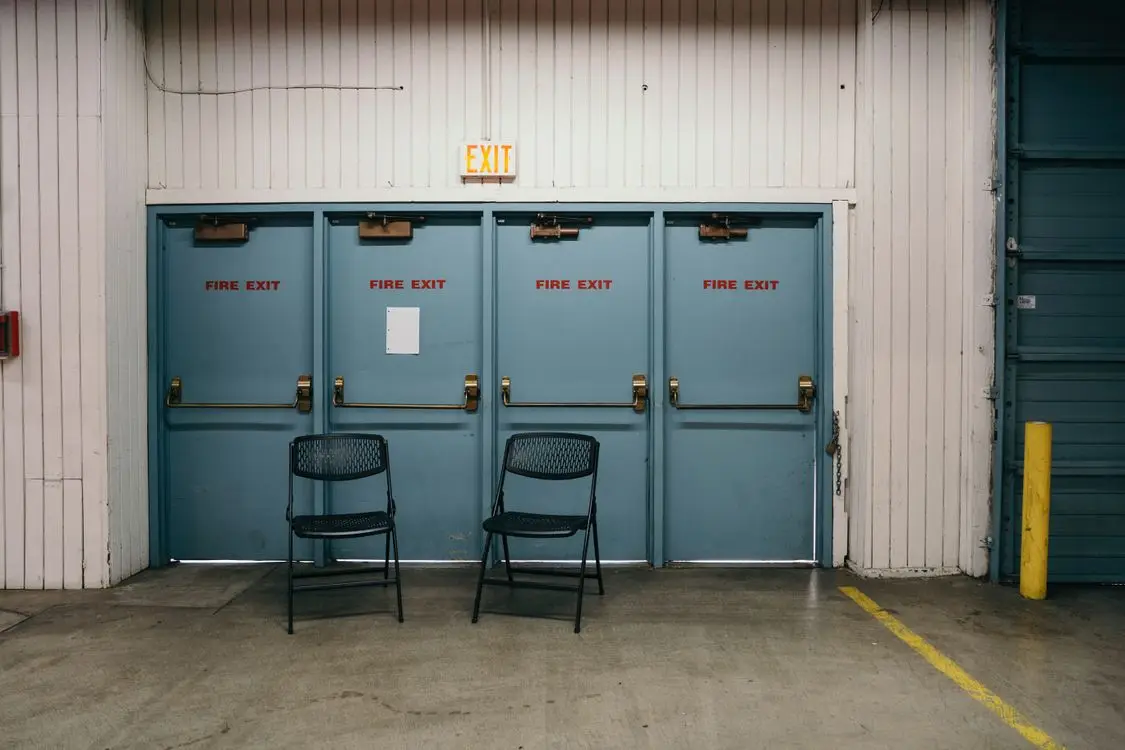
EI30 vs FD30 looks like a naming preference — same door, same thirty minutes, different side of the Channel. It isn't. EI30 is tested for two things; FD30 is tested for one. A buyer who asked for FD30 and received a door certified EI30 got more than they specified. A buyer who asked for EI30 and received FD30 got a door that may not be accepted at all.
Which rating your door needs is not a product decision. It's a function of the destination market and what the door is protecting. Work down the tree.
First branch: which market is the door being certified for?
Everything downstream depends on this, so it is the first question on the enquiry, not the last.
| Market | Rating system | What the letters/numbers mean | Test standard |
|---|---|---|---|
| EU / EEA | EI30, EI60, EI90, EI120 | E = integrity, I = insulation, for the stated minutes | EN 13501-2, tested to EN 1634-1 |
| UK | FD30, FD60 | Integrity for the stated minutes | BS 476-22, or BS EN 1634-1 |
| USA | 20, 45, 60, 90 minute, 3 hour | Minutes of opening protection, positive pressure | UL 10C / NFPA 80 |
| China | 甲级 / 乙级 / 丙级 (Class A / B / C) | ≥1.5 h / ≥1.0 h / ≥0.5 h fire resistance | GB 12955 |
The trap in that table is the middle two rows. A minute figure is not a rating. "30 minutes" means integrity-only in the UK column, integrity-and-insulation in the EU column, and a positive-pressure opening classification in the US column. They are three different tests that happen to share a number.
If the destination is the EU: you need both letters
Under EN 13501-2, a doorset is classified on separate criteria and the letters tell you which were achieved:
- E — integrity. The assembly resists the passage of flame and hot gases.
- I — insulation. The temperature rise on the unexposed face stays within limits, so the door doesn't ignite what's leaning against it and people can pass it.
- W — radiation. Radiated heat through the assembly is limited (used where glazing is large).
So EI30 = thirty minutes of integrity and insulation. E30 alone would be integrity only — which exists, and is not the same product.
Do this: state the full classification, in the standard's own syntax, including the test standard and the certificate number. EI₂ 30-C5-Sa carries more information than "30-minute fire door" and is the form an EU specifier expects to see.
If the destination is the UK: FD is not EI
A door labelled FD30 or FD60 has been tested for integrity only; a door tested for both properties carries an EI designation instead. The numbers matching does not make the ratings equivalent.
Two practical consequences for an exporter:
- You cannot substitute upward silently. Shipping an EI30 door against an FD30 order is technically more capable, but the certification, the labelling and the documentation trail all change. A UK inspector checks the label against the specification, not against the physics.
- You cannot substitute downward at all. If the specification says EI, integrity-only certification fails it, whatever the minute figure says.
Do this: put the certification body and certificate number on the door schedule and on the product image, next to the rating. Where a project is running under both a British and a European standard — which is common — name which test the certificate came from.
If the destination is the USA: the wall decides the door
The US system doesn't start from the door. It starts from the wall the opening sits in, and NFPA 80 classifies the opening accordingly. The rule that catches exporters is the ratio: door assemblies are typically rated at 75 % or less of the wall's rating. A 2-hour fire barrier wall calls for a 90-minute door assembly — not a 2-hour one.
| Opening class | Where it applies | Typical door assembly |
|---|---|---|
| A | Fire walls dividing a building into fire areas | 3 hour |
| B | Shafts, stairwell enclosures, 2-hour horizontal separations | 90 minute |
| C | Walls between rooms and corridors rated 1 hour or less | 45 minute (or 20 minute) |
| D | Exterior walls, severe outside exposure | 90 minute |
| E | Exterior walls, moderate or light outside exposure | 45 minute |
The 20-minute rating is the odd one out and worth understanding, because it is the one most often quoted casually. UL 10C tests assemblies under positive pressure, and 20-minute assemblies are generally exempt from the hose stream test — they exist for corridor and smoke-partition duty where the objective is smoke control rather than full containment. A 20-minute door is not "a slightly weaker 45."
Do this: ask which opening class and which wall rating the door serves. If a US buyer gives you a door rating without a wall rating, the specification is incomplete and the mismatch surfaces at inspection.
If the destination is China: grades, not minutes
GB 12955 classifies fire doorsets into three grades by fire resistance limit:
| Grade | Fire resistance limit | Typical duty |
|---|---|---|
| 甲级 (Class A) | ≥ 1.5 h | Highest-hazard separations |
| 乙级 (Class B) | ≥ 1.0 h | Stairwell enclosures, lobbies, high-occupancy passages |
| 丙级 (Class C) | ≥ 0.5 h | Lower-hazard openings, service risers |
Two things trip up conversions. First, the grades are expressed in hours, so "Class B" is 60 minutes, not "medium." Second, the standard has been revised — GB 12955-2024 supersedes the 2008 edition — so a certificate citing the old edition is an obvious question for a buyer to raise. Check which edition your test report references before it becomes a document review issue.
The decision matrix
| If the buyer says… | Ask this before quoting | Then supply |
|---|---|---|
| "30-minute fire door" | Which market and standard? | EI30 (EU), FD30 (UK), or 20/45-minute (US) — they are different certifications |
| "FD30" | Is insulation required by the project spec? | FD30 if integrity-only is genuinely accepted; flag EI30 if not |
| "EI30" | Which sub-classification — E, EI, EI₂, plus C and S suffixes? | Full classification string, not a minute figure |
| "90-minute door" | What is the wall's rating and opening class? | 90-minute assembly for a 2-hour wall (the 75 % rule) |
| "Class B fire door" | Chinese Class B (1.0 h) or NFPA opening class B (90 min)? | Confirm in writing — the same letter means two different things |
| "Fire rated, standard" | There is no standard default | Nothing yet. This is not a specification |
That fifth row is not hypothetical. "Class B" is a live collision between GB 12955 and NFPA 80 that produces a 30-minute gap in the wrong direction.
What goes on the door schedule and the product image
Fire ratings fail in documentation far more often than they fail in a furnace. The information exists; it just doesn't travel with the product.
Every fire door you quote should carry, on the drawing and on the catalogue image itself:
- The full classification string in its own syntax (
EI₂ 30-C5-Sa,FD30S,90-minute positive pressure,乙级) - The test standard and edition the certificate was issued against
- Certification body and certificate number
- Leaf dimensions and thickness, and the tested size range they sit within
- Frame type and the rough opening the assembly was tested in
- Intumescent seal type and position, and smoke seal if the S suffix applies
- Hardware that was part of the tested assembly — hinges, closer, lock
- Glazing type and maximum tested pane size, if glazed
That sixth and seventh line matter more than exporters expect: a fire door is certified as an assembly. Change the closer or the vision panel and the certificate may no longer describe what you shipped.
Worth being specific about the image, because this is where the information usually gets lost. A fire door photograph carries no dimensional or certification information at all — a 30-minute and a 90-minute leaf are the same picture. Put the leaf thickness, the tested size range and the classification string onto the drawing at the features they describe, dimensioned from the real geometry rather than typed into a caption. The mechanism matters: a callout snapped to the measured edge and exported at the buyer's catalogue size stays correct; an AI-generated product image will letter a plausible "45 mm" onto a leaf it never measured, and on a fire door that's a number a specifier may rely on. Measured beats convincing here in a way it rarely does elsewhere. The same rule applies to the frame side of the order, where the rough opening vs unit size distinction decides whether the tested assembly can even be installed.
FAQ
Is EI30 the same as FD30?
No. EI30 is thirty minutes of integrity and insulation under EN 13501-2. FD30 is tested for integrity only. The matching number makes them look equivalent and they aren't — an EI30 door exceeds an FD30 requirement, while an FD30 door does not satisfy an EI30 specification.
What do E, I and W mean on a fire door rating?
E is integrity — resisting the passage of flame and hot gases. I is insulation — limiting the temperature rise on the unexposed face. W is radiation — limiting radiated heat through the assembly. A classification lists only the criteria the assembly actually achieved, so E30 and EI30 are different products.
Why are 20-minute fire doors tested differently?
Because they protect lower-hazard openings such as corridors and smoke partitions, where the objective is smoke control rather than full fire containment. Under UL 10C, 20-minute assemblies are generally exempt from the hose stream test that higher ratings must pass. Treat a 20-minute door as a distinct product class, not a cheaper 45.
What fire door rating do I need for a 2-hour wall in the US?
A 90-minute assembly. NFPA 80 and the IBC rate door assemblies at 75 % or less of the wall's rating, so a 2-hour fire barrier takes a 90-minute door, not a 2-hour one. Always ask for the wall rating and opening class — a door rating quoted without them is incomplete.
What is the Chinese equivalent of EI60?
There is no exact equivalent, because GB 12955's 乙级 (Class B, ≥1.0 h) and EN 13501-2's EI60 are assessed under different test regimes and acceptance criteria. Roughly, 甲级 ≈ 90 minutes, 乙级 ≈ 60, 丙级 ≈ 30 — but for an export order the useful answer is to certify to the destination market's standard rather than to map between them. Note also that GB 12955-2024 has replaced the 2008 edition, so check which one your test report cites. Getting the paperwork wrong on a certified product is expensive in a specific way, and the return cost calculator puts a number on what one rejected consignment costs against the order margin. If handing is also in play, door handing for export covers the other field that reliably gets misread.
Sources & References
- EI 30 fire rating under EN 13501-2 — meaning of E, I and W, testing to EN 1634-1
- Selo — Difference between FD and EI fire rated doors (FD tested for integrity only; BS 476-22 and BS EN 1634-1)
- Intertek — UL 10C, Positive Pressure Fire Tests of Door Assemblies
- NFPA 80 fire door requirements — opening classes A–E and the door-to-wall rating ratio
- GB 12955-2024 Fire-resistant doorsets — national standard record (国家标准全文公开系统)