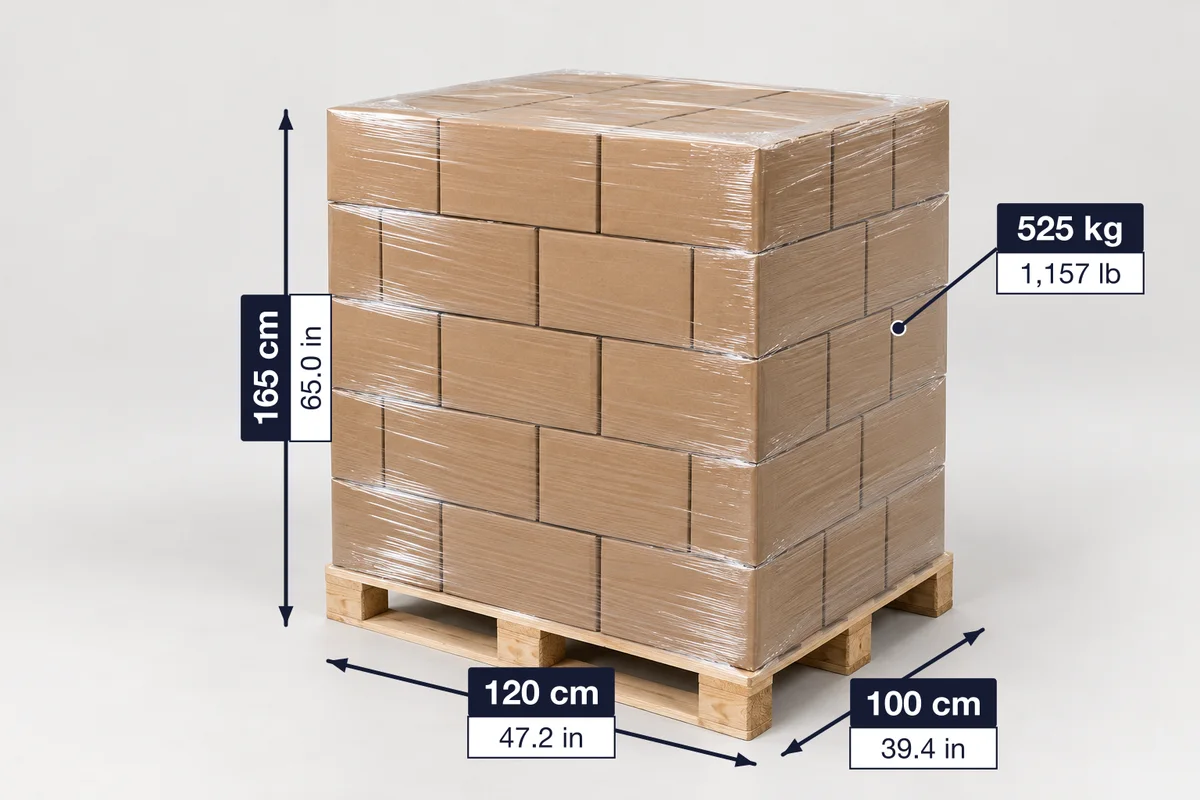
Enter the pallet and the carton to see how many cartons go on each layer, how many layers fit under your height limit, what the loaded pallet weighs, and how many pallets fit in a 20ft, 40ft and 40ft High Cube.
10 per layer × 5 layers. Space runs out before the load limit.
| Layers | 10 per layer × 5 |
|---|---|
| Carton side facing up | Height up (as packed) |
| Loaded pallet L × W × H | 48 in × 40 in × 65.5 in |
| Loaded pallet gross weight | 1,155 lb |
| Loaded pallet volume | 2.060 m³ |
| Pallet area covered | 100.0% |
One carton size, the same pattern on every layer, no gaps between cartons. Bulging cartons, corner boards and stretch film take space this does not count.
Pallets per container are the geometric maximum with the gap you enter. Loaders usually leave a few centimetres between pallets; try 25–50 mm to see a practical count.
Check the buyer's warehouse height and weight limits and your pallet's rated load before you plan stacked pallets.
Cartons per pallet, loaded size and gross weight, marked on a photo of your own loaded pallet, answer the buyer's logistics questions before they ask.
The calculator builds one layer, works out how many layers fit, then checks the weight. Cartons stay on the floor of the pallet the way they are packed unless you allow them to lie on their side.
Cartons per layer for some common outer carton sizes, using the best of the straight and two-block patterns. Multiply by the number of layers your height limit allows.
| Carton (L × W) | Euro 1200 × 800 | 1200 × 1000 | 48 × 40 in | 1100 × 1100 |
|---|---|---|---|---|
| 600 × 400 mm | 4 | 5 | 5 | 3 |
| 500 × 400 mm | 4 | 6 | 6 | 4 |
| 500 × 300 mm | 6 | 8 | 8 | 7 |
| 400 × 300 mm | 8 | 10 | 10 | 8 |
| 300 × 200 mm | 16 | 20 | 20 | 18 |
| 16 × 12 in | 5 | 8 | 10 | 7 |
| 20 × 16 in | 2 | 4 | 6 | 4 |
No overhang. A carton that overhangs the pallet edge is easily crushed in transit, and buyers' routing guides often forbid it.
Pallets placed on the floor in one tier, using the inside dimensions of a 20GP (5,900 × 2,352 mm) and a 40GP or 40HQ (12,032 × 2,352 mm). The first figure has no gap between pallets; the second leaves 25 mm, closer to what a loader achieves.
| Pallet | 20GP | 40GP / 40HQ |
|---|---|---|
| Euro 1200 × 800 | 11 / 11 | 25 / 23 |
| Industrial 1200 × 1000 | 9 / 9 | 22 / 20 |
| North American 48 × 40 in | 9 / 9 | 20 / 20 |
| Asian 1100 × 1100 | 10 / 10 | 20 / 20 |
A 40HQ has the same floor as a 40GP. Its extra 30 cm of height only helps if the loaded pallets can be stacked two high. Container sizes from the shipping container dimensions page.
Related: export pallet dimensions and container fit · how much weight a pallet can hold · how many pallets fit in a truck · standard pallet sizes · ISPM 15 marking
Divide the usable height by the carton height to get the layers, then multiply by the cartons per layer. A 400 × 300 × 300 mm carton on a 1200 × 1000 pallet with a 1.8 m height limit is 10 per layer × 5 layers = 50 cartons. Enter your own carton above; the answer changes with every centimetre.
In one tier: 11 Euro pallets (1200 × 800), or 9 industrial (1200 × 1000) or 48 × 40 in pallets. A 20GP is 2,352 mm wide inside, too narrow for two 1200 mm pallets side by side, which is why the larger pallets lose space.
Geometrically 25 Euro pallets and 22 industrial pallets in one tier, but only with almost no clearance. With 25 mm between pallets it is 23 and 20. North American 48 × 40 in pallets fit 20 either way.
There is no single rule. The receiving warehouse, the racking and the container all set limits: a 20GP or 40GP door is 2,292 mm high and a 40HQ door 2,597 mm. The receiving warehouse usually sets a lower limit for its racking. Agree the figure with the buyer and enter it above.
Because a mixed pattern often fits more. On a 1200 × 1000 pallet, two rows of 400 × 300 cartons lengthways plus one row turned crossways gives 10 per layer instead of 9. The cartons stay the right way up; only their direction on the pallet changes.