Weight = cross-section area × length × density. Pick the shape and the metal, enter the sizes, and get the weight per piece, per metre (or per square metre for plate) and for the whole order, in kg and lb.
| Per piece | 326.71 lb · 148.19 kg |
|---|---|
| Per area | 10.210 lb/ft² · 49.85 kg/m² |
| Density used | 7.85 g/cm³ |
| Pieces per tonne | about 6 |
| Carbon steel | 326.71 lb |
|---|---|
| Stainless 304 | 330.04 lb |
| Stainless 316 | 332.12 lb |
| Aluminium 6061 | 112.37 lb |
| Copper C11000 | 369.99 lb |
| Brass C36000 | 353.76 lb |
Theoretical weight from nominal sizes, with square corners. Rolled angles have a root radius and come out slightly heavier; cold-formed tubes have rounded corners and come out slightly lighter. The difference is usually a few percent.
Mill tolerances on thickness and diameter change the real weight. Say on the quotation whether you sell by theoretical or by weighed weight.
Section, length, material grade and weight per piece, marked on a photo of your own part, so the buyer can check the quote against the drawing.
Every shape comes down to the same multiplication: the area of the cross-section, times the length, times the density of the metal. With sizes in millimetres and density in g/cm³, the weight per metre is simply area (mm²) × density ÷ 1,000 kg/m. For plate the shortcut is even simpler: thickness (mm) × density gives kg per square metre, so 10 mm steel plate is 78.5 kg/m².
| Shape | Cross-section area | Example (carbon steel, 7.85 g/cm³) |
|---|---|---|
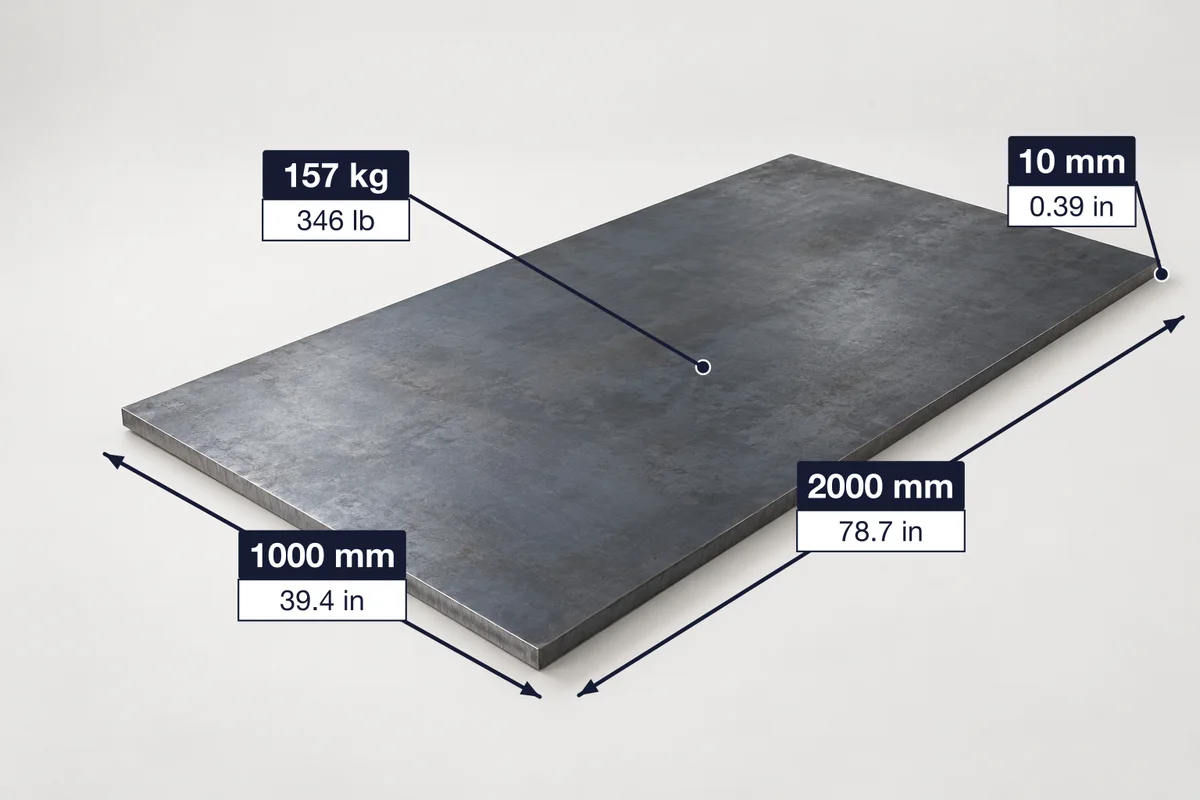
| Plate, sheet, flat bar | width × thickness (× length) | 2000 × 1000 × 10 mm plate = 157.00 kg |
| Round bar, rod | π × d² ÷ 4 | Ø20 mm = 2.466 kg/m |
| Square bar | a² | 20 mm square = 3.140 kg/m |
| Hex bar | 0.866 × s² (s = across flats) | 20 mm across flats = 2.719 kg/m |
| Pipe, round tube | π × (D − t) × t | 60.3 × 3.91 mm (2 in Sch 40) = 5.44 kg/m |
| Square tube | 4 × t × (a − t) | 50 × 50 × 3 mm = 4.427 kg/m |
| Rectangular tube | 2 × t × (a + b − 2t) | 100 × 50 × 4 mm = 8.918 kg/m |
| Angle | t × (a + b − t) | 50 × 50 × 5 mm = 3.729 kg/m |
The pipe formula is the same one ASME B36.10M uses for its plain-end weights: 0.0246615 × (D − t) × t is π × 7.85 ÷ 1,000. For pipe sizes and schedules, use the pipe size converter.
The density is the only number in the formula that is not a size, and it is where most disagreements between two weight tables come from. These are the values the calculator uses. Choose Other metal to enter your own.
| Metal | g/cm³ (= t/m³) | lb/in³ | 10 mm plate, kg/m² | Weight vs carbon steel |
|---|---|---|---|---|
| Carbon steel (A36, S235, Q235) | 7.85 | 0.2836 | 78.50 | — |
| Stainless 304 | 7.93 | 0.2865 | 79.30 | +1.0% |
| Stainless 316 | 7.98 | 0.2883 | 79.80 | +1.7% |
| Aluminium 6061 | 2.70 | 0.0975 | 27.00 | 34% of steel |
| Copper C11000 | 8.89 | 0.3212 | 88.90 | +13.2% |
| Brass C36000 | 8.50 | 0.3071 | 85.00 | +8.3% |
Carbon steel 7.85 is the density behind the nominal masses in EN 10025, EN 10058–10060 and GB/T 702. Stainless 7.93 / 7.98 are the values most Chinese weight tables use; EN 10088-1 lists 7.9 and 8.0, less than 0.4% apart. Aluminium from the Aluminum Association; copper and brass from the Copper Development Association.
Related: steel profile dimensions for export · rebar size designations · labeling metal product specifications · sheet metal gauge converter · rebar sizes · steel I-beam sizes
Multiply the volume by the density. In practice: cross-section area in mm² × length in metres × 7.85 ÷ 1,000 gives kilograms. A Ø20 mm round bar is 314.16 mm², so it weighs 2.466 kg per metre and 14.80 kg for a 6 m length.
Thickness in millimetres × 7.85 kg. A 10 mm steel plate is 78.5 kg/m², so a 2000 × 1000 mm sheet weighs 157 kg. For stainless 304 use 7.93 (79.3 kg/m²) and for aluminium 2.70 (27.0 kg/m²).
Exactly, π × d² ÷ 4 × 7.85 ÷ 1,000, which is 0.006165 × d² kg/m with d in mm. The shop-floor shortcut d² ÷ 162 gives almost the same number: Ø20 mm is 2.466 kg/m exactly and 2.469 by the shortcut. Rebar standards list nominal masses calculated the same way.
Usually one of four things: rolled sections with root radii or rounded tube corners, a different density (7.85 against 7.87, for example), sizes rolled to the plus or minus side of the tolerance, or a weighed figure that includes packing. Ask which standard and density their table uses.
About 1%: 7.93 against 7.85 for 304, and about 1.7% for 316 at 7.98. Aluminium 6061 weighs about a third as much (2.70), copper about 13% more (8.89) and C36000 brass about 8% more (8.50).