CBM (cubic metres) = length × width × height in metres. Enter the outer carton size and the number of cartons to get the shipment's volume, the LCL revenue tons and how many cartons fit in each container.
0.610 × 0.406 × 0.406 m = 0.1007 m³ per carton × 100 = 10.068 m³
| Per carton | 0.1007 m³ |
|---|---|
| In cubic feet | 355.56 ft³ |
| Total gross weight | 2,600 lb · 1,179.3 kg |
| LCL revenue tons | 10.068 W/M · billed on volume |
| Cargo density | 117 kg/m³ |
| Container | Inside volume | Cartons per container | Containers needed |
|---|---|---|---|
| 20GP | 33.2 m³ | 225 | 1 |
| 40GP | 67.7 m³ | 475 | 1 |
| 40HQ | 76.3 m³ | 580 | 1 |
Use the outer carton size, measured packed. Cartons per container are whole cartons stacked in the best single orientation, then capped by payload, the same method as the container loading calculator.
LCL is billed W/M: 1 CBM is treated as 1,000 kg and the higher of CBM and metric tons is charged. Many forwarders have a 1 CBM minimum.
Outer carton size, gross weight, pieces per carton and CBM, marked on a photo of your own carton, answer the buyer's freight questions before they ask.
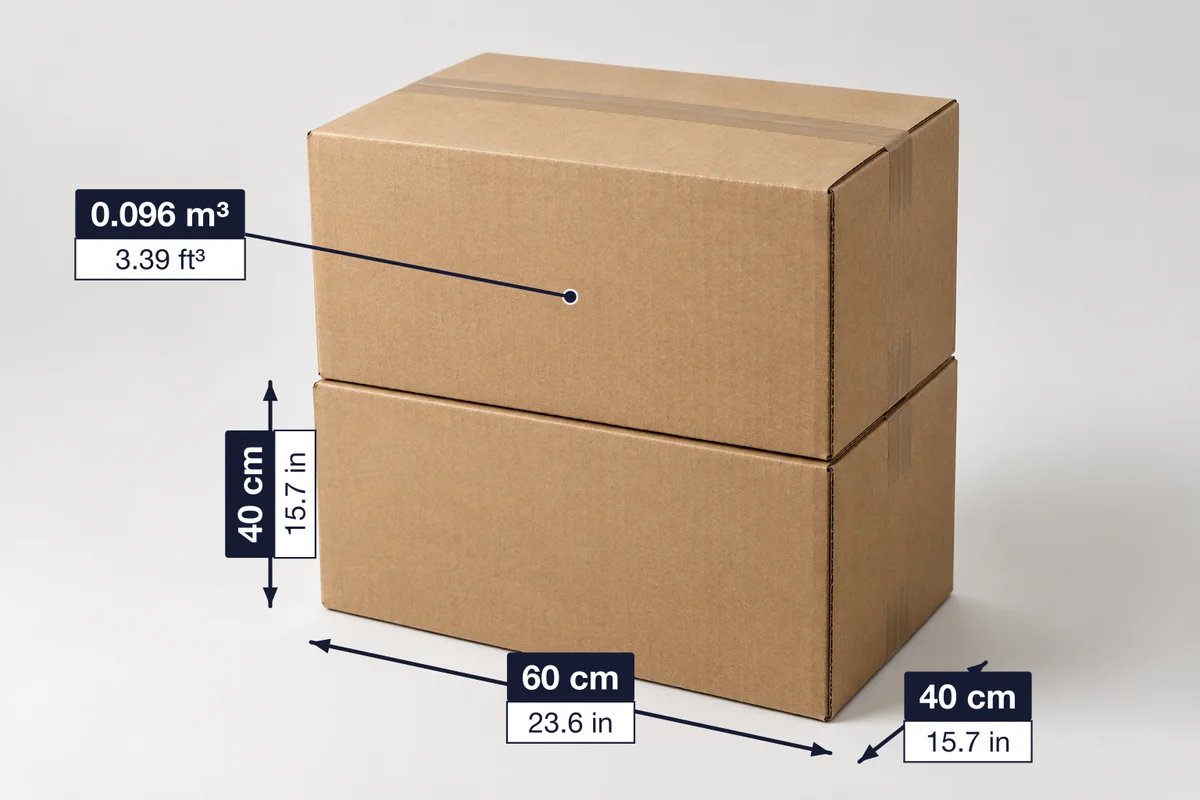
CBM is the volume of the carton in cubic metres: length × width × height, all in metres. A 60 × 40 × 40 cm carton is 0.6 × 0.4 × 0.4 = 0.096 CBM, and 100 of them are 9.6 CBM. With sizes in centimetres, multiply them and divide by 1,000,000; with inches, multiply and divide by 61,024.
Three rules keep the number honest. Use the outer carton size, not the inside size, because that is what the forwarder measures. Convert every side to the same unit before multiplying. And measure the packed carton at its widest point, bulges and handles included.
| Carton (cm) | CBM per carton | 100 cartons | 20GP / 40GP / 40HQ (cartons, by space) |
|---|---|---|---|
| 30 × 20 × 20 | 0.012 | 1.2 | 2,299 / 4,840 / 5,940 |
| 40 × 30 × 30 | 0.036 | 3.6 | 686 / 1,470 / 1,890 |
| 50 × 40 × 30 | 0.060 | 6.0 | 392 / 840 / 1,080 |
| 55 × 40 × 40 | 0.088 | 8.8 | 280 / 600 / 720 |
| 60 × 40 × 40 | 0.096 | 9.6 | 225 / 500 / 600 |
| 70 × 50 × 50 | 0.175 | 17.5 | 132 / 288 / 360 |
Container counts are whole cartons stacked in the best single orientation inside a 20GP (5,900 × 2,352 × 2,393 mm), 40GP and 40HQ, without payload limits. Heavy cartons reach the payload first: enter the gross weight above, or use the container loading calculator.
Related: master carton dimensions · gross, net and volumetric weight · pallet loading calculator · shipping container dimensions
Multiply the carton's length, width and height in metres, then multiply by the number of cartons. A 60 × 40 × 40 cm carton is 0.096 CBM; 100 cartons are 9.6 CBM. Use the outer dimensions of the packed carton.
Multiply by 35.315. 1 CBM = 35.315 ft³, so 9.6 CBM is 339 ft³. To go from inches to CBM, multiply the three sides in inches and divide by 61,024.
A 20GP has about 33.2 m³ inside, but whole cartons rarely use all of it. How much you actually load depends on the carton size; enter yours above to see the carton count and the CBM it adds up to.
By W/M, weight or measurement. One CBM is treated as 1,000 kg; the forwarder compares your CBM with your weight in metric tons and charges the higher. 8 CBM weighing 3 t bills as 8 revenue tons; 8 CBM weighing 10 t bills as 10.
No. CBM is a volume in cubic metres, used for sea freight. Volumetric weight is a billing weight in kg for air and express: L × W × H in cm ÷ 6000 or ÷ 5000. The same carton gives different numbers under each.