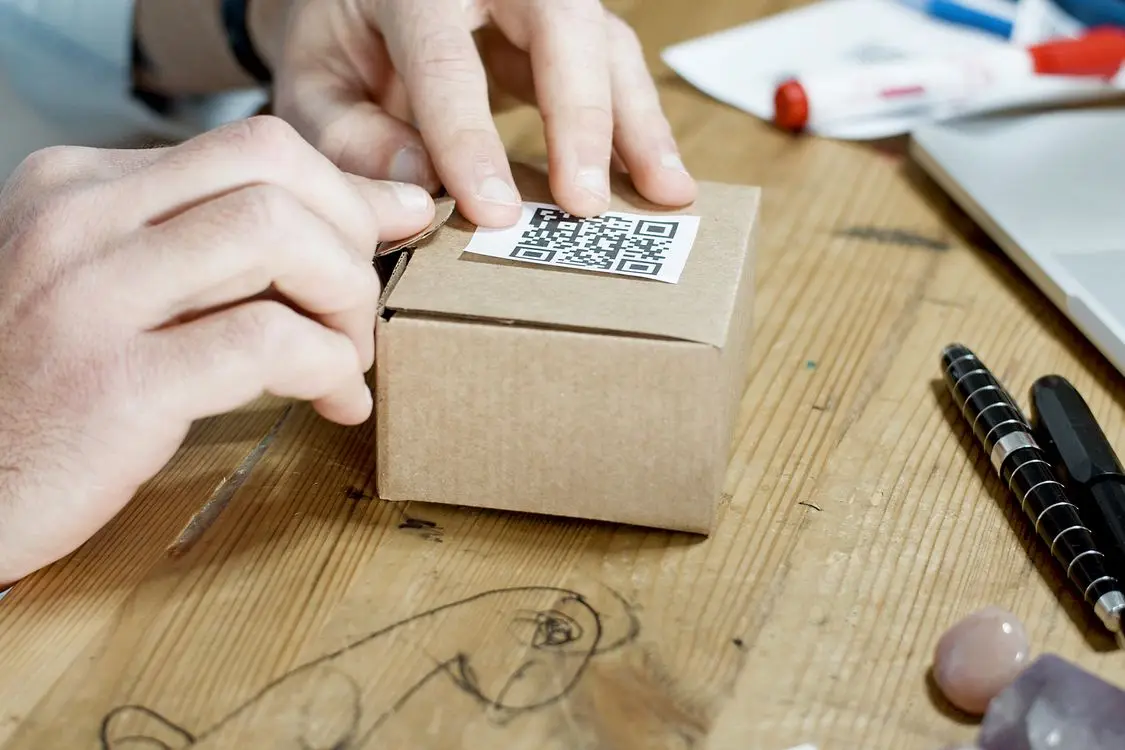
Most packaging artwork gets its QR code the way it gets its legal text: somebody finds a corner with space and drops it there. That corner is usually wrong. A 2D barcode on retail packaging meant to scan at a checkout has to sit within 50 mm of the centre of the UPC — the distance at which GS1's testing found lanes still hit the 40 to 70 items per minute a store is staffed for.
The rest of the layout follows from constraints like that: module size, quiet zone, the data inside the code, and where the consumer QR your marketing team already printed has to move.
This is an artwork and data brief for suppliers, not a legal opinion. GS1's guidance is voluntary industry standard; what actually binds you is the artwork specification your retail customer sends.
What a 2D barcode on retail packaging actually changes
A 2D barcode is a matrix symbol — a QR Code or Data Matrix — carrying the same GTIN as your EAN or UPC, with room for batch or lot number, production date, serial number, or a web address through GS1 Digital Link.
A linear barcode answers one question at the till: which product is this. A 2D code answers that and can hand the same scan a lot or expiry date, which makes recalls, shelf-life checks and returns processing cheaper for your buyer. In GS1's own words: "The initial goal is for retail point-of-sale (POS) scanning to be globally capable of reading and processing the GTIN from both existing linear and 2D barcodes by the end of 2027."
Read that carefully, because "globally capable" describes retail scanning infrastructure, not your cartons. GS1 calls it Ambition 2027 and treats it as an industry milestone, not a regulation with a fine attached. If your buyer has already upgraded its lanes, its artwork spec will say so — and that spec, not the year, is what your next print run has to satisfy.
The three 2D codes a retailer will accept at checkout
There is no single 2D symbol for all retail. GS1 approves three for consumer trade items scanned at point-of-sale, and they are not interchangeable.
| Symbol |
Data syntax |
Camera on a phone |
Size on the pack |
Where it already dominates |
| GS1 DataMatrix |
GS1 element string |
Needs a specialised app |
Smallest POS-compliant 2D option |
Regulated healthcare, billions of packs |
| QR Code (GS1 Digital Link URI) |
GS1 Digital Link URI |
Opens with the phone's default camera |
Larger of the POS-compliant 2D options |
Consumer engagement, emerging retail rollouts |
| Data Matrix (GS1 Digital Link URI) |
GS1 Digital Link URI |
Needs a specialised app |
Small |
Markets that want a web address in a small symbol |
The QR Code carries a consumer benefit without an app install and eats the most panel area. If your pack is crowded, that trade-off is the decision — not which symbol looks tidier.
Size and quiet zone: the numbers your designer needs
A 2D barcode on retail packaging cannot be specified as one number. GS1 publishes one symbol specification table for consumer trade items scanned at general retail point-of-sale: the three approved 2D symbols share the same size range and minimum print quality, and differ in one place that ruins artwork — the quiet zone.
| Symbol |
X-dimension minimum |
X-dimension target |
X-dimension maximum |
Quiet zone |
Minimum verify grade |
| GS1 DataMatrix |
0.396 mm (0.0150 in) |
0.495 mm (0.0195 in) |
0.990 mm (0.0390 in) |
1X on all four sides |
1.5/12/660 |
| Data Matrix (GS1 Digital Link URI) |
0.396 mm |
0.495 mm |
0.990 mm |
1X on all four sides |
1.5/12/660 |
| QR Code (GS1 Digital Link URI) |
0.396 mm |
0.495 mm |
0.990 mm |
4X on all four sides |
1.5/12/660 |
The X-dimension is the width of one module. Everything else scales off it, which is why a designer who shrinks the code to fit a gap shrinks the thing the scanner reads.
Two rules explain the numbers in that table:
- A 2D module has to be bigger than a bar. GS1's guidance says the 2D X-dimension needs to be roughly 50% larger than the equivalent linear barcode, because of the optical effects in camera-based image capture at a modern lane. A code that looks the same size as the EAN beside it is undersized.
- A QR needs four times the clearance of a DataMatrix. The quiet zone is measured in X units, so at a 0.495 mm module a QR Code needs about 2 mm of clear space on every side and a DataMatrix about 0.5 mm. Print a rule, a border or a photo edge into that 2 mm and the scan rate drops for reasons nobody can see on the proof.
"1.5/12/660" is GS1's verification shorthand for the minimum grade: 1.5 on the ISO/IEC 15415 scale, with the aperture and light wavelength GS1 specifies. A supplier who only tests with a phone has no idea what grade the carton actually prints to.
The 50 mm co-location rule that decides the layout
When a pack carries both the linear barcode and a 2D code, GS1's testing found the 2D code needs to be within 50 mm of the linear barcode's centre. That distance protects the checkout's throughput target of 40 to 70 items per minute: the lane has to see both codes in one pass, and a code parked on the far side of the panel forces a second look or a manual key-in.
The 50 mm figure is not a design preference. It is the distance at which GS1's lab testing found both codes can still be captured in one pass at checkout speed.
Practically, that means one block of artwork on one flat panel: the UPC, the 2D code within 50 mm of its centre, and the human readable text both need. It also rules out the sealing flap, a fold, under tape, or the glossy band where a verifier grades poorly.
Dual marking: why the UPC stays on the panel
A 2D barcode on retail packaging does not replace the UPC in this print run. GS1 is explicit: until 90% of point-of-sale scanning solutions in use can read a GS1-compliant 2D code and at minimum capture the GTIN, any product carrying a retail 2D barcode must also carry a POS linear barcode.
So the artwork question is not "QR instead of EAN". It is "where do both go, and which one gets the clean, flat, unscuffed panel". A supplier who removes the EAN after seeing a 2D rollout announcement gets cartons that one chain can scan and the next cannot.
Some packs are too small for both, and GS1 acknowledges those products may have to wait until the linear code is no longer required. If you make hardware in poly bags or small fittings cartons, the honest answer may be a hang tag or an outer case label rather than a micro-printed QR on the bag.
Where the second QR code must not go
Most suppliers already have a QR on the packaging — a warranty page, a video, an instruction download. GS1's guidance flags the failure mode: a consumer-engagement 2D code in a different quadrant of the same panel as the checkout code can be captured by the lane along with it, producing an unintended transaction.
Put the consumer code on a different panel. If your pack carries codes on adjacent sides, keep them close enough that a multi-angle scanner recognises they belong to the same item, which is what prevents a double scan.
One more rule for the day the 2D code stands alone: when it is the only code on the object, the 14-digit GTIN has to be printed as human readable text — the HRI — beneath it. Designers who print nothing but the square build a pack that fails the moment the reader is a person with a clipboard.
Large, heavy and bulky items have their own placement rules
Furniture, flat-pack units and building materials are where a 2D barcode on retail packaging stops being a small-pack problem. GS1 already anticipates this: its placement rules define large, heavy or bulky items as 450 mm (18 inches) or more in any two dimensions and/or weighing more than 13 kg, and those items follow a different placement section of the General Specifications rather than the standard panel arrangement.
Good news for a wardrobe or a steel profile; bad news for anyone treating the exception as a free pass. It changes where the code goes; it does not change the module size floor, the quiet zone, the verify grade, or the rule that the code sits on a surface still flat when the carton reaches the store. A carton that is strapped, dragged and stacked needs its codes away from the edges and the tape line, not just "somewhere on the back".
What actually goes inside the code
The GTIN is the anchor. In a 2D symbol it is written as a zero-padded 14-digit string: a GTIN-13 becomes 09521101530001, a GTIN-12 becomes 00012345000058. A GTIN-14 is not a retail point-of-sale identifier and does not belong here.
Around the GTIN, GS1 Application Identifiers carry the extra data: 01 for the GTIN, 10 for batch or lot, 17 for the expiry date, 21 for a serial number, 243 for a packaging component number that stays internal and never appears on the label.
One constraint catches web teams rather than packaging teams: a GS1 Digital Link URI must be encoded in uncompressed form, so a short minified redirect URL is non-conformant inside the symbol.
This is where packaging meets product data, because a 2D code is now the natural carrier for the Digital Product Passport timeline. The code is only as good as its destination: if the page it opens shows a rounded catalogue size, a contradictory label photo and no revision date, the scan is worse than no code at all. The discipline that fixes the barcode size requirements on the linear symbol — state the measurement, state which measurement it is — is what keeps the destination page and the carton agreeing.
For that to hold, the numbers the code points at have to be measured on the real item and locked to the image the buyer sees: mark the actual dimensions on a photo of the product, so the export spec sheet and the page behind the QR cannot drift apart between revisions.
Pre-artwork checklist
Run this before the designer sends a proof, not after the plates are made.
Next steps
Three things decide whether this lands well:
- Ask the buyer for the artwork spec. Most large retailers publish one, and it settles the symbol choice faster than any standard can. Ask before the plates are made.
- Prove the print on the real board. A digital label holds the module size easily; flexo on recycled board with ink spread may not. Print a test sheet on the production substrate and verify it, rather than approving a PDF.
- Fix the destination while the artwork changes. A page with measured dimensions on the product image, a revision date and the same figures as the spec sheet turns a compliance chore into a sales asset — worth building properly, not as a screenshot of a spreadsheet.
FAQ
Is Sunrise 2027 a mandatory barcode deadline?
No. Sunrise 2027 — GS1's name for the industry goal that retail lanes read the GTIN from both linear and 2D codes by the end of 2027 — is a milestone for scanning infrastructure, not a regulation with a fine attached, and the linear UPC stays valid. What binds you is your customer's artwork requirement: some chains specify 2D codes today, and their spec sheet is what matters for your next print run.
How big should a QR code be on retail packaging?
GS1 sets the module at a minimum of 0.396 mm, a target of 0.495 mm and a maximum of 0.990 mm, with a quiet zone of 4X on all four sides. Overall size is module size times module count plus the quiet zones, which is why a Digital Link QR with a long URI comes out larger than a GTIN-only symbol.
Can I replace the UPC with a QR code?
Not during the transition. Until 90% of point-of-sale systems can read a GS1-compliant 2D code and capture the GTIN, a trade item carrying a retail 2D barcode also needs a POS linear barcode. Dropping the UPC early leaves stores that have not upgraded with nothing to scan.
Where should the QR code go on the packaging?
Within 50 mm of the linear barcode's centre if it must scan at the checkout, on a flat panel clear of folds and tape. A consumer-engagement QR belongs on a different panel: a second code in another quadrant of the same panel can be captured as a checkout code and create a wrong transaction. Large or heavy items follow their own placement section in the GS1 General Specifications.
Can my existing marketing QR code also scan at the checkout?
Only if it is re-encoded with the GTIN using GS1 Digital Link and printed to the retail module size and grade — GS1 US recommends exactly that as a first step for brands. A decorative QR pointing at a campaign URL cannot do it.
Sources & References
- GS1 — 2D Barcodes at Retail Point-of-Sale Implementation Guideline (Ambition 2027, the 50 mm co-location distance, 40–70 items per minute, dual marking, quiet zones, symbol specification table)
- GS1 US — What is GS1 Sunrise 2027? (the crawl, walk, run adoption path and the recommendation to update existing QR codes with the GTIN)
- GS1 — General Specifications (X-dimensions, quiet zones, human readable interpretation rules, and the placement section for large, heavy and bulky items)
- GS1 — Digital Link URI syntax reference (the uncompressed-form requirement for the URI encoded in the symbol)
- GS1 US — Sunrise 2027 Technical Resource Guide (barcode data design and the transition from 1D to 2D at retail POS)