Enter cartons, weights and sizes, and the template works out carton numbers, total weights and CBM. Items and quantities come from the same form as your commercial invoice, so the two always match.
Enter weights per carton in kg and carton size in cm. Totals, carton numbers and CBM are worked out for you.
Pro adds your logo and a company stamp or signature. See Pro
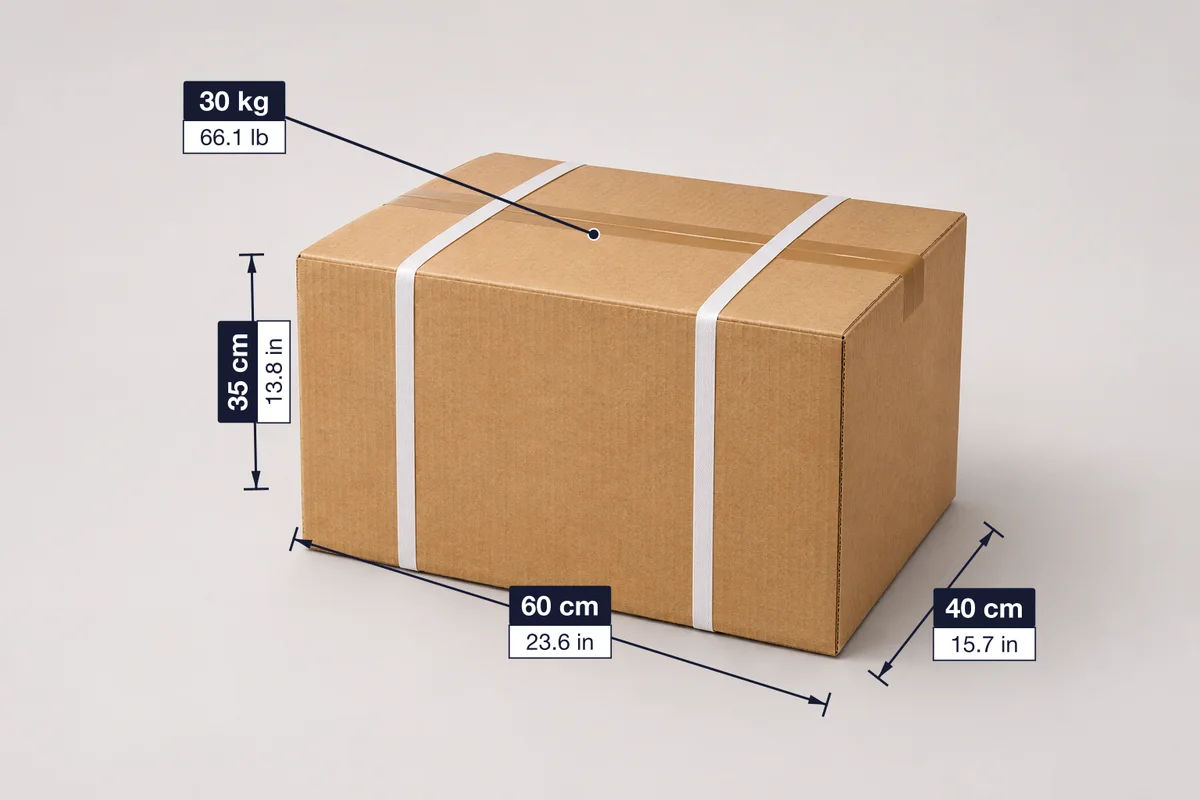
A photo of the packed carton with its size marked answers the forwarder's and buyer's questions before they ask.
An export packing list says what is in each package of a shipment: how many cartons, what each one holds, what it weighs and how big it is. It normally shows no prices.
Your forwarder uses it to book space and prepare the bill of lading, customs uses it to check the cargo against the invoice, and the buyer uses it to receive the goods carton by carton.
| Field | What to write | Who needs it |
|---|---|---|
| Seller, buyer and consignee | The same names as on the invoice | Customs, forwarder |
| Invoice number and date | The number of the matching commercial invoice | Everyone: it links the two documents |
| Carton numbers | A running range, such as 1-30 and 31-90 | Warehouse and buyer, to find a carton |
| Description and quantity | The same wording as on the invoice | Customs, buyer |
| Net weight | Weight of the goods alone | Customs, buyer |
| Gross weight | Weight of the goods plus packaging | Carrier, forwarder, customs |
| Carton size | Length × width × height | Forwarder, to plan the load |
| Volume (CBM) | Total cubic metres | Forwarder, for space and freight charges |
| Shipping marks | What is printed on the cartons | Port and warehouse staff, to identify the cargo |
Weights are in kilograms and sizes in centimetres, as most export paperwork expects. If your buyer needs pounds and inches, say so in the notes and confirm with your forwarder.
Carton numbers run on from one item to the next. If the first item takes 30 cartons and the second takes 60, they are numbered 1-30 and 31-90.
Weights are the weight per carton times the number of cartons. For 30 cartons at 31.5 kg gross and 60 cartons at 30 kg gross, the total is 945 + 1,800 = 2,745 kg.
CBM is length × width × height in metres, times the number of cartons. A 60 × 40 × 35 cm carton is 0.6 × 0.4 × 0.35 = 0.084 m³, so 60 cartons take 5.04 m³. Add the 30 cartons of 50 × 40 × 30 cm at 0.06 m³ each and the shipment comes to 6.84 m³. The CBM calculator does the same sum on its own, and the container loading calculator shows how many cartons fit in a container.
| Document | Used for | Shows prices |
|---|---|---|
| Export packing list | International shipments: customs, forwarder, buyer | Usually not |
| Packing slip | Domestic parcels and online orders: a note inside the box | Usually not |
| [Commercial invoice](/tools/commercial-invoice-template) | The bill and the customs value | Yes |
The packing list reads from the same form as the commercial invoice, proforma invoice and quotation. Items and quantities appear on all of them, so changing a quantity once changes it everywhere.
Your draft stays in your browser and nothing you type is uploaded while you work. Every figure is yours: the template adds up what you enter and never guesses a weight or size.
A document that lists what is in each package of a shipment, with quantities, weights, carton sizes and shipping marks. It usually shows no prices.
Usually not. Prices belong on the commercial invoice. Some buyers and countries ask for a combined document, so follow what your buyer or forwarder asks for.
Net weight is the goods alone. Gross weight is the goods plus all packaging, such as cartons, fillers and pallets. Gross is what the carrier charges and plans for.
Multiply length × width × height in metres for one carton, then multiply by the number of cartons. A 60 × 40 × 35 cm carton is 0.084 m³, so 60 of them take 5.04 m³. Enter the sizes in centimetres and the template does the sum.
Use one running sequence across the shipment, so every carton can be found on the list. The template numbers each line in order, such as 1-30 and 31-90.
Many countries, carriers and banks ask for one, and most forwarders do too. Requirements differ, so check with your forwarder for your route. Under a letter of credit, the credit itself says whether it's needed.
A packing list is a shipping document for international freight. A packing slip is a simple note inside a parcel, used for domestic and online orders.
Yes. Filling it in needs no account, and downloading the PDF needs a free one. The free PDF has a small line in the footer. Pro removes it and adds your logo and stamp.