
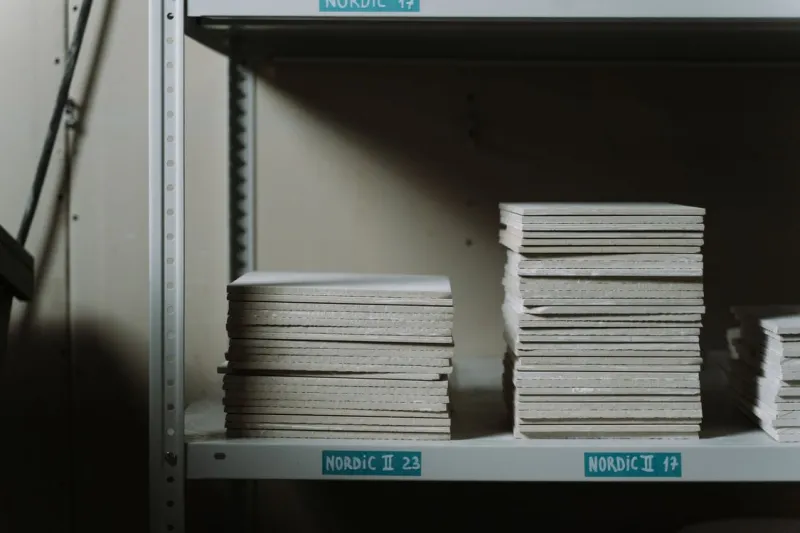
Rectified vs non-rectified tile is not a quality grade, and it is not a marketing word. It is one manufacturing step — grinding the edges after firing — and it changes three numbers your buyer's installer will act on: the work size printed on the box, the caliber, and the narrowest grout joint the tile can legally be laid at. Get those three onto the spec card and the disputes stop. Leave them off and you get a claim about "wrong size tiles" that is really a claim about a missing line of text.
What "rectified" means, precisely
A rectified tile is a ceramic tile that, after firing, is subjected to a precise mechanical finishing of the edges. That is the definition in ISO 13006:2018, clause 3.11 — nothing about quality, hardness, or price, only about the edges being machined to a tighter facial dimension after the kiln.
A non-rectified tile skips that step. Clay shrinks in the kiln, and it never shrinks by exactly the same percentage twice, so pressed tiles come out of a firing at slightly different sizes. The factory sorts them into batches of like size — calibers — and prints the caliber on the box.
ANSI A108.02 uses three matching labels for the same idea:
| Term | What it means |
|---|---|
| Natural | Tiles that are not sized or sorted mechanically |
| Calibrated | Tiles sorted to meet a manufacturer's stated caliber range |
| Rectified | Tiles that have had all edges mechanically finished to achieve a more precise facial dimension |
"Non-rectified" in commercial use almost always means calibrated. If your tile is genuinely unsorted, say "natural" — the installer will plan a completely different joint for it.
The three sizes on every tile box, and the one everybody quotes
ISO 13006:2018 defines four size terms, and a spec card that only carries the first one is incomplete:
| Term | ISO 13006:2018 definition | Plain reading |
|---|---|---|
| Nominal size | Size used to describe the product | The round number on the marketing sheet: "600 × 600" |
| Work size (Sw) | Size of a tile specified for manufacturing, to which the actual size shall conform within specified permissible deviations | What the factory is actually aiming at: 598 × 598 |
| Actual size | Size obtained by measuring the face of a tile, per ISO 10545-2 | What the inspector's caliper reads |
| Coordinating size (Sc) | Work size plus the joint width — Sc = Sw + j | What one tile plus one joint occupies on the wall |
Clause 8.1 of ISO 13006:2018 is not optional and it is not vague. Tiles and/or their packaging are required to carry, among other items, the manufacturer's mark and country of origin, an indication of first quality, the group and annex reference, the nominal and work sizes with "M" if modular, glazed or unglazed, the number of tiles in the package, the batch number, a colour-consistency indication, and the maximum dry weight.
The standard's own marking examples show exactly how rectified and non-rectified tiles are declared:
Dry-pressed porcelain tile, ISO 13006:2018, Annex G, Group BIa, Rectified — 60 cm × 60 cm (Sw 598 mm × 598 mm × 10 mm), UGL
Dry-pressed tile, ISO 13006:2018, Annex H, Group BIb Non-rectified — 30 cm × 30 cm (Sw 299 mm × 299 mm × 10 mm), GL
A "600 × 600" rectified porcelain tile is manufactured at 598 × 598 mm, and ISO 13006 requires both numbers on the box — not just the round one. The 2 mm is not an error. It is the design allowance that lets a 600 mm module close up once a grout joint is added.
Rectified vs non-rectified tile: what actually changes
| Rectified | Non-rectified (calibrated) | |
|---|---|---|
| Edge treatment | Machined after firing | As-fired, sorted into calibers |
| Edge profile | Square, sharp arris | Slightly rounded / cushioned |
| Facial size scatter within a box | Tight | Wider; controlled by caliber sorting |
| Caliber on the packaging | Usually not needed | Required in practice — mixed calibers wreck the layout |
| Minimum grout joint (ANSI A108.02, running bond, side > 450 mm) | 1/8 in (3 mm) average | 3/16 in (4.5 mm) average |
| Lippage sensitivity | Higher — tight joints magnify it | Lower — wider joints absorb variation |
| What must be on the spec card | Nominal + work size, "Rectified" | Nominal + work size, "Calibrated", caliber number |
Note the direction of that trade: a rectified tile is not the easier tile to install. It buys a narrower joint, and a narrower joint punishes an out-of-flat substrate.
The grout joint is the number the buyer actually needs
The rectified vs non-rectified tile choice stops being an aesthetic preference here, because ANSI A108.02 clause 4.3.8.1 is explicit for the layout that causes the most complaints. For running bond or brick patterns using square or rectangular tiles with any side greater than 18 in (450 mm), the grout joint shall be, on average, a minimum of 1/8 in (3 mm) wide for rectified tiles and, on average, a minimum of 3/16 in (4.5 mm) wide for calibrated (non-rectified) tiles.
And it does not stop there: the joint width has to be increased above that minimum by the amount of edge warpage on the longest edge of the tiles actually being installed. The standard's worked example — a rectified tile with 1/32 in (0.8 mm) of edge warpage on its longest edge needs 1/8 in + 1/32 in, or about 5/32 in (4 mm), on average.
Allowable lippage under ANSI A108.02 clause 4.3.7 tightens as joints narrow:
| Tile type | Tile size | Joint width | Allowable lippage |
|---|---|---|---|
| Glazed wall / mosaics | 1 × 1 in to 6 × 6 in (25–150 mm) | 1/16 in to 1/8 in (1.5–3 mm) | 1/32 in (0.8 mm) |
| Quarry | 6 × 6 in to 8 × 8 in (150–200 mm) | 1/4 in (6 mm) or greater | 1/16 in (1.5 mm) |
| Paver | All | 1/16 in to less than 1/4 in (3–6 mm) | 1/32 in (0.8 mm) |
| Paver | All | 1/4 in (6 mm) or greater | 1/16 in (1.5 mm) |
| Gauged porcelain tiles, panels and slabs | All | All | 1/32 in (0.8 mm) |
There is also proposed language, cited by installation-materials manufacturers as being under consideration for the next revision of the ANSI installation specifications: the actual grout joint should be at least 3 times the actual range of facial dimensions of the tile supplied — so a tile with 1/16 in of total facial variation would call for a minimum 3/16 in (4.5 mm) joint — and in no circumstance should the grout joint be less than 1/16 in (1.5 mm). Treat that as direction of travel, not as a clause you can cite today.
The practical consequence for a supplier is simple. If you sell a 1200 × 600 rectified porcelain tile and your listing shows a 1 mm hairline joint, you are illustrating an installation the American standard does not permit in a running bond. That image will be quoted back at you.
What ISO 13006 allows on size, and why you must quote the annex
Each tile group has its own requirements table, and they are not interchangeable. Annex A, covering extruded ceramic tiles of Group AIb (0.5 % < Ev ≤ 3 %), sets the pattern:
- The manufacturer chooses the work size so that, for modular tiles, a nominal joint width between 3 mm and 11 mm is possible; and for non-modular tiles, the difference between work size and nominal size is not more than ±3 mm.
- The deviation of the average size of each tile from the work size: ±1.0 %, to a maximum of ±2 mm for Precision tiles; ±2.0 %, to a maximum of ±4 mm for Natural.
- Deviation of each tile's average size from the average of the ten test specimens: ±1.0 % Precision, ±1.5 % Natural.
- Straightness of sides: ±0.5 % / ±0.6 %. Rectangularity: ±1.0 % both. Centre curvature: ±0.5 % / ±1.5 %. Thickness: ±10 %.
Quote the annex that matches your product's group — Annex G for dry-pressed Group BIa, Annex H for BIb, and so on — not "per ISO 13006." A buyer's QC engineer will check the annex, and the wrong reference reads as a factory that has not opened the standard.
For the size families buyers are comparing your SKU against, the standard tile sizes reference lays out the common nominal formats. The companion number nobody prints correctly is the box yield — see building material coverage per box.
Caliber: the line that vanishes between two containers
Caliber is where non-rectified tile generates real money losses, and it is almost always a documentation failure rather than a production one.
A calibrated tile's box carries a caliber code because the factory has sorted that run into size bands. Two boxes of the same SKU, same nominal size, different caliber, laid in the same room, will not hold a constant joint. The installer notices at about the fourth row.
Three lines prevent it, and all three are free:
- Caliber printed on every box, in the same field position, every run.
- Caliber recorded on the packing list per pallet, so a partial shipment can be matched later.
- A written note that calibers must not be mixed within one continuous area — put it on the spec card, not only in an email.
Suppliers who ship rectified tile sometimes assume none of this applies to them. It mostly does not — but shade and batch still do, which is why clause 8.1 also requires an indication of colour consistency and a batch number.
The spec card that ends the questions
| Field | Write it like this |
|---|---|
| Product designation | Dry-pressed porcelain tile, ISO 13006:2018, Annex G, Group BIa, Rectified |
| Nominal size | 600 mm × 600 mm |
| Work size (Sw) | 598 mm × 598 mm × 10 mm |
| Surface | UGL (unglazed), polished |
| Minimum grout joint | 3 mm for running bond with any side > 450 mm; add edge warpage of the longest edge |
| Caliber | Not applicable (rectified) — or the caliber code, for calibrated tile |
| Batch / shade | Batch B52, shade 0590 |
| Packaging | 3 pcs/box, max dry weight 16 kg |
Pre-shipment checklist
- "Rectified" or "Calibrated" stated in words, not implied by the price
- Nominal size and work size both printed on the box and on the spec card
- Correct annex and group cited (Annex G / BIa, Annex H / BIb, and so on)
- Caliber code on every box of calibrated tile, plus on the packing list
- Minimum grout joint stated, with the running-bond condition called out separately
- Edge warpage measured on the longest edge and disclosed, not averaged away
- Batch number and colour-consistency indication present per clause 8.1
- Country of origin marked on the reverse or edge of each tile
- Product images show a joint width the tile can actually be laid at
- Maximum dry weight of tiles plus packaging declared
FAQ
What does rectified tile mean?
A rectified tile is one whose edges have been mechanically ground after firing to a more precise facial dimension — that is the ISO 13006:2018 clause 3.11 definition. It is a process, not a grade. A rectified tile is not automatically stronger, denser, or more wear-resistant; those properties come from the group classification and the water absorption class, which is a different part of the spec card entirely — see tile PEI rating vs water absorption.
Is rectified tile better than non-rectified?
Only for one purpose: narrow grout joints. Framed properly, rectified vs non-rectified tile is a substrate question, not a quality question. Rectified tile permits a 3 mm average joint in a running bond where calibrated tile needs 4.5 mm, under ANSI A108.02 4.3.8.1. In exchange it is less forgiving of an uneven substrate, because a narrow joint makes lippage more visible. For a floor over a rough slab, calibrated tile with a wider joint is the better engineering answer.
Why is my 600 mm tile actually 598 mm?
Because 600 mm is the nominal size and 598 mm is the work size. ISO 13006:2018 requires both on the marking, and the difference exists so the tile plus its grout joint adds up to the 600 mm module. It is a specification, not a shortfall — which is why "the tiles are undersized" claims usually collapse the moment the box marking is read properly.
How do I show tile sizes so buyers stop asking?
Put the numbers on the picture, not only in the PDF. Buyers comparing five tile suppliers scan images first, and a photo carrying nominal size, work size, thickness and the minimum joint answers the whole first round of questions before an email is sent. The catch is accuracy: a dimension typed onto a photo by hand — or generated by an AI image tool that invents a plausible-looking number — is indistinguishable from a measured one until an inspector puts a caliper on the sample. Software that snaps to the tile's real edges, scales against a known reference, and exports at each marketplace's or catalogue's required size produces a building material spec diagram whose numbers survive a QC report.
Does every tile need a caliber number?
No. Calibers exist because as-fired tiles vary in size, so they are essential for calibrated (non-rectified) tile and generally irrelevant for rectified tile. But batch and shade still matter for both — ISO 13006:2018 clause 8.1 requires a batch number and a colour-consistency indication regardless of edge treatment.
Sources & References
- ISO 13006:2018 — Ceramic tiles: definitions, classification, characteristics and marking
- Tile Council of North America — Warpage, Lippage, and Related Challenges
- The Construction Specifier — Tile and stone lippage: what is acceptable, and how do you specify it
- LATICRETE TDS 164 — Lippage: Causes and Prevention, quoting ANSI A108.02 4.3.7 and 4.3.8.1
- TileLetter (NTCA) — Lippage in tile installation