
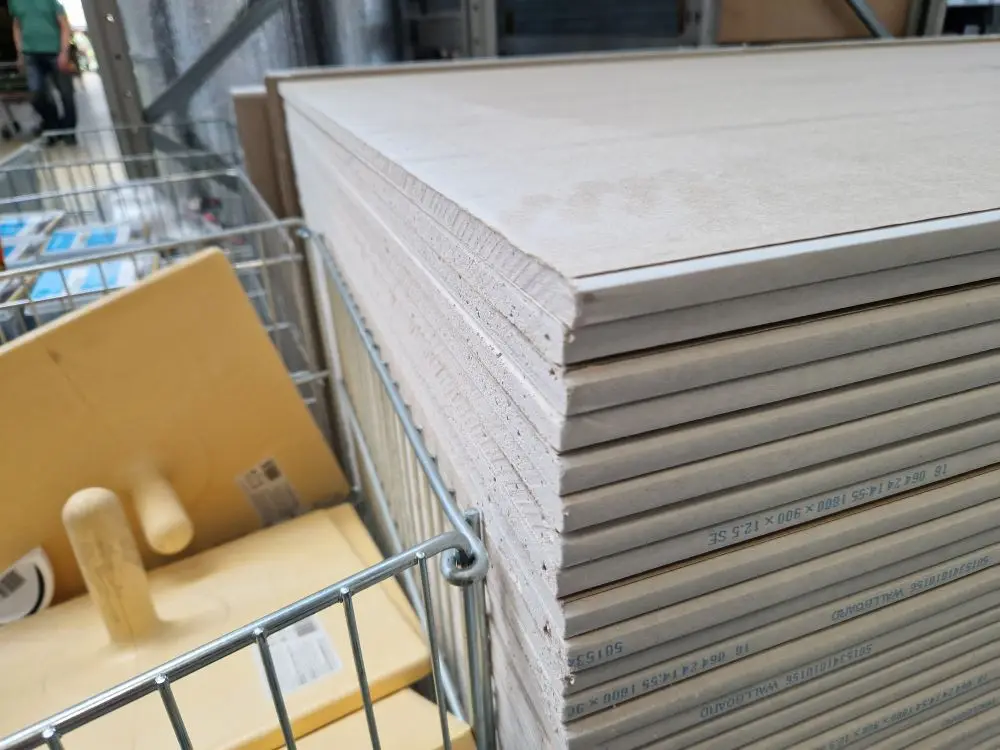
Type X vs Type C drywall is the question that stalls export orders, and the honest answer surprises people: one of the two is defined in an ASTM standard and the other one isn't defined in any standard at all. Type C is a trade designation. It has no ASTM definition, no dimensional spec of its own, and no independent rating — and it is still the correct, non-substitutable product on thousands of drawings.
If you manufacture or export gypsum board, that gap is where your quotes get rejected. Below are the six questions buyers, specifiers, and code officials actually ask, answered in the order they come up.
Type X vs Type C drywall: what the standard actually defines
Type X is defined in ASTM C1396/C1396M. The Gypsum Association states the benchmark plainly: 5/8-inch Type X gypsum board provides at least a one-hour fire-resistance rating when applied parallel to, and on both sides of, load-bearing 2×4 wood studs spaced 16 inches on centre. That is the anchor the whole North American system hangs on.
Type C is not defined in ASTM C1396, or in any other ASTM standard. Type C panels are proprietary Type X products with a modified core — additional glass fibre and a shrinkage-compensating additive that expands as the core is heated, so the board holds its dimension and keeps joints closed longer in a fire. Manufacturers signal it by putting a "C" in the trade name. That is the entire naming system: a letter in a product name, backed by test data on specific assemblies.
So the accurate framing is not "Type C is a better grade than Type X." It is: Type X is a standard; Type C is a product family that performs beyond that standard in listed assemblies.
Is Type C stronger than Type X?
Under fire, yes — but "stronger" is the wrong axis, and quoting a number here is where suppliers get caught out.
Type C does not carry a rating on its own. Neither does Type X. A fire-resistance rating belongs to the tested assembly — the studs, the spacing, the fasteners, the insulation, the layers, and the joint treatment — never to the sheet of board by itself. A 5/8-inch Type C panel lying on a pallet has no rating. Put it into a specific listed design and that design has a rating.
This is why "our board is 2-hour rated" is a sentence that should never appear in an export catalogue. It is not true of any board, from any manufacturer, anywhere.
Why does my drawing say Type C when Type X is "one hour"?
Because the assembly the architect selected was tested with Type C, and the listing names it.
Listed assemblies are recipes. When a design is tested and published, the board type is part of the recipe alongside stud gauge and screw spacing. Substituting Type X into a design that was listed with Type C does not produce a slightly worse wall — it produces an unlisted wall, which in inspection terms is an unrated wall. The rating is not a property you can carry over.
This matters most in the assemblies where Type C earns its keep: many one-hour floor-ceiling and column-protection designs, and a lot of the tighter shaft-wall and area-separation designs, are listed with Type C specifically because the core additive keeps the board from shrinking away from the joints.
Practical call: if the drawing says Type C, quote Type C or quote nothing. Offering a Type X substitution "because it's also one hour" reads to a specifier as a supplier who does not understand listings, and it is the fastest way to lose a project bid.
What is the European equivalent of Type X?
There isn't one, and this is the single most expensive misunderstanding in gypsum board export.
Europe classifies boards under EN 520, which sorts plasterboard into lettered types by property — Type A (standard), Type D (defined density), Type E (sheathing), Type F (improved core cohesion at high temperature — the fire board), Type H (reduced water absorption), Type I (enhanced surface hardness), Type P and Type R. Type F is the fire-performance type, and it is the closest conceptual cousin to Type X.
But it is not an equivalent, because the two systems measure different things and report in different units:
| North America | Europe | |
|---|---|---|
| Board specification | ASTM C1396/C1396M (Type X defined) | EN 520 (Types A, D, E, F, H, I, P, R) |
| "Type C" status | Proprietary, not in any ASTM standard | No equivalent designation exists |
| Fire-resistance test | ASTM E119 | EN 1364 / EN 1365 series |
| Fire-resistance result | Hours: 1, 2, 3, 4 | Minutes with criteria letters: EI 60, REI 90 |
| Reaction-to-fire result | ASTM E84 flame spread / smoke | EN 13501-1 Euroclass, e.g. A2-s1,d0 |
| What carries the rating | The listed assembly | The classified assembly |
Two separate concepts hide inside the European column, and conflating them is a classic rejection reason. Reaction to fire (EN 13501-1, the Euroclass A2-s1,d0 style code) describes how much the product itself contributes to a fire. Fire resistance (EN 13501-2, the EI/REI style code) describes how long an assembly keeps a fire on one side. A board can hold an excellent Euroclass and belong to no rated assembly whatsoever. One certificate does not convert into the other, and neither converts into an ASTM hourly rating.
If you already ship fire-rated doors into both systems, the same split shows up there, laid out in EI30 vs FD30 fire door ratings.
Is a 15 mm EN board the same as 5/8-inch Type X?
No, and the arithmetic is worth memorising because it comes up in every mixed-market quotation.
| Nominal callout | Actual thickness | Difference |
|---|---|---|
| 1/2 inch (US) | 12.7 mm | — |
| 12.5 mm (EN) | 12.5 mm | 0.2 mm thinner than 1/2" |
| 5/8 inch (US) | 15.875 mm | — |
| 15 mm (EN) | 15.0 mm | 0.875 mm thinner than 5/8" |
A 15 mm EN board is not a 5/8-inch board. It is close enough to look interchangeable on a packing list and far enough to fall outside a US assembly listing that specifies 5/8-inch Type X. Same story on sheet size: a 1200 × 2400 mm sheet is not a 4 × 8 ft sheet — it is roughly 19 mm narrower and 38 mm shorter. Those gaps are trivial in a warehouse and fatal in a listed assembly, and they are the reason the full standard drywall sheet sizes reference belongs in your quotation pack.
Which fire number belongs on the label, and which doesn't
Here is the split that keeps a spec sheet defensible.
| Claim | Safe to publish | Why |
|---|---|---|
| "Type X per ASTM C1396" | Yes, if true | A product-level standard the board genuinely meets |
| "EN 520 Type F" | Yes, if true | A product-level classification |
| "Euroclass A2-s1,d0 per EN 13501-1" | Yes, with the test report reference | Reaction to fire is a product property |
| "1-hour rated board" | No | Ratings belong to assemblies, not boards |
| "EI 60 board" | No | EI classifications belong to assemblies |
| "Equivalent to Type X" | No | Equivalence is a claim only a listing can make |
| "Suitable for use in [named listed design]" | Yes, if the design names your product | Traceable to a specific published listing |
The rule underneath all of it: publish what the product is, cite what the assembly achieved, and never merge the two sentences.
Pre-export checklist
- Board type stated with its governing standard (ASTM C1396 Type X, or EN 520 Type F) — never a bare letter
- "Type C" quoted only as Type C, never substituted with Type X
- Thickness given in both mm and inches, with the actual value, not the nominal callout
- Sheet dimensions given in mm and feet-inches, actual values
- Reaction-to-fire class and fire-resistance rating listed as separate lines, never merged
- Every rating tied to a named, published assembly or listing number
- No hourly rating printed against the board itself
- Test report numbers and issuing laboratory included in the submittal pack
- Edge profile stated (tapered, square, bevelled) — it changes the joint detail
- Destination market's system identified before quoting, so the right certificate travels with the goods
The picture does the work the PDF doesn't
Everything above lives in a submittal package that a busy contractor will not read. The board photo, on the other hand, gets looked at every time.
A product image that carries the measured thickness on the cut edge, the actual sheet width and length on the face, the edge profile called out where it is visible, and the standard designation printed next to the product name settles most of these questions before anyone opens a document. The important word is measured: the thickness label has to come from the real dimension of the real board, pinned to the edge in the image, not typed in from the nominal callout — because "15 mm" and "5/8 inch" are exactly the pair that looks right and fails a listing. Software that snaps annotations to the actual edges in the photo and exports the result at the size each catalogue, marketplace listing, and submittal PDF requires does this in minutes per SKU; an AI image generator will produce a handsome board render with an invented number on it, which is precisely the failure mode this article is about. The same discipline applied across a product line is covered in how to label building material dimensions.
FAQ
What does the C stand for in Type C drywall?
Nothing official — it is a manufacturer's trade-name letter, not a standardised designation. Type C is not defined in ASTM C1396 or any other ASTM standard. Producers use the letter to signal a Type X core enhanced with extra glass fibre and a shrinkage-compensating additive, and the actual proof of performance is the listed assembly that names the specific branded product.
Can I substitute Type X for Type C?
No. If a listed assembly specifies Type C, substituting Type X leaves you with an assembly that was never tested in that configuration, which means it carries no rating at all. Fire ratings are properties of tested assemblies, not of boards, so a substitution is not a downgrade — it is a total loss of the listing.
Is EN 520 Type F the same as ASTM Type X?
No. EN 520 Type F is the European product classification for plasterboard with improved core cohesion at high temperature, and ASTM C1396 Type X is the North American product specification. They describe similar intent, are tested by different methods, and report results in incompatible units — minutes with EI/REI criteria versus hours. Neither certificate converts into the other, so a board destined for both markets needs both classifications documented separately.
How thick is 5/8 Type X drywall in millimetres?
15.875 mm. That matters because the nearest European fire board is 15.0 mm, which is 0.875 mm thinner and therefore not a drop-in replacement in an assembly listing that calls for 5/8 inch. When you publish thickness on a spec sheet or a product photo, publish the actual measured value in both units rather than the nominal callout — labelling a 15 mm board as "5/8 inch" is the most common dimensional error in gypsum board export documents, and it is the kind of mislabel that annotated, measurement-accurate product images are specifically good at preventing.
Does a higher Euroclass mean a longer fire rating?
No, and this is the most common confusion in European fire documentation. Euroclass (A1, A2-s1,d0, B, and so on, from EN 13501-1) measures reaction to fire — how much the material itself contributes to a fire's growth. Fire resistance (EI 30, REI 60, from EN 13501-2) measures how long a complete assembly holds a fire back. A product can be Euroclass A1 and belong to no rated assembly at all. The two are independent, and a spec sheet should never present one as evidence of the other.
Sources & References
- Gypsum Association — Understanding the Differences Between Type X and Type C Gypsum Boards
- Association of the Wall and Ceiling Industry — Gypsum Board Fire Ratings
- ASTM C1396/C1396M — Standard Specification for Gypsum Board
- ASTM E119 — Standard Test Methods for Fire Tests of Building Construction and Materials
- EN 520:2004+A1:2009 — Gypsum plasterboards: definitions, requirements and test methods
- International Building Code, Chapter 7 — Fire and Smoke Protection Features