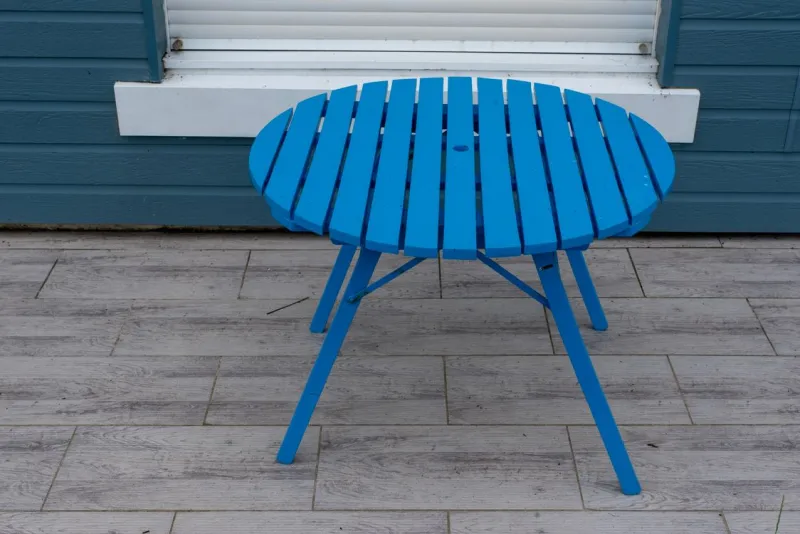
A "60-inch round table" can arrive on a 36-inch base, and the buyer discovers it the moment four chairs won't tuck under it. The top was 60 inches. Nobody lied. Someone labeled one number and let it stand for three.
Learning how to measure a round table is not difficult. The hard part is deciding which circle you are measuring — and then writing it down so the buyer pictures the same table you built.
Why a round table is harder to size than a rectangle
A rectangular table gives you three independent numbers: length, width, height. They can't be confused with each other, and the shape is settled.
A circle gives you one number that describes everything: the diameter. That sounds simpler until you notice a pedestal table has three different circles stacked on top of each other:
- the top, which is the size the room has to hold;
- the base, which is what actually touches the floor and what chairs have to clear;
- the clearance under the top, which decides whether a chair or a knee fits.
Label only the top and the buyer fills in the rest by assumption. A round table has one headline size and two hidden ones, and the hidden ones are where the returns come from.
How to measure a round table, step by step
1. Put the tape across the center, not along the rim
The diameter is the longest straight line through the center of the circle — edge to edge, passing through the middle. Measure it twice, the second time at roughly 90° to the first, and use the average. A round top that is slightly out of true will read 1–3 mm differently depending on where you start, and the two readings tell you whether the top is actually round.
Do not measure an arc, a chord, or "the widest bit I can see in the photo." On a photo, perspective makes the near edge look wider than the far edge, so a visual estimate is not a measurement.
2. Turn the table over and measure the base
The base diameter is the circle on the floor — the pedestal foot, the four-leg spread, or the cross stretcher. Write it down even when it looks obvious. It is the number that decides whether chairs slide underneath and how stable the table feels.
3. Measure height to the top edge, not the center
Height is floor to the top surface, measured at the edge. Skip the center if the top is dished, crowned or has a raised lip — you'll pick up millimetres of curvature that the buyer never sees. If the table has a thick apron or a lower shelf, note that too; "height" alone doesn't tell someone where their knees go.
4. Calculate the overhang before you write the label
Overhang is half the difference between the top and the base:
(top diameter − base diameter) ÷ 2
A 60-inch top on a 36-inch base gives a 12-inch overhang all around. That number is what lets a buyer judge chair tuck and toe space without driving to your showroom. Put it in the spec table; it takes one line and prevents the most common fit complaint.
5. Check the clearance that decides whether anything fits underneath
For a dining table, the overhang plus the base geometry tells you if a chair back will clear the pedestal. For a desk, counter or public table, the number is regulated rather than aesthetic: the ADA Standards require knee clearance at least 27 inches (685 mm) high and 30 inches (760 mm) wide, extending 11 inches (280 mm) deep at 9 inches above the floor (2010 ADA Standards for Accessible Design, §306.3). If you sell into the US contract or hospitality market, that is not a preference — it is the number a specifier checks.
The five numbers that belong on the spec
| Number |
Where it comes from |
What it decides |
Common error |
| Top diameter |
Tape through the center, twice at 90° |
Whether the table fits the room |
Read off a photo instead of measured |
| Base diameter |
The circle touching the floor |
Chair tuck and stability |
Left off the sheet entirely |
| Height |
Floor to top edge |
Seat and standing comfort |
Measured at the center of a dished top |
| Overhang |
(Top − base) ÷ 2 |
Toe space and chair clearance |
Assumed to be equal on every model |
| Clearance height |
Underside of top to floor |
Knee and chair-back room |
Confused with table height |
For the reference diameters themselves — the standard sizes buyers compare against — the standard dining table dimensions page has the ranges by seat count, so you can check the model you're labeling without re-deriving them.
Diameter vs radius: the label that doubles the size
Diameter (Ø) is the full width through the center. Radius (R) is half of it — center to edge. Get them backwards and the buyer plans for a table twice or half the size you ship.
Dimensioning practice is unambiguous about which symbol to use: ASME Y14.5-2018, Dimensioning and Tolerancing sets the uniform practices for stating and interpreting dimensions, and the diameter symbol is the one that marks a full circular feature. In supplier-facing work the convention is simple:
- Ø for the top, the base, and any full circular feature.
- R for an edge radius, a corner fillet, or a partial arc — never for the size of the table.
So "R30" on a round table is wrong even if it happens to describe a 60-inch top, because a buyer reading R30 expects a 30-inch radius and a 60-inch width — and the next person reading it may expect a 30-inch table. The symbol is not decoration; it carries the factor of two.
Where each number goes on the photo
Knowing how to measure a round table is half the job; the other half is drawing the numbers so they survive a thumbnail.
| What you're showing |
How to draw it |
What not to do |
| Top diameter |
One line through the center, edge to edge, with Ø |
An arc or a curved arrow around the rim |
| Base diameter |
A second, smaller line low on the base |
Omitting it because the top is "the size" |
| Height |
Vertical dimension outside the silhouette |
A number floating in the middle of the top |
| Overhang |
Short dimension from base edge to top edge |
Mixing it with the height measurement |
| Units |
Both metric and imperial on every figure |
One unit and a note elsewhere |
If the dimension lines start crowding the product, the fixes are in product photo callouts: fewer callouts, larger type, and one number per line. And when the photo has to carry scale without a person in frame, the setups in how to show product size in a photo do more for buyer confidence than any text block underneath.
Round tables that are not full circles
Three shapes get mislabeled more than any others:
- Oval and racetrack tops. Oval table dimensions are a pair, not one: major axis × minor axis. A 60 × 42 oval is not a 60-inch circle, and the seat count changes with the shape. Label both axes.
- Square tops with rounded corners. Length × width for the top, plus an R for the corner radius. The R describes the corner only — it never replaces the size.
- Trapezoid and D-end tops. Two widths (front and back) and a depth. A single "width" here is ambiguous by definition.
In each case the rule is the same: one dimension per independent measurement, and never let a radius do a diameter's job.
Pre-send checklist for a round table
FAQ
How do you measure the diameter of a round table?
Measure edge to edge through the center, then repeat at 90° and average the two readings. The diameter is the longest chord of the circle, so any line that doesn't pass through the center will read short.
Is the base the same size as the top on a round table?
Usually not. Pedestal tables commonly have a base far smaller than the top, and four-leg tables measure across the leg spread rather than the top. Measure both and label both; the difference is the overhang, which is the number buyers use to judge chair clearance.
Should a round table be labeled with Ø or R?
Use Ø for the top and the base. R belongs to edge radii and partial arcs, and using it for the table's size invites a factor-of-two error. If you're producing these labels from a photo, a measured callout pinned to the real edge — with the Ø line drawn through the center and both units attached — gives the buyer the same number your factory builds to, rather than a plausible-looking one.
How do you measure an oval table?
Two measurements at the widest and narrowest points: the major axis and the minor axis, both through the center. Label them as two axes, not as "diameter", because an oval has no single diameter.
Is circumference ever useful on a spec sheet?
Rarely for furniture, occasionally for round cartons, skirts or edge trim. Circumference is π times the diameter (diameter and circumference relationship), so if you already publish the diameter, a buyer can derive it — but a trim supplier quoting a length will want it stated rather than calculated.
Sources & References