
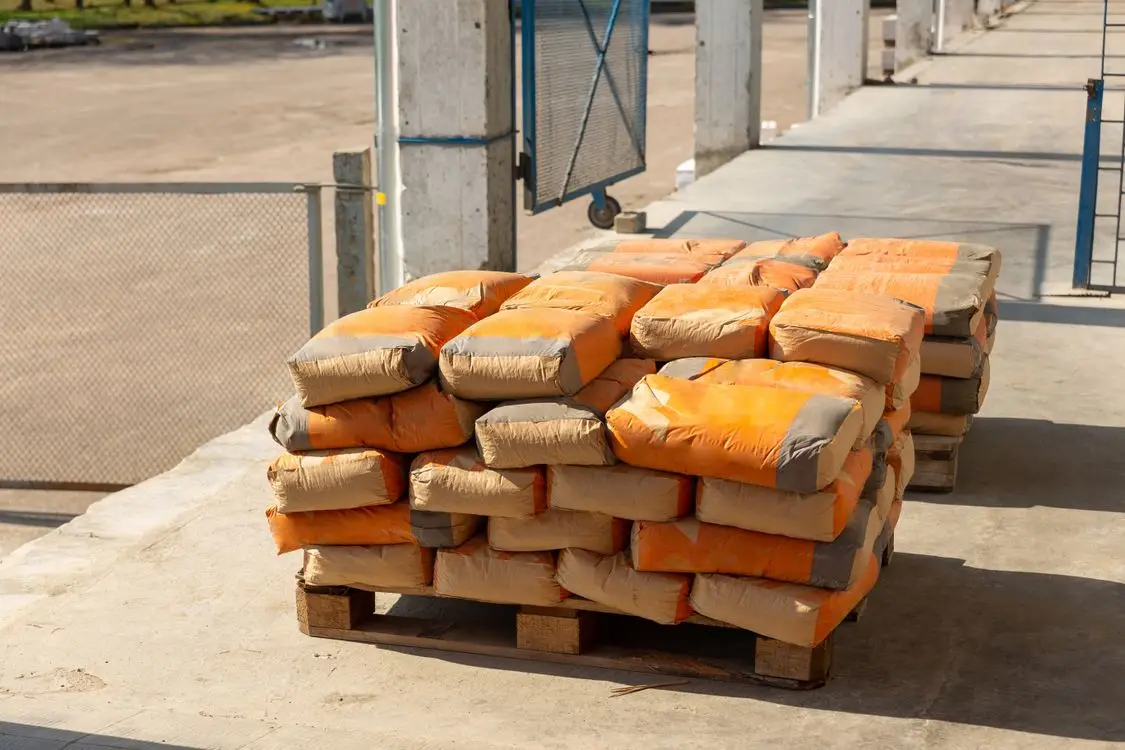
Bulk bag dimensions decide whether a shipment sits flat on a pallet, clears a container door, and stays inside its rated load — and a buyer who cannot see all three numbers in your listing will guess. A wrong guess on a bulk bag is expensive: a load rejected at the port, a forklift split on the dock, or a full container reworked before it can ship. What follows is the sizing reference exporters actually need, with the standard FIBC sizes, the safe working loads behind them, and the exact figures to print on every product image and spec sheet.
What is a bulk bag (FIBC)?
A bulk bag — also called an FIBC (Flexible Intermediate Bulk Container), jumbo bag, big bag, or super sack — is a woven polypropylene sack built to carry roughly 500 to 2,000 kg of dry, flowable product in a single lift. It is not a shipping container and not a hand sack: it is a liftable, pallet-sized unit of packaging, filled from the top by gravity, moved by forklift or crane, and emptied through a discharge spout at the bottom.
That is why "size" is the wrong single question. A bulk bag has three dimensions that matter, and they are independent:
- Base footprint — the square length × width of the bag sitting on the ground, sized to match a pallet.
- Filled height — how tall the bag stands once it is full, which decides container clearance and stacking.
- Rated load — the safe working load (SWL) the bag is tested and certified to lift.
A quote that lists only one of the three is not a spec. It is a guess with a price on it.
What are the standard bulk bag dimensions?
The industry-standard FIBC base is 90 × 90 cm (35 × 35 in) for U-panel and four-panel construction, or 36 × 36 in for circular and tubular bags — the difference is how the fabric is sewn, not the load. Overall height typically runs 30 to 70 inches (76 to 178 cm) in 5-inch steps, though metric-market bags for cement, agriculture, and chemicals commonly reach 110 to 200 cm depending on the load type.
The components around the bag have tolerances of their own, and every one of them is a dimension a buyer can measure and reject you on:
| Component | Standard size | Manufacturing tolerance |
|---|---|---|
| U-panel / four-panel base | 35 × 35 in (90 × 90 cm) | ±2 cm (width & length) |
| Circular / tubular base | 36 × 36 in | ±2 cm (width & length) |
| Overall bag height | 30–70 in (76–178 cm), 5-in steps | ±2 cm |
| Fill & discharge spout | 14 in diameter × 18 in long | +2 cm / −1 cm (width), ±2 cm (length) |
| Duffle (top skirt) length | 33 in | ±2 cm |
| Lift loop height | 10 in standard / 15 in custom | +2 cm / −1 cm |
| Fabric weight (woven PP) | — | ±5% |
Base footprints are not arbitrary — they are sized to sit inside a standard pallet. A 35 × 35 in base (889 mm) fits a 1,000 × 1,200 mm pallet with margin; a 36 × 36 in base (914 mm) fits a 1,140 × 1,140 mm pallet. A base that overhangs its pallet makes the bag unstable on the forks and stops the pallet stacking.
For the full reference — every base, height, and component on one page — see the standard FIBC bulk bag dimensions chart.
Bulk bag sizes chart: which base fits which load
Bag size is chosen to match the product's bulk density and the loads your customer's handling equipment can lift, not by habit. The four combinations below cover most export trade:
| Load type | Base footprint | Height | Volume | Safe working load (SWL) |
|---|---|---|---|---|
| Chemicals & minerals | 90×90–100×100 cm | 110–140 cm | 0.9–1.2 m³ | 1,000–1,500 kg |
| Food grains & sugar | 95×95–100×100 cm | 140–180 cm | 1.2–1.6 m³ | 1,000–1,500 kg |
| Cement & construction | 90×90–95×95 cm | 110–130 cm | 0.9–1.1 m³ | 1,500–2,000 kg |
| Agricultural products | 100×100 cm | 160–200 cm | 1.4–2.0 m³ | 1,000–1,500 kg |
Two rules fall out of that table. Denser product needs a shorter bag — cement at roughly 1,400 kg/m³ hits a 2,000 kg load long before a 1.1 m³ bag is full. Lighter, fluffier product needs a taller bag to reach an economical weight per unit, which is why agricultural bags run to 200 cm.
How much does a bulk bag hold?
"How much does a bulk bag hold" has two honest answers, and the buyer needs both: a volume and a weight.
- Volume — a standard 90 × 90 × 110 cm bag holds about 0.9 m³; a large 100 × 100 × 200 cm bag holds about 2.0 m³.
- Weight — the safe working load is most commonly 1,000 to 2,000 kg, with 1,500 kg the single most common figure in export trade.
Which limit binds first is set by bulk density. Take one 0.9 m³ bag: filled with wheat (around 770 kg/m³) it holds roughly 690 kg and the volume runs out first; filled with sand (around 1,600 kg/m³) the same bag weighs about 1,440 kg and the SWL becomes the constraint. Same dimensions, two different legal fill levels — and that gap between "full" and "at rated load" is where most overfill disputes start. Quote the fill weight the bag is rated for, never the geometric volume alone.
What is the difference between a bulk bag and a super sack?
None in construction — "super sack" is a brand name that became generic, adopted the way the market adopted "jumbo bag," "big bag," and "ton bag." The standards term, and the one a buyer's quality team expects on a spec sheet, is FIBC (Flexible Intermediate Bulk Container). The only real difference is the size the slang implies: "super sack" and "ton bag" usually suggest a 1,000 to 1,500 kg bag, while FIBC covers the full 500 to 2,000 kg range. Quote the base, the height, and the SWL regardless of which name the buyer used.
FIBC types A, B, C, D — what the letter means for your load
The letter on an FIBC is a static-electricity classification, and it is a safety spec, not a marketing tier. It decides what product the bag may legally carry:
| Type | Anti-static construction | Grounding required | Typical use |
|---|---|---|---|
| A | None — plain woven PP | No | Non-flammable, non-combustible-dust product |
| B | Breakdown-voltage limited fabric | No | Prevents propagating brush discharge; some combustible dusts |
| C | Conductive fabric and threads | Yes — must be grounded | Flammable dusts and solvents in hazardous zones |
| D | Static-dissipative, no conductive path | No | Combustible dusts where grounding is impractical |
Getting this wrong is not a returns problem; it is an explosion-risk problem. If your customer fills a Type A bag with a combustible powder in a hazardous zone, no dimension on the bag can save the load.
What is a bulk bag safe working load — and how is it tested?
The safe working load (SWL) is the maximum mass the bag is certified to lift repeatedly, and it is always quoted together with a safety factor. Under ISO 21898, the international FIBC standard, a single-trip bag is type-tested to 5:1 — five times its SWL — and a multi-trip bag to 6:1. A 1,000 kg single-trip bag, in other words, is proven to survive a 5,000 kg top lift before it goes into service.
Three things follow for the spec sheet:
- A 5:1 bag is single-trip. It must not be reused. A 6:1 bag may be reused, but only with documented inspection and cleaning between trips.
- The SWL is a top-lift figure. It assumes the load is lifted by all the loops the design requires, evenly. Lifting by one or two loops derates the bag instantly.
- The label is the proof. A bag that arrives without its SWL and safety factor printed on the body is not sellable as an engineered FIBC, whatever it holds in the yard.
The FIBC safety factor breakdown covers how 5:1 and 6:1 are proven in testing if your buyer wants the mechanism.
What does the UN marking on a bulk bag mean?
For dangerous goods, the bag carries a UN marking, and it is read left to right. The first block, 13H1, is the packaging code: 13 means a flexible IBC, H means woven plastics, and the trailing digit describes the coating and liner — 13H1 is woven plastic without coating, 13H2 is woven plastic with coating, 13H3 adds a liner, and 13H4 has both. The letters and numbers after that are the packing group, the manufacture date, the authorising country, and the maker's code — for example 13H1/Y/02.11/D/PA-.
| Code position | Meaning | Example |
|---|---|---|
| Packaging code | 13 = flexible IBC; H = woven plastics; 1–4 = coating/liner | 13H1 |
| Packing group | X = I, Y = II, Z = III | Y (Group II) |
| Month / year | Date of manufacture | 02.11 (Feb 2011) |
| Country | Authorising state | D (Germany) |
| Maker | Manufacturer's approval code | PA- |
The US rules that define these codes and the marking are in the Code of Federal Regulations: the code system is in 49 CFR §178.702 and the marking requirements in 49 CFR §178.703. The test battery behind the rating sits in the same subpart.
How do you label bulk bag dimensions so buyers get it right?
The failure is almost never the bag. It is the listing. A single photo of a full bag on the floor tells a buyer the colour and the spout, and nothing about whether the load fits their pallet, their truck, or their racking.
The fix is not "take a better photo." It is putting the measured numbers on the image, where the buyer's eye already is — a snap-to-edge line on the base, a vertical callout on the filled height, and the SWL printed as a value, not buried in a paragraph. That is the one capability that makes a bulk bag listing self-explanatory: deterministic measurement locked onto the photo, measured off the real bag and exported at the platform's spec-diagram size, rather than a number typed over a picture or a plausible-looking figure an image generator invented.
One line describes the whole discipline: a bulk bag has no size — it has a base, a height, and a load rating, and the buyer needs all three before they can say yes.
Put this block on every listing and spec sheet:
| Field | What to write | Example |
|---|---|---|
| Base (L × W) | Nominal base with units and tolerance | 90 × 90 cm (±2 cm) |
| Filled height | Full, filled height — not empty | 130 cm filled |
| Volume | Usable fill volume | 1.0 m³ |
| SWL | Safe working load in kg and lb | 1,500 kg (3,307 lb) |
| Safety factor | 5:1 (single-trip) or 6:1 (multi-trip) | 5:1 |
| Type | FIBC static type | Type C |
| UN code (if applicable) | Full 13H marking | 13H1/Y/… |
| Fill weight | Recommended fill weight, product-specific | 1,400 kg max for cement |
If the bag ships in a mixed container, pair those numbers with the container loading quantity math so the buyer sees whether two bags still sit side by side. A correct bag dimension and a wrong container plan still lose the order.
Next steps
If you are quoting a bulk bag order this week, three moves cover most of the risk:
- Pull the base, height, and SWL onto one spec block and put it on the listing image, not only in the text. See the bag size annotation example for what a measured overlay looks like.
- Reconcile fill weight against bulk density before you promise a volume. A 0.9 m³ bag is not a 1,400 kg bag for every product.
- Confirm the static type and UN code for the actual load; if the product is a combustible dust or a dangerous good, the type letter and 13H code are not optional.
If your team already has the measurements, a dimension annotation tool that snaps lines to the real edges and exports a platform-ready spec diagram turns those three moves into one afternoon. Hand-drawn arrows work too — just make sure the number is measured, not estimated.
FAQ
What is the base size of a standard bulk bag?
The standard FIBC base is 35 × 35 in (90 × 90 cm) for U-panel and four-panel bags, and 36 × 36 in for circular or tubular bags. Both are sized to sit within a standard export pallet without overhang.
How much does a standard bulk bag hold?
A standard 90 × 90 × 110 cm bulk bag holds about 0.9 m³ and is usually rated for 1,000–2,000 kg. Which limit you hit first depends on bulk density — dense products such as sand or cement reach the rated weight before the bag fills.
Is a super sack the same as a bulk bag?
Yes. "Super sack," "jumbo bag," "big bag," and "ton bag" are trade or slang names for the same packaging. The standards term is FIBC — Flexible Intermediate Bulk Container — and that is the term a buyer's quality team expects on a spec sheet.
Can a bulk bag be reused?
Only if it is rated for it. Single-trip FIBCs carry a 5:1 safety factor and must never be reused; multi-trip bags carry 6:1 and may be reused with documented cleaning and inspection between trips, per ISO 21898.
What does 13H1 mean on a bulk bag?
13H1 is the UN packaging code for a flexible IBC made of woven plastic without coating. The first two characters (13) identify a flexible intermediate bulk container, H identifies woven plastics, and the final digit identifies the coating and liner configuration.
Sources & References
- eCFR — 49 CFR §178.702: IBC codes (the 13H1 / 13H2 / 13H3 / 13H4 flexible-IBC code system)
- eCFR — 49 CFR §178.703: Marking of IBCs (packing group, date, country, and maker fields)
- eCFR — 49 CFR Part 178, Subpart M: Testing of Intermediate Bulk Containers (the top-lift and cyclic tests behind a 5:1 / 6:1 rating)
- IMCA — International Marine Contractors Association: safe use and handling guidance for flexible intermediate bulk containers (FIBCs)