
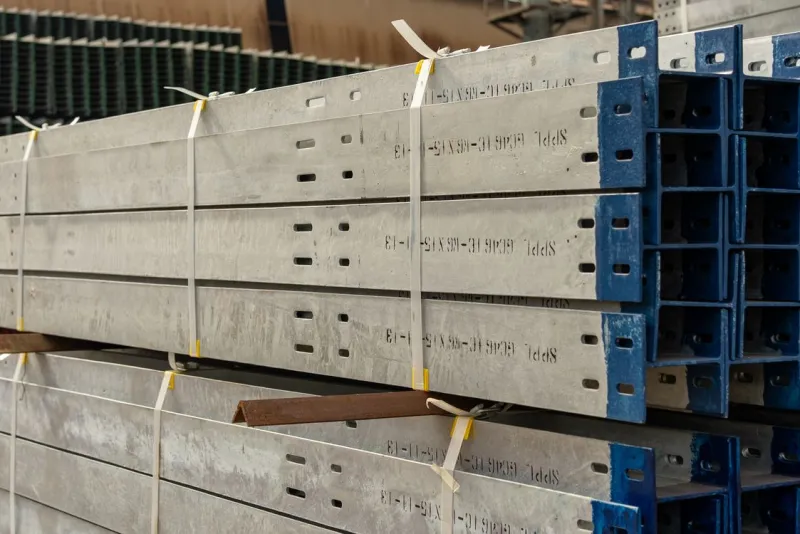
IPE vs HEA vs HEB is not a spelling test. It is the distance between a section that is 100 mm wide and one that is 200 mm wide, between roughly 22 and 41 kg of steel per metre, and between an order that clears and a load that gets rejected at the port. An exporter in Foshan and a buyer in Rotterdam can both write "HEA 200" and still be picturing two different beams, because in the European family the number after the letters is a name, not a measurement.
This is a disambiguation guide, not a design manual. Below: what actually separates an I-beam from a wide-flange (H) beam, what the numbers in IPE, HEA, HEB and HEM refer to, the exact dimensions behind three sections all called "200", and how the same steel is renamed in the US, UK, India, Australia and Canada. If you quote or label steel, this is the vocabulary that decides whether the buyer receives the beam on their drawing.
I-beam vs H-beam: the flange width is the whole difference
An I-beam is a hot-rolled structural section with two parallel flanges joined by a central web, shaped like a capital I or H. The web resists shear; the flanges resist bending. When the flanges are narrow relative to the depth, the section reads as an "I" and is sold as a standard I-beam. When the flanges are broad — up to as wide as the section is deep — the same rolled shape is called a wide-flange beam, an H-beam, or a universal beam.
That single ratio explains almost every naming fight:
- IPE / IPN / I-profile — the I-shaped family. Tall and narrow: the web is clearly deeper than the flange is wide.
- HE / W / UB / UC / ISMB — the wide-flange family. Broad, parallel flanges, which is why these sections double as columns.
So "I-beam vs H-beam" is not really two products. It is the two ends of one flange-width scale, and each end has its own table of sizes.
IPE vs HEA vs HEB: what the number after the letters means
The IPE series (I Profile European) is standardised at IPE 80 through IPE 600. The designation is simply the letters plus the nominal height in millimetres, and — importantly — the flange is narrow: IPE 200 is 200 mm deep but only 100 mm wide.
The HE family is different. It has three sub-series, all wide-flange, differing only in flange thickness:
- HEA — light, per DIN 1025-3 (also called IPBl)
- HEB — normal, per DIN 1025-2 (also called IPB)
- HEM — heavy, per DIN 1025-4 (also called IPBv)
Here is the trap. In the HE family, the number is the nominal total height of the base HEB section, in millimetres — not the height of the section you are ordering. For base sections up to 300 mm, the flange width b equals that number. Above 300 mm, the flange width is pinned at 300 mm. That is the rule that makes "HEA 200" mean something you did not expect.
| Section | h — height (mm) | b — flange width (mm) | tw — web (mm) | tf — flange (mm) | Nominal mass (kg/m) |
|---|---|---|---|---|---|
| IPE 200 | 200 | 100 | 5.6 | 8.5 | 22.4 |
| HEA 200 | 190 | 200 | 6.5 | 10 | ≈41 |
| HEB 200 | 200 | 200 | 9 | 15 | ≈60 |
| HEM 200 | 220 | 206 | 15 | 25 | ≈103 |
Read the first two rows together and the whole problem appears. IPE 200 and HEA 200 share the number "200", but one is 100 mm wide at 22.4 kg/m and the other is 200 mm wide at nearly double the steel. HEB 200 is the same footprint as HEA 200 with a much thicker web and flange; HEM 200 is heavier again and actually taller than the 200 in its name.
Mass figures are nominal. The IPE 200 value is the standard hot-rolled figure; the HE values are one manufacturer's published numbers for a laser-welded range, so a hot-rolled carbon section sits within a kilogram or two.
Why "HEA 200" is not 200 mm tall
The HEB base rule explains the odd-looking heights in the table. HEA 200 measures 190 mm, ten short of its name, because the "200" belongs to the HEB it is derived from — and HEB 200 really is 200 mm tall. Push further up the range and the gap widens: HE 1000 A is 990 mm tall while HE 1000 B is a full 1000 mm.
This is the sentence to remember and repeat to a buyer: in the HE family, the number tells you which HEB the section is based on, not how tall the steel you receive will be.
That is also why you cannot convert A, B and M by arithmetic. HEA, HEB and HEM are three separate rolled shapes with their own webs and flanges — not three thicknesses of the same stamping.
The same beam under five names
Europe is not the only naming system, and the others do not map one-to-one. The US, for example, folds weight into the designation, not just depth:
| Market | Example designation | What the number means | Governing standard |
|---|---|---|---|
| Europe (IPE) | IPE 200 | nominal height, mm | EN 10365 |
| Europe (HE) | HEA 200 | height of the base HEB, mm | DIN 1025 / EN 10034 |
| United States | W10×22 | depth (in) × weight (lb/ft) | ASTM A6 / AISC manual |
| Canada | W250×33 | depth (mm) × weight (kg/m) | CSA / CISC handbook |
| Mexico | IR250×33 | depth (mm) × weight (kg/m) | IMCA manual |
| United Kingdom | 152×152×23 UC | depth × width × mass × type | BS 4-1 |
| Australia | 460UB67.1 | depth + type (UB/UC) + kg/m | AS/NZS 3679.1 |
| India | ISMB 450 | depth, mm | IS 808 |
Two things follow. First, a US "W" number is not a height — it is depth and weight, so W10×22 is about 10 in deep and 22 lb/ft, and a W14 series member can run as deep as 22.84 in despite the "14". Second, there is no clean lookup that turns IPE 200 into a W-shape: the flange widths differ, so a beam that matches on depth will usually mismatch on width and weight.
Add the material grade and the spec grows again. Wide-flange shapes are commonly rolled to ASTM A992 (yield 50,000–65,000 psi, 340–450 MPa); the older A36 grades at 36,000 psi (250 MPa) and A572 at 42,000–60,000 psi. A section is not specified until depth, width, thickness and grade all agree.
Where a beam spec actually breaks
Almost every beam dispute traces to one of three hand-offs:
- The quotation drops the width and thickness, keeping only "200 beam". The mill prices a different section.
- The drawing shows a section number the reader maps to their own local table.
- The mill certificate confirms the section but carries its own dimensional and mass tolerance, so the delivered bar moves a little.
The fix is not a prettier drawing. It is pinning the measured h, b, tw and tf onto the image so the number and the shape travel together — the same discipline behind standard steel I-beam sizes, where each section is a specific set of four numbers rather than a nickname. When you annotate a beam for a quotation, use a tool that locks the measured dimension to the edge (snap-to-edge measurement, exported at the buyer's spec size) instead of a generic photo editor or an AI image generator that renders a plausible-looking number nobody can trace. A measured annotation is a promise the buyer can check; a restyled photo is not.
If the section you are selling is a channel, angle, tube or hollow section rather than a beam, the same designation-versus-dimension trap applies — see steel profile dimensions. And if the wall thickness enters the conversation, cross-check it against sheet metal gauge to mm before it reaches the quotation.
Beam spec checklist before you quote
- Name the series and the sub-series: IPE 200, not "200 beam"; HEA 200, not "HE 200"
- Give all four dimensions: height h, flange width b, web thickness tw, flange thickness tf
- State the standard: EN 10365 / EN 10034 for IPE and HE; ASTM A6 for W; BS 4-1 for UB/UC
- State the grade: S235JR / S355J2 for Europe, A992 for US W-shapes
- Add the weight per metre you are pricing against, and say whether it is theoretical or weighed
- Confirm the buyer's number is the height, not the base-HEB height, before you cut anything
- Keep the mill certificate's tolerance visible — nominal is not delivered-to-the-millimetre
FAQ
What is the difference between an I-beam and an H-beam?
Flange width relative to depth. A narrow-flange I-section (an IPE, IPN or US "S" shape) comes to a point at the flanges; a wide-flange H-section (HEA/HEB, W, UB/UC, ISMB) has flanges up to as wide as the section is deep. The H-profile resists torsion and bidirectional bending better, which is why it is used for columns as well as beams.
Is IPE the same as HEA?
No. IPE is a narrow, I-shaped section; HEA is a wide-flange section. IPE 200 is 200×100 mm at 22.4 kg/m; HEA 200 is 190×200 mm at roughly 41 kg/m. They are not interchangeable even when the number matches.
Why does HEA 200 measure 190 mm instead of 200 mm?
Because the number in an HE designation is the nominal height of the base HEB section, not of the A-section. HEB 200 is 200 mm tall; the lighter HEA derived from it is 190 mm. The further up the range you go, the more the A-height trails the number.
How do I convert an IPE section to a US wide-flange beam?
You cannot do it by number. Match on all four dimensions and the grade, then accept a near-miss — US W-shapes fold weight into the designation and have different flange widths. Give the buyer the full h, b, tw, tf and the standard so they can substitute deliberately.
What does the number in W10×22 mean?
Depth and weight, not height and number. The "10" is approximately 10 inches deep and the "22" is 22 pounds per foot. The actual depth varies across the series, so always read the section table rather than trusting the round number.
Sources & References
- Wikipedia — I-beam: definitions, the IPE 200 dimensions (200 × 100 × 5.6 × 8.5 mm, 22.4 kg/m), US/Canadian/Mexican/UK/Australian/Indian designation systems, and the governing standards (ASTM A6, BS 4-1, IS 808, AS/NZS 3679.1).
- Wikipedia (DE) — Profilstahl: the DIN 1025 family behind IPE, HEA, HEB and HEM, and their relationship to EN 10034.
- Wikipedia (DE) — Breitflanschträger: HEA per DIN 1025-3, HEB per DIN 1025-2, HEM per DIN 1025-4, all governed by EN 10034.
- Wikipedia (ES) — Perfil HE: the rule that the HE number is the nominal height of the base HEB section, with flange width b = h up to 300 mm and b = 300 mm above it.
- Montanstahl — HEA, HEB & HEM European wide flange beams: the section table used for the HEA 200, HEB 200 and HEM 200 dimensions and nominal masses.