
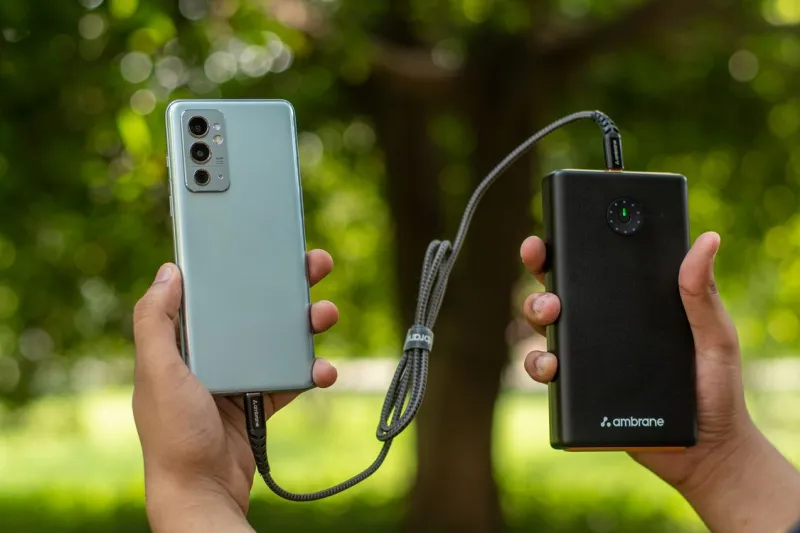
mAh to Wh conversion decides whether your product flies, and the mAh figure printed on the box is not the number anyone in the freight chain reads. A power bank marked 20,000 mAh is 72 Wh, 74 Wh or 100 Wh depending on which voltage you multiply by — and only one of those is the figure an airline uses to accept or refuse the shipment.
Here is the finding, stated plainly: mAh measures charge, Wh measures energy, and every air-transport threshold in the world is written in Wh. A spec sheet that publishes only mAh has published the one number the regulation does not use.
The conversion, and the mistake inside it
The arithmetic is trivial:
Wh = (mAh ÷ 1000) × V
The failure isn't the formula. It's which V you substitute. A lithium-ion cell has a nominal voltage around 3.6–3.7 V. A power bank's USB output is 5 V. The mAh figure on the label is rated at the cell voltage, so pairing that mAh with the 5 V output voltage inflates the result by about 35 %.
| Marked capacity | × 3.6 V (cell nominal) | × 3.7 V (cell nominal) | × 5 V (USB output — wrong pairing) |
|---|---|---|---|
| 5,000 mAh | 18 Wh | 18.5 Wh | 25 Wh |
| 10,000 mAh | 36 Wh | 37 Wh | 50 Wh |
| 20,000 mAh | 72 Wh | 74 Wh | 100 Wh |
| 26,800 mAh | 96.5 Wh | 99.2 Wh | 134 Wh |
| 30,000 mAh | 108 Wh | 111 Wh | 150 Wh |
Read the 20,000 mAh row twice. Multiplied correctly it is 72–74 Wh, comfortably inside the passenger limit. Multiplied against the output voltage it reads 100 Wh — sitting exactly on the threshold, which is where inspectors stop and ask questions about a product that was never actually near the line.
The rule that removes the ambiguity: the mAh and the V must describe the same thing. Publish the cell nominal voltage next to the mAh, or publish Wh directly and skip the argument.
Where the thresholds actually sit
| Energy per battery | Passenger aircraft status | What it requires |
|---|---|---|
| ≤ 100 Wh | Permitted, no airline approval needed | Standard carry-on rules |
| 101–160 Wh | Permitted with airline approval | Advance approval, quantity limited (typically 2 spares) |
| > 160 Wh | Not permitted in passenger baggage | Cargo only, as fully regulated Class 9 dangerous goods |
Converted back through the cell nominal voltage, those thresholds land at roughly 27,000 mAh (100 Wh at 3.7 V) and 43,200 mAh (160 Wh at 3.7 V). Any product marketed above about 27,000 mAh is in approval territory whether or not the listing mentions it.
The packing instruction decides the paperwork
Three packing instructions cover lithium-ion, and which one applies depends entirely on how the battery travels relative to the product:
| Packing instruction | UN number | What it covers |
|---|---|---|
| PI 965 | UN 3480 | Loose cells and battery packs shipped on their own |
| PI 966 | UN 3481 | Batteries packed with equipment |
| PI 967 | UN 3481 | Batteries installed in equipment |
The same battery moves under three different rule sets depending on packing, and the paperwork differs at each. There is also a state-of-charge condition that catches exporters by surprise: batteries shipped under PI 965 Sections II, IA and IB must be at 30 % state of charge or less. That applies to loose cells and separate packs, not to units already installed in equipment. A warehouse that charges everything to full before dispatch has just created a rejected shipment.
Separately, UN 38.3 certification is mandatory — transport is only permitted with testing per the UN Manual of Tests and Criteria. And the documentation bar moved recently: IATA issued the 65th edition of the Dangerous Goods Regulations in January 2026, tightening lithium battery declaration requirements, with several major express carriers updating their declaration formats at the same time. If your test report and declarations were assembled before that, they are worth re-checking.
The four numbers that decide the shipment
Everything above reduces to four figures that either appear on your documentation or don't:
- Watt-hours per battery — the number every threshold is written in
- Cell nominal voltage — without it, the mAh figure cannot be converted by anyone else
- Number of batteries per package and per shipment — quantity limits bite at 101–160 Wh
- State of charge at dispatch — 30 % ceiling under PI 965 Sections II, IA, IB
A spec sheet carrying all four can be assessed by a freight forwarder in thirty seconds. One carrying "20000mAh, high capacity" cannot be assessed at all, and the default outcome of an unassessable dangerous good is refusal.
Worth noting where this sits relative to the rest of your compliance file: the Wh figure is a transport requirement, and it is separate from the market-entry marking your product needs on arrival. For the EU that second set is covered by the GPSR labelling requirements, and satisfying one has never satisfied the other.
What this means for the listing, not just the export file
The gap here is rarely engineering. It's that the Wh figure lives in a compliance PDF while the marketing surface — the listing image, the carton, the catalogue page — carries only mAh, because mAh is the bigger, more impressive number.
That split creates two costs. Buyers who need the Wh figure to plan freight have to email and ask, which is friction on every enquiry. And buyers who don't know they need it discover the problem at the airport or the forwarder's counter, which turns into a claim against you.
The practical fix is to put Wh, cell nominal voltage and UN 38.3 status on the product image and the carton artwork, at the place they describe, not only in the datasheet. A battery or a power bank photographed on a white background carries no scale and no electrical information at all — 5,000 mAh and 30,000 mAh look identical. Callouts pinned to the actual product geometry and exported at the size each marketplace requires keep those numbers attached to the thing they describe. The mechanism matters, because this is a category where a wrong number has a regulatory consequence rather than a cosmetic one: an image generator will letter a confident "98 Wh" onto a pack it never measured or tested, and on a battery listing that reads exactly as authoritative as a certified figure — right up to the point a forwarder checks it against the UN 38.3 report. Measured and documented beats plausible. The same discipline applies to the electrical side of any exported device, where plug type and voltage by export market is the field that most often ships wrong.
FAQ
How do you convert mAh to Wh?
Divide mAh by 1,000 and multiply by the battery's nominal voltage: Wh = (mAh ÷ 1000) × V. Use the cell nominal voltage (typically 3.6–3.7 V for lithium-ion), not a USB output voltage. A 10,000 mAh pack at 3.7 V is 37 Wh.
How many mAh is 100Wh?
About 27,000 mAh at a 3.7 V cell nominal (27,027 mAh exactly), or 27,778 mAh at 3.6 V. The 160 Wh ceiling works out to roughly 43,200 mAh at 3.7 V. Any conversion quoted without its voltage is meaningless, which is why the threshold is written in Wh in the first place.
Why does my 20000mAh power bank sometimes read as 100Wh?
Because someone multiplied the cell-rated 20,000 mAh by the 5 V USB output voltage instead of the 3.6–3.7 V cell voltage. The correct figure is 72–74 Wh. The mismatched calculation overstates energy by roughly 35 % and can push a compliant product onto the approval threshold on paper.
What happens above 160 Wh?
The battery cannot travel in passenger baggage at all. It moves as fully regulated Class 9 dangerous goods in cargo, with the corresponding packaging, marking, documentation and carrier acceptance requirements. Between 101 and 160 Wh, carriage is possible in passenger baggage but needs advance airline approval and is quantity-limited.
Do I need UN 38.3 testing to ship lithium batteries by air?
Yes. Air transport is only permitted for cells and batteries certified to UN 38.3 under the UN Manual of Tests and Criteria. Keep the test summary with the shipping file — and re-check its format against the IATA DGR 65th edition issued in January 2026, which tightened lithium battery declaration requirements. If you want the cost side of getting this wrong before you invest in re-documenting a range, the return cost calculator prices what a single refused or returned consignment takes out of the order margin.
Sources & References
- Battery University BU-704a — Shipping lithium-based batteries by air (PI 965/966/967, UN 3480/3481, 30 % state-of-charge rule, UN 38.3 requirement, Wh calculation)
- IATA — Lithium Batteries (Dangerous Goods Regulations guidance for shippers)
- FAA PackSafe — Lithium batteries: 100 Wh limit, 101–160 Wh airline approval band, spare battery rules
- mAh to Wh converter with airline limit check (conversion at common nominal voltages)