
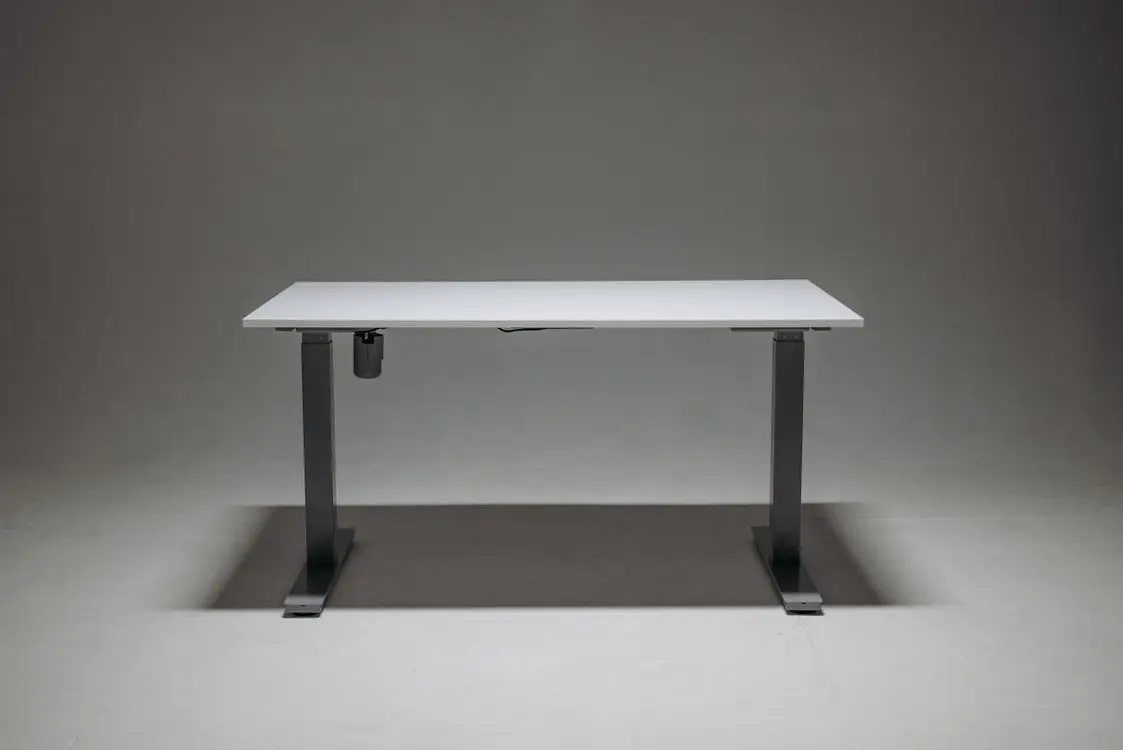
Desk height standards are three different answers pretending to be one. Europe fixes a seated worktop at 740 mm. North America's furniture trade publishes a recommendation, not a rule. And US accessibility law caps a work surface at 34 inches, which is a fourth number again. Quote the wrong one into a spec sheet and the sample arrives 22 mm out of tolerance — on paper, before anyone has touched a machine.
This is a reference for the numbers themselves: what each instrument says, what legal weight it carries, and the four dimensions a buyer checks before they sign. If you export office desks, work tables or sit-stand frames, the tables below are the part worth keeping.
Desk height standards at a glance
| Instrument | Where it applies | Status | What it actually fixes |
|---|---|---|---|
| EN 527-1 (cited by DGUV Information 215-410) | EU / EEA | European standard, referenced by national occupational-safety guidance | Worktop heights, worktop size, leg room |
| ANSI/BIFMA G1-2013 | US / Canada, furniture trade | Guideline — the dimensions in it are recommendations, not requirements | Recommended adjustment ranges from anthropometric data |
| ADA 2010 Standards, section 902 | US, covered facilities | Federal regulation | Height band and clearance for accessible work surfaces |
| OSHA Computer Workstations eTool | US | Advisory guidance, not enforceable on its own | Usable clearance under the desk |
Four instruments, four statuses. Only one of them is law, and it is the one that says the least about the desk itself. That is the whole difficulty with desk height standards: the document with the most detailed numbers has no legal force in the market where it is quoted most often.
What EN 527-1 actually fixes
EN 527-1 is the European standard that sets the dimensions of office work tables and desks — worktop height, worktop size, and the leg room underneath — for seated, sit-stand and standing work. German occupational-safety guidance publishes the numbers in full while citing DIN EN 527 as the governing standard, which makes it the most usable free reference for the figures.
| Configuration | Worktop height |
|---|---|
| Fixed height, seated work | 740 ± 20 mm |
| Fixed height, standing work | 1050 ± 20 mm |
| Height-adjustable, seated only | 650–850 mm |
| Height-adjustable, standing only | 950–1250 mm |
| Height-adjustable, sit-stand | 650–1250 mm |
Two more numbers travel with those heights and get forgotten more often than the height does:
- Worktop size: a minimum of 1600 mm wide × 800 mm deep for a normal workstation, with 1200 mm width accepted where there is a single screen and little paperwork. The ergonomic recommendation runs to 1800 mm wide × 900–1000 mm deep.
- Leg room width: not below 850 mm, with 1200 mm or more recommended so the user can change posture.
That 850 mm leg-room floor is the quiet one. A 1200 mm desk with a pedestal under it can pass on worktop size and fail on leg room, and nobody notices until the buyer's ergonomist measures it.
ANSI/BIFMA G1-2013 is a guideline, and that matters
ANSI/BIFMA G1-2013 is the North American ergonomics guideline for furniture used in office work spaces designed for computer use. Its own front matter is explicit that the dimensions inside are recommendations rather than requirements — it is a design aid for manufacturers and a shopping list for specifiers, not a conformity gate.
Its dimensions are derived from CAESAR anthropometric data (2002), weighted to US population demographics from the NHANES 2007–2008 and 2009–2010 datasets, and it points at ISO 9241-5 and ISO 9241-303 for the underlying ergonomic principles.
There is a gap in the public record here, and it is worth naming rather than glossing over: BIFMA sells G1 rather than publishing it, so the headline sit-stand range circulates through manufacturers' conformity sheets rather than a free primary text. Those sheets state a range of 22–46.5 in (559–1181 mm), covering the 5th-percentile woman to the 95th-percentile man. Treat that figure as well-attested trade knowledge, not as a clause you can point a buyer to.
The 69 mm gap
Line the two up and the mismatch is arithmetic, not opinion:
| Bottom of range | Top of range | |
|---|---|---|
| EN 527-1, sit-stand | 650 mm | 1250 mm |
| ANSI/BIFMA G1-2013 (as published in conformity sheets) | 559 mm (22 in) | 1181 mm (46.5 in) |
| Difference | BIFMA goes 91 mm lower | BIFMA stops 69 mm short |
A sit-stand frame engineered to the top of the North American recommendation lands 69 mm — about 2.7 in — below the top of the European range. It is not defective. It simply cannot be written into a tender that quotes EN 527-1, and no amount of resending the catalogue changes that.
Where ADA changes the answer in the United States
ADA is the only one of these desk height standards that is enforceable law, and it is the least specific about the desk. Section 902 requires the tops of dining and work surfaces to be 28 in (711 mm) minimum and 34 in (865 mm) maximum above the finish floor. Section 306 then requires knee clearance of 27 in (685 mm) high minimum and 30 in (760 mm) wide minimum under an accessible surface.
Two things about that band get misread constantly.
First, scope. ADA applies to covered facilities and to the accessible portion of them — not to every desk in every private office. A specifier fitting out a US public-facing building will ask; a distributor selling home-office frames will not. Say which you are quoting for and the question resolves itself.
Second, the failure is almost never the top. A 29 in desk sits comfortably inside the 28–34 in band. What fails is the underside: an apron, a stretcher, a crossbar, a cable tray or a centre drawer dropping the clear height below 27 in. OSHA's advisory eTool puts usable under-desk clearance at 20–28 in (50–72 cm) and tells users to keep that space clear of CPUs, files and storage — so a desk that satisfies OSHA's advisory floor of 20 in can still fail the ADA floor of 27 in by seven inches. The wider set of clearance figures behind this is laid out in ADA clearance dimensions for furniture.
The four numbers a buyer checks before signing
| Number | Why they ask | Where it belongs |
|---|---|---|
| Worktop height, or the full adjustment range | Decides whether the desk can be specified in that market at all | On the elevation view, with the range as a single dimension |
| Worktop size, width × depth | Decides floor-plan fit and whether two screens work | On the plan view |
| Clear leg-room width | Decides chair fit and posture change | On the front elevation, measured between obstructions |
| Clear height to the lowest obstruction underneath | The number that fails ADA and irritates everyone else | On the front elevation, measured to the apron or crossbar, not the worktop |
The fourth one is the one suppliers almost never publish, and it is the one that generates the follow-up email. Height only works if the chair meets it, which is why the matching seat figures in office chair seat height standard belong in the same conversation.
Three ways a desk quotation goes wrong
1. Converting inches into a millimetre spec
29 in is 736.6 mm. 30 in is 762 mm. EN 527-1's fixed seated height is 740 ± 20 mm, so the band runs 720–760 mm. The 29 in desk passes with 3.4 mm to spare. The 30 in desk misses by 2 mm and is out of spec on paper before it is out of the factory.
Two millimetres is not an engineering problem. It is a quoting problem, and it costs a re-tool or a lost tender exactly as much as a real one would.
2. Quoting the frame range instead of the desk range
This one is field practice rather than a written rule, so treat it as a habit worth adopting rather than a clause. Lift-column suppliers publish the travel of the frame. Buyers specify the height of the finished desk. Take a frame that travels 620–1270 mm and put a 25 mm worktop on it: the delivered desk works from 645 mm to 1295 mm. Both ends have moved, and the low end is what usually breaks a seated-only specification.
State clearly whether your published range includes the worktop. It is one sentence and it removes an entire round of email.
3. Sending a photograph with no height on it
A buyer comparing four suppliers is not reading four spec tables side by side. They are looking at four photographs, and the one where the height is written on the image is the one that gets shortlisted.
The fix is not a longer spec table. It is the photograph the buyer is already looking at, carrying the real measured heights — worktop height, the adjustment range, the clear leg room — drawn where the eye already is. Software that measures the image itself does this properly: you snap a dimension line to the product's actual edge, the geometry is computed rather than estimated, and the annotated file exports at whatever size the marketplace or catalogue wants. The contrast worth understanding is with AI image generators, which will cheerfully draw a clean arrow labelled 740 mm across a desk that is 762 mm, because a plausible number is not a measured one. What that looks like applied across a range is the furniture spec diagram approach, and the underlying reference figures sit on the standard desk dimensions page.
Pre-quote checklist
- Stated which market the quoted height is specified against (EN 527-1, BIFMA guideline, ADA, or none)
- Gave the fixed height in mm with the tolerance, or the full adjustment range with both ends
- Said explicitly whether the adjustment range includes the worktop or is frame travel only
- Published worktop width × depth, not just the model name
- Published clear leg-room width measured between obstructions, not overall width
- Published clear height to the lowest thing under the top (apron, crossbar, drawer, cable tray)
- Checked the inch conversion against the ± 20 mm band before quoting a round-inch size into a metric market
- Put the height and the range on the product photograph, not only in the table
FAQ
What is the standard desk height in Europe?
740 mm plus or minus 20 mm for a fixed-height seated desk, and 1050 mm plus or minus 20 mm for a fixed standing desk, per EN 527-1 as published in German occupational-safety guidance. A fully height-adjustable sit-stand desk is expected to cover 650–1250 mm.
Is 29 inches the standard desk height in the United States?
29 in (736.6 mm) is the common trade convention, not a legal standard. The only binding US number is the ADA band of 28–34 in, and it applies to accessible work surfaces in covered facilities rather than to office desks generally. BIFMA's G1 is a guideline whose dimensions are explicitly recommendations.
What adjustment range does a sit-stand desk need to meet EN 527-1?
650–1250 mm for a desk intended for both seated and standing work. Seated-only adjustable desks are expected to cover 650–850 mm, standing-only 950–1250 mm. A frame quoted at 620–1270 mm of travel does not automatically deliver those numbers once a worktop is on it.
Do ADA desk height rules apply to furniture we export to the United States?
Only where the furniture serves an accessible position in a covered facility. Free-standing office desks sold into private offices or homes are not covered. The safe commercial answer is to publish the clear knee-clearance height alongside the worktop height so the specifier can decide, rather than claiming compliance you cannot control.
How do I show desk height so buyers stop asking?
Put it on the image. One photograph of the actual desk with worktop height, the adjustment range and the clear leg room measured onto it answers in four seconds what a spec table answers in four emails. The practical requirement is that the numbers are measured from the real product rather than typed over a rendering — annotation software that snaps dimension lines to the product's edges and exports at catalogue size does this in a couple of minutes per SKU, and the same file works for the tender, the marketplace listing and the printed catalogue.
Sources & References
- DGUV Information 215-410, section 7.3.1 — Arbeitstisch/Arbeitsfläche: worktop heights, worktop sizes and leg-room minima, citing DIN EN 527
- DGUV Information 215-410 — Bildschirm- und Büroarbeitsplätze, full guideline (PDF)
- Swedish Institute for Standards — SS-EN 527-1, Office furniture: work tables and desks, Part 1: Dimensions (scope and edition)
- EN 527-1 catalogue entry — Office furniture, work tables and desks, Part 1: Dimensions
- NBS Publication Index — ANSI/BIFMA G1-2013, Ergonomics guideline for furniture used in office work spaces designed for computer use
- Manufacturer conformity sheet stating the ANSI/BIFMA G1-2013 height range of 22–46.5 in (PDF)
- 2010 ADA Standards for Accessible Design — section 902 dining and work surfaces, section 306 knee and toe clearance
- US Access Board — ADA Accessibility Standards, full text
- OSHA Computer Workstations eTool — Desks: under-desk clearance of 20–28 in (50–72 cm)