Dimensions / Building materials / Plywood
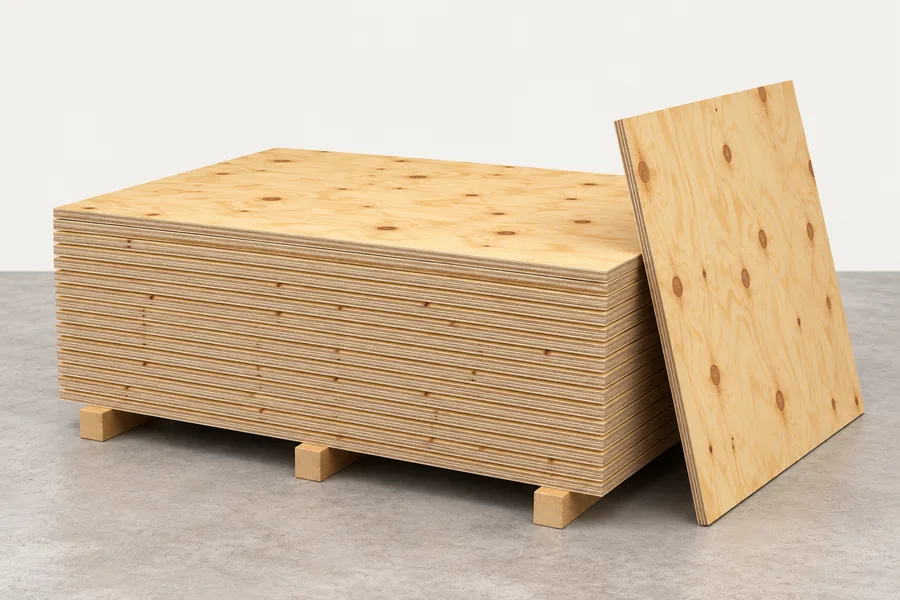
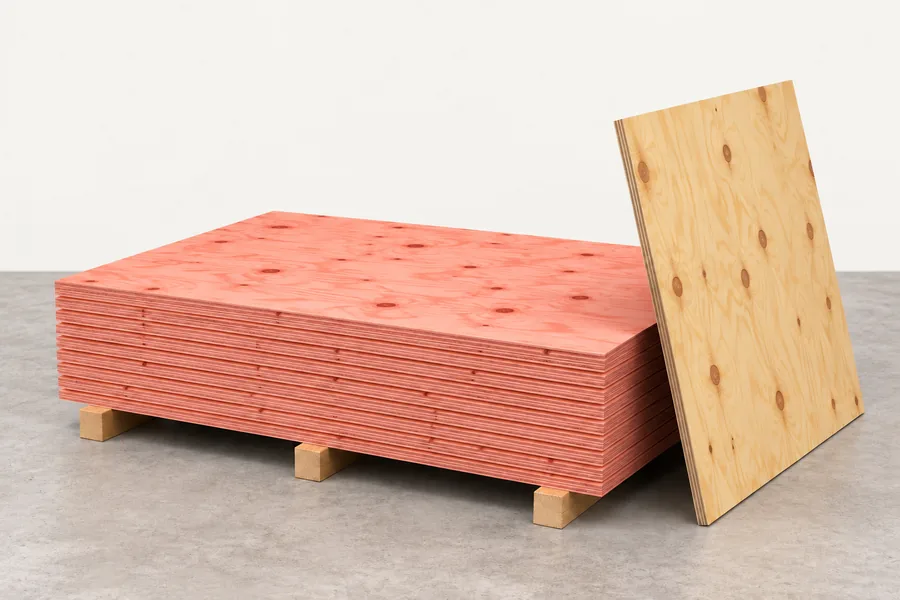
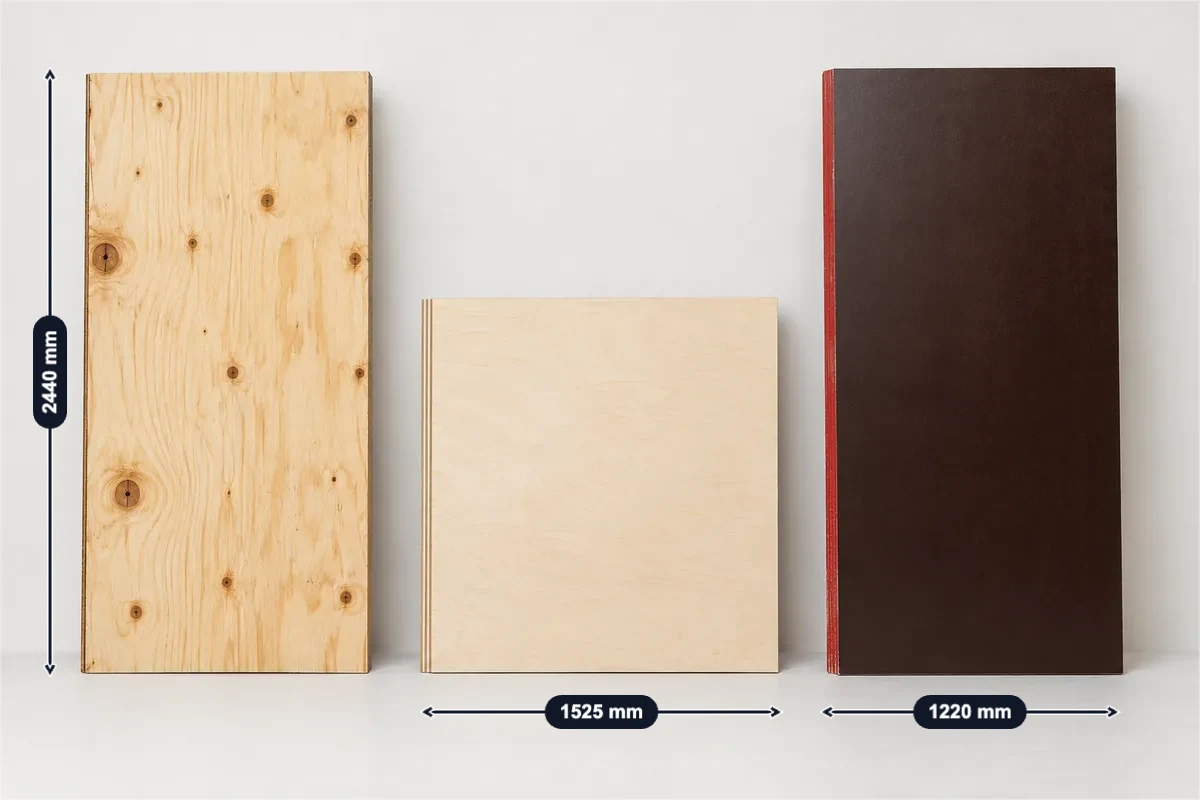
Three kinds of plywood cover most of the trade: softwood sheathing on a 4 × 8 ft (1220 × 2440 mm) module, birch panels measured in millimetres, and film-faced panels for concrete forms. North American sheathing runs a little under its name, as Georgia-Pacific cuts it to 3’-11 7/8” × 7’-11 7/8” and labels a 23/32 panel 0.703 in (17.85 mm). Birch is sold in 1525 × 1525 mm sheets with 13 plies at 18 mm, formwork in 1250 × 2500 and 1525 × 3050 mm, 12 to 21 mm thick.
| Structural sheathing (CDX), nominal | Birch plywood square sheet | Formwork panels, WISA standard sizes |
|---|---|---|
| 4 × 8ft1220 × 2440 mm | 1525 × 1525mm5 × 5 ft | 1250 × 2500mm1525 × 3050 mm |
Sources: APA, Koskisen, UPM. Checked October 2026.
4 × 8 ft; 23/32 labelled 0.703 in (17.85 mm)
Softwood sheathing for roofs, walls and subfloors, stamped with a span rating.
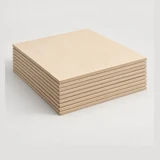
1525 × 1525 mm; 18 mm = 13 birch plies
All-birch panels for furniture, cabinets and jigs, sold by the millimetre.
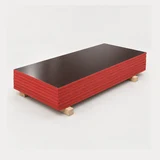
1250 × 2500 mm, 18 or 21 mm, 120 g/m² film
Concrete formwork panels with a phenolic film on both faces and sealed edges.
Pick sheathing, birch or formwork panels, then enter the job, the panel and a measured thickness; each check rests on a standard or a maker figure from the tables below.
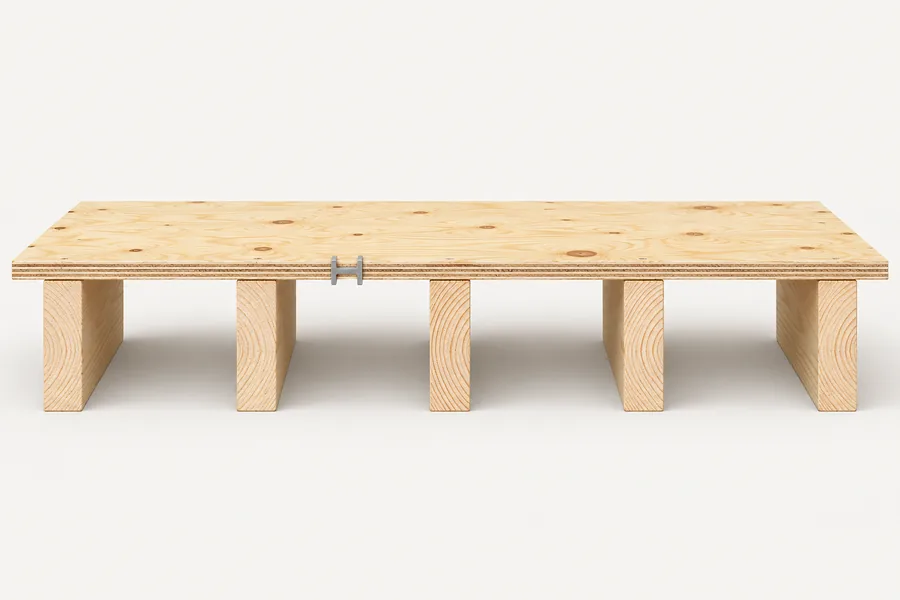
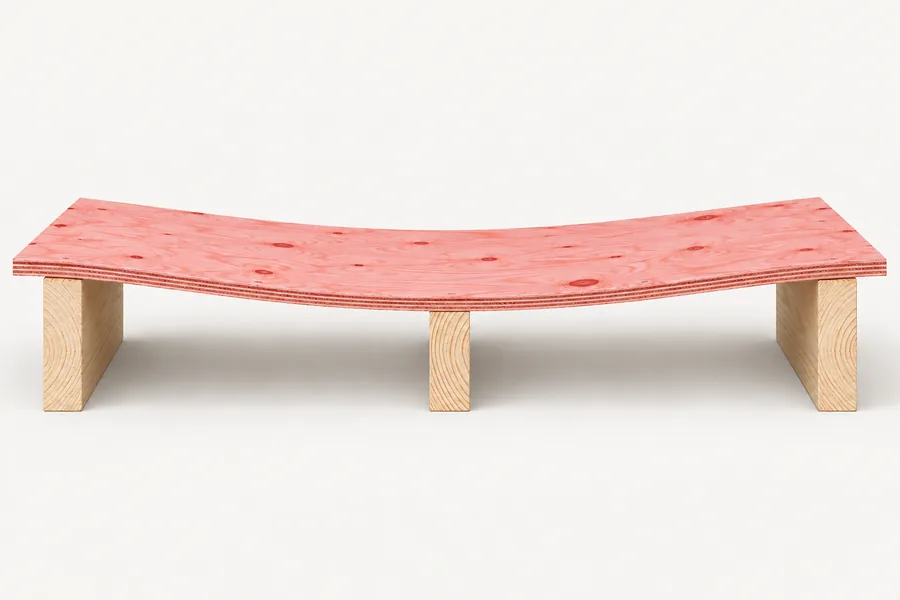
A span rating holds with the long side of the panel across the supports. Panels sized for spacing are cut a little under the nominal size, so with the recommended gap they lay out on the full module.
800 sq ft plus 10% for cuts is 880 sq ft: 28 panels of 96 × 48 in, 32 sq ft each. Your 28 panels cover it.
APA: a 48 × 96 in module with the 1/8 in gap.
As subfloor a 15/32 panel rated 32/16 spans 16 in; your joists 24 in apart are too far.
32/16: subfloor joists 16 in apart at most.
An unsanded 15/32 Performance Category panel may be 0.438–0.500 in; your 0.460 in is within it.
PS 1-22: 15/32 unsanded 0.438–0.500 in.
Quoting plywood for export? Photograph a panel and its edge, mark the size, the real thickness, the plies and the grade in SizeMarker, and attach the picture to your quote.
Mark a photo| Type | Common sizes | Thickness | Example |
|---|---|---|---|
| Structural sheathing (CDX) | 4 × 8 ft (1220 × 2440 mm), often sized for spacing; also 4 × 9 and 4 × 10 ft | Performance Categories 3/8 to 1-1/8; 15/32 unsanded 0.438–0.500 in | Georgia-Pacific: 3’-11 7/8” × 7’-11 7/8”; 23/32 labelled 0.703 in (17.85 mm) |
| Baltic birch | 1525 × 1525 mm (5 × 5 ft); 1220 or 1250 × 2440 or 2500 mm; 1500 or 1525 mm wide up to 3660 mm | 4–50 mm; 18 mm has 13 plies and may be 17.1–18.1 mm | Koskisen 1525 × 1525 mm; Metsä 12.2 kg/m² at 18 mm |
| Film-faced formwork | 1220 × 2440, 1250 × 2500, 1500 × 3000 and 1525 × 3050 mm | 12, 15, 18 and 21 mm; Metsä Form 21 mm 20.0–20.9 mm | Metsä Form: 120 g/m² film; 21 mm 14.3 kg/m², 30 panels of 1500 × 3000 mm to a pallet |
Sources: APA — V345 concrete forming (hosted by Roseburg) · Georgia-Pacific — Plytanium Plywood Rated Sheathing · NIST — PS 1-22 Structural Plywood · Koskisen — handbook of Koskisen plywood · Latvijas Finieris — Riga Ply data sheet · Metsä Wood — Birch product data sheet · UPM — WISA concrete forming plywood brochure · Metsä Wood — Form product data sheet
| Panel | Sold as | Actual |
|---|---|---|
| Georgia-Pacific Plytanium sheathing | 4’ × 8’ | 3’-11 7/8” × 7’-11 7/8” (1.216 × 2.435 m), sized for spacing |
| Georgia-Pacific 23/32 Cat | 23/32, sold at retail as “3/4” | 0.703 in (17.85 mm) |
| APA long panel | 4 × 9 ft | 1220 × 2740 mm |
| Riga Ply 18 mm | 18 mm | 17.1–18.1 mm, 13 plies |
| Doka DokaPly Birch 18 mm | 125 × 250 cm | 38.5 kg a panel |
Sources: Georgia-Pacific — Plytanium Plywood Rated Sheathing · Arco — 23/32 (3/4") certified plywood 4’x8’ (retailer) · APA — V345 concrete forming (hosted by Roseburg) · Latvijas Finieris — Riga Ply data sheet · Doka — formwork sheets user information
| Rule | What it says |
|---|---|
| PS 1-22 Table 10, unsanded | 15/32 Performance Category 0.438–0.500 in; 23/32 0.688–0.750 in; the label for 23/32 is .703 in |
| Span rating (PS 1-22; APA E30) | 32/16: roof supports up to 32 in apart, subfloor joists up to 16 in; 48/24 for 23/32 |
| APA M300S | A 1/8 in gap at panel ends and edges; panels sized for spacing then lay out on a 48 × 96 in module |
| EN 314-2 Class 3 | Exterior phenolic bond at Riga Ply, Metsä, UPM and Koskisen |
| EN 315, as printed by Riga Ply and Metsä | Length and width ±3 mm over 2000 mm, ±2 mm for 1000–2000 mm |
| Containers (ONE) | Payload: 20 ft dry 28,330 kg, 40 ft high cube 28,800 kg |
Sources: NIST — PS 1-22 Structural Plywood · APA — Engineered Wood Construction Guide E30, roofs (hosted by Georgia-Pacific) · APA — Builder Tip M300S (hosted by Tolko) · Latvijas Finieris — Riga Ply data sheet · Metsä Wood — Form product data sheet · Ocean Network Express — dry containers
4 × 8 ft, which APA gives as 1220 × 2440 mm. Much US sheathing is sized for spacing, a little under (Georgia-Pacific: 3’-11 7/8” × 7’-11 7/8”); APA also lists 4 × 9 ft (1220 × 2740 mm) and 4 × 10 ft.
Most “3/4” sheathing is the 23/32 Performance Category: Georgia-Pacific labels it 0.703 in (17.85 mm), and PS 1-22 allows 0.688–0.750 in unsanded. The category is a nominal designation, not a measurement.
1525 × 1525 mm (5 × 5 ft), which Koskisen lists; mills also make 1220 or 1250 × 2440 or 2500 mm and 1500 or 1525 mm wide panels up to 3660 mm long. An 18 mm sheet has 13 plies.
1220 × 2440, 1250 × 2500, 1500 × 3000 and 1525 × 3050 mm, 12 to 21 mm thick; WISA’s standard sizes are 1250 × 2500 and 1525 × 3050 mm. Metsä Form 21 mm weighs 14.3 kg/m².
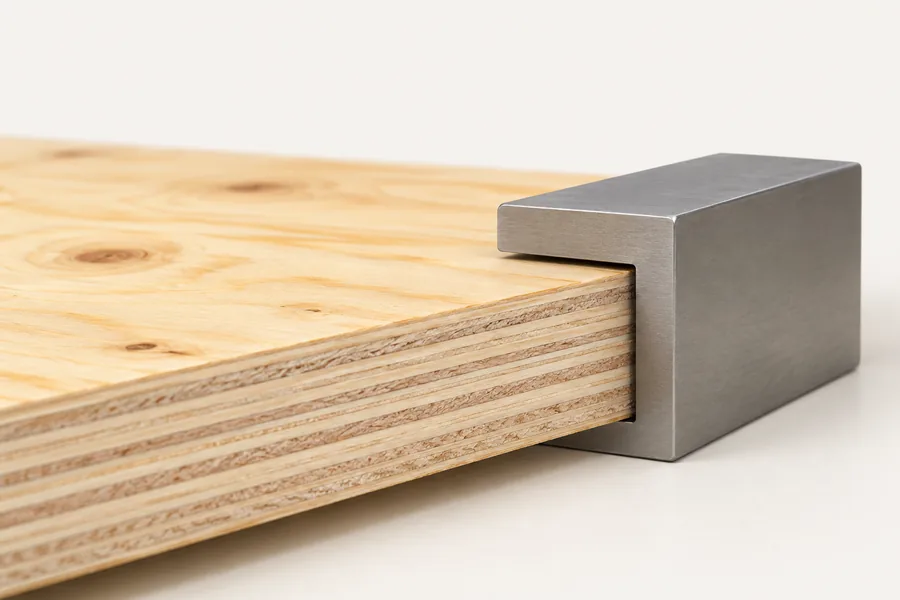
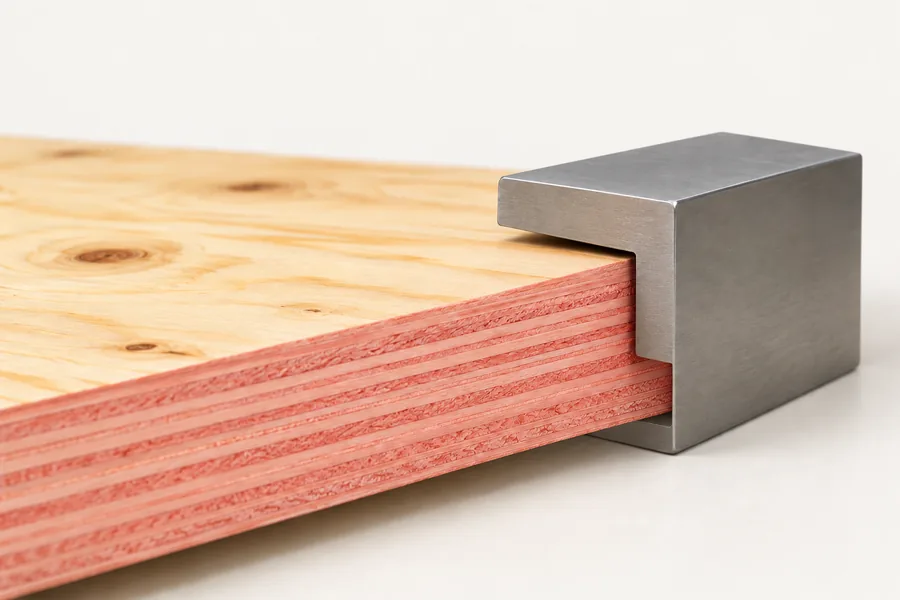
Knotty softwood faces with a stamp naming a span rating and Exposure 1 mean structural sheathing (CDX); pale sanded faces with many thin, even plies mean birch; a smooth dark brown face with painted edges means film-faced formwork.
The left number is the largest roof support spacing in inches, the right one the largest subfloor joist spacing: 32/16 means 32 and 16 in, with the long side of the panel across the supports (PS 1-22; APA E30).
Before ordering, buyers want the nominal and actual size, the real thickness and its tolerance, the number of plies and the core species, the face and back grades, the glue and bond class, the film weight for formwork, the formaldehyde class, and panels, weight and volume per pallet or bundle. Label these on a photo of your own panel in SizeMarker and send buyers the spec diagram over WhatsApp or WeChat.